
Temu Dropshipping Rules and How to Evaluate Suppliers

Table of Contents
Temu dropshipping usually means selling a product through your own store, then buying it on Temu and entering your customer’s shipping address. The attraction is straightforward: low advertised prices, a broad product selection, and no inventory to purchase before an order arrives.
But placing an order and securing a reliable supplier relationship are different tasks. Before building a store around this model, sellers need to understand Temu’s consumer-account terms, their own selling channel’s rules, and the costs that remain after the product leaves the checkout.
For sellers evaluating Temu as a source, the useful questions are practical: Do you have permission to use the purchasing arrangement commercially? Who controls packaging and delivery? What happens when prices change or a customer requests a refund? And would a dedicated supplier offer a more dependable way to sell the same type of product?
What Is Temu Dropshipping?
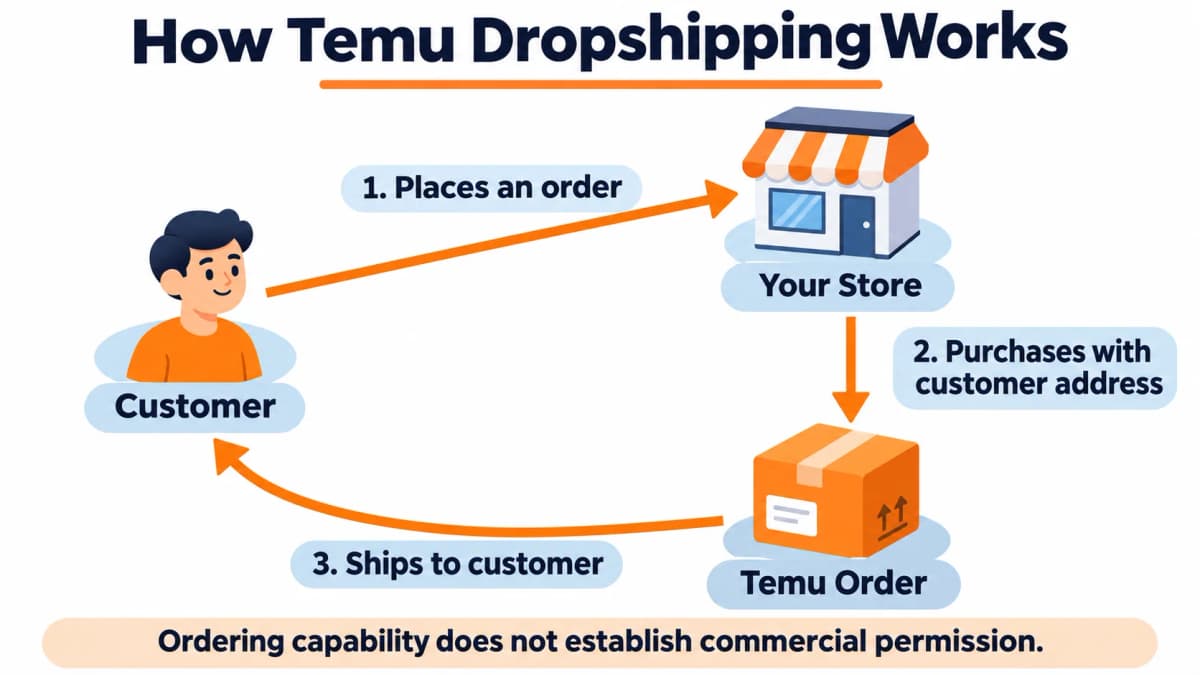
In a typical Temu dropshipping arrangement, the customer buys from your storefront while the physical product comes from an order you place on Temu.
The transaction follows this sequence:
- You list a product in your store.
- Your customer places an order and pays your retail price.
- You purchase the product on Temu using the customer’s delivery address.
- The product ships through the fulfillment arrangement associated with that Temu listing.
- You remain the customer’s contact for delivery questions, refunds, and complaints.
This arrangement gives you limited control over the underlying purchase. Your customer expects the experience promised by your store, even when another business controls stock availability, parcel preparation, and shipping.
Buying From Temu
Buying a product from Temu for delivery to your customer uses Temu as the retail purchasing source.
If you instead receive the item yourself, inspect it, and ship it onward, you have introduced a separate inventory and fulfillment step. That can improve quality control, but it also adds handling, storage, and a second delivery cost. It does not automatically resolve questions about commercial permission or resale requirements.
The operating model matters because each approach creates different responsibilities.
| Arrangement | Where the customer buys | Who arranges fulfillment | Main issue to resolve |
|---|---|---|---|
| Retail purchase sent directly to a customer | Your storefront or marketplace listing | The Temu order’s fulfillment network | Commercial permission and limited fulfillment control |
| Purchase, inspect, and resell | Your storefront or marketplace listing | You or your logistics provider | Inventory, handling, and resale requirements |
| Sell your own products on Temu | Temu | Your seller fulfillment arrangement | Temu seller requirements |
| Work with a dropshipping supplier | Your storefront or marketplace listing | A supplier under your agreement | Supplier performance and selling-channel compliance |
Selling on Temu
Becoming a Temu seller is a separate business arrangement. You list your products on Temu and fulfill orders under the requirements associated with your seller account.
The distinction becomes especially important when evaluating Shopify integrations. A connection that helps merchants sell on Temu does not necessarily help them buy from Temu to fulfill an independent store’s orders.
Does Temu Allow Dropshipping?
Sellers should not treat an ordinary Temu shopping account as automatic authorization to run a commercial dropshipping operation.
Temu’s United States Terms of Use, updated November 1, 2026, grant access for personal and non-commercial use under Section 7.4. Section 7.5 also restricts commercial use of information on the service and use for another business’s benefit unless Temu explicitly permits it in advance.
These provisions make permission a question to resolve before relying on consumer purchases for customer fulfillment.
Consumer Account Terms
A consumer checkout is designed to complete a purchase. It does not, by itself, establish a supplier agreement covering your business.
For example, a successful order does not confirm that you have:
- Permission to use the arrangement for ongoing commercial fulfillment.
- Agreed service levels for dispatch and delivery.
- Control over packaging, invoices, or promotional inserts.
- Reserved inventory for products listed in your store.
- A process for managing customer returns at business scale.
Checking out successfully answers whether an order can be placed. It leaves these operating questions unresolved.
Commercial Permission
Before depending on any arrangement, establish which account terms apply and what commercial activity has been explicitly permitted.
Keep records of the relevant permission and the business providing it. A third-party software subscription, an importer extension, or a tutorial does not grant permission on behalf of the purchasing platform.
Also distinguish platform rules from legal requirements. A platform’s restrictions govern the use of its services; product safety, intellectual property, taxes, and consumer obligations depend on the product and markets involved.
For a supplier-based business, the stronger starting point is an agreement that addresses commercial supply and fulfillment directly.
Temu Dropshipping With Shopify and Marketplaces
The selling channel affects what you can offer and how you can fulfill it. A workflow that is technically possible on an independent store may conflict with the rules of a marketplace.
Shopify Sales Channel
Shopify’s official Temu sales channel lets merchants publish their products to Temu and manage connected selling operations through Shopify.
The direction is important:
Your Shopify product catalog → Temu marketplace → Temu customer orders.
It is not evidence that Temu authorizes merchants to import its consumer listings and use ordinary shopping accounts as a supply network.
When comparing an integration, inspect the actual tasks it performs. Product publishing, inventory synchronization, order import, and supplier purchasing are different capabilities.
Third-Party Import Tools
Some third-party applications advertise product importing or other Temu-related functionality. Assess each feature separately.
A product importer might help transfer listing information without providing any of the following:
- Permission to reuse product photos or descriptions.
- An approved commercial purchasing arrangement.
- Guaranteed inventory availability.
- A supplier agreement covering packaging and returns.
- Reliable order placement and shipment tracking.
Before installing an application, map what happens after the customer pays. Identify who purchases the product, which account is used, who handles exceptions, and what happens when the listed variant becomes unavailable.
A faster listing process is useful only when the underlying fulfillment process can support the sale.
Marketplace Fulfillment Rules
eBay allows dropshipping from wholesale suppliers, while prohibiting the practice of listing an item and then purchasing it from another retailer or marketplace that ships directly to the customer.
That distinction directly affects a Temu-to-eBay retail fulfillment workflow.
For any marketplace, check its current policy before listing products. Confirm whether your inventory ownership, supplier agreement, packing documents, and delivery process satisfy its requirements.
An integration tool cannot override those rules.
Costs and Fulfillment Risks to Calculate
A low product price can make the opportunity look larger than it is. The relevant figure is the contribution left after the costs associated with acquiring and serving the customer.
Price and Stock Changes
The price available during product research may differ from the price available when a customer orders.
Introductory offers, coupons, variant differences, and shipping conditions can change the purchase cost. A product that appears profitable under a temporary discount may produce a loss at its regular price.
Build the initial calculation using a repeatable purchase price. Then test what happens if:
- The product price rises.
- The cheapest variant becomes unavailable.
- Shipping charges change.
- A substitute costs more.
- The customer needs a replacement.
For stock availability, distinguish seeing an item listed from having inventory reserved for your store.
Packaging and Delivery
Packaging affects what your customer receives and how they understand the purchase.
Before making promises about neutral packaging, invoices, or branding, verify the actual arrangement. Do not assume every order uses the same packaging, or that a supplier can remove identifying material on request.
Delivery promises need similar care. The useful evidence includes:
- The dispatch location for the relevant product.
- Processing time before carrier collection.
- Tracking availability and carrier coverage.
- Delivery performance to the target country.
- The procedure for delayed or lost parcels.
A delivery estimate on one listing should not become a storewide promise. For background on the factors behind dispatch locations, see where Temu orders ship from.
Returns and Refunds
Your customer bought from your business. They will expect your business to resolve the problem.
The upstream purchase’s return conditions may not match the policy you offer in your store. You may need to refund a customer before receiving reimbursement, arrange a replacement, or absorb return shipping.
Decide in advance:
- Where the customer sends a return.
- Who pays for return transport.
- How damaged or incorrect items are documented.
- Whether replacement stock is available.
- How long you can carry the refund cost.
Include an allowance for these costs in the margin calculation. Treating every order as a successful delivery with no support work makes the business look more profitable than it is.
A Worked Margin Example
Consider an illustrative order with a selling price of $29.99. The figures below are assumptions for evaluating the model, not typical Temu costs or expected earnings.
| Item | Amount |
|---|---|
| Customer payment | $29.99 |
| Product purchase | −$10.00 |
| Shipping | −$4.00 |
| Payment processing | −$1.20 |
| Advertising acquisition cost | −$8.00 |
| Expected refund and replacement allowance | −$1.50 |
| Contribution before fixed overhead and other applicable costs | $5.29 |
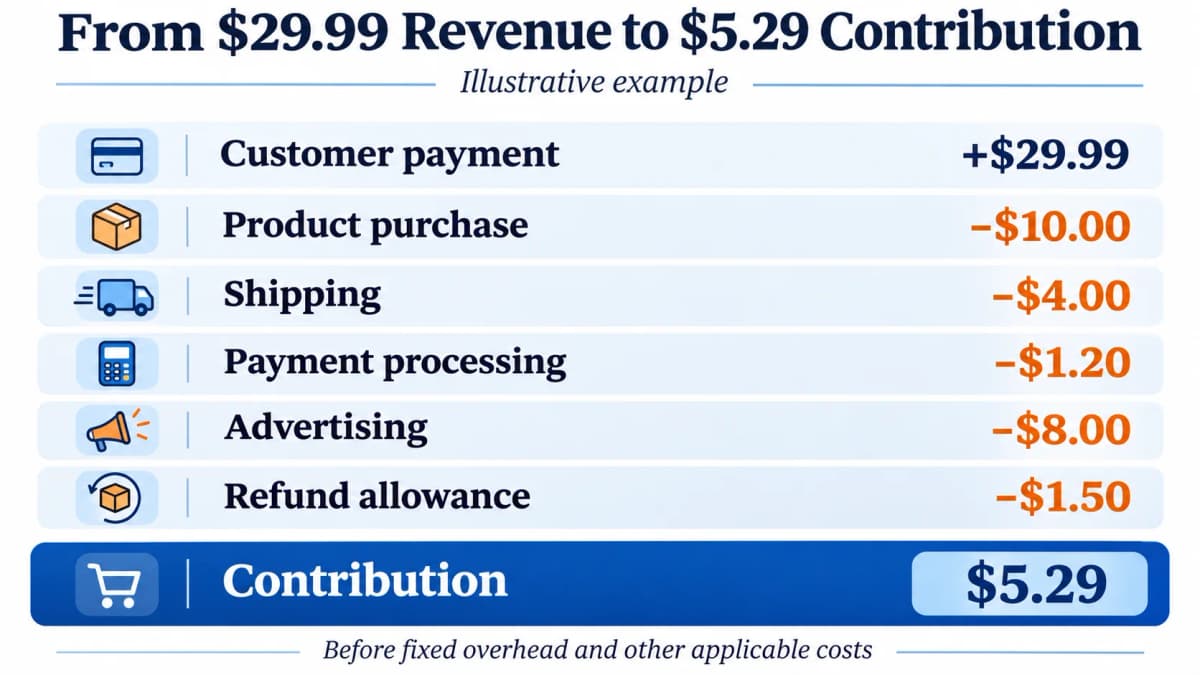
The gap between the selling price and product purchase price is $19.99. After the other listed costs, only $5.29 remains.
For this example, the break-even advertising acquisition cost is:
$29.99 − $10.00 − $4.00 − $1.20 − $1.50 = $13.29
That figure still excludes fixed overhead and any additional applicable costs, such as duties or taxes borne by the seller.
If the product purchase rises by $3, the contribution falls to $2.29 at the same advertising cost. If acquiring the customer also becomes $3 more expensive, the order loses $0.71 before fixed overhead.
Use this calculation to set a maximum acquisition cost and minimum acceptable contribution before launching advertisements.
How to Evaluate Products and Suppliers Before Selling
A useful research process connects product demand with supplier capability. Finding an attractive listing is the beginning of that process.
1. Define Your Product Criteria
Start with a narrow category and a specific customer need.
For an initial test, set criteria you can evaluate consistently:
- Target selling-price range.
- Maximum landed product cost.
- Required delivery window.
- Acceptable dimensions and shipping weight.
- Product documentation requirements.
- Minimum contribution per order.
- Reasons a shopper would choose your offer.
Avoid choosing a product solely because its Temu price looks low. Assess whether you can offer a meaningful advantage through product selection, a clearer bundle, original content, service, or delivery.
Your output should be a short screening table. Reject products that cannot meet the required economics or operating conditions before spending time on a storefront.
2. Compare Demand and Pricing
Compare several relevant products using consistent specifications.
A useful comparison includes the product’s size, material, quantity, accessories, variant, and delivery conditions. Two listings that look similar may represent different products or different purchase terms.
Nexscope’s Temu data APIs support this research through product search, product details, category research, and other available Temu datasets. Teams can connect supported data to their own analysis through REST API or MCP.
Use the data to build a shortlist and investigate questions such as:
- Which comparable products occupy the target price range?
- How do ratings and review counts differ across candidates?
- Which categories contain relevant alternatives?
- Does the candidate remain attractive when compared with similar offers?
Record the query date and market alongside the results. Where a dataset includes sales estimates or historical information, preserve the field’s definition and coverage rather than treating it as a guaranteed forecast.
The output is a comparison table that helps decide what deserves a supplier conversation or sample order. Marketplace research does not establish that a supplier permits dropshipping, owns a particular factory, or can fulfill your orders.
3. Verify Supplier Permission
Once a product type looks promising, identify a supply arrangement that explicitly supports your intended business.
Ask the prospective supplier to confirm:
| Question | Evidence to request |
|---|---|
| Can you supply this product for resale? | Written commercial terms |
| Can you ship individual orders to customers? | Fulfillment process and service conditions |
| Can you meet packaging requirements? | Sample parcel and written specification |
| How is inventory communicated? | Stock update method and exception process |
| Who handles defective items? | Replacement and refund terms |
| Can you supply relevant product documentation? | Applicable records for the product and market |
| Can your images be reused? | Explicit permission or a licensed asset package |
A visually similar listing does not prove that two sellers use the same manufacturer. Use product specifications, samples, and supplier documentation to verify equivalence.
If a supplier cannot clarify its role or provide workable terms, remove it from the shortlist.
4. Test Samples and Delivery
Place a sample order through the same fulfillment route you intend to use for customers.
Inspect the product against the proposed listing:
- Does the material match the description?
- Are dimensions and included accessories correct?
- Does the item function as expected?
- Is the packaging suitable for transit?
- Are labels and instructions appropriate for the market?
- Does the tracking experience support your delivery promise?
Record the order date, dispatch date, delivery date, and any support interactions. Photograph the product and packaging so you can compare future deliveries.
A successful sample is useful evidence, but it does not establish long-term consistency. Use it to decide whether the arrangement merits a limited commercial test.
5. Pilot and Measure Orders
Launch a small test only after the supply arrangement and selling-channel requirements are satisfied.
Set measurable limits before taking orders. Track:
- Actual contribution per order.
- Supplier cancellation rate.
- Dispatch and delivery performance.
- Refunds, replacements, and customer complaints.
- Time spent resolving order exceptions.
- Differences between advertised and actual purchase costs.
Define the conditions that would pause the test. For example, repeated stock failures or delivery times outside your stated promise may require correcting the process before accepting additional orders.
Increase volume when the measured economics and service performance support it.
Alternatives to Buying Retail Orders From Temu
If consumer-order fulfillment does not provide the permission or control your business needs, evaluate a different supply arrangement.
Direct Wholesale Agreements
A direct agreement can clarify pricing, stock availability, product documentation, and responsibilities.
Some wholesalers support individual-order shipping; others require minimum quantities. Confirm the actual service before describing the arrangement as dropshipping.
This route is most useful when a supplier can provide the product consistently and agree to the requirements of your selling channel.
Dropshipping Supplier Networks
A supplier network may help with catalog access, order routing, and fulfillment coordination.
Evaluate the individual supplier as well as the software platform. Check warehouse locations, product quality, processing times, shipping charges, and returns.
An extensive catalog is less valuable than a dependable supplier for the few products your store actually sells.
Inventory With a 3PL
Buying inventory and using a third-party logistics provider creates a different cost structure. You commit money before making sales, but you may gain more control over inspection, packaging, and dispatch.
Model the full cost of this arrangement, including:
- Initial stock purchases.
- Inbound transport.
- Receiving and storage.
- Picking and packing.
- Outbound shipping.
- Return processing.
- Unsold inventory.
| Supply model | Inventory commitment | Control to evaluate | Main cost consideration |
|---|---|---|---|
| Wholesale supplier with direct fulfillment | Depends on agreement | Supplier service terms | Unit price and per-order shipping |
| Dropshipping supplier network | Often limited upfront stock | Supplier and platform performance | Product, shipping, and service charges |
| Owned inventory with a 3PL | Upfront inventory purchase | Packaging, stock, and dispatch setup | Storage, handling, and inventory risk |
Choose the model that supports your customer promise and unit economics.
Conclusion
Temu dropshipping attracts interest because the retail prices can appear to leave room for a markup. A workable business requires more: permission for the purchasing arrangement, a selling channel that accepts the fulfillment model, dependable delivery, and sufficient contribution after acquisition and support costs.
Start by distinguishing buying from Temu from selling on Temu. Then verify the supplier relationship and test the economics before taking on more orders.
Research Products With Nexscope
Nexscope provides ecommerce data that teams can use in their own research workflows through REST API or MCP.
Use these Temu APIs to move from product discovery to a more focused sourcing review:
- Temu Product Source Query API: Filter products by keyword, category, price, sales, and ratings to build a shortlist that matches your selection criteria.
- Temu Product Detail API: Look up a product by its ID and region, then examine the returned product details and available history before ordering a sample.
- Temu Store Source Query API: Find stores by country, category, sales, and ratings to identify relevant competitors and prioritize stores for further research.
Use the results to compare candidates, then confirm commercial supply terms, product quality, and fulfillment arrangements directly with the prospective supplier.
Build a Better Temu Product Shortlist
Compare available product and market data before committing to a supply arrangement.
Explore Nexscope Temu Data APIs →Frequently Asked Questions
Can you dropship from Temu?
People use the term to describe taking an order in their own store and purchasing the product on Temu for delivery to the customer. However, the ability to place that order does not establish permission for ongoing commercial fulfillment. Check the applicable Temu terms, obtain any required permission, and verify your selling channel’s rules before relying on the arrangement.
Does Temu allow commercial use of buyer accounts?
Temu’s United States Terms of Use restrict personal-account service access to personal and non-commercial use, and restrict use for another business’s benefit unless explicitly permitted in advance. A standard consumer account should therefore not be treated as automatic approval for a commercial fulfillment operation. Determine which terms and permissions apply to the specific arrangement.
Can you connect Temu to Shopify for dropshipping?
Shopify’s official Temu sales channel helps merchants sell their products on Temu. That is different from buying Temu consumer products to fulfill Shopify orders. Third-party tools may advertise importing or other functionality, but their existence does not establish commercial permission, image rights, or a dependable supplier relationship. Verify each part of the workflow separately.
Can you use Temu to fulfill eBay orders?
eBay prohibits listing an item and then buying it from another retailer or marketplace that ships directly to the customer. It permits dropshipping from wholesale suppliers, subject to its requirements. Buying a Temu retail product after an eBay sale for direct delivery to the buyer falls within the retail-marketplace fulfillment pattern described by that prohibition.
Is Temu dropshipping profitable?
Profitability cannot be determined from the difference between your selling price and a Temu listing price alone. Include product purchases, shipping, payment fees, advertising, refunds, replacements, and other applicable costs. Calculate the break-even acquisition cost and test how price changes affect contribution. A temporary discount should not be the basis for a long-term margin assumption.
Can you use Temu product photos in your store?
Do not assume that purchasing a product or importing a listing gives you permission to reuse its photos. Obtain permission from the relevant rights holder or create original product photography using a sample. Confirm that the images accurately represent the product and variant you will deliver, including accessories, packaging, dimensions, and material.
What should you check before choosing a supplier?
Confirm commercial supply permission, product specifications, stock communication, packaging, delivery performance, returns, and relevant documentation. Test a sample through the intended shipping route and calculate the full cost per order. Keep the resulting records so that supplier selection reflects evidence about the product and fulfillment process.
Sources
- Temu. 2026. United States Terms of Use. temu.com
- Shopify. Accessed 2026. Temu. help.shopify.com
- Shopify. Accessed 2026. Publishing Your Products to Temu. help.shopify.com
- eBay. Accessed 2026. Dropshipping. ebay.com
- Nexscope. Accessed 2026. Ecommerce Data APIs for Seller Workflows. nexscope.ai