

Utility Patent vs Design Patent: Key Differences

Table of Contents
A utility patent protects a qualifying invention’s functional or technical features. A design patent protects a qualifying product’s ornamental appearance. The essential distinction is what the invention does and how it works versus how the claimed design looks.
That distinction matters whether you are developing an original product or selecting one from a supplier’s catalog. A different-looking product may still raise questions about a patented mechanism. A familiar mechanism may sit inside a distinctive exterior that deserves a separate design review.
This guide explains the differences under the United States patent system, then turns them into a practical checklist for ecommerce sourcing. Other markets use different terminology and rules. The lamp examples below are hypothetical illustrations, not descriptions of actual patents or legal conclusions about a product.
What Is a Utility Patent?
A utility patent is a form of protection for a qualifying new and useful invention, such as a process, machine, manufactured article, composition of matter, or improvement. Its focus is the invention’s technical substance.
Function and Technical Features
Imagine an adjustable desk lamp with a newly developed joint that holds its position without a conventional locking knob. The joint’s structure and operation could be relevant to a utility patent application, if the invention meets the applicable requirements.
The interesting feature is the way the mechanism works. Changing the shade from round to square would not, by itself, answer whether that joint falls within someone else’s patent claims.
For a seller, this means a supplier’s product photo is only part of the information needed. Technical specifications, assembly details, and an explanation of the mechanism may be more useful than another lifestyle image.
The Role of Patent Claims
A utility patent’s claims define the invention for which protection is sought or granted. The title and abstract help you understand the subject, but they are not substitutes for reviewing the claims in context.
When screening a product, avoid treating a shared benefit—such as “adjustable lighting”—as proof that two products use the same patented invention. Equally, a different exterior does not resolve questions about a shared technical feature. Those questions require a more specific comparison than a visual search can provide.
What Is a Design Patent?
A design patent protects a new, original, ornamental design for an article of manufacture. It concerns the claimed appearance rather than the product’s technical operation.
Shape and Surface Ornamentation
Return to the hypothetical desk lamp. Its sculpted shade, shaped base, or surface ornamentation could be relevant to design protection. These features are different from the internal joint that lets the arm move.
A useful product can have ornamental features. However, the fact that a shape is visible does not mean every part of it is covered by a particular design patent. The actual claimed design matters.
The Role of Patent Drawings
Drawings are central to understanding a design patent. Review the available views together, rather than comparing only a supplier’s main product image with the first drawing you find.
The USPTO’s design application guidance explains that broken lines may identify matter that forms no part of the claimed design. Read the accompanying description to understand how they are used in that document.
For an initial review, keep clear front, side, and perspective images of your product. They make it easier to identify which records deserve closer examination and to explain your questions to a patent professional.
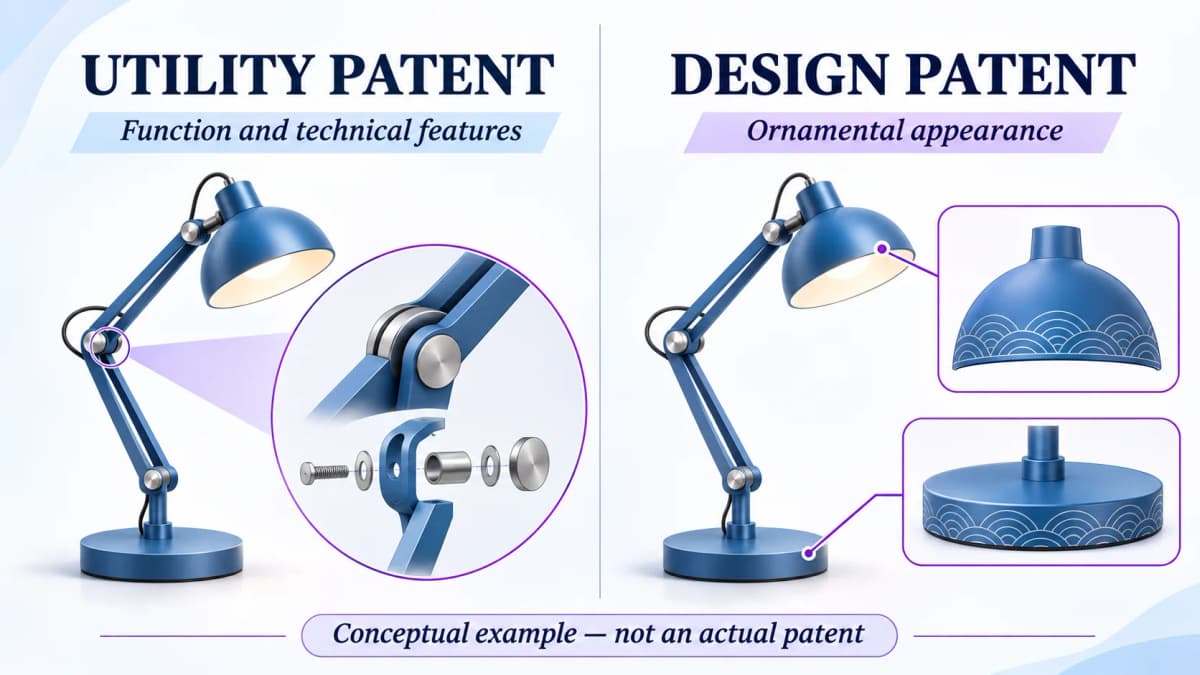
Conceptual illustration: the mechanism and exterior highlight different questions to investigate, not established patent rights.
Utility Patent vs Design Patent: Key Differences
The comparison below summarizes the main distinctions. It is a starting point for deciding what to investigate, rather than a method for declaring a product safe to sell.
| Comparison | Utility patent | Design patent |
|---|---|---|
| Main focus | Functional or technical invention | Ornamental appearance of an article |
| Lamp illustration | An adjustment mechanism | A claimed shade or base design |
| What to review | Claims, specification, and relevant drawings | Claimed design, drawings, and description |
| General US term | Usually up to 20 years from the relevant nonprovisional filing date, subject to applicable rules | 15 years from grant for applications filed on or after May 13, 2015 |
| Maintenance fees | Required at specified intervals after grant | No US maintenance fees |
| Useful search starting point | Technical terms, classifications, inventors, and assignees | Product images, design classifications, and registration records |
Patent Terms and Maintenance
The two terms run from different starting points. Comparing “20 years” with “15 years” without checking the relevant dates can therefore be misleading.
For US design applications filed before May 13, 2015, the term is generally 14 years from grant. Later applications receive the 15-year term described above. A utility patent’s actual expiration can depend on factors such as its filing history and applicable adjustments.
US utility maintenance fees are normally due at 3½, 7½, and 11½ years after grant. Do not infer that a record is currently enforceable merely because its nominal term has not ended. Check its current status and relevant history.
Application Costs and Requirements
A meaningful cost comparison separates official fees from professional services. Preparing technical descriptions and claims, preparing drawings, responding to examination, and pursuing protection in multiple countries can create different expenses.
For an original product, ask for a quote tied to the invention and intended markets. For a sourced product, the immediate question may instead be what it costs to investigate existing rights. The cost of applying for your own patent does not tell you whether another party’s rights affect your product.
Can a Product Have Both Types of Patents?
Yes. A product can involve both functional innovation and ornamental design, with separate protection addressing each aspect.
Our hypothetical lamp could have an inventive adjustment mechanism and a distinctive ornamental housing. A utility application might concern the mechanism, while a design application might concern the claimed exterior. Neither example establishes that the lamp automatically qualifies for protection.
For ecommerce teams, separate two decisions:
- Protecting your work: What aspects of your original product may justify a patent application?
- Checking others’ rights: What existing rights may affect the product you intend to make, import, or sell?
A supplier’s patent certificate might be relevant to the first question, but it does not settle the second. The USPTO explains that a patent grants a right to exclude others; it does not itself grant permission to practice the invention. Another party may hold rights affecting part of the product.
What Sellers Should Check Before Sourcing
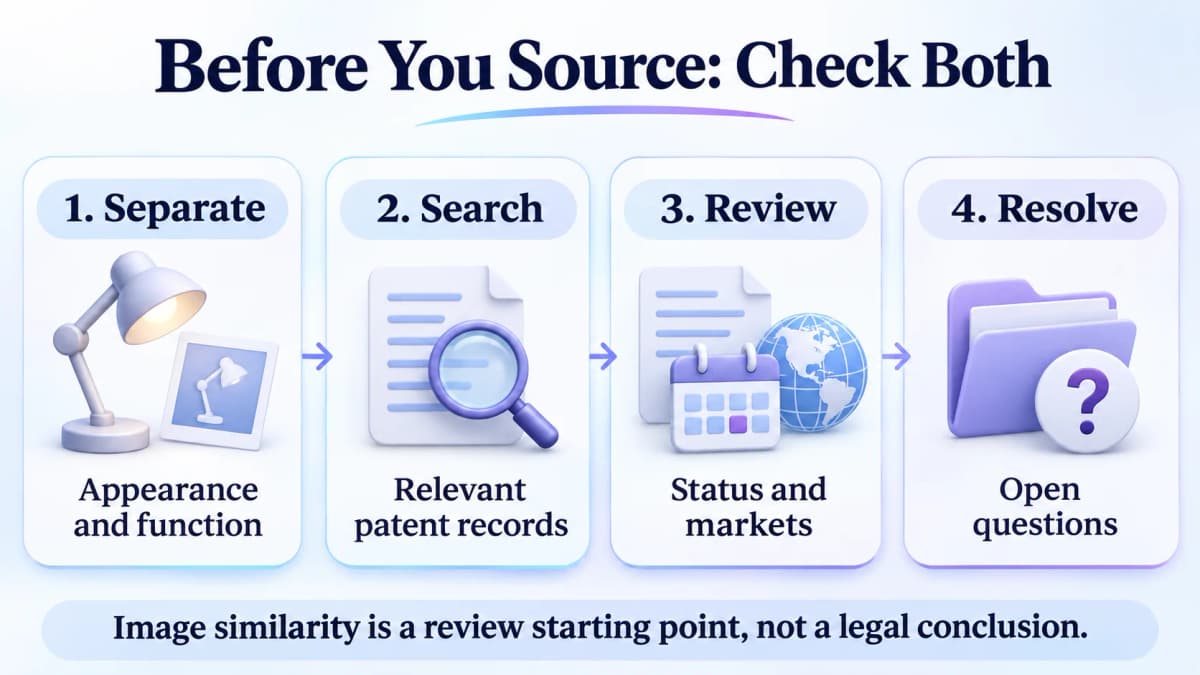
Start with a product brief that is specific enough to investigate. “Desk lamp” is a category; a particular housing, joint, and intended sales market describe the product decision you actually need to make.
Separate Appearance from Function
Create a short record for the exact model under consideration:
- Clear images showing its exterior from multiple angles.
- A description of how its important mechanisms work.
- The supplier’s name, model identifier, and available technical documents.
- The countries where you intend to manufacture, import, and sell it.
Keep decorative features and technical features in separate notes. This prevents a successful appearance search from being mistaken for a review of the entire product.
Search the Relevant Records
Use design-focused searches to investigate visible similarities. If you have only a supplier photo, image search can help identify candidate registered designs without knowing a patent number.
Investigate functional concerns separately through appropriate patent databases and technical searches. If a supplier highlights a proprietary mechanism or cites a patent, obtain the exact identifier and relevant documents rather than relying on a marketing description.
Record what you searched and what you found. A useful research note states the product version, search date, input images or terms, and records that need follow-up. This is more actionable than an unexplained “passed” label.
Review Status and Market Coverage
For a potentially relevant record, check the available owner information, drawings, dates, status, and territorial coverage. An image match alone leaves those questions unanswered.
Pay attention to the difference between where a record comes from and where rights may apply. A database’s source-country label is not a substitute for reading the registration’s relevant territories.
If important fields are missing or unclear, preserve that uncertainty in your notes. It should lead to a follow-up question, not an assumed favorable answer.
Resolve Questions Before Ordering
Ask the supplier for documents supporting any claim of ownership or authorization. Match those documents to the relevant product, rights, and markets; a generic assurance is difficult to evaluate.
Before committing to a large order, assemble the unresolved records and product details for a qualified patent professional. A focused brief gives that review a clearer starting point.
For the lamp example, your brief might say: “This registration appears visually close to the shade; please review the drawings and status. Separately, the supplier describes a proprietary joint, but has not provided its patent identifier.” That distinguishes two open questions without inventing a legal verdict.
Check Similar Designs with Nexscope
When your starting point is a product photo or sketch, an image-based search can help you move from a broad category to specific design records worth reviewing.
Nexscope’s design patent search supports this appearance-focused research through two capabilities:
- Design Similarity Search: Find visually similar registered-design candidates from a product photo or sketch.
- Design Registration Details: Use a returned record ID to look up available holder information, dates, and recorded status.
Limited-time free access through December 10, 2026 (UTC). Sign in for unlimited Design Similarity Search and Design Registration Details queries during the promotion, with no credits deducted. The offer is available to new and existing users and applies only to these two tools.
Provide a clear image, compare the returned designs, and inspect the available registration details. Keep relevant record IDs with your sourcing notes. The page also provides instructions for supported agent access and API integration.
Coverage varies by source and market. Visual similarity is a starting point for review, not an infringement finding; no matches do not establish permission to sell. Technical patent questions require a separate investigation.
Free Design Patent Search Until December 10
Limited-time offer ends December 10, 2026 (UTC). Sign in to use both tools with no credits deducted.
Search Design Patents Free Until December 10 →Conclusion: Make Patent Checks Part of Product Selection
The utility patent vs design patent distinction gives you two questions to ask about any product: what is technically distinctive, and what is visually distinctive? Keeping those questions separate helps you decide which records and expertise you need.
Before placing an order, turn your findings into a short decision brief: the exact product model, intended sales markets, relevant records, and questions still awaiting answers. Use that brief to follow up with your supplier and obtain professional review where needed, while you still have time to reconsider the purchase.
Have a product photo ready? Start the appearance-focused part of your research with Nexscope’s design patent search.
Check Your Next Product Before You Order
Design Similarity Search and Design Registration Details are free through December 10, 2026 (UTC). Sign in to use both tools with no credits deducted.
Start Your Free Design Search →This article provides general information about US patent distinctions and product research. It is not a legal opinion on a particular product.
Frequently Asked Questions
Is a utility patent the same as a utility model?
No. A US utility patent should not be confused with a utility model. Utility models are a separate form of protection available in some jurisdictions, with requirements and terms that vary by country. Check the specific system rather than translating the names as if they were interchangeable.
Which is better, a utility patent or a design patent?
Neither is universally better. The relevant question is what you want to protect: a technical invention, an ornamental appearance, or both. If you are sourcing someone else’s product, the priority is identifying relevant existing rights rather than choosing a patent type to file.
Does changing a product’s color avoid design patent infringement?
Do not treat a color change as an automatic solution. A meaningful review depends on the particular claimed design and the relevant legal analysis. Look at the full record and obtain advice about the actual product comparison rather than using a fixed rule about how much to change.
Can an image search identify utility patent risks?
An image search may provide useful research leads, but it cannot establish whether a product falls within technical patent claims. Internal mechanisms and processes may not be visible. Investigate functional features with technical information and appropriate claim review.
Does owning a patent mean I can sell the product?
No. A patent gives its owner exclusionary rights, not blanket permission to sell. Other patents and other applicable legal requirements may still affect commercialization. Keep your own protection strategy separate from your assessment of others’ rights.
Sources
- USPTO — Patent Essentials; uspto.gov.
- USPTO — MPEP 1502: Definition of a Design; uspto.gov.
- USPTO — Design Patent Application Guide; uspto.gov.
- USPTO — MPEP 1505: Term of Design Patent; uspto.gov.
- USPTO — Managing a Patent; uspto.gov.
- WIPO — Utility Models; wipo.int.
- Nexscope — Design Patent Search; nexscope.ai.