
AI Shopping Is Replacing Google Search — Now What?

The way consumers discover products is undergoing a fundamental shift. Instead of typing keywords into Google and scrolling through search results, shoppers are now asking AI assistants like ChatGPT, Google Gemini, and Microsoft Copilot exactly what they need — and getting personalized product recommendations with images, prices, and direct checkout links.
For Shopify store owners, this shift represents both a threat and an opportunity. Stores optimized for AI shopping are already seeing 10-15x increases in AI-referred orders. Those that ignore this trend risk becoming invisible to a growing segment of buyers who never visit Google at all.
The Numbers Behind AI Shopping
A home organization DTC brand provides a real-world example of this shift. In 2025, the brand generated $3.8M in annual revenue, primarily through Google SEO and Facebook ads. By Q4, organic traffic had declined and ad ROI dropped from 3.8x to 1.9x.
After optimizing for AI search in January 2026, February data showed:
- 32% of new orders came from AI assistants (ChatGPT, Google Gemini)
- 27% higher average order value compared to traditional channels
- 60% lower customer acquisition cost
- 19% higher repeat purchase rate
These results are not isolated. Early adopters across categories are reporting similar patterns as AI shopping volume grows exponentially.
How AI Shopping Actually Works
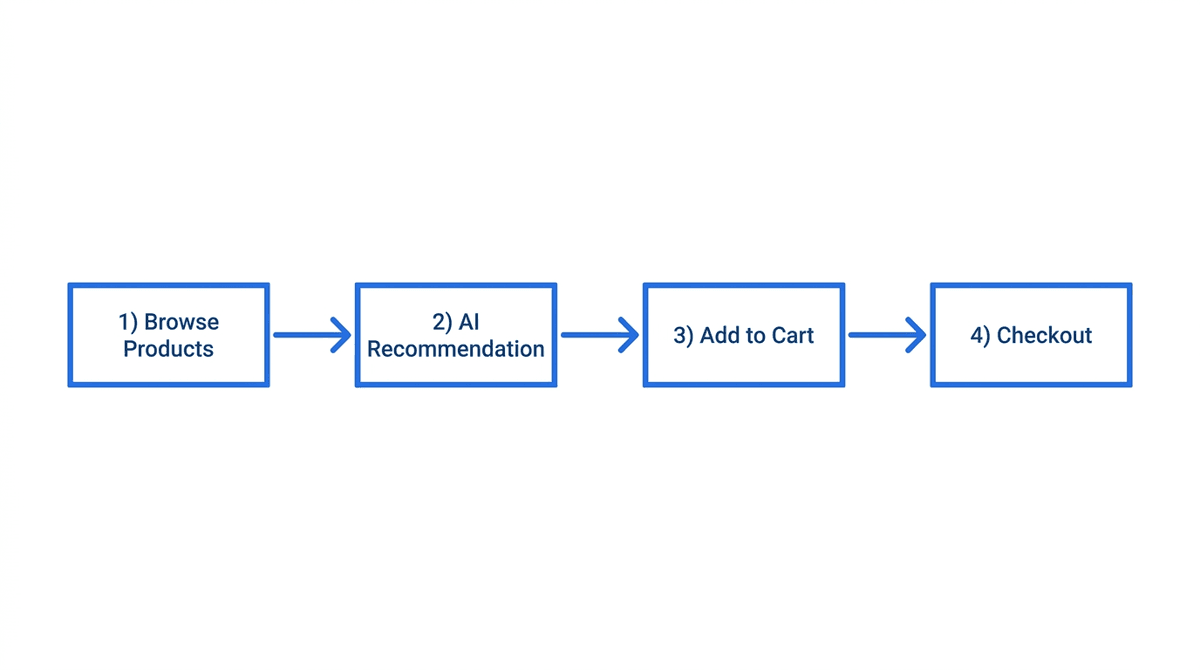
Traditional e-commerce search follows a familiar pattern: consumer types keywords → search engine returns ranked results → consumer clicks through pages → consumer makes purchase decision.
AI shopping eliminates most of these steps:
- Consumer describes need in natural language — "I need a waterproof storage cabinet for my small apartment bathroom"
- AI matches intent to products — Not keyword matching, but semantic understanding of use case, constraints, and preferences
- AI presents curated recommendations — Complete with images, prices, specifications, and reviews
- Consumer clicks directly to checkout — One click from AI response to product page
The critical difference: AI does not rank pages by SEO authority or ad spend. It matches products to stated needs based on how well the product information answers the consumer's question.
Shopify Agentic Storefronts: The New Standard
Shopify has responded to this shift with Agentic Storefronts — a feature that connects store product catalogs directly to AI shopping assistants. When enabled, product data syncs automatically with ChatGPT, Google Gemini, Microsoft Copilot, and other AI platforms.
What Agentic Storefronts Does
- Real-time product sync — Prices, inventory, and availability update automatically
- Structured data feed — Product information formatted for AI consumption
- Direct checkout integration — AI can generate purchase links that take shoppers directly to checkout
- Multi-platform distribution — One setup connects to all major AI shopping platforms
Why This Matters
Without Agentic Storefronts enabled, products are invisible to AI shopping assistants. They cannot recommend what they cannot see. As AI shopping volume grows, stores without this connection will see declining traffic from an increasingly important channel.
3-Step Guide to AI Shopping Optimization
Enabling Agentic Storefronts is necessary but not sufficient. Product information must be optimized for AI understanding to maximize recommendation likelihood.
Step 1: Restructure Product Information
AI assistants need clear, structured product data to match products with consumer queries. Vague or marketing-heavy descriptions reduce match accuracy.
Before (Poor AI Readability):
"Bestselling Storage Cabinet — Perfect for Any Home!"
After (AI-Optimized):
"Multi-Layer Wood Storage Cabinet | Small Space Living Room | Water-Resistant Finish | 4-Tier Capacity | 24" W x 12" D x 48" H"
Optimization Checklist:
- Include specific dimensions and measurements
- List materials and finishes
- Specify use cases and room types
- Add capacity or quantity information
- Include compatibility details (if applicable)
The goal: enable AI to answer specific consumer questions like "Will this fit in my 30-inch closet?" or "Is this waterproof for bathroom use?"
Step 2: Enable Agentic Storefronts
The technical setup takes minutes:
- Log into Shopify Admin
- Navigate to Settings → Sales Channels
- Find AI Shopping Channels
- Enable sync permissions for ChatGPT, Gemini, Copilot
- Verify product catalog connection
Once enabled, product data automatically flows to the Shopify Global Product Catalog, which AI assistants query in real-time.
Step 3: Run AI Readiness Audit
Not all products will be AI-visible even after enabling Agentic Storefronts. Missing data fields, vague descriptions, or formatting issues can prevent AI from reading and recommending products.
Use an AI readiness tool to identify gaps:
- Shopify App Store offers AI audit tools (such as Sixth Shop)
- Scan entire product catalog for "AI invisible" items
- Prioritize fixes for high-margin and high-volume products
- Target 90%+ AI readability across the catalog
Why This Changes Everything
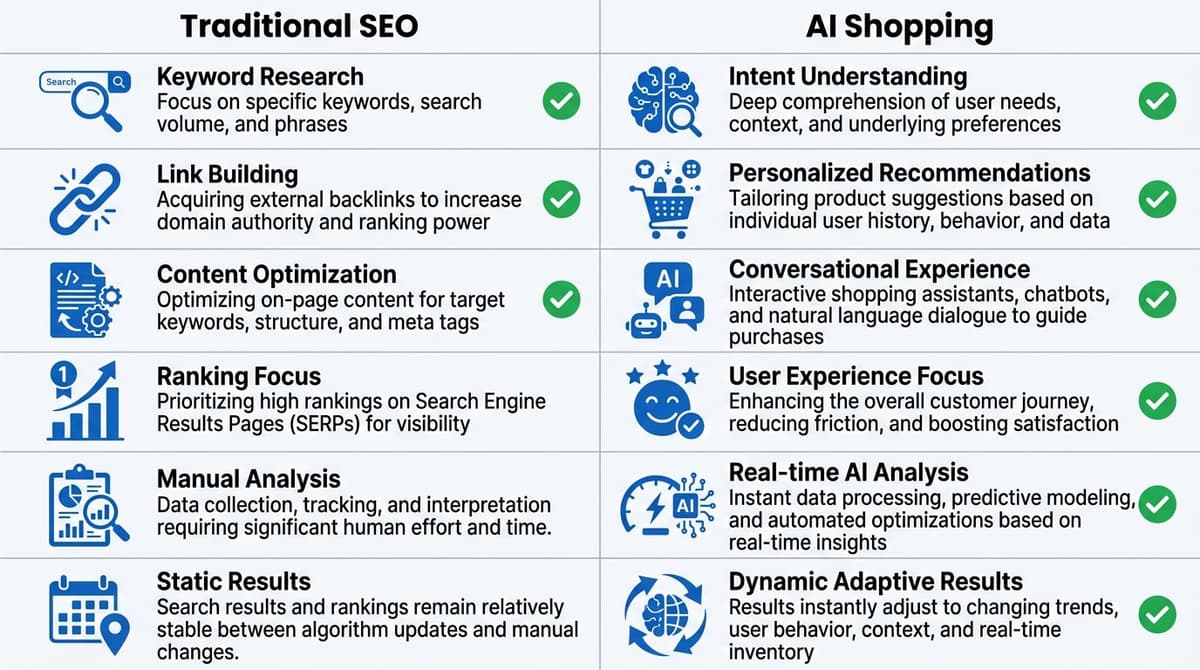
The shift to AI shopping fundamentally changes competitive dynamics in e-commerce.
Traditional Model
- SEO: Compete for rankings through backlinks, content, technical optimization
- Paid Ads: Compete for placements through bidding and budget
- Winner: Whoever has the most authority or the biggest budget
AI Shopping Model
- Product-Need Match: AI recommends based on how well product information answers consumer questions
- No Ranking Competition: AI presents relevant options, not a ranked list to scroll
- Winner: Whoever has the clearest, most complete product information
This levels the playing field. A small DTC brand with excellent product data can outperform a large retailer with vague listings — because AI does not care about domain authority or ad spend.
The Timeline: Act Now or Fall Behind
AI shopping adoption is following the classic technology adoption curve, but faster:
| Phase | Timeline | Consumer Behavior |
|---|---|---|
| Early Adopters | 2025 | Tech-savvy users experimenting with AI shopping |
| Early Majority | H1 2026 | Mainstream consumers discovering AI shopping convenience |
| Late Majority | H2 2026 | 68%+ of consumers using AI for product discovery |
| Laggards | 2027+ | Remaining holdouts convert as AI becomes default |
Stores that optimize now capture growing AI traffic with minimal competition. Stores that wait until H2 2026 will face a crowded field of optimized competitors.
Getting Started Today
The window for early-mover advantage is closing. Three immediate actions for Shopify store owners:
- Enable Agentic Storefronts — The technical foundation takes 10 minutes to set up
- Audit top 20 products — Restructure descriptions for AI readability
- Install an AI readiness scanner — Identify and fix gaps across the catalog
AI shopping is not replacing traditional e-commerce overnight, but the traffic shift is accelerating. Stores that adapt now will capture a growing share of high-intent, high-value customers who never see a Google search result.
Tools for AI Shopping Optimization
For sellers looking to automate AI optimization, Nexscope SkillHub offers skills specifically designed for e-commerce AI readiness:
amazon-listing-optimization — Restructure product descriptions for AI consumption
npx skills add nexscope-ai/Amazon-Skills --skill amazon-listing-optimization -g
amazon-keyword-research — Identify how consumers phrase needs to AI assistants
npx skills add nexscope-ai/Amazon-Skills --skill amazon-keyword-research -g
amazon-competitor-analysis — Reveal how top-performing stores structure product data
npx skills add nexscope-ai/Amazon-Skills --skill amazon-competitor-analysis -g
Browse 200+ e-commerce skills at nexscope.ai/skillhub, or install the complete collection:
npx nexscope install
Nexscope provides structured ecommerce data that teams can use in focused web tools or connect to their existing Agent through API, MCP, or Skills. Ready workflows include Keyword to Ads, Video Clone, and Buy Box Repricer.
The rules of e-commerce traffic are being rewritten. AI shopping rewards clarity, specificity, and structure over authority and budget. The stores that adapt first will capture the next wave of online retail growth.
Connect Ecommerce Data to Your Agent
Use Nexscope through API, MCP, or Skills, or open a ready seller workflow.
Explore Ecommerce Data →1,000 free credits • API, MCP & Skills
Sources
- Shopify Agentic Storefronts Announcement — Official Shopify documentation on AI shopping integration
- ChatGPT Shopping Features — OpenAI's product discovery capabilities
- Google Gemini Shopping Integration — Google's AI shopping assistant features