

Amazon Haul’s 2026 Holiday Sale Brings $0.11 Deals

Table of Contents
Amazon Haul is running its 2026 Haul-iday sale from November 9–14, with $1 flash deals throughout the event and selected $0.11 deals on November 10–11. Orders of $25 or more qualify for free delivery, with 5% off orders over $50 and 10% off orders over $75.
For shoppers, the appeal is affordable gifts and everyday purchases. For sellers, there is another development to watch: Amazon says relevant Haul products now appear in its regular search results. That puts low-price alternatives within reach of shoppers who may never have opened the Haul storefront.
A good purchase still depends on what arrives, when it arrives, and the final checkout total. A sensible seller response starts with understanding those same comparisons before changing a price.
What’s Included in Amazon Haul’s Holiday Sale?
Amazon reports a Haul catalog exceeding 10 million products, mostly below $10, including more than one million below $5. The event covers categories such as fashion, beauty, home, electronics, and holiday decor.
| Offer | What to know |
|---|---|
| Flash promotions | Selected products receive special prices; the entire catalog is not priced at $0.11. |
| Cart savings | Check the qualifying subtotal and the discount applied at checkout. |
| Seasonal selection | Further daily and weekly deal drops are planned through November and December. |
Shoppers can find Haul by searching for it in the Amazon Shopping app or visiting its storefront. Check individual offers as you browse: prices and availability can change.
For Buyers: When Is a Haul Deal Worth Buying?
The strongest deals solve a purchase you already intended to make. A small decoration, household accessory, or inexpensive gift can be a useful find when its specifications match the job. Start with a shopping list and a spending limit before browsing the flash offers.
Compare the actual product
Photos can make products with different sizes, materials, or quantities look similar. Read the selected variant and included contents before comparing prices.
For example, a hypothetical $3 listing for one storage pouch and a $9 listing for four pouches have different unit costs. The four-pack costs $2.25 per pouch, but it only makes sense if you need the additional pieces and the products are comparable.
Check these details together:
- Dimensions: Will the item fit the drawer, shelf, device, or space you have in mind?
- Quantity: Does the price cover one item, a pair, or a complete set?
- Material and construction: Do the description and customer photos support your intended use?
- Compatibility: Are the model, connection, or size requirements correct?
- Reviews: Look for repeated comments about durability, missing parts, or misleading dimensions.
A low purchase price does little for an item you cannot use. For gifts, also consider whether the packaging and finish match what you want to give.
Calculate the final basket cost
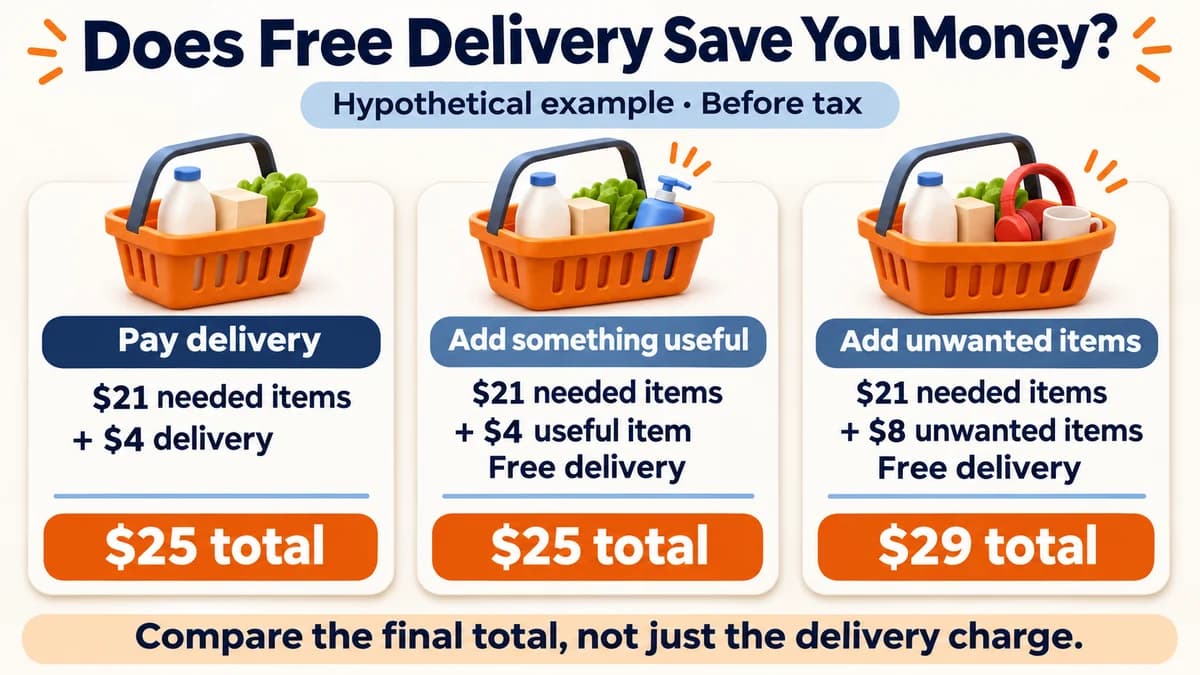
Hypothetical example before tax; use the delivery charge shown at checkout.
Free delivery can be useful when your planned purchases already qualify. Adding unwanted products to reach a threshold can increase your total spend.
Consider a hypothetical checkout example: you have $21 of items you need, and checkout shows a $4 delivery charge. Paying for those items would cost $25 before tax. Adding a useful $4 item to qualify for free delivery leaves the same total and gives you something extra. Adding $8 of unwanted items raises the total to $29.
Use the delivery charge actually displayed for your order. Apply the same calculation to basket discounts: compare the final total before and after adding products, including any changes in eligibility. A larger percentage saving can still leave you spending more money.
Match delivery to the occasion
For a party, gift exchange, or holiday trip, the delivery estimate matters as much as the price. Check the date shown for your address and leave room for a replacement if the product is unsuitable.
Order time-sensitive purchases around that deadline. A cheap decoration delivered after the event has little value, while an everyday organizer may be worth waiting for.
What to Check Before Checkout
Before paying, review the order as a whole:
- Confirm the selected size, color, quantity, and included accessories.
- Check that the advertised promotion applies to your selected item.
- Read any purchase limits attached to the offer.
- Review delivery estimates and the total after shipping, discounts, and tax.
- Check the return eligibility shown for each purchase.
Amazon’s announcement specifies free returns for eligible purchases over $3 within 15 days of delivery. Do not assume an eleven-cent item has the same return terms as every other Amazon purchase.
Keep your order details so you can compare the delivered product with the variant and quantity you bought. For inexpensive products, this simple check can prevent a small pricing win from turning into an unnecessary replacement purchase.
For Sellers: Haul Is Part of the Search Comparison
Amazon also reports nearly 350% year-over-year growth in customers making Haul purchases. That is a buyer-count metric, rather than a measure of units sold or revenue.
The practical question for a seller is whether those shoppers encounter a comparable Haul offer while searching for the seller’s product. Potential exposure is worth examining in categories where shoppers can easily substitute one unbranded item for another.
Start with products that combine several characteristics:
- Broad, generic search terms drive a meaningful share of traffic.
- Competing listings show similar designs and functions.
- Buyers can accept flexible delivery timing.
- The listing gives shoppers few visible reasons to pay more.
A sub-$15 price can help prioritize a review, but price alone does not establish direct competition. A specialized accessory, a clearly documented material advantage, or an urgent delivery need may change the comparison substantially.
Protect Margins Before Changing Prices
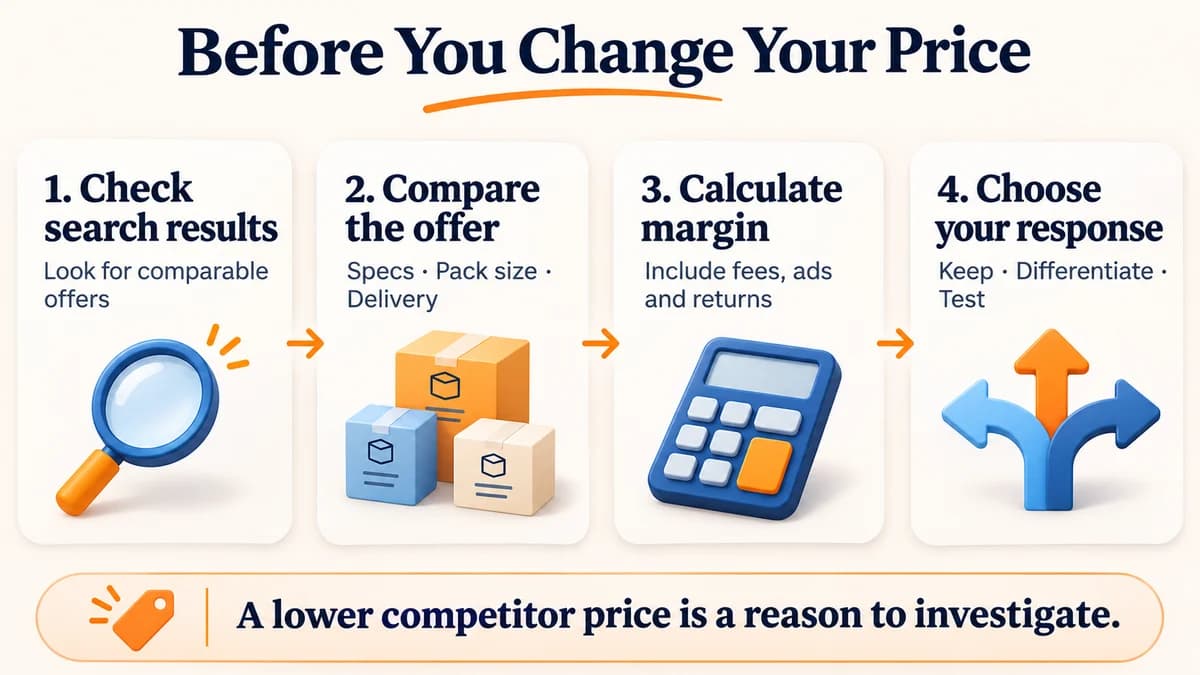
Check comparable offers and contribution margin before changing a price.
Inspect your important searches
Build a short list of the terms that matter to your existing catalog. Nexscope provides ecommerce research data through REST API and Amazon MCP tools. Its Amazon ASIN keywords capability can help identify relevant traffic terms and associated ranking signals for a product.
Use that shortlist to inspect Amazon results for your target marketplace and delivery location. Record any visible Haul offers alongside their price, pack size, product specifications, and delivery promise. Confirm Haul identity from the actual shopping experience; a low price by itself is insufficient.
Keep observations dated so you can distinguish a temporary promotion from a persistent competitor. Compare changes with your own conversion and advertising results over suitable periods, accounting for your promotions, stock availability, and other competitors.
Make the value difference visible
Compare like-for-like products before deciding that your price is too high. A single item, a multi-pack, and a coordinated kit meet different needs.
If you sell a stronger material, a specific compatibility range, or a useful set of accessories, show that distinction clearly in your images and product copy. Support claims with accurate specifications and product evidence. Make it easy for a shopper to understand what the additional money buys.
For example, a hypothetical cable-organizing kit might justify comparison on the number of usable pieces, supported cable sizes, and included mounting accessories. Simply describing it as “premium” gives the shopper much less to evaluate.
Test packs against real demand
Multi-packs can make sense for repeat-use products or tasks that require several pieces. Check whether customers need that quantity, then calculate the economics of the packaged offer.
Include product cost, packaging, fulfillment, referral fees, expected returns, advertising, and any promotion costs. Extra pieces can increase shipping weight or package dimensions, so a higher order value does not automatically produce a higher contribution profit.
Prioritize suitable packs you already have available. Introducing a new configuration requires its own listing, inventory, and policy checks; it is not an instant response to a short sale.
Set a contribution floor
Work backward from the amount each order needs to contribute after variable costs. In a simplified example, a $12 sale with $8 of variable costs contributes $4. A $2 reduction halves that contribution to $2 if the costs stay unchanged.
Apply the calculation to the offer and keyword combinations where you see meaningful competition. Use your Amazon Black Friday preparation checklist to connect pricing decisions with available inventory, promotion costs, and advertising limits.
Conclusion
Buyers can approach the Haul sale with a clear purchase list, a delivery deadline, and a final-total comparison. Sellers can use those same buying criteria to identify genuine substitutes and explain why their own offers deserve consideration.
Plan Your Next Checks With Nexscope
The Nexscope Amazon Data API gives ecommerce teams structured research data to support these decisions beyond a single promotion.
Key Features
- Amazon product search helps investigate products returned for relevant keywords.
- Amazon price and rank history supports comparisons over time.
- Amazon competitor research helps compare competing products and their market signals.
- Amazon ASIN keyword research helps prioritize traffic terms and ranking checks.
- Amazon market research supports evaluation of demand, competition, and niche structure.
- Amazon review research helps surface customer complaints and unmet needs.
Connect the relevant data to your own applications, agents, or research workflows through REST API or Amazon MCP tools. Start with the products and searches where a better comparison could change a pricing or merchandising decision.
Plan Your Amazon Research
Explore Amazon data capabilities and connect relevant research to your own workflows.
Explore Amazon Data →FAQs
Should I buy extra products to qualify for free delivery?
Compare the additional product cost with the delivery charge you would otherwise pay. Adding something you need can be worthwhile; buying unwanted items can increase the total even when shipping becomes free.
Are multi-packs always better value?
Compare the price per usable item, specifications, and quantity you actually need. A lower unit cost is less useful when the extra pieces go unused or the product differs from the alternative.
Should Amazon sellers match Haul prices?
First check whether the offers are genuine substitutes. Compare specifications, quantity, delivery, and customer needs, then calculate your contribution profit at the proposed price. Adjust individual offers based on evidence rather than applying a catalog-wide reduction.
Sources
- Amazon Staff. (2026). Amazon Haul’s early Haul-iday deals event: $1 flash deals, $0.11 steals, and millions of items under $10. Retrieved from aboutamazon.com