

Amazon Variation Review Sharing Rules Sellers Must Know

Amazon variation reviews can now look very different when a shopper switches from one child ASIN to another. A parent listing may still show hundreds of reviews, while a flavor, formula, model, or functionally different option shows only a small fraction of that total. The change can affect the star rating and review count shoppers see, even when the parent-child relationship remains intact.
Amazon began rolling out updated review-sharing rules by product category on February 12, 2026. The rollout was scheduled to continue through May 31, 2026. Reviews can still be shared across variations with minor differences that do not change product functionality. Variations that materially change the customer experience may need to build their own review history.
That shift changes more than a number on the product page. Sellers need to decide which child ASINs deserve Vine inventory, advertising spend, listing improvements, and ongoing review analysis. This guide explains the official rules, the likely operational impact, five compliant ways to build useful feedback, and a data workflow for prioritizing the variations that can support profitable growth.
What Amazon Changed
Amazon previously shared reviews broadly across products in the same variation family. That approach could place feedback about one product experience next to a materially different child ASIN. Amazon's updated policy limits review sharing to variations whose differences are minor and do not affect functionality.
The parent-child relationship may remain active even when reviews stop sharing across every child ASIN. Sellers should avoid assuming that a lower review count means Amazon deleted reviews or automatically broke the variation family.
Review sharing is one part of a wider set of Amazon seller-facing changes in 2026. Separate Amazon Featured Offer eligibility changes remove a preliminary seller-level screening step while preserving the final offer-selection process. Updated 75-character Amazon listing title rules affect title compliance for most non-media categories. These policies govern different layers of an ASIN: review sharing controls which customer feedback appears across variations, Featured Offer rules affect offer consideration and competition, and title requirements control product-content compliance. Sellers should track the three changes separately instead of attributing every visibility or conversion shift to one update.
Sharing-Eligible Variations
Amazon's review-sharing announcement identifies several variation types that may continue sharing reviews:
- Color or pattern changes for the same product
- Size changes that preserve the same function, such as different bedding dimensions
- Pack size or quantity changes
- Secondary scent differences for products where scent is not the main function
- Model fitment differences for the same product type, such as cases made for different phone models
Eligibility still depends on the product type, marketplace, variation theme, and whether the family accurately represents the products. A valid variation theme does not make unrelated products eligible for shared reviews.
Reviews That Stay Separate
Reviews may remain separate when a child ASIN changes the product's function, formula, flavor, specification, or core user experience. Amazon gives the example of a product with both flavor and size variations: the flavor options may not share reviews, while eligible size options still can.
This distinction matters because feedback for one formula may not help a shopper judge another formula. The same logic can apply to products with different functions, performance levels, materials, or configurations. If a variation theme is used inconsistently and groups products with significant differences, Amazon may stop sharing reviews across the entire family.
Sellers should confirm that product attributes, variation themes, titles, images, and descriptions accurately match each child ASIN. Clear Amazon listing optimization also reduces the risk that buyers purchase an option based on expectations created by another variation.
Rollout and Display Effects
Amazon scheduled the category-by-category rollout from February 12 through May 31, 2026. The company said affected sellers would receive an email notice before changes reached their products, although timing can still differ across categories, marketplaces, and accounts.
Amazon later clarified several practical effects through its Seller Assistant announcement:
- Search-result star ratings and review counts reflect only reviews eligible to be shared within the product family.
- Review sharing does not directly change Best Sellers Rank.
- Eligible Vine reviews may return to the original child ASIN, subject to Vine limits and Amazon's review policies.
- Seller Assistant can help check which variations qualify for review sharing.
- Reviews may be shared again when an incorrect variation structure is fixed and the products are eligible.
These statements describe Amazon's review display and eligibility rules. They do not guarantee a particular conversion-rate, advertising, or ranking outcome for an individual listing.
Seller Impact
The visible review count is the immediate change, but the operational impact reaches product launches, budget allocation, inventory planning, and product improvement.
Child ASIN Trust
A new color or pack quantity may still benefit from shared reviews when it meets Amazon's criteria. A functionally different flavor, formula, or model may need to establish its own feedback history.
When shoppers select that child ASIN, they may see:
- A lower review count
- A different average star rating
- Fewer reviews about the selected option
- Less evidence about fit, flavor, durability, or actual use
A conversion decline is a reasonable operating risk, but it is not an automatic result of the policy. Price, listing quality, category norms, advertising relevance, brand familiarity, delivery speed, and competitor offers also influence conversion.
Variation-Level Demand
Pooled reviews can hide weak demand. A parent listing with 500 reviews may owe most of its sales and feedback to one or two child ASINs. Once review visibility becomes more product-specific, the performance of each variation is easier to evaluate.
That creates a useful diagnostic opportunity. Sellers can compare each child's orders, estimated sales, price, advertising conversion, return rate, review count, rating, and repeated complaints. A child ASIN that depended on the parent's reputation may no longer justify the same inventory or ad budget.
The same evidence can improve future Amazon product research. A variation with genuine demand, acceptable margins, stable feedback, and clear positioning is a stronger expansion signal than a child ASIN whose apparent popularity came from pooled social proof.
Budget and Inventory Pressure
Suppose a parent has four functionally different child ASINs. A seller may previously have concentrated early orders and Vine participation on one option, then relied on shared reviews across the family. Separate review histories make that approach less dependable.
Average budget allocation is usually inefficient in this situation. Four small campaigns can leave every child below the level needed to build meaningful sales and feedback. A stronger plan prioritizes the variation with the best combination of demand, margin, inventory, product readiness, and early conversion.
Review strategy now needs a child-ASIN budget, not only a parent-level target. That budget should cover Vine units when eligible, advertising, coupons, content improvements, inventory depth, and the cost of correcting product issues uncovered by low-star feedback.
Three Variation Buckets
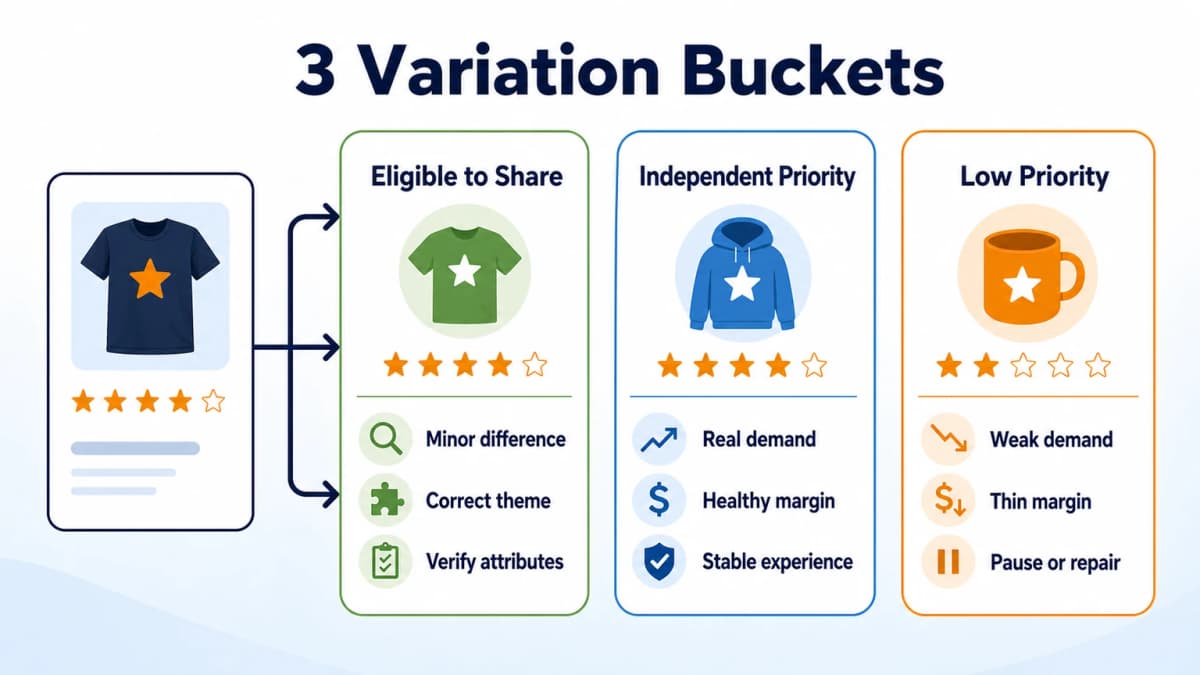
Each child ASIN can be placed into one of three operating buckets. The classification should be reviewed whenever Amazon changes review visibility, a product receives repeated complaints, or conversion performance shifts.
Eligible to Share
This bucket includes minor differences that may remain eligible for shared reviews, such as colors, patterns, functional-equivalent sizes, and pack quantities.
Before creating a separate review plan for every child, verify:
- The selected variation theme matches the real difference.
- Attribute values are accurate and consistent.
- Parent-child relationships follow category requirements.
- Front-end options match the Seller Central configuration.
- Images and copy describe the selected child accurately.
If an eligible product lost shared reviews because of incorrect data, correcting the structure may allow Amazon to re-share reviews. Sellers should use Seller Assistant and Seller Support for account-specific eligibility rather than rebuilding or merging families repeatedly.
Independent Priority ASINs
This bucket includes variations that cannot share reviews but have enough independent demand and margin to justify investment. They should be managed like separate launches within a product family.
Priority signals include:
- Sufficient search demand for the specific use case
- Margin that can absorb Vine units, coupons, and advertising
- Inventory depth that supports continued promotion
- A stable product experience without unresolved defects
- Early conversion and return performance that supports scaling
These child ASINs need their own review, advertising, conversion, inventory, and product-quality monitoring. Sellers enrolled in Amazon Brand Registry should also confirm that each child has accurate branded content and product information.
Low-Priority ASINs
Some child ASINs have weak demand, thin margins, poor ad conversion, or unstable product feedback. Losing shared reviews can make those weaknesses more visible.
Continuing to spend simply to restore a large review number can destroy margin. A low-priority child may need a small validation test, a product fix, a listing correction, or a pause. Sellers should protect capital for variations that can earn repeatable demand and credible product-specific feedback.
Pausing promotion does not always require deleting the child ASIN. The objective is to stop automatic budget allocation until evidence supports the next action.
Five Compliant Review Tactics
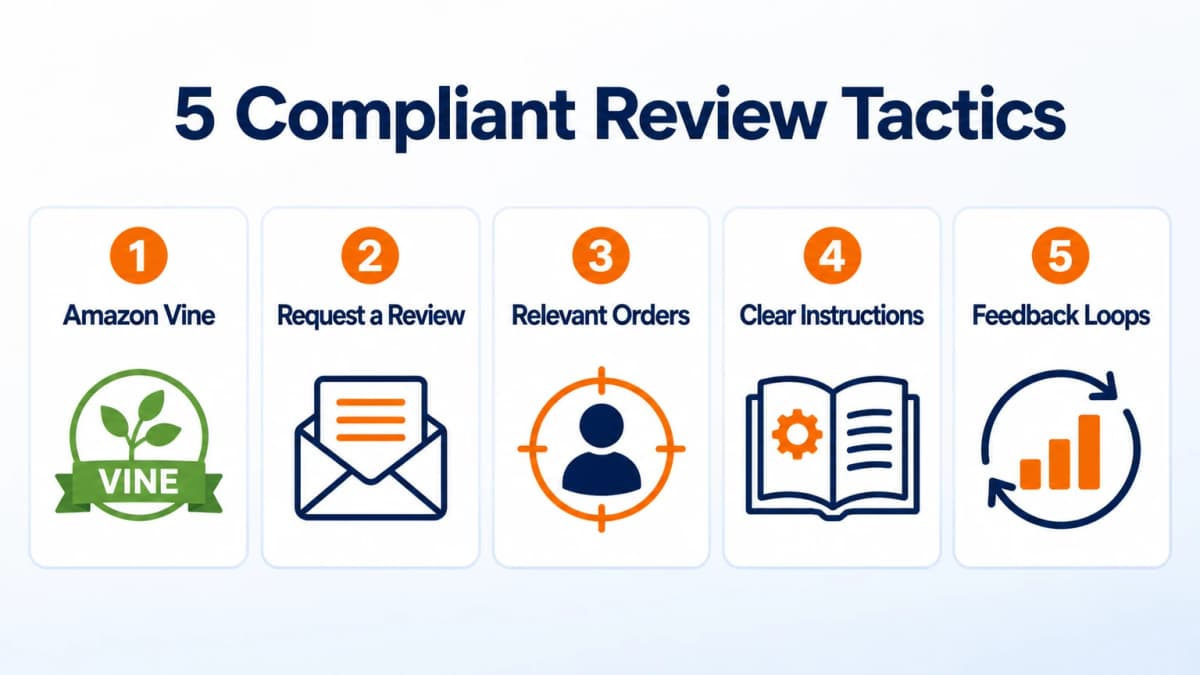
High-quality reviews are authentic, specific, and useful to shoppers. No compliant tactic can guarantee a positive rating. The goal is to create enough accurate product experiences and eligible requests for real customers to provide independent feedback.
Amazon Vine
Amazon Vine can help eligible products receive early reviews from invited Vine Voices. Amazon's published US Vine fee tiers include up to two units at $0, up to ten units at $75, and up to 30 units at $200. Fees, availability, and eligibility can change, so the current enrollment screen in Seller Central remains the final source of truth.
Vine should be prioritized around the strongest child ASIN rather than spread automatically across every variation. Before enrollment, confirm that the child has:
- A customer-ready listing and accurate variation data
- Stable packaging, instructions, and product performance
- Available FBA inventory and applicable program eligibility
- Enough margin and inventory to support follow-on promotion
Vine Voices can leave low-star reviews. An unstable product may accumulate negative evidence faster through Vine, which is why product readiness comes before review volume.
Request a Review
Amazon's Request a Review guidance says the feature sends standardized language that asks for both a product review and seller feedback. The message is automatically translated into the customer's preferred language.
A request can generally be sent once per eligible order between five and 30 days after delivery. Sellers should not send an additional review request for the same order through Buyer-Seller Messaging after using the standard feature.
A consistent daily or weekly process can prevent eligible orders from aging out of the window. Automation may improve execution efficiency only when it triggers Amazon's standard request and follows current policy. It cannot be used to screen for satisfied buyers, ask for five stars, or suppress negative feedback.
Relevant Customer Acquisition
Verified Purchase reviews depend on real orders. Deep discounting can increase order volume, but it may also attract buyers whose needs do not match the product. Misaligned buyers are more likely to return the item or report that it failed to meet expectations.
A more durable launch combines:
- Precise advertising around the core use case
- A reasonable coupon that lowers initial purchase friction
- Clear titles, bullets, images, dimensions, compatibility, and limitations
- Accurate statements about who the product is designed for
If a product works only in a small room, the listing should not imply whole-home coverage. Accurate expectations may reduce clicks from irrelevant shoppers while improving the quality of orders and feedback.
Product Instructions
Many low-star reviews begin with avoidable setup or usage problems. Buyers may miss an accessory, install parts in the wrong order, misunderstand dimensions, skip charging time, or use an unsuitable cleaning method.
Packaging, manuals, installation videos, and product-page FAQs can reduce that confusion. They should focus on successful product use and accurate limitations. Inserts must not ask for a positive review, offer compensation, direct only satisfied buyers to Amazon, or route unhappy buyers away from leaving a review.
Product instructions and listing content should communicate the same requirements. Contradictory guidance creates support contacts, returns, and low-star feedback.
Low-Star Feedback Loops
Reviews become more useful when they inform product decisions. A weekly variation-level review should combine:
- One- to three-star review themes
- Return reasons and return-rate changes
- Voice of the Customer signals
- Buyer questions and support contacts
- Rating differences across child ASINs
- Advertising conversion and order share
When the same issue appears repeatedly, the correct next step may be lower advertising spend, a listing correction, a packaging update, a supplier investigation, or a temporary inventory hold. Continuing to scale traffic can expose more buyers to the same problem and deepen the negative review pattern.
Variation-Level Data Workflow
Review counts alone cannot identify which variation deserves investment. A child ASIN may have fewer reviews but stronger demand and a better rating. Another may have many inherited reviews while showing weak sales, unstable pricing, or repeated complaints.
Nexscope's Amazon Data API helps ecommerce teams compare review signals with the demand and product evidence needed to decide whether a child ASIN should be scaled, repaired, validated, or paused.
Use a compact variation-level scorecard:
| Decision | Useful signals |
|---|---|
| Prioritize a child ASIN | Price, rating, review count, estimated sales, BSR, margin, and inventory readiness |
| Investigate weaker conversion | Selected variation, recent low-star themes, return signals, price position, and competitor ratings |
| Pause or repair a variation | Repeated complaints, rating decline, weak sales, and an unstable product experience |
The dedicated Amazon Reviews List API can narrow review analysis by ASIN, star rating, keyword, recency, Verified Purchase status, and media. That makes it easier to test whether a complaint belongs to one child ASIN instead of treating the parent listing's pooled review count as the answer.
These data points support prioritization, but Amazon's official policy pages, Seller Central notifications, and account-specific Seller Assistant guidance remain the final authority for review-sharing eligibility.
Four-ASIN Budget Example
Consider a parent listing with four flavors that no longer share reviews. The seller has a limited launch budget and cannot give every child the same Vine, advertising, and inventory support.
| Child ASIN | Current evidence | Recommended action |
|---|---|---|
| Flavor A | Highest demand, stable margin, sufficient inventory, consistent experience | Prioritize eligible Vine enrollment, precise advertising, and review monitoring |
| Flavor B | Moderate demand and encouraging conversion | Use a smaller validation budget and monitor independent feedback |
| Flavor C | Weak demand and average ad conversion | Run a limited test before expanding inventory or review investment |
| Flavor D | New product with unstable feedback | Fix product experience and instructions before scaling traffic |
Flavor A receives the strongest launch support because it has the best chance to create repeatable orders and product-specific reviews. Flavor B earns a controlled test. Flavor C must prove demand. Flavor D stays below scale until the experience is stable.
This sequencing protects cash and improves learning speed. It also gives the seller a clearer benchmark for deciding whether a weak child needs more promotion, a better listing, a product change, or removal from the active growth plan.
Prohibited Review Tactics
Amazon's customer product reviews policy says the company monitors abnormal review accumulation relative to order volume and typical customer behavior. Review manipulation can affect reviews, listings, brands, and selling privileges.
The following tactics create unnecessary account and listing risk:
- Rebates, refunds, gifts, discounts, or free products in exchange for reviews
- Requests for five-star or positive reviews
- Review clubs, paid review providers, social groups, or third-party review purchases
- Reviews from employees, close family, or parties connected to the seller
- Requests to remove or change a negative review in exchange for compensation
- Product inserts that direct satisfied buyers to review while diverting unhappy buyers
- Selective review requests based on predicted customer satisfaction
- Forced variation relationships between unrelated or functionally different products
- Repeated review requests for the same order
A short-term increase in review count does not justify the risk of losing the listing or account. Sustainable review growth depends on relevant orders, accurate expectations, a stable product, compliant requests, and continuous improvement.
Ten-Point Audit Checklist
Sellers can use this review after any visible change in variation-level ratings or review counts:
- Check notifications. Confirm whether Amazon sent a review-sharing update for the category or ASIN family.
- Record visible changes. Capture the rating and review count for every child ASIN.
- Validate variation themes. Confirm that each theme matches the real product difference.
- Check sharing eligibility. Use Seller Assistant and current Amazon guidance for the specific family.
- Classify every child. Place each variation into shared, independent-priority, or low-priority status.
- Confirm Vine eligibility. Review the current Seller Central requirements and fee tier before enrollment.
- Protect request windows. Process eligible orders within the five- to 30-day Request a Review period.
- Inspect packaging. Remove language that asks for positive reviews or offers incentives.
- Connect feedback signals. Compare low-star themes with returns, support contacts, and product batches.
- Reallocate resources. Move inventory and advertising toward child ASINs with credible demand and stable experiences.
The checklist should be stored with the review date, marketplace, ASINs, data source, and decision owner. That record makes later performance comparisons more reliable.
Conclusion
Amazon variation review sharing now depends more heavily on whether child products create the same core customer experience. Minor differences may continue sharing reviews. Functionally significant variations may need independent review histories, even while they remain in the same product family.
The strongest response is a variation-level operating plan. Sellers should validate parent-child data, classify every child ASIN, prioritize Vine and advertising around the best opportunities, use Request a Review consistently, improve instructions, and treat low-star feedback as product evidence.
For recurring reviews, Nexscope's Amazon Data API can connect child-ASIN feedback with demand and product signals, while the Amazon Reviews List API provides focused review filtering. Use the resulting evidence to prioritize decisions, while treating Amazon's official policy and account-specific guidance as the final authority.
Turn Amazon Review Signals Into Better Decisions
Explore Nexscope's API documentation to connect review data with product, competitor, keyword, sales, and market intelligence.
Explore API Docs →Frequently Asked Questions
Do all Amazon product variations still share reviews?
No. Amazon says reviews can continue to be shared when variations have minor differences that do not affect functionality. Examples include eligible color, pattern, pack quantity, same-function size, secondary scent, and model-fitment differences. Reviews may remain separate when a variation changes flavor, formula, function, specification, or another part of the core customer experience. Eligibility depends on the product type, variation theme, marketplace, and accuracy of the parent-child relationship.
Which Amazon variations remain eligible for review sharing?
Amazon lists colors, patterns, pack quantities, functionally equivalent sizes, secondary scents for products where scent is not the main function, and model fitments for the same product type as examples that may qualify. These are examples rather than universal guarantees. Sellers should verify the actual theme and attributes in Manage All Inventory, then use Seller Assistant or Seller Support for account-specific guidance. An inaccurate or inconsistent variation family may lose review sharing even if one attribute would normally qualify.
Does review sharing affect Best Sellers Rank?
Amazon states that the review-sharing update does not directly affect Best Sellers Rank. Review visibility can still influence shopper confidence and conversion, and conversion may contribute to broader product performance over time. Those indirect effects vary by listing and should be treated as operating hypotheses rather than official outcomes. Sellers should compare BSR, orders, conversion, price, advertising, and review changes before attributing a performance shift to review sharing alone.
What happens to separated Vine reviews?
Amazon says eligible Vine reviews may be reinstated to the original child ASIN when products no longer qualify for shared reviews. Reinstatement remains subject to Vine policy limits and Amazon's customer-review policies. Sellers should not assume every historical Vine review will appear on every variation. The practical check is to review the child ASINs, current Vine limits, Seller Central notifications, and Seller Assistant guidance after the category's review-sharing change takes effect.
How can sellers get Amazon reviews compliantly?
Compliant options include Amazon Vine for eligible products, the standard Request a Review feature, relevant customer acquisition, accurate listing content, useful product instructions, and continuous improvement based on low-star feedback. Sellers cannot guarantee positive ratings. Incentives, paid reviews, selective requests, employee or family reviews, and compensation for removing negative feedback can violate Amazon policy. Each child ASIN should earn reviews through real product experiences and eligible customer requests.
How should sellers prioritize child ASINs?
Each child can be classified as eligible for shared reviews, independently worth promoting, or low priority. Priority should reflect demand, margin, inventory, conversion, return behavior, rating stability, and product readiness. The strongest child receives the first Vine, advertising, and inventory support. Weaker options receive controlled tests or pauses. This approach reduces the risk of spreading budget across several variations that all remain below a sustainable launch level.
Can Amazon reviews be analyzed through API or MCP?
Yes. Nexscope documents an Amazon Reviews List API that can retrieve reviews by ASIN across 15 marketplaces and filter by star rating, keyword, recency, helpfulness, Verified Purchase status, media, and format. The capability can be accessed through REST or its documented MCP method. Coverage and freshness must be checked in the current API documentation. A reliable analysis should record the ASIN, marketplace, request date, filters, response fields, and any stated data limitations.
Sources
- Amazon. (2026). Changes to Review Sharing Across Product Variations Starting Feb 12. Retrieved from sellercentral.amazon.com
- Amazon. (2026). Check Review Sharing Eligibility With Seller Assistant. Retrieved from sellercentral.amazon.com
- Amazon. (2023). Boost Sales Through Reviews With Lower-Priced Fee Tiers for Amazon Vine. Retrieved from sellercentral.amazon.com
- Amazon. (2026). Product Reviews Policy: What Every Seller Should Know. Retrieved from sellercentral.amazon.com
- Amazon. (2024). Request a Review From a Customer. Retrieved from sellercentral.amazon.com