
10 Best AliExpress APIs for Product Data in 2026

Table of Contents
An AliExpress API can help you find products, enrich a catalog, or collect listing data for your own research tools. Choosing one gets harder when the same search results include official integrations, ready-made data endpoints, and scraping infrastructure that still needs a parser.
The useful question is what you want back from a request. A product URL, a keyword, and a category page are different starting points. A rendered HTML page, a structured product record, and an authorized seller response are different outputs.
The ten options below cover product research, catalog enrichment, and custom data pipelines. Compare their data coverage, integration approach, and billing model to find the right fit for your project.
AliExpress API Comparison at a Glance
Use this table to shortlist a service by the work you need to do. Prices based on records, requests, products, and credits are not directly interchangeable.
| API or service | Main approach | Useful starting point | Billing model | Main consideration |
|---|---|---|---|---|
| Nexscope | Ecommerce data endpoints | Keyword, product URL, category URL | Subscription credits or Data-only top-ups | Product discovery and enrichment |
| AliExpress Open Platform | Official integration | Application and approved API scope | Depends on API and access terms | Developer onboarding and permissions |
| Bright Data | Managed AliExpress scraper | Product or category URL | Records and volume plans | Map requested fields to your destination schema |
| Oxylabs | Web Scraper API | Product ID, query, or URL | Usage plans | Plan parsing alongside retrieval |
| Apify | Community AliExpress Actor | Search input with optional enrichment | Actor-specific product/event pricing | Evaluate the individual Actor and its maintenance |
| ScrapingBee | Rendering and extraction API | Product URL plus extraction rules | Request credits | Own the extraction schema |
| Scrapfly | Scraping infrastructure and SDK | Product or search-page workflow | Credit-based plans | Maintain collection and parsing code |
| Scrappa | Structured AliExpress endpoints | Search, item, store, or destination | Credits and pay-as-you-go calls | Market context and endpoint-specific limits |
| Monocrawl | Structured AliExpress operations | Query, item ID, store, or destination | Monthly credits; per-operation costs | Budget for every enrichment request |
| EveryInfra | Action-based AliExpress API | Keyword or product URL | Requests; search row-based metering | Action-specific fields and regional settings |
How to Choose an AliExpress API
Data Coverage
Start with a small field checklist. For product research, that might be a stable item ID, source URL, title, observed price, currency, image, and collection timestamp. For a comparison tool, add the variant and destination context that makes two prices comparable.
Then separate discovery from enrichment. Keyword search helps build a candidate set, category collection broadens the starting pool, and product details add depth to shortlisted items.
Keep the source values alongside your normalized fields so that product records remain easy to trace and update.
Access and Integration
Choose between three integration models:
- Official API access: Application permissions and, where relevant, seller authorization define what your integration can access.
- Structured data APIs: The provider handles extraction and returns a product-oriented response. Validate the actual schema against your target listings.
- Scraping infrastructure: The provider helps retrieve or render pages; your code may still need to find and normalize product fields.
Also check delivery behavior. Some services return a synchronous response, while others create a task whose result must be retrieved later. Your application needs to distinguish an accepted job from a completed dataset.
Cost and Maintenance
Compare the cost of a finished workflow, not just one advertised call. For example, collecting 100 candidate listings and enriching 20 shortlisted products may involve search pagination, detail requests, and optional review or shipping requests.
A practical calculation is:
Workflow cost = discovery + selected-product enrichment + optional data + retries + storage and maintenance.
Run a small pilot with representative listings before increasing volume. Include a product with many options, a discounted item, a listing with sparse information, and your actual destination market. Check the percentage of records containing your required fields, rather than treating a successful HTTP status as a complete result.
The 10 Best AliExpress APIs
1. Nexscope
Nexscope combines AliExpress research interfaces, cross-marketplace data, and REST API/MCP access in one ecommerce API platform. Its growing AliExpress catalog receives new interfaces and updates over time, giving teams room to expand from product discovery into broader sourcing and market research.
Core Capabilities
The AliExpress collection covers several research needs. Key interfaces include:
- AliExpress Product Search: Keyword-based discovery for finding candidate products around a niche, buying phrase, or sourcing brief.
- AliExpress Product Detail: Product-URL-based research for enriching shortlisted items and organizing product comparisons.
- AliExpress Category Products: Category-led discovery for exploring a broader assortment than a single keyword search.
- AliExpress Category Variants: Category-level variant observations for researching the range of product options in a niche.
- Cross-marketplace coverage: Amazon, 1688, and other ecommerce data APIs sit alongside AliExpress in Nexscope, making the platform useful for research that spans multiple marketplaces.
The full AliExpress API catalog brings the interfaces together in one place.
What You Can Build
- Product-discovery and sourcing tools: Combine keyword, category, and product-detail interfaces in an application that helps a team find and evaluate candidates. Complementary endpoints support both broad exploration and closer product research.
- Cross-marketplace comparison dashboards: Bring AliExpress, Amazon, and 1688 research into the same application. Access to several ecommerce sources through Nexscope gives teams a common platform for expanding their market coverage.
- AI-assisted research tools: Give an AI assistant access to ecommerce data through MCP for tasks such as product exploration and comparison-table preparation. This makes Nexscope relevant to both conventional software and agent-based applications.
- Internal catalogs and research reports: Feed product research into a team's database or reporting system. API access makes the data reusable across internal tools and recurring analysis.
Access and Integration
- REST API access: Integrate ecommerce research into a backend, SaaS product, or internal dashboard using HTTP requests.
- MCP access: Connect supported Nexscope data tools to an MCP-compatible AI client, making them available within an assistant's research environment.
- Composable interfaces: Combine discovery and detail APIs according to the application’s needs, and add other marketplace data as the project grows.
Pricing
- Subscription plans: Nexscope offers Starter, Growth, and Pro subscriptions with 30,000, 75,000, and 150,000 credits per month, respectively. Subscription credits are shared across supported ecommerce Data APIs, video generation, and image creation.
- Monthly or annual billing: Choose monthly payments or annual billing. Annual plans are paid yearly, while included credits refresh monthly. Unused subscription credits expire at the end of each credit cycle.
- Pay-as-you-go Data Credits: Purchase additional credits specifically for Data API calls, with no subscription required. This option suits data-only projects and teams that need extra API usage alongside a subscription.
- Free trial: Eligible new users receive 1,000 trial credits valid for three days, with no credit card required.
Compare the Nexscope pricing plans to choose a subscription or Data API top-up for your usage.
Best For
- Sourcing teams and category managers: Finding candidate products and exploring assortments and product options.
- Ecommerce analysts and research teams: Studying product ideas across AliExpress and other marketplaces.
- Developers and SaaS builders: Adding ecommerce data to product-research software, internal catalogs, and dashboards.
- AI application and automation builders: Connecting ecommerce research tools to assistants through MCP.
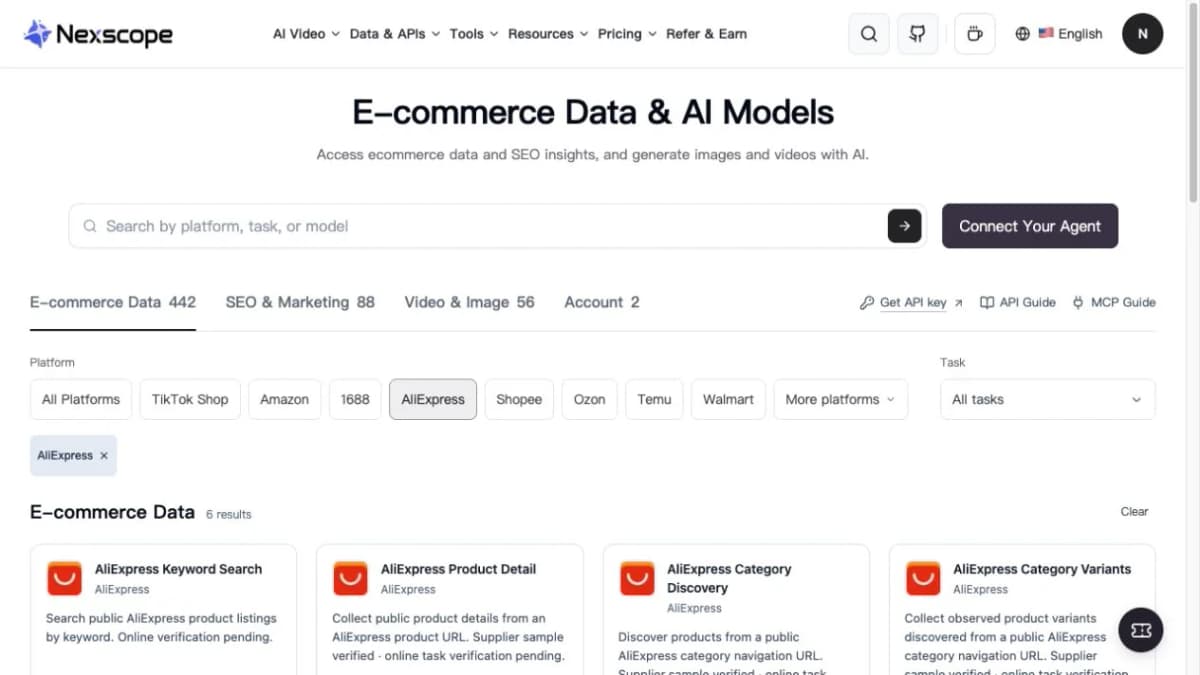
Nexscope's AliExpress API catalog groups the relevant discovery and detail interfaces.
Plan Your AliExpress Data Workflow
Explore keyword search, category discovery, and product-detail interfaces for your research pipeline.
Explore AliExpress Data APIs →2. AliExpress Open Platform
AliExpress Open Platform is the official integration route for applications working with AliExpress systems.
- Core capabilities: Integrate with the API groups assigned to your application, including authorized access to seller business data.
- What you can build: Seller-facing software and business workflows that connect to the seller’s AliExpress account.
- Access: Register as a developer, create an application, and use its App Key and App Secret. Seller-data access uses seller authorization.
- Pricing: Permissions and fees depend on the API group and application type.
- Best for: ERP and seller-software developers building authorized AliExpress account integrations.
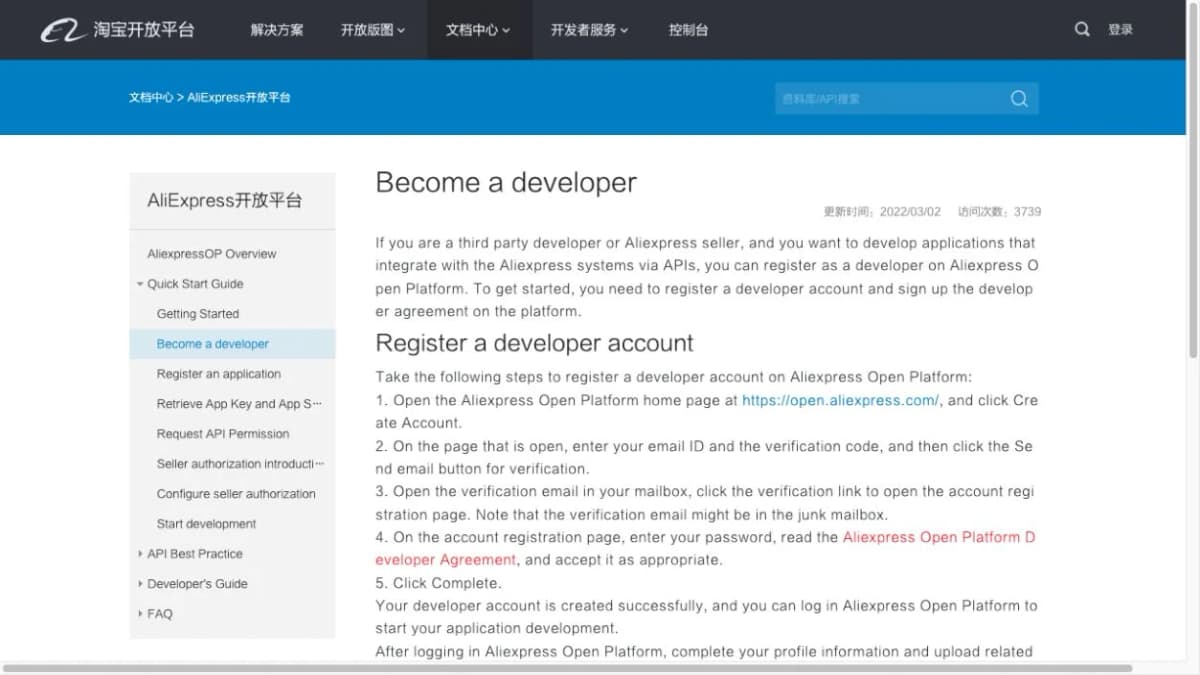
The official developer guide outlines registration and links to application and permission setup.
3. Bright Data
Bright Data’s AliExpress scraper turns product and category URLs into structured marketplace records.
- Core capabilities: Collect item identifiers, titles, descriptions, prices, seller information, ratings, and images.
- What you can build: Product-data batches for a catalog, data warehouse, or recurring market-research pipeline.
- Output and integration: Export JSON, NDJSON, or CSV; configure asynchronous collection and delivery to your destination.
- Pricing: Pay-as-you-go pricing starts at $1.50 per 1,000 records, with volume plans available.
- Best for: Data engineers and ecommerce analytics teams collecting product records in batches for warehouses and reporting.
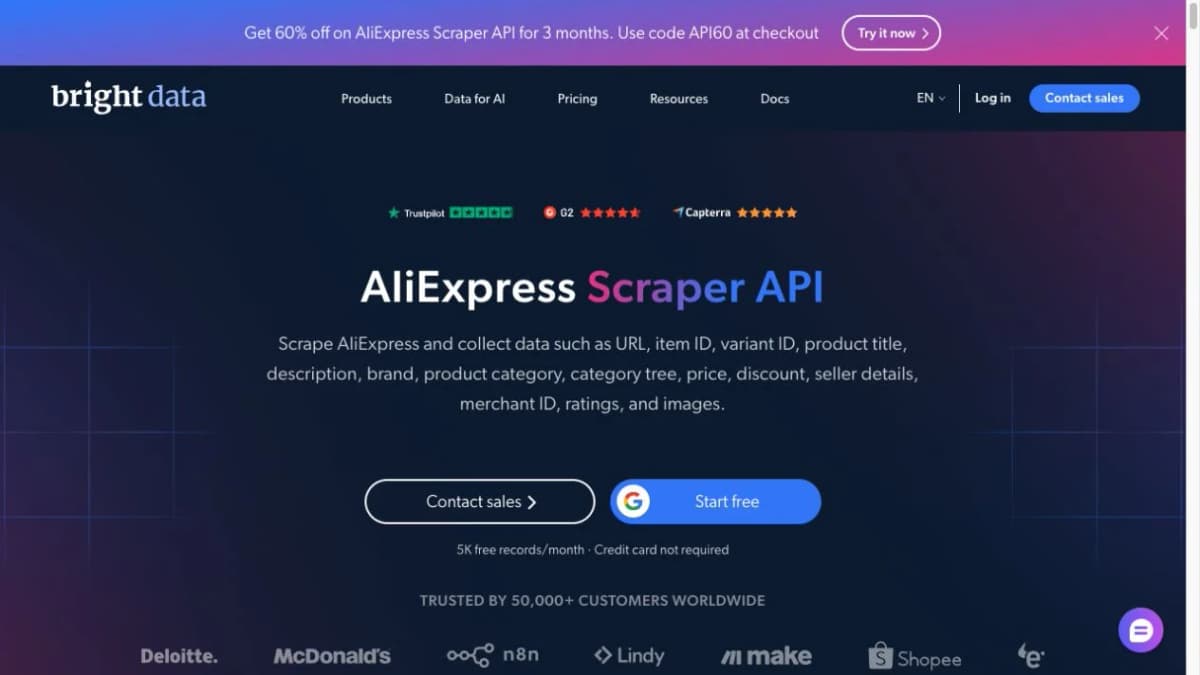
Bright Data offers an AliExpress-specific scraper with structured delivery options.
4. Oxylabs
Oxylabs’ AliExpress scraping API provides managed page retrieval through Web Scraper API.
- Core capabilities: Collect data using a product ID, search query, or direct URL through separate source types.
- What you can build: Custom product-research pipelines that feed your own database or analytics system.
- Parsing: Turn retrieved HTML into your chosen product schema with parsing options such as OxyParser or your own parser.
- Integration work: Your team defines the downstream fields and maintains custom parsing rules as page structures change.
- Pricing: Usage plans depend on the retrieval and parsing configuration.
- Best for: Backend developers and data engineering teams that maintain a custom product schema and parsing pipeline.
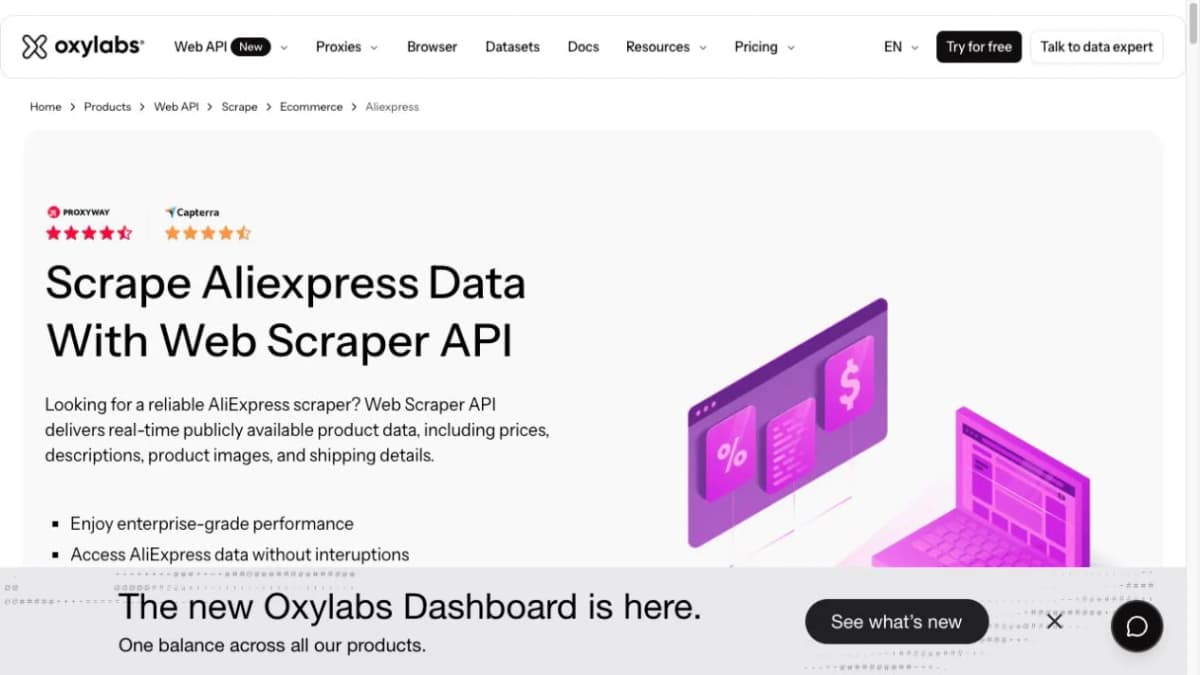
Oxylabs presents AliExpress collection as part of its Web Scraper API.
5. Apify
Apify’s AliExpress Scraper by Data Scrapers is a community Actor identified as datascrapers/aliexpress-scraper.
- Core capabilities: Collect search listings and add optional product-detail and review enrichment.
- What you can build: Search-to-dataset workflows and scheduled research jobs within an existing Apify setup.
- Integration: Configure the Actor’s inputs, trigger a run through the API, and retrieve its completed dataset.
- Pricing: Starts at $0.80 per 1,000 products; optional enrichment follows the Actor’s event charges.
- Best for: Automation specialists and research teams already using Apify Actors, scheduled runs, and datasets.
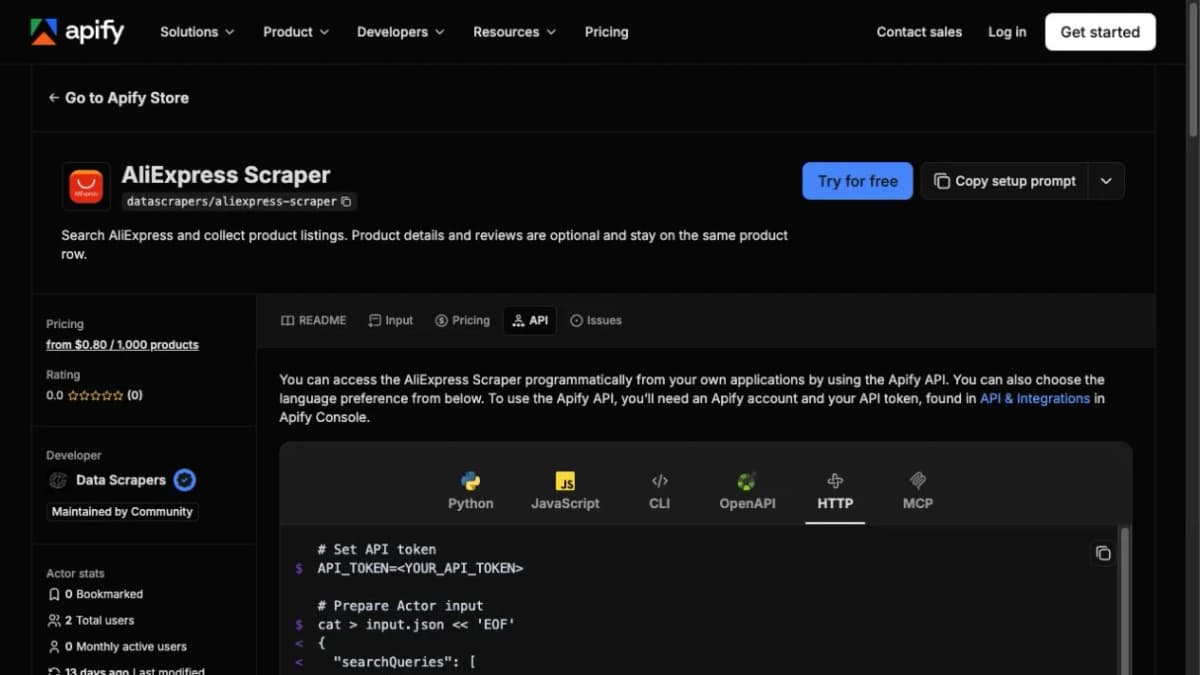
The selected Apify Actor exposes API-triggered runs and dataset retrieval.
6. ScrapingBee
ScrapingBee combines page rendering with configurable extraction for AliExpress product URLs.
- Core capabilities: Retrieve a product page and extract selected fields using your own extraction rules.
- What you can build: A focused product-research tool that collects fields such as title, displayed price, and source URL.
- Output: Define a compact schema around the fields and product options your application uses.
- Integration work: Maintain the extraction rules and normalize the returned values in your application.
- Pricing: Credit usage varies with request options, including JavaScript rendering and proxy configuration.
- Best for: Developers building focused internal tools that need a small, customized set of product fields.
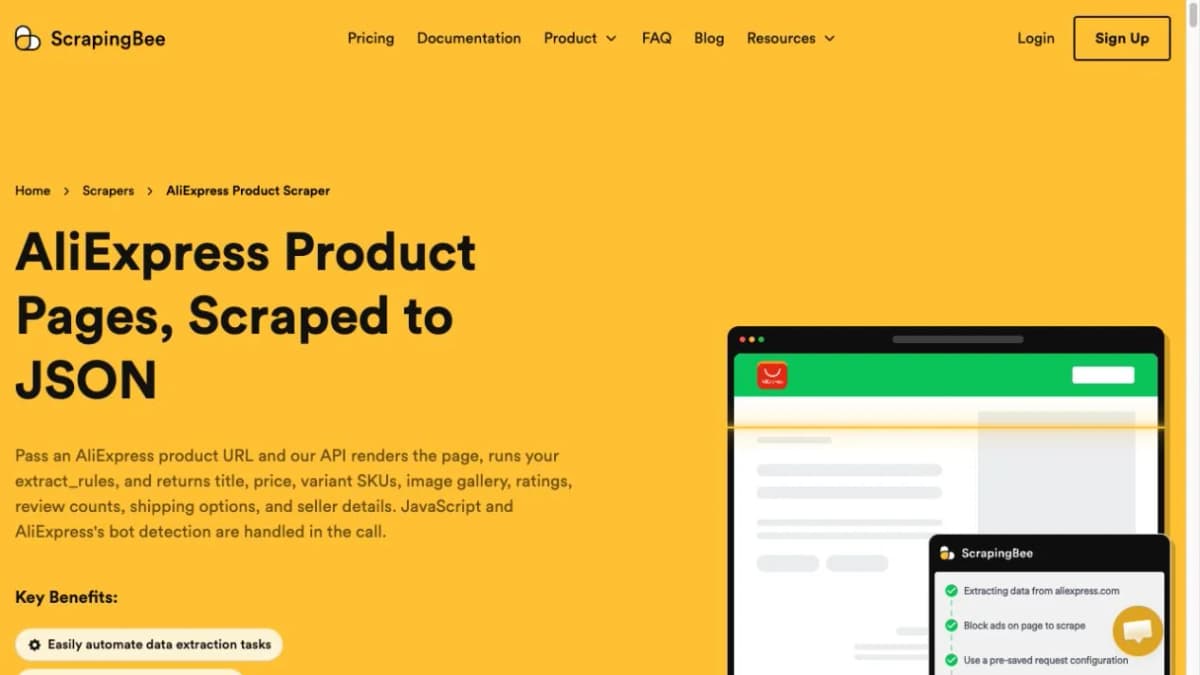
ScrapingBee combines page retrieval with configurable extraction.
7. Scrapfly
Scrapfly provides scraping infrastructure and SDKs for building code-driven AliExpress collection workflows.
- Core capabilities: Retrieve product and search pages, then parse product information in your collection code.
- What you can build: Custom crawlers with your own navigation, filtering, transformation, and storage logic.
- Integration: Use the SDK in a Python workflow and connect parsed records to your database or reporting tools.
- Maintenance: Your team owns the collection program and updates parsing logic when product-page structures change.
- Pricing: Credit plans vary with request configuration; development and maintenance are part of the project cost.
- Best for: Python developers and scraping engineers who want to control collection, parsing, and storage in code.
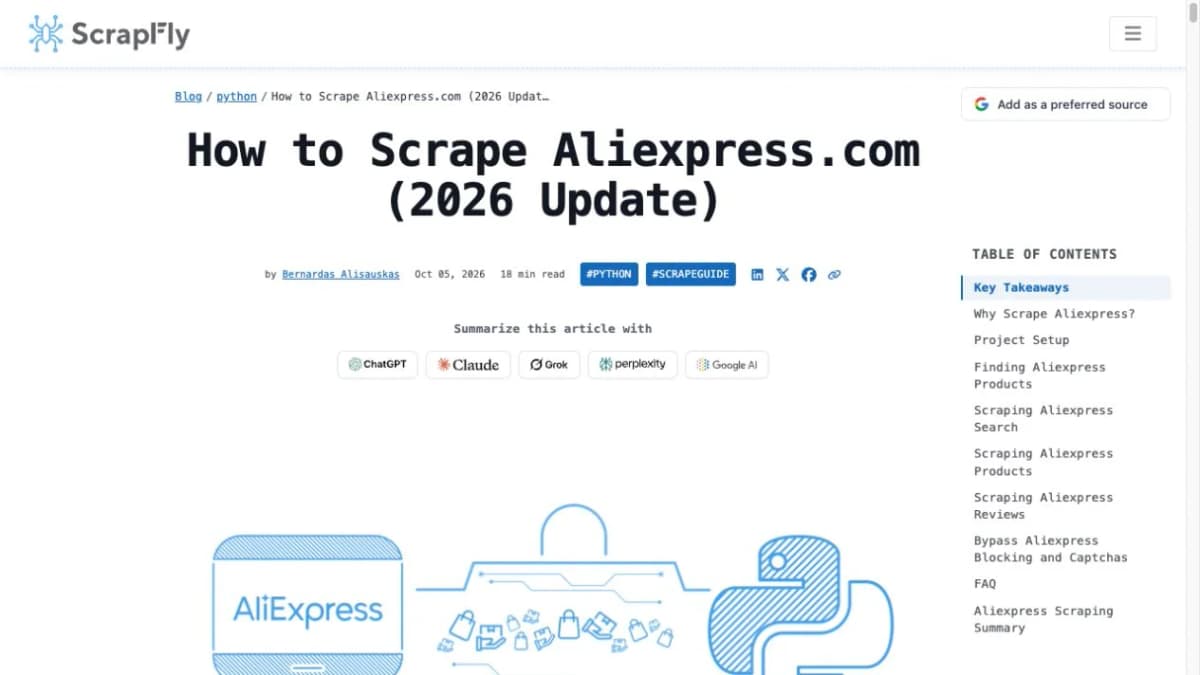
Scrapfly's guide demonstrates an implementation built on its scraping infrastructure.
8. Scrappa
Scrappa’s AliExpress API connects product discovery with seller, review, and shipping data through structured endpoints.
- Core capabilities: Search and autocomplete, product details and descriptions, reviews, shipping, and store information.
- What you can build: A product-comparison application that combines listing information with seller and destination context.
- Output and access: JSON responses authenticated with an API key; currency and language follow the source market.
- Workflow: Join product and shipping responses by item identifier, keeping the shipping destination with each comparison.
- Pricing: A free credit allowance plus pay-as-you-go usage; costs depend on endpoint usage and pagination.
- Best for: Product teams building comparison or sourcing tools that combine listing, seller, review, and shipping data.
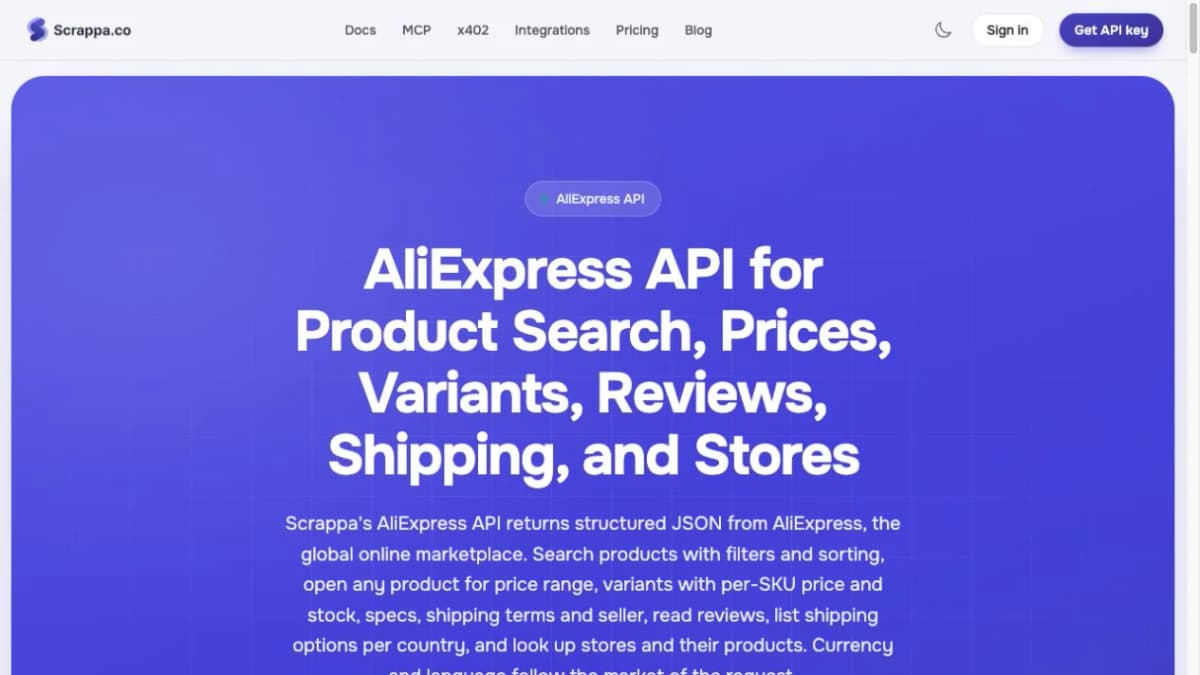
Scrappa groups several AliExpress data types under a structured API.
9. Monocrawl
Monocrawl’s AliExpress API groups twelve operations across discovery, product inspection, stores, and delivery.
- Core capabilities: Product search, listing details, reviews, related products, store data, and shipping operations.
- What you can build: A research workflow that discovers products first and adds reviews or delivery context to shortlisted items.
- Output and access: API-key authentication and structured JSON with product identifiers, currency, and observed price ranges.
- Pricing: 150 initial free credits; the Starter plan is $29 per month for 10,000 credits. Product, search, and review operations cost three credits each; some other operations cost one.
- Best for: Developers and small product teams building modular research tools with separate product, review, and shipping requests.
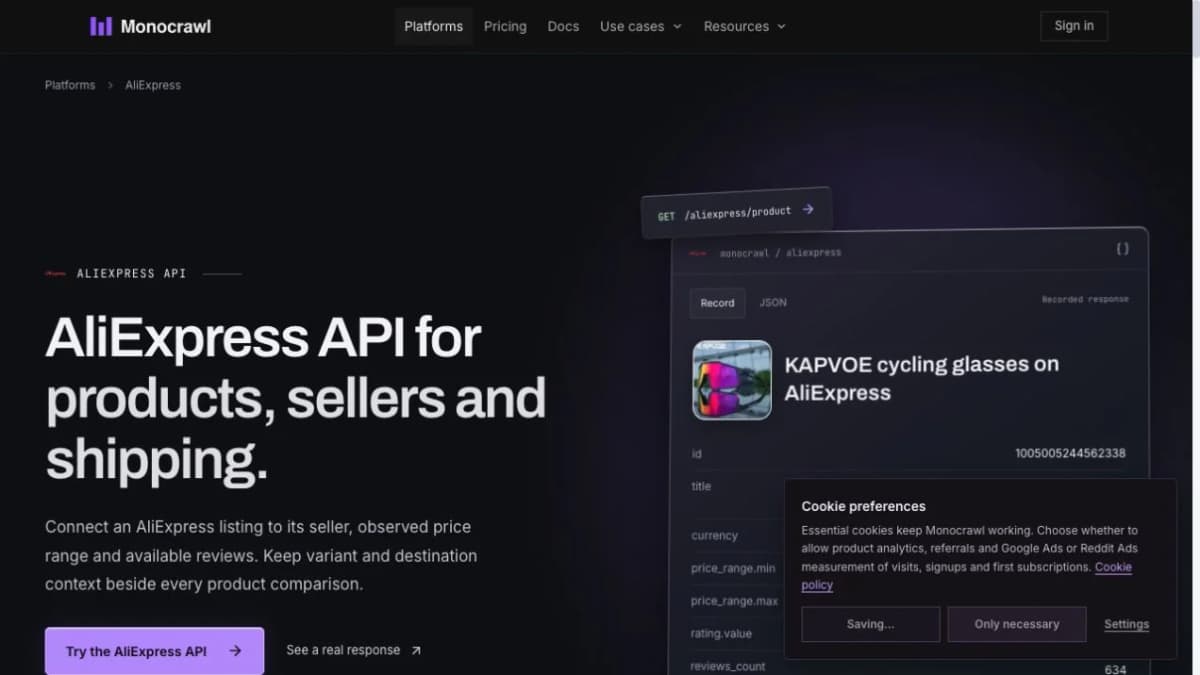
Monocrawl’s AliExpress interface groups product, seller, and shipping operations.
10. EveryInfra
EveryInfra’s AliExpress API offers action-based access to product and buyer-feedback data.
- Core capabilities: Keyword search, product information, variants, reviews, rating summaries, and detailed product data.
- What you can build: Product-research tables enriched with buyer feedback and regional product information.
- Action selection: Use
profilefor product-page information andreviewsfor individual feedback; rating summaries provide the average rating and review count. - Regional settings: Relevant product actions accept country and currency inputs, helping keep comparisons in the same market context.
- Pricing: $1.39 per 1,000 requests; search counts each block of 50 rows as a call.
- Best for: Ecommerce analysts and application developers combining product research with buyer-feedback analysis.
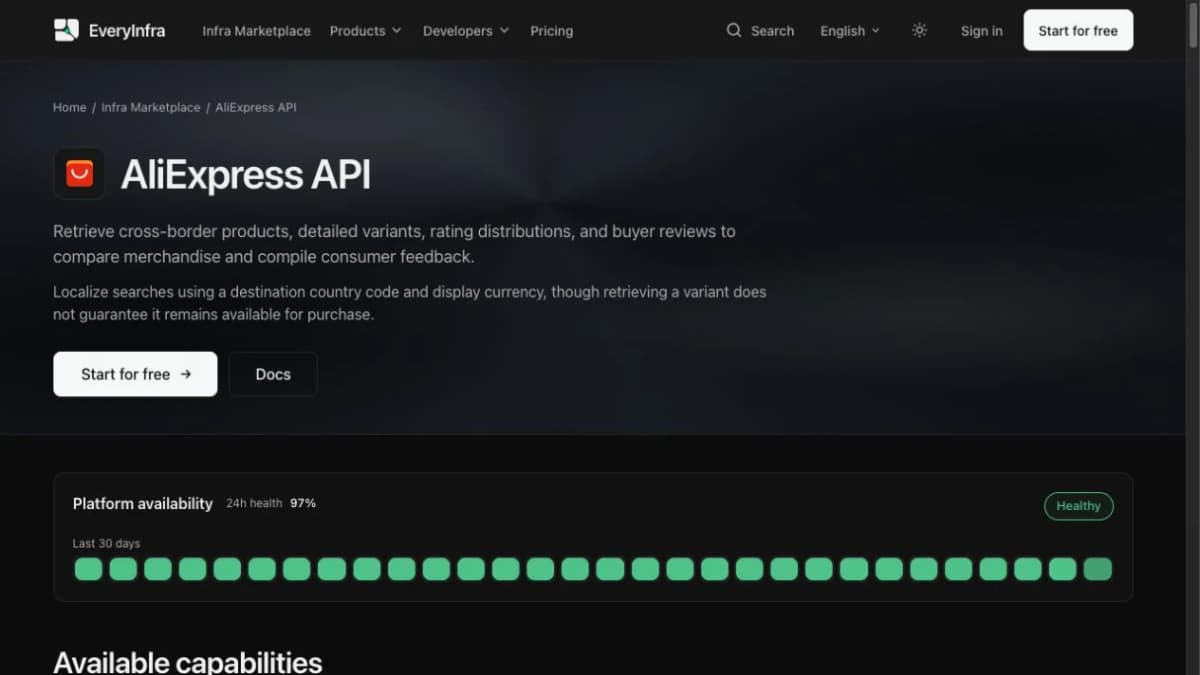
EveryInfra publishes AliExpress actions with field descriptions and action-level pricing.
Match the API to Your Workflow
The strongest shortlist is usually two or three candidates that match your output requirements. Use the same sample inputs for each and inspect the completed results.
| Your project | Start by evaluating | What to validate first |
|---|---|---|
| Product research across ecommerce sources | Nexscope | Discovery inputs and product-detail workflow |
| Authorized seller integration | AliExpress Open Platform | Application type, permissions, and seller authorization |
| Managed product-data batches | Bright Data | Required field coverage and delivery behavior |
| A custom collection pipeline | Oxylabs, ScrapingBee, Scrapfly | Retrieval configuration, parsing ownership, and maintenance |
| Existing Apify automation | The selected Apify Actor | Current Actor output and enrichment charges |
| Connected product, seller, or shipping views | Scrappa, Monocrawl | Coverage, limits, and market context |
| Product and buyer-feedback enrichment | EveryInfra | Action-specific fields, pagination, and billing units |
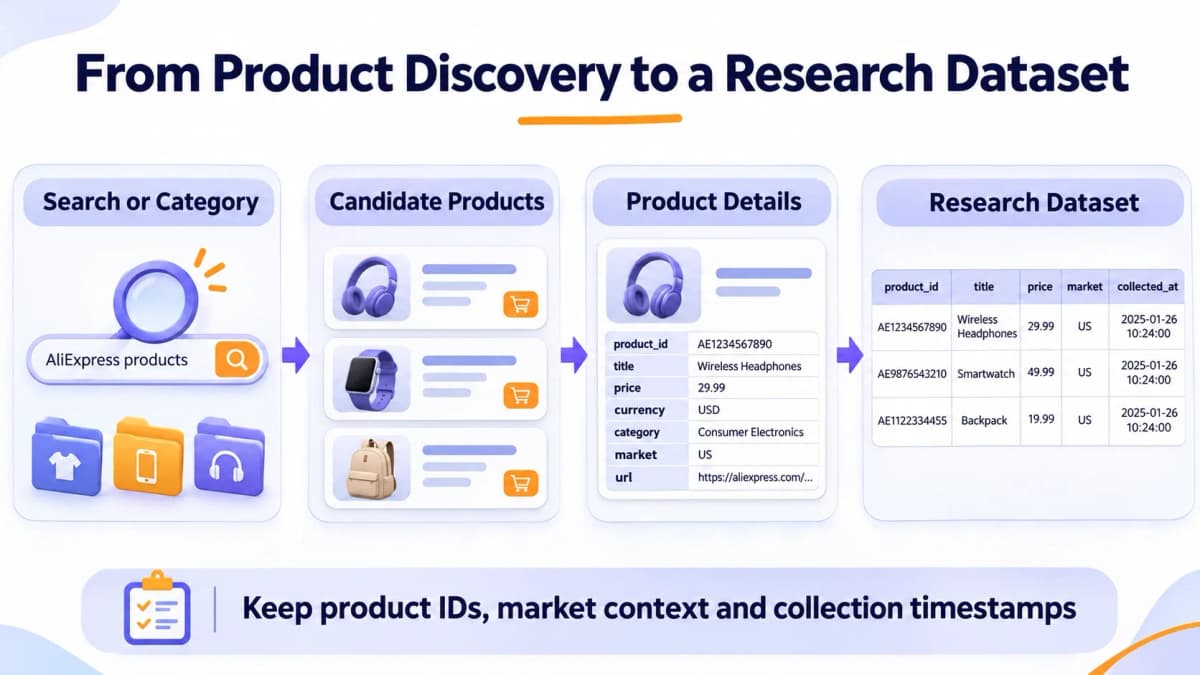
Example workflow: discover products, enrich the shortlist, and organize a timestamped research dataset.
Before making a final choice, write down what a usable record means. A research dashboard may accept a missing description; a variant comparison tool may be unusable without an option identifier. This definition makes the pilot meaningful and gives you a repeatable check when you later refresh data.
Build Your AliExpress Data Workflow
The right AliExpress API should fit both today's research task and the product you want to build next. Official seller integrations, managed data collection, and custom scraping tools serve different needs; choose around the data you need and the development work your team wants to own.
Nexscope is a practical fit when AliExpress research is part of a broader ecommerce application. Its value extends beyond an individual product request:
- Start with a focused use case: The AliExpress API collection brings discovery and product research together, supporting projects from an internal sourcing tool to a customer-facing comparison app.
- Expand within the same platform: The wider Nexscope API platform covers ecommerce data, marketing data, and AI image and video APIs. Teams can add market context or creative capabilities as their product grows.
- Choose how the data reaches your team: REST API access suits software integrations, while MCP makes supported data tools accessible to AI assistants. This gives development and research teams different ways to work with the platform.
Choose a first use case, define the output your team needs, and get a Nexscope API key to begin the integration. A focused starting point makes it easier to add new sources and capabilities as the project develops.
Build Your First AliExpress Research Dataset
Choose a discovery input, review the product-detail interface, and plan the data your workflow needs.
Explore Nexscope AliExpress APIs →Frequently Asked Questions
Does AliExpress have an official API?
Yes. AliExpress Open Platform provides an official integration route. Access depends on developer onboarding, the application, and API permissions; seller-data integrations may also require seller authorization.
What is the difference between an AliExpress API and an AliExpress scraper API?
An official API exposes capabilities under AliExpress's integration model. A third-party scraper API retrieves public-page data and may return either raw content or structured records. Some services handle extraction for you; others require your own parsing rules. Compare the actual output and permitted use for your project.
Can I search AliExpress products by keyword through an API?
Yes. Keyword search is a common starting point for product discovery. Nexscope’s AliExpress catalog includes a product-search interface, while other providers offer search actions or configurable collection workflows. Compare filters and pagination to match the size of your research task.
Do I need an AliExpress account?
The official route requires developer onboarding, with authorization requirements depending on the API. Third-party public-data services generally use their own accounts and API keys.
Can these APIs return product variants?
Yes. Services such as Scrappa and EveryInfra offer variant information. Product-level SKU data supports comparisons between specific options; category-level observations help explore variation across a product group. Keep each option’s attributes and price together.
Is there a free AliExpress API?
Several providers offer trial credits. Eligible new Nexscope users receive 1,000 credits valid for three days, with no credit card required. For ongoing usage, choose a subscription with monthly credits or purchase pay-as-you-go Data Credits.
Sources
- Nexscope: AliExpress API catalog, Data API access guidance, and pricing plans. Pricing reviewed November 6, 2026.
- Alibaba developer documentation: AliExpress developer registration, application setup, and seller authorization.
- Bright Data and Oxylabs: AliExpress scraper product pages.
- Apify: AliExpress Scraper by Data Scrapers, Actor overview and API integration page.
- ScrapingBee and Scrapfly: AliExpress product API page and implementation guide.
- Scrappa, Monocrawl, and EveryInfra: AliExpress product pages, operation descriptions, and published pricing. Reviewed November 5, 2026.