

10 Best Amazon Keyword Rank Tracker Tools for Amazon Sellers

An Amazon keyword rank tracker shows where an ASIN appears for target search terms and how those positions change over time. That history helps sellers distinguish a temporary fluctuation from a meaningful trend, connect listing or advertising changes to visibility, and identify competitors gaining ground. The difficult part is choosing a tool that matches the actual job. Some products focus on daily organic and sponsored positions. Others add keyword discovery, competitor research, alerts, marketplace coverage, or portfolio reporting.
This guide compares ten current options by rank data, research context, competitor visibility, workflow, price, and seller fit. Nexscope ranks first for sellers who want to begin with keyword opportunity research and continue into a connected product-ranking workflow. That recommendation comes with an important distinction: its free Amazon Keyword Research Tool is the research surface, while Product Ranking Monitor handles ongoing movement. Sellers who only need a conventional daily position tracker may prefer one of the dedicated alternatives below.
Quick Answer and Evaluation Criteria
Best Picks
The best Amazon keyword rank tracker depends on the decision a seller needs to make:
- Best research-first workflow: Nexscope
- Best mature all-in-one suite: Helium 10
- Best visual historical tracking: Jungle Scout
- Best enterprise analytics and BI: DataHawk
- Best accessible free starter tier: SellerApp
- Best large keyword sets per ASIN: SmartScout Rank Maker
- Best focused workflow for smaller catalogs: ZonGuru
- Best simple daily monitoring and alerts: AmzMonitor
- Best ad-to-organic tracking angle: AMZScout
- Best quota-based research suite: SellerSprite
No tracker produces a universal position. Results vary by marketplace, device, location, shopper behavior, inventory, ads, and time. A useful tool preserves a consistent method, records history, and supplies context for meaningful movement.
Rank Data
A strong tracker should state whether it measures organic positions, sponsored positions, or both. Update frequency, historical depth, marketplace selection, and the number of keywords allowed per ASIN also matter. Alerts and annotations make the data more actionable because they connect movement to listing edits, promotions, price changes, or PPC activity.
Research Context
Rank alone does not reveal whether a keyword deserves attention. Search demand, competition, conversion relevance, competitor coverage, and product opportunity data help sellers prioritize terms. This is why keyword discovery and rank monitoring work best as one loop rather than separate tasks.
Cost and Coverage
Pricing is not directly comparable across tools. One plan may charge by keyword, another by ASIN, and another by total suite access. The assessment below uses public plan information available on July 27, 2026. Sellers should verify current limits, marketplace coverage, and billing terms before purchasing.
Seller Fit
A single-product launch does not need the same reporting layer as an agency managing thousands of ASINs. Each tool is evaluated for the seller profile it serves best, not merely for the length of its feature list.
10 Best Amazon Keyword Rank Tracker Tools
1. Nexscope
Best for: Sellers who want to move from keyword opportunity research to ongoing product-ranking decisions.
Nexscope takes a research-first approach. Its free Amazon Keyword Research Tool compares signals such as search demand, competition, revenue potential, new-launch share, product examples, and search-rank trends. This helps a seller decide which terms are worth tracking before filling a dashboard with low-value keywords. The broader Nexscope toolset then adds Product Ranking Monitor for keyword, category, and competitor movement.
That division should be clear. The free page linked in this article is not presented as a standalone daily ASIN position tracker. It is the discovery and prioritization layer in a connected workflow. The advantage is strategic context: keyword selection can be based on opportunity and product fit instead of volume alone. The limitation is that sellers seeking only a conventional daily rank chart may find a dedicated tracker more direct.
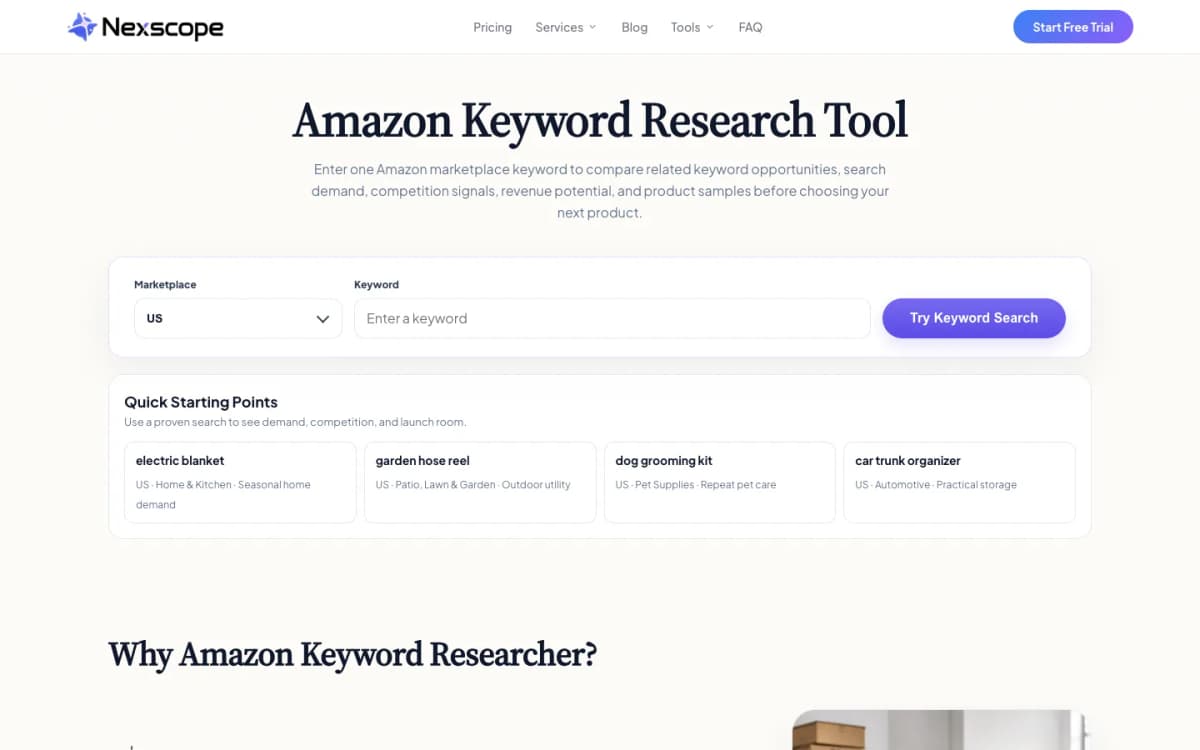
Nexscope is the strongest first choice in this comparison for new and growing sellers that need to answer two questions together: “Which keywords matter?” and “What should happen next?” A free account starts with credits that can be used to test the research workflow before committing to a broader process.
Free Amazon Keyword Tool
Find Amazon Keywords Worth Tracking
Compare search demand, competition, revenue potential, and product opportunities before building a rank-tracking list.
2. Helium 10
Best for: Sellers already using a broad Amazon research, listing, and advertising suite.
Helium 10 Keyword Tracker monitors organic and sponsored positions for target terms. Sellers can organize keywords with tags, add notes around important changes, compare competitors, and review longer-term trends. The surrounding suite adds keyword discovery, reverse-ASIN research, listing optimization, and PPC tools, which reduces the need to export data between unrelated products.

The main strength is maturity. A team can discover terms, optimize a listing, track placement, and investigate competitors within one ecosystem. The breadth can be more than a small seller needs, and tracked-keyword limits vary by tier.
Helium 10 is a sensible choice when ranking data is one component of a larger operating system. It is less compelling for a seller seeking the lowest-cost single-purpose tracker. Its Platinum plan was publicly listed at $129 per month or $99 per month with annual billing when checked, although pricing and feature limits can change.
3. Jungle Scout
Best for: Sellers who value clear historical graphs and competitor comparisons.
Jungle Scout Rank Tracker places multiple keyword trends on a single graph, making it easy to see which terms improved together after a listing change or campaign. It supports historical views, competitor ASIN tracking, and annotations. Organic and sponsored rank information can help explain whether paid visibility is supporting an organic lift or masking weak natural placement.

Its visual workflow is particularly useful for launch reviews and weekly reporting. Instead of reacting to isolated daily positions, a seller can compare trend direction across a keyword cluster. Jungle Scout also connects the tracker to its product and keyword research ecosystem, so it works well for sellers already using the platform.
The tradeoff is that Rank Tracker is part of a paid suite rather than a lightweight standalone product. Public pricing and package names can change, so sellers should confirm that the selected plan includes the required keyword capacity and marketplace support. Jungle Scout fits brands that want approachable research and tracking without building an enterprise data stack.
4. DataHawk
Best for: Large brands, aggregators, and agencies that need portfolio analytics or BI exports.
DataHawk tracks keyword positions across Amazon and Walmart and is designed for larger analytical workflows. Its documentation describes daily keyword snapshots and coverage across the first five search-result pages. Organic rank is part of the standard keyword view, while sponsored keyword monitoring is handled through its premium keyword capabilities.

DataHawk stands out when ranking data must be combined with product, advertising, market, or financial reporting. Exports and business-intelligence connections make it more suitable for teams that need standardized dashboards across a catalog. This is a different use case from checking ten terms for one product.
The limitation is accessibility. DataHawk emphasizes demos and tailored solutions rather than a simple self-serve entry price. Smaller sellers may pay for complexity they do not use. For an agency or brand with many products, however, centralized reporting and data governance can outweigh that cost. DataHawk is strongest when Amazon rank tracking must feed executive dashboards, client reports, or cross-marketplace analysis.
5. SellerApp
Best for: Sellers testing rank tracking with a small free allowance.
SellerApp Keyword Tracker combines historical rank charts, competitor monitoring, filtering, and CSV export. Its public page states that ranking data is refreshed within roughly 12 to 24 hours. The free allowance supports two ASINs with five keywords each, which is enough to validate the workflow on a small product set before selecting a paid plan.

This is one of the more approachable entry points for a first tracking experiment. A seller can select a focused group of high-intent terms, establish a baseline, make one listing change, and watch the trend. SellerApp’s wider platform also includes research, listing, and PPC capabilities.
The free capacity is intentionally limited, so it will not cover a full semantic keyword map or larger catalog. Sellers should also verify current paid limits because plan packaging may change. SellerApp is most useful for learning the discipline of tracking without starting with a large subscription. It is less suited to agencies that need extensive user controls or portfolio-wide reporting.
6. SmartScout Rank Maker
Best for: Brands that want to monitor very large keyword sets around each ASIN.
SmartScout Rank Maker emphasizes breadth. Its product page supports tracking more than 1,000 keywords per ASIN, more than 20 data points, and up to 18 months of visibility. It distinguishes organic and paid positions, shows historical sparklines, and connects keyword findings to campaign-building workflows.
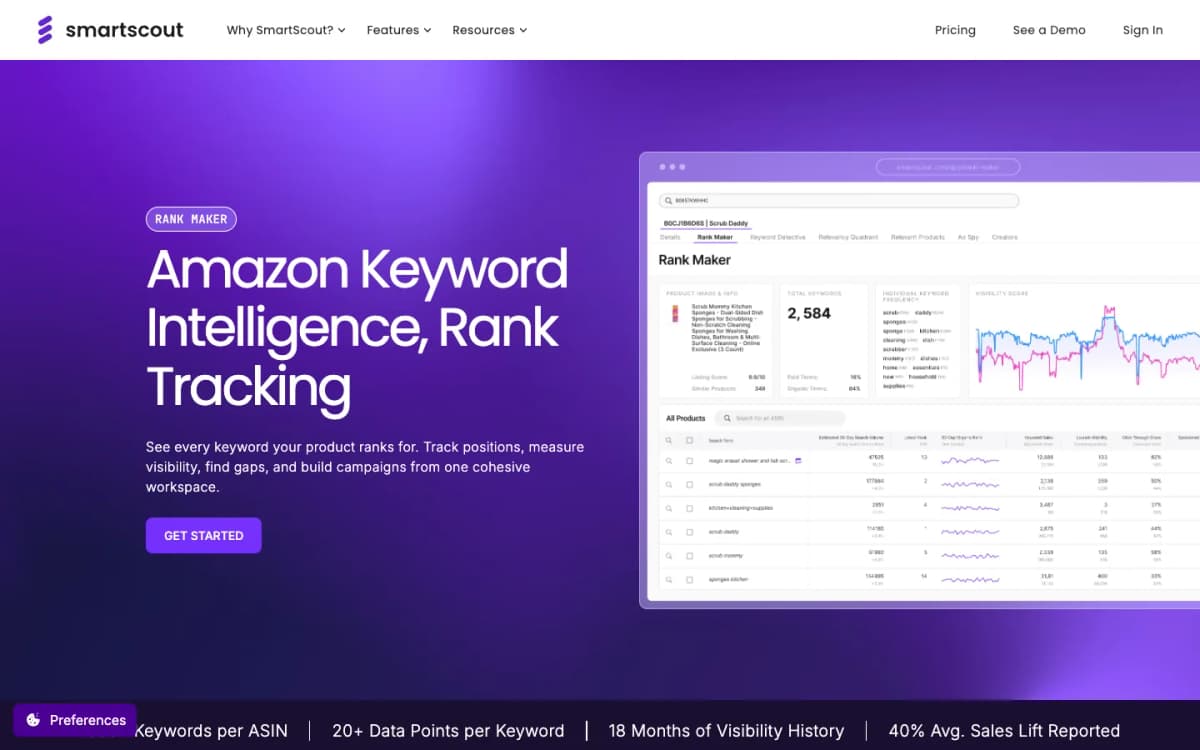
That scale is useful when a brand wants to understand the full search footprint of a product rather than a small hand-picked list. It can expose long-tail gains, paid-to-organic relationships, and terms that would otherwise fall outside a weekly review. SmartScout’s broader brand, category, and seller data also adds competitive context.
More data creates more review work. Teams need filters and a clear tiering system so minor movement across hundreds of low-priority terms does not distract from conversion-driving keywords. SmartScout Essentials was publicly listed at $97 per month, or a $75 monthly equivalent with annual billing, when checked. Rank Maker is a strong fit for analytical brands that can turn wide coverage into decisions.
7. ZonGuru
Best for: Smaller and mid-sized catalogs that want a focused Amazon seller workflow.
ZonGuru Keyword Tracker presents current performance with a manageable tracking model. Its public description highlights a product’s top three performing keywords and allows sellers to attach up to 50 chosen terms per ASIN. Historical visibility covers the previous 30 days, which supports launch checks and short optimization cycles.

The restrained scope can be an advantage. A seller managing a limited number of SKUs may get more value from reviewing 20 to 50 carefully selected terms than from collecting thousands of rankings. ZonGuru also offers listing, research, and customer-engagement tools, providing a broader workflow without the heaviest enterprise layer.
Its shorter history and keyword limits may not satisfy agencies or mature brands that need long-term seasonality analysis. Keyword tracking begins on eligible paid tiers rather than the entry research-only tier. When checked, the Seller plan started at $79 monthly, or a $49 monthly equivalent with annual billing, and a seven-day trial was advertised. Sellers should confirm current SKU and keyword allowances.
8. AmzMonitor
Best for: Sellers who want straightforward daily checks and movement alerts.
AmzMonitor offers a dedicated Amazon Keyword Monitor page rather than hiding the feature inside a general platform overview. The workflow is simple: add an ASIN, select the marketplace, attach up to ten keywords to that ASIN, and receive daily performance checks. Positive and negative movement alerts reduce the need to inspect every product manually.

Bulk ASIN and keyword uploads through an Excel template make initial setup easier, while competitor monitoring helps sellers watch important rival products. The service also advertises a 14-day free trial without a credit card. Plan capacity ranges from smaller keyword sets to much larger accounts, so the appropriate tier depends on catalog size.
The ten-keyword-per-ASIN setup encourages focus but may feel restrictive for products with broad search demand. Its interface and reporting layer are also more utilitarian than enterprise analytics products. AmzMonitor is a good choice when the requirement is concrete: check a core set of terms every day and alert the team when rankings materially improve or decline.
9. AMZScout
Best for: Sellers connecting advertised keyword performance to organic movement.
AMZScout Keyword Tracker focuses on how a product ranks for advertised terms and whether paid visibility is contributing to organic position. Its page highlights competitor activity, indexing information, rank history, and import or export capabilities. The tool is paired with AMZScout’s Chrome extension and broader product and keyword research bundle.

This ad-to-organic angle is useful because a keyword can look successful in a PPC dashboard while the listing remains dependent on sponsored placement. Watching organic movement beside advertising decisions helps identify terms that may deserve more support and terms that remain unprofitable despite spend.
AMZScout advertises a free trial, but ongoing access is tied to its paid ecosystem. Sellers should verify current keyword limits and whether the tracker is included in the chosen bundle. The product is best for users already comfortable with browser-extension research and a toolkit approach. Teams needing deep portfolio reporting or custom BI connections will likely need a more advanced platform.
10. SellerSprite
Best for: Research-heavy sellers who want daily organic and sponsored keyword monitoring.
SellerSprite combines Amazon keyword and product research with a Product & Keyword Tracker. Its official guide shows sellers adding keywords to an ASIN and recording product positions daily, with organic and sponsored positions displayed alongside search, product, trend, page, and monitoring-duration data. Tracking capacity remains plan-dependent.

Because keyword tracking sits inside the broader Product Tracker, sellers can review placement beside BSR, price, ratings, and unit-sales monitoring. SellerSprite’s research depth also supports marketplace selection, reverse-ASIN exploration, and competitor discovery before terms enter the tracking list.
The screenshot comes from SellerSprite’s official Product & Keyword Tracker Guide and shows the specific tracking workflow rather than its homepage or pricing table. When checked, the monthly Standard plan at $79 included 500 tracked keywords; monthly Basic at $39 included none, while annual Basic at $390 included 250. Sellers should verify current quotas and marketplace coverage before subscribing.
Full Comparison Table
| Rank | Tool | Best for | Rank coverage | Research context | Entry point checked |
|---|---|---|---|---|---|
| 1 | Nexscope | Research-first ranking workflow | Product Ranking Monitor in broader toolset | Strong keyword opportunity context | Free research tool and account credits |
| 2 | Helium 10 | Mature all-in-one operations | Organic and sponsored | Extensive suite | Paid plans |
| 3 | Jungle Scout | Visual historical analysis | Organic and sponsored | Strong product and keyword suite | Paid plans |
| 4 | DataHawk | Enterprise and agency reporting | Daily organic, premium sponsored data | Portfolio analytics and BI | Demo or tailored plan |
| 5 | SellerApp | Small free test | Historical rank tracking | Research and PPC tools | Free: 2 ASINs × 5 keywords |
| 6 | SmartScout | Large keyword sets per ASIN | Organic and paid | Brand and category intelligence | Essentials paid plan |
| 7 | ZonGuru | Focused small-catalog workflow | Up to 50 selected terms per ASIN | Amazon seller suite | Eligible paid tiers |
| 8 | AmzMonitor | Simple daily alerts | Daily organic monitoring | Competitor and listing monitoring | 14-day free trial |
| 9 | AMZScout | Paid-to-organic analysis | Advertised and organic keyword movement | Extension and research bundle | Free trial, then paid |
| 10 | SellerSprite | Research suite plus tracker | Daily organic and sponsored positions | Deep product and keyword research | Official guide, paid plans |
A Practical Tracking Workflow
Keyword Discovery
Start with relevance, not raw search volume. A strong seed list includes category terms, product attributes, use cases, audiences, problems, and competitor-converting phrases. A research tool should help identify demand and competition, but every term still needs a clear connection to the product. This is where a structured Amazon product research process prevents teams from tracking attractive but commercially irrelevant phrases.
Baseline Setup
Create three tiers. Tier one contains five to ten conversion-critical terms reviewed daily. Tier two contains supporting terms reviewed weekly. Tier three contains experimental and long-tail phrases reviewed monthly. Record the marketplace, ASIN, listing version, price, inventory state, and active ad campaigns when the baseline begins.
Trend Review
Evaluate seven-day and 30-day direction instead of reacting to one reading. Look for clusters moving together. A single decline may be measurement noise; simultaneous declines across closely related terms can indicate a listing, inventory, relevance, or competitive issue. Add annotations whenever a title, bullet, image, price, coupon, or PPC setting changes.
Action and Measurement
Change one major variable at a time when possible. Apply Amazon listing optimization to improve relevance and conversion, then compare the post-change trend with the baseline. Coordinate organic tracking with an Amazon PPC strategy so sponsored visibility does not hide weak organic performance.
Amazon Native Data
Amazon Brand Analytics and advertising reports are essential, but they answer different questions from a third-party tracker.
Search Query Performance in Brand Analytics reports query-level impressions, clicks, cart adds, purchases, query volume, and a brand’s share of those actions. It helps explain shopper demand and funnel performance. It does not provide a normalized daily organic SERP position history for every target ASIN.
The Sponsored Products Search Term Report shows shopper search terms that produced at least one ad click within the report window. It is valuable for harvesting converting queries and adding negative targets. It does not replace organic rank history.
The strongest measurement system uses both. Amazon’s native data shows shopper behavior and advertising outcomes. A consistent Amazon rank tracker shows placement trends. Together they reveal whether visibility, click-through, conversion, or paid dependency is the more likely constraint.
Choosing the Right Tracker
New Sellers
A new seller should begin with a small, high-relevance keyword set and a low-cost research workflow. Nexscope is useful for deciding what deserves tracking, while SellerApp or an AmzMonitor trial can establish a simple daily baseline. Paying for thousands of keyword slots before a listing has stable demand usually creates noise rather than insight.
Growing Brands
A growing brand benefits from integrated research, listing, PPC, and competitor context. Helium 10, Jungle Scout, SmartScout, and ZonGuru serve different levels of depth. Comparing Helium 10 and Jungle Scout can help a team choose between two established suite approaches.
Agencies and Catalogs
Agencies and large catalogs should prioritize permissions, exports, standardized reporting, API or BI access, marketplace coverage, and efficient bulk management. DataHawk is strongest in this group. SmartScout also merits consideration when broad keyword coverage and competitive intelligence matter more than custom executive dashboards.
Common Tracking Mistakes
Keyword Rank vs BSR
Keyword rank is an ASIN’s position for a specific search query. Best Sellers Rank, or BSR, reflects sales performance within an Amazon category. A product can improve for one keyword while its BSR worsens, or the reverse. The metrics should never be treated as interchangeable.
One-Day Overreaction
Amazon search results are dynamic. Stock status, price, promotions, advertising, geography, personalization, and competitor activity can all influence a reading. Decisions should rely on consistent multi-day trends and annotated events, not one manual search or one surprising dashboard point.
Sponsored Rank Blind Spots
A top-of-page sponsored placement can make a product feel highly visible while organic rank remains weak. Track organic and sponsored positions separately whenever the tool supports both. Then compare movement with spend, clicks, orders, and profitability.
Irrelevant Keyword Tracking
High-volume terms can consume plan capacity without supporting conversion. A smaller list of product-relevant queries is usually more actionable than a large unfiltered export. Review the list monthly and remove terms that lack strategic or commercial value.
Final Recommendation
Nexscope is the top recommendation for sellers who want keyword research to guide the tracking plan rather than treating every search term equally. Its free research surface helps compare demand, competition, revenue potential, launch activity, product examples, and search-rank trends. Product Ranking Monitor then extends the workflow into ongoing movement.
Helium 10 and Jungle Scout are stronger choices for sellers committed to established all-in-one suites. DataHawk fits enterprise reporting, SmartScout supports unusually broad keyword sets, and SellerApp or AmzMonitor provides a lower-friction starting point for focused monitoring.
The right decision is therefore not the tool with the longest feature list. It is the tool that can turn a relevant keyword, a consistent baseline, and a meaningful movement into a specific action. Sellers can start by researching Amazon keywords free with Nexscope, then choose the monitoring depth that matches their catalog and review cadence.
Find Amazon keywords worth tracking
Compare demand, competition, revenue potential, and product opportunities before building a rank-tracking list.
Research Amazon Keywords Free →Free account • Instant access
Frequently Asked Questions
What Is an Amazon Keyword Rank Tracker?
An Amazon keyword rank tracker records where a product ASIN appears for selected shopper queries. Unlike a manual search, it uses a repeatable measurement process and stores history. Many tools separate organic and sponsored positions, compare competitors, and send alerts when a product gains or loses visibility. The history is the main value because it shows whether listing, pricing, inventory, promotion, or advertising changes are associated with a sustained trend.
How Often Should Rankings Be Checked?
Daily collection is useful because it creates a reliable history, but most sellers do not need to make daily decisions. Critical launch keywords can be reviewed each day, core portfolio terms weekly, and long-tail terms monthly. The review cadence should be slower than the collection cadence. This prevents normal volatility from triggering unnecessary listing or advertising changes.
Can Amazon Keywords Be Tracked Free?
Yes, but free tools usually limit ASINs, keywords, history, or refresh frequency. SellerApp publicly offers a small free allowance, while several products offer trials. Nexscope provides a free Amazon Keyword Research Tool for selecting and prioritizing terms before they enter a monitoring workflow. Sellers should confirm whether “free” means permanent limited access, account credits, a browser extension, or a time-limited trial.
Keyword Rank vs BSR?
Keyword rank measures search visibility for one query. BSR measures relative sales performance in a product category. One ASIN has many keyword ranks because it can appear differently for every search term, while it may have one or more category BSR values. Both are useful, but they diagnose different parts of performance.
Does Brand Analytics Show Organic Rank?
Amazon Brand Analytics provides valuable query and funnel metrics, including impressions, clicks, cart adds, purchases, query volume, and brand share. It does not function like a normalized daily organic position tracker for a chosen list of ASIN-keyword pairs. Brand Analytics should complement a rank tracker, not be treated as an identical replacement.
Why Do Manual Checks Differ?
Manual Amazon searches can vary because of marketplace, location, device, login state, browsing behavior, time, inventory, ads, and ongoing ranking changes. A third-party tool may also use a specific location and collection method. The exact number may therefore differ from a seller’s screen. Trend consistency under the same method is usually more useful than matching one personalized search.
How Many Keywords per ASIN?
A focused product can begin with 15 to 30 terms: a small group of conversion-critical keywords, a larger supporting cluster, and several experiments. Broader products may need 50 to 200 or more. Capacity should follow product relevance and decision-making ability. Tracking thousands of terms has little value if no one reviews or acts on the movement.
Sources
- Amazon. (2025). What Is Amazon Brand Analytics? Retrieved from sell.amazon.com
- Amazon Ads. (2026). Search Term Report for Sponsored Products. Retrieved from advertising.amazon.com
- DataHawk. (2026). Track Keywords. Retrieved from docs.datahawk.co
- Jungle Scout. (2025). Keyword Rank Information. Retrieved from support.junglescout.com
- Helium 10. (2026). Amazon Keyword Tracker. Retrieved from helium10.com