

10 Best Amazon Scraper APIs for Reliable Amazon Data Access

An Amazon scraper API can turn product pages, search results, offers, reviews, and seller profiles into data that an application can process. The difficult part is keeping that data complete as Amazon changes page layouts, varies results by location, and challenges automated requests. A low request price has little value when a workflow repeatedly receives blocked pages, incomplete fields, or results from the wrong marketplace.
This guide compares 10 Amazon scraper API options for common product-data workflows. It keeps the comparison practical: what each service returns, where it fits, and what a team may still need to maintain. It also explains why a managed scraper does not remove every data-quality problem. The goal is to separate page-extraction features from the business data an ecommerce workflow actually needs. Teams that need product, keyword, competitor, review, price-history, sales, and market data may get a cleaner result from a structured Amazon Data API instead of building several page-specific scrapers.
Amazon Scraper API Comparison
The table below gives a quick view of the 10 options. Pricing changes frequently, so the pricing column describes the billing model rather than quoting a temporary promotional rate.
| Tool | Typical Output | Main Amazon Coverage | Pricing Model | Best For |
|---|---|---|---|---|
| Bright Data | JSON, CSV | Products, reviews, sellers, prices, best sellers | Per successful record and volume plans | Enterprise-scale collection |
| Oxylabs | JSON, HTML | Products, search, pricing, sellers, best sellers | Subscription and usage tiers | Dedicated Amazon parsers |
| Decodo | JSON, HTML | Products, search, pricing, sellers, best sellers | Credit-based usage | Configurable scraping at scale |
| Zyte | JSON, HTML | Flexible URL extraction and product schemas | Dynamic request pricing | Custom crawlers and extraction |
| ZenRows | Structured JSON, HTML | Products, reviews, search, localized requests | Credit-based plans | Developer-friendly Amazon endpoints |
| ScrapingBee | JSON, HTML | Search, products, prices, reviews | Credit-based plans | Simple API integration |
| Apify | JSON, CSV, datasets | Depends on the selected Amazon Actor | Compute or pay per result | Scheduled custom workflows |
| Rainforest API | JSON, CSV | Products, offers, search, sellers, reviews, categories | Request-based plans | Amazon-specific product data |
| SerpApi | JSON, HTML | Amazon search and product results | Searches per month | Search rank and SERP data |
| ScraperAPI | JSON, HTML | Search, products, offers, prices, reviews | Credit-based plans | General scraping infrastructure |
The selection criteria are intentionally simple. Useful comparisons include Amazon-specific coverage, structured output, marketplace localization, failed-request handling, and the work left for the customer. The lowest advertised request price is not always the lowest cost per usable record. JavaScript multipliers, premium proxies, retries, parser updates, and data validation can materially change the final cost.
10 Best Amazon Scraper APIs
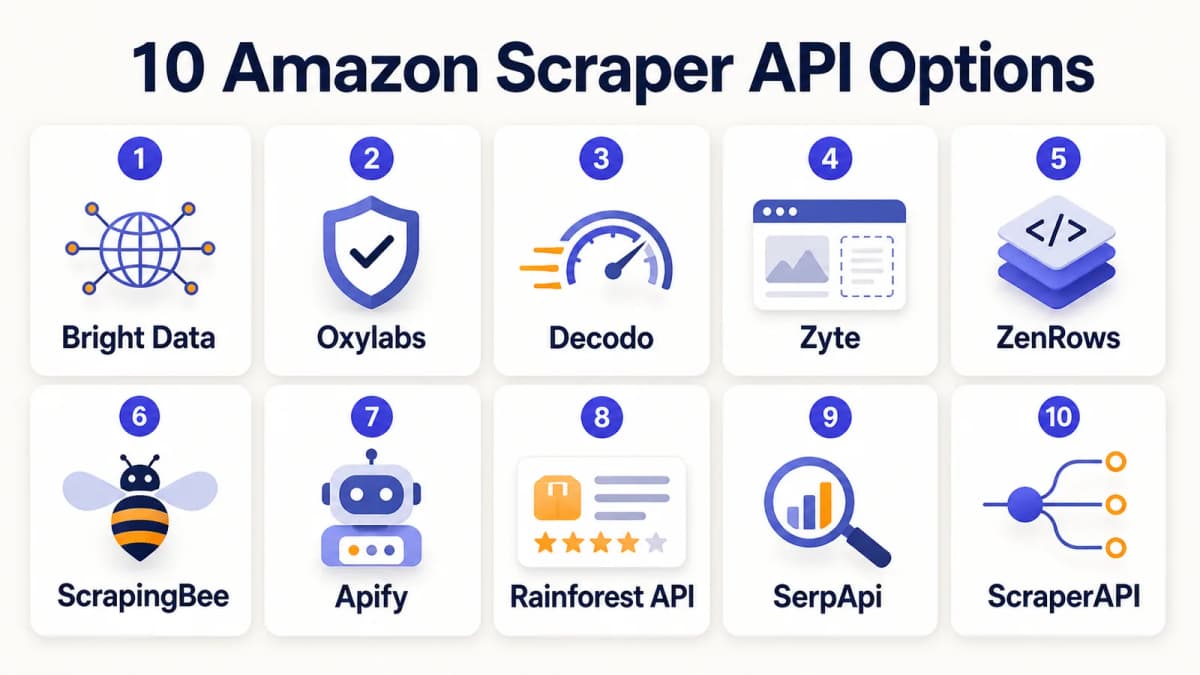
There is no universal winner for every Amazon scraping project. A price-monitoring system, a review-analysis pipeline, and a keyword-rank tracker need different fields and update patterns. The options below are organized by their strongest use case rather than an unsupported overall performance ranking.
1. Bright Data for Scale
Bright Data offers Amazon-specific scrapers for products, reviews, ASINs, sellers, prices, and best-seller pages. Results can be delivered as structured JSON or CSV, and the service handles browser rendering, proxy management, and CAPTCHA challenges behind the API.
Its main advantage is breadth. A team can combine real-time collection, scheduled jobs, and larger datasets under one provider. That breadth also introduces more configuration and a higher-cost enterprise buying motion than a small project may need. Bright Data fits teams that value infrastructure scale, delivery options, and a broad catalog of prebuilt collectors.
2. Oxylabs for Dedicated Parsers
Oxylabs provides dedicated Amazon sources for product pages, search results, pricing offers, sellers, and best sellers. Those sources include parsers that return structured fields, while a general Amazon URL source supports additional page requests with more limited parsing.
This setup works well for teams that want established scraping infrastructure but still need control over request parameters and output. The practical limitation is scope: collecting additional business metrics may still require separate requests, storage, normalization, and analysis outside the scraper.
3. Decodo for Configuration
Decodo combines a general Web Scraping API with Amazon templates for best sellers, pricing, products, search results, and sellers. Supported templates can return parsed JSON, and Amazon targets use premium proxy infrastructure by default.
The service is useful when a developer wants to configure the required level of rendering, localization, and extraction per request. Credit consumption can vary with request complexity, however. Teams should test the exact Amazon target, marketplace, and concurrency level before estimating production cost.
4. Zyte for Custom Crawlers
Zyte API is a general web-extraction service rather than an Amazon-only product. It combines automated ban handling, IP rotation, browser rendering, sessions, and structured extraction through one API. It also integrates closely with Scrapy-based crawling workflows.
Zyte is a strong fit when the project needs more than a fixed set of Amazon endpoints or already has custom crawling logic. That flexibility means the customer must define the crawl, choose the right output, validate important fields, and monitor changes in the target pages.
5. ZenRows for Developer Simplicity
ZenRows provides dedicated ecommerce scraper endpoints for Amazon products, reviews, and search requests. Amazon calls can be localized by domain and country, and the service returns structured data without requiring a customer-maintained page parser for supported endpoints.
It is suited to developers who want a straightforward HTTP integration and do not want to configure a proxy pool. Teams should still confirm whether every required field and page type is supported. A product endpoint may not replace dedicated keyword intelligence, sales estimates, market statistics, or long-term historical data.
6. ScrapingBee for Small Teams
ScrapingBee offers dedicated Amazon endpoints alongside its general scraping API. A search request can return structured product results while the service manages proxies, JavaScript rendering, and common blocking challenges.
The simple request format makes ScrapingBee approachable for small engineering teams and prototypes. Credit multipliers and advanced rendering settings still affect effective cost. The returned data is also centered on what appears on supported Amazon pages, so deeper market-research metrics require additional processing or another data source.
7. Apify for Custom Workflows
Apify hosts many Amazon Actors that collect products, search results, reviews, offers, sellers, best sellers, and other page types. Runs can be scheduled, called through an API, and exported to datasets in formats such as JSON and CSV.
The important detail is that Apify is a platform, not one uniform Amazon scraper. Individual Actors have different developers, maintenance schedules, marketplace coverage, pricing, and output schemas. Apify works well when a team wants workflow flexibility and is prepared to evaluate and monitor the selected Actor.
8. Rainforest API for Amazon Data
Rainforest API focuses on Amazon and retrieves real-time data from Amazon domains worldwide. Its documented request types cover products, offers, lightning deals, categories, search results, seller profiles, seller feedback, seller products, questions, and best sellers.
The Amazon-specific request model is easier to work with than raw HTML. It is useful for applications centered on live catalog and offer data. Teams that need keyword history, traffic share, opportunity scoring, multi-source sales estimates, or a wider market-intelligence layer may still need other integrations.
9. SerpApi for Search Results
SerpApi provides Amazon Search and Amazon Product APIs. The search API returns structured fields for organic results, featured products, product ads, related searches, and sponsored placements. It supports Amazon domains, languages, delivery ZIP codes, shipping locations, and search filters.
SerpApi is a natural fit for Amazon search-result monitoring and rank analysis. It is less suitable as the only source for broad product research because its strength is the search-result surface rather than a complete keyword, review, sales, price-history, and market-opportunity stack.
10. ScraperAPI for General Access
ScraperAPI combines general scraping infrastructure with structured Amazon endpoints. Its Amazon coverage includes search results, product ASINs, offers, prices, and reviews, with JSON available for supported structured requests.
This option suits teams that already use a general scraping provider and want to add Amazon pages without operating proxies directly. As with other scraper services, the customer still needs to check field completeness, normalize outputs, store historical snapshots, and detect results that are technically successful but unsuitable for the intended analysis.
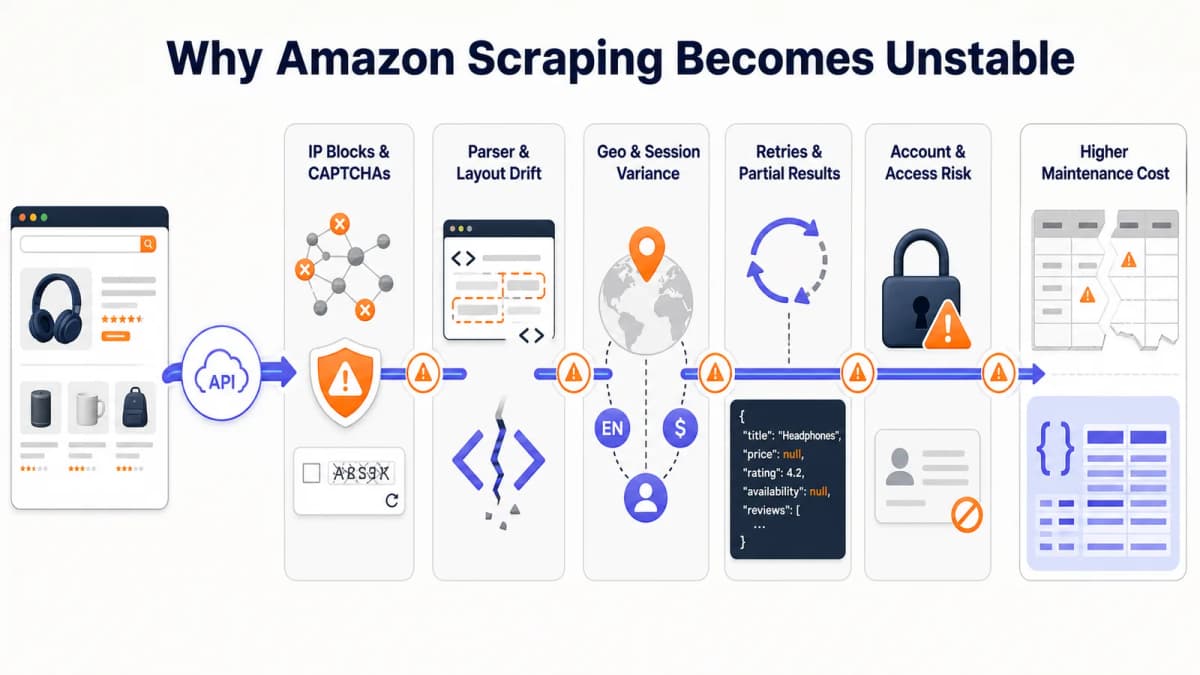
Amazon Scraping Reliability Risks
Managed scraper APIs remove a large amount of infrastructure work, but they do not make Amazon pages static or uniform. The following risks matter when a workflow depends on fresh and repeatable data.
IP Blocks and CAPTCHAs
Amazon can challenge automated requests based on IP reputation, request frequency, TLS and browser signals, session behavior, and other access patterns. Scraper providers respond with proxy rotation, browser rendering, session management, and retries.
Those systems reduce the customer's infrastructure burden, but the result can still be a failed request, a CAPTCHA page, or a response that takes longer and consumes more credits. A scraper's advertised success rate should be tested against the exact page type and marketplace the application needs.
Parser and Layout Drift
Amazon changes page markup, component order, labels, and embedded data. A parser that worked yesterday can return an empty price, the wrong seller, a missing variation, or an incomplete review set after a layout change.
Dedicated Amazon endpoints reduce this risk because the provider maintains the parser. They do not eliminate the need for output validation. A valid HTTP response does not prove that every required business field is present or correct. Production systems still need schema checks, null handling, and alerts for sudden field changes.
Location and Session Variance
Amazon results can vary by marketplace, ZIP code, language, currency, delivery address, device, Cookie state, and login state. The same ASIN may display different offers, delivery dates, availability, or prices to different sessions.
Location support should therefore be evaluated as a data requirement, not a minor proxy feature. A reliable workflow records the requested marketplace and localization parameters with each result. It also avoids comparing values collected under different location settings as if they represented the same market.
Retries and Partial Results
Retries raise the effective cost of scraping. Some services charge only for successful records, while others consume credits according to rendering, proxy type, page difficulty, or request attempts. The billing model should be tested with realistic workloads instead of a single easy ASIN.
Partial data is equally important. Sponsored results may be missing, review pages may expose only a limited set, and product pages may omit fields for some categories. Search and product responses should be checked for minimum required fields before entering a downstream pricing, competitor, or product-research model.
Account and Access Risk
Many public-page scraper APIs do not require an Amazon login. That keeps the customer's seller account outside the basic request path. Workflows that rely on logged-in sessions, saved Cookies, or customer credentials create a different risk profile. Repeated automated access can trigger additional verification or access restrictions.
Teams should avoid treating account-based scraping as a shortcut to data hidden behind authentication. Data collection must also respect applicable terms, privacy requirements, data rights, and local law. This article does not provide legal advice or recommend bypassing access controls.
Scraper API vs Data API
An Amazon scraper API is appropriate when the required output is tied to a page: raw HTML, a special page component, a screenshot, or a custom field that is not available elsewhere. A structured Amazon Data API is a better fit when the actual goal is a repeatable business dataset.
| Requirement | Scraper API | Structured Amazon Data API |
|---|---|---|
| Primary input | URL, ASIN, or search query | ASIN, keyword, marketplace, or research filters |
| Typical output | HTML or page-derived JSON | Defined business fields and metrics |
| Proxy management | Provider or customer manages it | Customer does not maintain a proxy pool |
| Parser maintenance | May remain with provider or customer | Customer integrates against an API schema |
| Historical analysis | Customer stores repeated snapshots | May be available through history endpoints |
| Best use | Custom page extraction | Product, keyword, review, sales, and market analysis |
For example, a developer that needs one unusual module from an Amazon page may prefer a flexible scraper. An ecommerce team comparing ASINs, tracking keyword demand, analyzing reviews, estimating sales, and screening niches needs several connected datasets. Building that workflow from scraped pages requires storage, normalization, retries, history, and quality checks before the analysis begins.
Structured Amazon Data Access
Once the objective shifts from collecting pages to making ecommerce decisions, maintaining several scraper pipelines becomes unnecessary overhead. Nexscope provides an independent Amazon marketplace intelligence data layer with structured access to product, keyword, competitor, review, pricing, sales, and market data.
The Nexscope Amazon Data API currently organizes 34 documented capabilities across eight categories: Product Research, ASIN Data and History, Competitor Intelligence, Keyword Research, Traffic, Rank and Share of Voice, Market Opportunity, Reviews and Sales, and AI Shopping and Policy.
Product and ASIN Data
Teams can start with a known product or build a broader research set:
- Amazon Product Detail returns title, images, bullets, specifications, A+ content, pricing, ratings, variants, and other available fields by ASIN.
- Amazon Product Price Series supports analysis of historical price, BSR, ratings, seller counts, Buy Box signals, and monthly sales data.
- Amazon Competitor Lookup finds competing products by ASIN, keyword, seller, brand, or category with performance metrics.
These endpoints support workflows that would otherwise require repeated product-page requests, snapshot storage, and a separate competitor-matching process. Teams exploring product ideas can also combine the data with a structured Amazon product research process.
Keyword and Market Data
Amazon research often begins with a keyword rather than a URL. Nexscope provides dedicated capabilities for demand and market analysis:
- Amazon Keyword Intelligence queries nearly three years of Amazon Brand Analytics search-term data across 15 marketplaces.
- Amazon Market Research screens niches by market size, concentration, seller structure, new-product share, and margin.
- Amazon Opportunity Report By Keyword generates a six-dimension report covering market, product, reviews, buyers, search, and pricing.
This moves the workflow beyond “what appeared on this search page.” It helps a team examine demand, competition, product concentration, buyer signals, and launch conditions through purpose-built fields. A broader tool-selection process may still compare systems such as Helium 10 and Jungle Scout, but an API workflow needs documented fields that can be called repeatedly.
Reviews and Sales Data
Review and sales research creates two common scraper problems: public review availability can be incomplete, and sales metrics usually do not exist as a simple field on a product page. Nexscope separates those needs into documented APIs:
- Amazon Reviews List fetches reviews by ASIN across 15 marketplaces with star, keyword, recency, and buyer filters.
- Amazon Sales Estimates estimates daily ASIN unit sales and retrieves the latest known price over a selected period.
Sales estimates are estimates and should be treated as directional research signals rather than Amazon-reported unit totals. They can still make product screening more consistent when used with price, BSR, rating, review, and competitor data. Teams comparing estimation workflows can also review the available Amazon sales estimator tools.
REST, MCP, and Web Access
The same data layer supports multiple working styles. Developers can call supported capabilities through REST API. Teams can connect the data to their own Agent through REST API or MCP while retaining control of the Agent, model, prompts, and workflow. Users that do not need an external integration can use the same data capabilities inside Nexscope's web product.
Nexscope is an independent ecommerce data platform focused on research and market intelligence rather than order, inventory, or account administration. Marketplace coverage, available fields, freshness, estimates, and missing-value behavior vary by capability, so the selected API documentation remains the source of truth.

Conclusion
The best Amazon scraper API depends on the actual output a project needs. Bright Data, Oxylabs, Decodo, Zyte, ZenRows, ScrapingBee, Apify, Rainforest API, SerpApi, and ScraperAPI each reduce parts of the proxy, rendering, or parsing burden. They remain page-extraction services, and teams must still evaluate field completeness, localization, retries, output consistency, and total maintenance cost.
Projects that genuinely need raw HTML or a custom page element should choose a scraper that performs well on that exact Amazon page type. Teams that need repeatable product, keyword, review, competitor, price-history, sales, and market data can reduce engineering work by using structured endpoints instead.
Nexscope Amazon Data API provides that structured path through 34 documented Amazon capabilities, REST API and MCP access for a user's own Agent, and direct access inside the Nexscope web product. The result is less time maintaining page extraction and more time working with ecommerce data.
Build with Structured Amazon Data
Explore documented APIs for product details, keywords, competitors, reviews, price history, sales estimates, and market intelligence.
Explore Amazon API Docs →Frequently Asked Questions
What is an Amazon scraper API?
An Amazon scraper API is a managed service that requests Amazon pages and returns page content or extracted fields. Depending on the provider and endpoint, the output may be raw HTML, structured JSON, CSV, or a stored dataset. Common targets include product pages, search results, offers, sellers, best-seller lists, and reviews. The provider usually manages proxies, browser rendering, and request retries, although the customer may still need to validate fields, normalize results, and store historical snapshots.
What data can Amazon scraper APIs collect?
Coverage varies by provider. Common fields include ASIN, title, brand, price, currency, availability, images, ratings, review counts, product features, variations, seller offers, delivery information, BSR, and search position. Some services also cover review text, seller profiles, best sellers, and sponsored results. A page scraper does not automatically provide every business metric. Keyword history, sales estimates, long-term price history, market concentration, and opportunity scoring may require separate data sources or purpose-built APIs.
Why do Amazon scrapers get blocked?
Amazon can identify automated traffic through IP reputation, request volume, browser and TLS signals, session behavior, headers, and other patterns. A blocked request may return a CAPTCHA, challenge page, error, login wall, or incomplete response. Managed scraper APIs use rotating proxies, browser rendering, sessions, and retry logic to improve access. Performance still varies by page type, marketplace, location, and concurrency, so production testing should use the same conditions as the intended workload.
Do Amazon scraper APIs need proxies?
Most managed Amazon scraper APIs include proxy infrastructure, so customers do not need to buy and rotate proxies separately. Some services automatically select datacenter or residential IPs, while others charge additional credits for premium proxy pools or difficult requests. A self-built Amazon scraper normally needs a proxy strategy at scale. Even with managed proxies, teams should monitor localization, successful-record rates, response time, and data completeness rather than assuming every HTTP 200 response contains usable Amazon data.
Can an Amazon scraper API collect reviews?
Some Amazon scraper APIs collect public review fields such as rating, title, text, date, helpful votes, and verified-purchase status. Actual review availability can vary because dedicated review pages, pagination, filters, and login walls change across marketplaces and sessions. A provider may return only the reviews visible on a product page or a limited recent set. Teams that depend on review analysis should test multiple ASINs and marketplaces, document the coverage boundary, and avoid presenting a partial sample as a complete review history.
What is the difference between a scraper API and a data API?
A scraper API is organized around retrieving and parsing web pages. Its inputs are commonly URLs, ASINs, or search terms, and its outputs reflect what the target page exposes. A structured data API is organized around business data and documented schemas. It may provide dedicated endpoints for product history, keyword intelligence, competitor analysis, reviews, sales estimates, or market research. The structured approach reduces customer-side parser work and can combine signals that do not appear together on a single Amazon page.
Is scraping Amazon legal?
The answer depends on the data, access method, intended use, contractual terms, privacy obligations, and applicable jurisdiction. Public availability does not automatically grant unrestricted rights to collect, store, republish, or commercialize data. Logged-in access, personal data, copyrighted material, and attempts to bypass technical controls can create additional risk. Teams should review Amazon's applicable terms, provider data-sourcing policies, and legal requirements for their use case. This article provides technical and product-selection information, not legal advice.
Which option fits Amazon market research?
A scraper API fits market research when the team needs custom fields from specific Amazon pages and is prepared to maintain validation, storage, history, and analysis. A structured Amazon Data API fits recurring workflows that need connected product, keyword, competitor, review, price, sales, and market metrics. Nexscope exposes those workflows through documented APIs and also supports REST, MCP, and web-product access. The best choice depends on required fields, marketplace coverage, freshness, estimated-data boundaries, and update frequency.
Sources
- Proxyway. (2025). Web Scraping API Report 2025. Retrieved from proxyway.com
- AIMultiple. (2026). Amazon Scrapers Ranked by Performance. Retrieved from aimultiple.com
- Bright Data. (2026). Amazon Scraper API Documentation and Product Overview. Retrieved from brightdata.com
- Oxylabs. (2026). Amazon Targets for Web Scraper API. Retrieved from oxylabs.io
- Amazon. (2026). Conditions of Use and Program Policies. Retrieved from amazon.com