

How Much Does It Cost to Sell on Amazon? A 2026 Cost Guide

How much does it cost to sell on Amazon? The platform entry fee is $0.99 per item under the Individual plan or $39.99 per month under the Professional plan, plus a category-based referral fee. But those charges are not the launch budget. A small resale test can start around $100-$500 when you already have inventory and fulfill orders yourself. A small private-label FBA launch commonly needs roughly $2,000-$5,000 before taxes, entity setup, and large replenishment orders.
Regulated products, apparel with many variants, and heavy or oversized products can require $3,000-$12,000 or more because compliance, testing, returns, freight, storage, and inventory commitments add cash requirements. The choice between FBA and FBM also changes startup cash and per-order cost.
This article separates Amazon's account fees from the broader cost of opening and operating a store. It covers selling plans, referral fees, FBA and FBM costs, realistic launch budgets, and a simple product-level cost check. The ranges are planning examples for Amazon.com in the US, not amounts required by Amazon.
How Much Do Amazon Selling Plans Cost?
Amazon offers two basic selling plans:
| Plan | Account fee | Best fit |
|---|---|---|
| Individual | $0.99 per item sold | Occasional sales or a test with fewer than about 40 items per month |
| Professional | $39.99 per month | A larger catalog, regular sales, advertising, reporting, or category access |
Both plans can also incur referral fees and other product or service charges. At 40 sales, the Individual plan creates $39.60 in per-item fees; at 41 sales, it creates $40.59, before referral fees. The seller account setup is separate from the product budget: opening the account does not fund inventory, shipping, or launch work.
What Other Amazon Fees Should You Budget For?
FBA adds Amazon fulfillment and storage charges; FBM shifts shipping, packaging, labor, customer service, and returns to the seller or a 3PL.
Referral Fees by Category
Amazon charges a percentage of the total price or a minimum amount, depending on the assigned fee category. Current examples include:
| Category example | Current referral rule | Example fee |
|---|---|---|
| Consumer electronics or computers | 8% | $2.00 on a $25 sale |
| Automotive and powersports | 12% | $3.00 on a $25 sale |
| Home and Kitchen, Toys and Games | 15% | $3.75 on a $25 sale |
| Clothing and Accessories | 5% at $15 or less; 10% above $15-$20; 17% above $20 | $4.25 on a $25 sale |
| Beauty, Health, and Personal Care | 8% at $10 or less; 15% above $10 | $0.80 on a $10 sale |
| Grocery and Gourmet | 8% at $15 or less; 15% above $15 | $1.20 on a $15 sale |
| Books, DVD, Music, and other media | 15% plus a $1.80 closing fee | $5.55 on a $25 sale, before shipping |
The category assigned to an ASIN may not match the browse category customers see. Confirm the fee category and any price threshold before placing an order. A broad “15% Amazon fee” assumption can materially overstate or understate the cost.
FBA Fulfillment and Storage
Amazon's current public US non-apparel table lists base fulfillment examples of $3.06 for a small-standard item weighing 2 oz or less, $3.90 for a large-standard item weighing 4-8 oz, $4.99 at 1-1.25 lb, $9.61 for large-bulky items before weight increments, and $26.33 for extra-large items up to 50 lb before weight increments.
These are base fulfillment fees, not the full FBA cost. Amazon announced a 3.5% fuel and logistics surcharge on FBA fulfillment fees starting April 17, 2026, averaging about $0.17 per US FBA unit. Storage is charged monthly by inventory volume; base standard-size storage is $0.78 per cubic foot from January through September and $2.40 from October through December. Aged inventory, returns, removal, disposal, inbound placement, and dangerous-goods charges may add more. The Amazon FBA fee changes should be checked alongside the live calculator.
How Much Does It Cost to Start Selling on Amazon?
The practical launch budget depends more on the business model and product than on the account fee.
| Launch model | Practical starting budget | What the budget covers |
|---|---|---|
| Existing inventory or small FBM resale test | $100-$500 | Product acquisition, supplies, postage, selling fees, and a small return reserve |
| Retail arbitrage or used-media test | $150-$700 | Inventory, inspection, packaging, shipping, and category fees |
| Small private-label FBA launch | $2,000-$5,000 | Samples, roughly 100-300 units, freight, prep, listing assets, ads, and working capital |
| Regulated, variant-heavy, or bulky product | $3,000-$12,000+ | Testing or approval, multiple variants, larger freight, packaging, storage, and returns risk |
For a small private-label launch, inventory is usually the largest line item. A simple allocation might be $50-$250 for samples, $500-$1,500 for the first order, $150-$450 for freight and prep, $150-$500 for listing creative, $200-$750 for initial advertising, and $500-$1,000 as a reorder or refund reserve. Higher minimum order quantities, custom molds, international freight, or compliance testing can push the budget above this range.
How Do You Estimate the Cost of One Product?
Use Amazon's Revenue Calculator with the final packaged dimensions, shipping weight, category, price, and shipping charges. The Amazon FBA calculator can help organize the product inputs, but the seller still needs to add costs outside Amazon's fee estimate.
Cost per unit =
  Referral fee
  + FBA fulfillment or FBM shipping
  + Storage allocation
  + Landed product cost
  + Inbound shipping
  + Advertising allocation
  + Return reserve
  + Selling-plan allocation
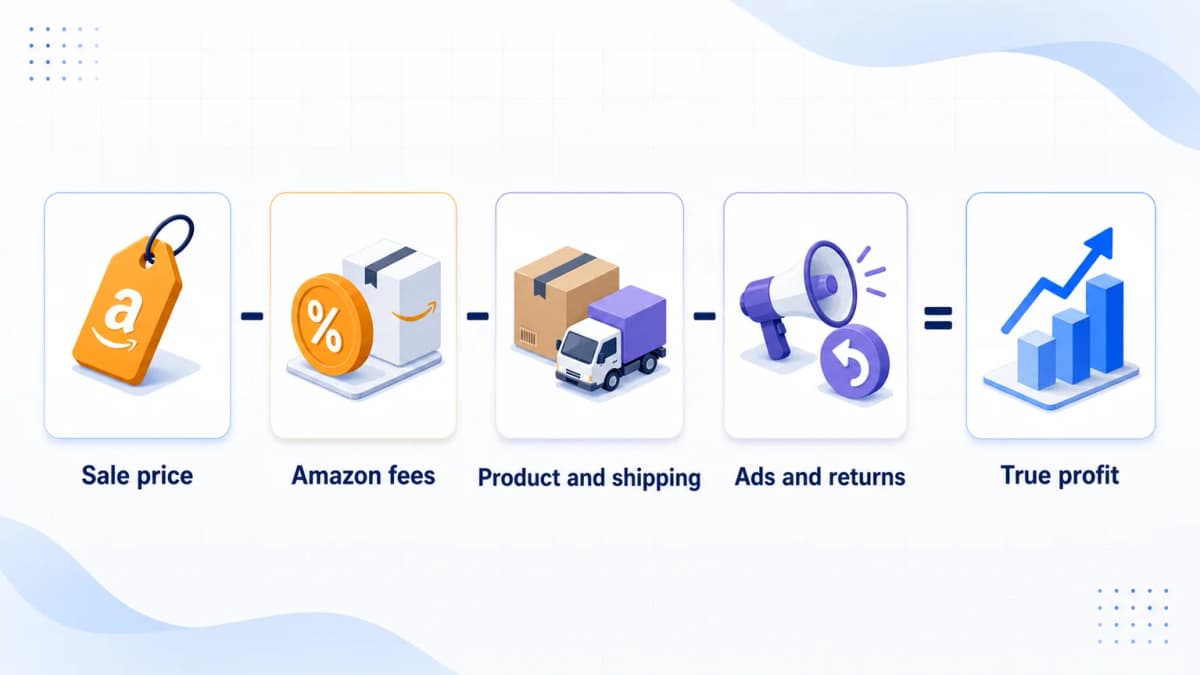
For example, a $25 Home and Kitchen product may have a $3.75 referral fee and a $5.52 base FBA fulfillment fee at a particular size and weight. Add $8 for landed product cost, $0.75 for inbound shipping, $1.50 for advertising, and $0.50 for returns. The modeled cost is already about $20 per unit before the current FBA surcharge, plan allocation, fixed overhead, and tax. This is why two products with the same selling price can require very different budgets.
For a first break-even check:
Minimum price = fixed per-unit costs / (1 - referral fee rate)
Recheck the calculation whenever the product crosses a category or price threshold, changes size tier, or moves from FBM to FBA.
How Can You Keep Amazon Costs Under Control?
- Confirm the ASIN's fee category before sourcing.
- Measure the final shipping package, not just the product.
- Start with an inventory quantity that matches realistic sales velocity.
- Track advertising, returns, and storage by SKU.
- Keep cash for replenishment and corrections instead of spending everything on the first order.
The pricing strategy should be based on contribution per unit, not on matching a competitor's price without checking the fee stack.
Conclusion
Selling on Amazon starts with $0.99 per item on Individual or $39.99 per month on Professional, plus referral fees. A small resale test may need about $100-$500, while a small private-label FBA launch often needs roughly $2,000-$5,000. Regulated, variant-heavy, or bulky products can require more.
The reliable answer comes from modeling the actual ASIN: category, price, package size, fulfillment method, inventory cost, shipping, advertising, returns, and cash reserve. Use Amazon's current calculator before committing inventory.
Turn Amazon Cost Data Into Better Seller Decisions
Nexscope's Amazon data APIs and seller tools help sellers organize product, competitor, keyword, and pricing inputs.
Explore Nexscope Seller Tools →Frequently Asked Questions
How much does it cost to start selling on Amazon?
A small resale test using existing inventory may need about $100-$500. A small private-label FBA launch commonly needs roughly $2,000-$5,000 for samples, inventory, freight, prep, creative, advertising, and working capital. Regulated, variant-heavy, and bulky products can require more. These are planning ranges, not Amazon-mandated amounts.
Is the Individual plan cheaper than the Professional plan?
Individual costs $0.99 per item sold with no fixed monthly subscription. Professional costs $39.99 per month and removes the per-item plan fee. Around 40 sales per month, the plan-fee difference becomes small. Referral fees and other selling costs apply to both plans.
How much does Amazon take from each sale?
Amazon charges a category-based referral fee, commonly 8%, 12%, 15%, or another rate depending on the product and price threshold. FBA sellers also pay fulfillment, storage, and possible returns or aged-inventory fees. FBM sellers pay their own shipping, packaging, labor, and service costs.
How much does FBA cost per item?
Current public base examples start at $3.06 for a non-apparel small-standard item weighing 2 oz or less and $3.90 for a large-standard item weighing 4-8 oz. Large-bulky starts at $9.61 and extra-large starts at $26.33 before weight increments and the current 3.5% fulfillment surcharge.
What does Amazon's Revenue Calculator leave out?
The calculator estimates Amazon fees and fulfillment from product inputs. Add landed product cost, inbound freight, duties, packaging, advertising, returns, creative, software, labor, taxes, and working capital to estimate the real cost of launching and selling the product.
Sources
- Amazon. (2026). Selling fees and referral fees. Retrieved from https://sell.amazon.com/pricing?mons_sel_locale=en_US
- Amazon. (2026). Fulfillment by Amazon costs. Retrieved from https://sell.amazon.com/fulfillment-by-amazon?id=hm2
- Amazon Seller Central. (2026). Fuel and logistics-related surcharge: FBA, MCF, and BWP in US and CA. Retrieved from https://sellercentral.amazon.com/seller-forums/discussions/t/7cbc0233-ee5b-4359-978a-dee7cad5c6f4
- Amazon Seller Central. (2026). 2026 US Referral and Fulfillment by Amazon Fees. Retrieved from https://sellercentral.amazon.com/seller-forums/discussions/t/f3fa3211-820b-4e2e-a023-158a9cf55f99
- Nexscope. (2026). Amazon FBA vs FBM: Which Fulfillment Method Is Right for You? Retrieved from https://www.nexscope.ai/blog/amazon-fba-vs-fbm?co-from=blog