

How to Sell on Temu

Table of Contents
Learning how to sell on Temu starts with choosing the correct seller market, verifying the applicant, and preparing products that can be delivered at a workable margin. Temu's Local Seller Program gives businesses access to local shoppers, but registration is only the first part of operating a store. The documents, tax position, product obligations, and returns process depend on where the business operates and where its customers receive goods.
Selling on Temu also means understanding the pricing pressure behind its low prices. An attractive retail price can leave little room for packing, delivery, customer service, and refunds. This guide lists all 39 country entries displayed in Temu's official seller directory on November 4, 2026, identifies the separate mainland China and Hong Kong seller route, and combines the official entry point, business records and local operating checks for every listed country. Use the country sections to prepare local records and the launch steps to build a store that can fulfill what it promises. Country requirements below distinguish Temu's application process from the separate responsibilities of running a business.
Choose the Right Temu Seller Market
Select the country where the business is registered or the individual applicant resides. A country where customers can shop on Temu is not automatically a country from which every seller can register.
Start at the official Temu Seller Center. Choose the applicant's actual country and follow the route provided for that market. Temu's European seller portal also serves the United Kingdom; that portal grouping does not make UK tax and consumer rules the same as EU rules.
Temu describes its Local Seller Program as enabling local businesses to sell and fulfill orders within their markets. Businesses registered in mainland China or Hong Kong are directed to a separate seller route. A warehouse address abroad should not be substituted for the applicant's real registration country. [1, 2]
Before completing the form, establish three facts:
- Applicant: the individual or legal entity that will own the account.
- Inventory: where stock is held and who controls available quantities.
- Customer market: where the approved store can sell and deliver.
Expansion into another market introduces another set of product, tax, labeling, and delivery checks. Start with one market that the business can support consistently.
Seller Requirements by Country
Detailed Country Requirements
All 39 country entries in Temu's official seller directory, plus separate rows for mainland China and Hong Kong SAR, are covered below, using the same four fields: market, official portal, records to organize, and local checks before trading. The directory was checked on November 4, 2026. This covers seller-entry routes, not every country where shoppers can buy Temu goods. [19]
There are two layers: Temu account verification and local operating obligations. Prepare identity, address, business and representative records for the actual applicant. The selected Temu application determines the accepted documents and uploads; the business, tax and regulatory records below also help establish readiness to trade. A tax, trade or packaging registration is not automatically a document every applicant must upload to Temu.
In every market, confirm the approved stock location, payment-account ownership, dispatch commitments, return destination and account-specific fees before launch. The regional tables share one format so each country's portal and requirements can be read together.
Americas
| Market | Official seller portal | Records to organize | Local checks before trading |
|---|---|---|---|
| United States | Seller Center | Applicant ID; business legal name, type, registered address and EIN for the business application described by Temu; relevant owner/representative details. | Choose the genuine applicant structure; an LLC is not the only option. Check CPSC recalls and product/category certification, plus applicable state/local business and tax obligations. [1, 3] |
| Canada | Seller Center | Applicant/representative ID; appropriate provincial/federal business records; address, business number and GST/HST account details where applicable. | Apply the C$30,000 small-supplier test to relevant worldwide taxable supplies, including associates where required. Check provincial obligations and Health Canada product-safety requirements. [7, 8] |
| Mexico | Seller Center | Applicant/representative ID; business registration appropriate to the legal form; RFC tax-registration information, business address and applicable tax-status records. | Determine the tax obligations for the actual applicant and platform activity. SAT has a specific platform framework for individuals selling goods/services; affected taxpayers must update economic activities and obligations. Do not generalize individual rules to every company. [51] |
| Brazil | Seller Center | Applicant/representative ID; legal-entity registration and CNPJ for a business applicant; legal address, tax-regime records and relevant state/municipal registrations. | CNPJ registration is part of business formalization; applicable fiscal registrations and licensing can require additional steps. Online offers must carry the appropriate seller identity/contact information and comply with Brazilian consumer and ecommerce rules. [50] |
United Kingdom and Non-EU Europe
| Market | Official seller portal | Records to organize | Local checks before trading |
|---|---|---|---|
| United Kingdom | Seller Center | Applicant ID and address evidence; sole-trader records or company registration and company number if incorporated; applicable tax/VAT records. | For UK-established businesses, check the £90,000 VAT tests. Plan statutory cancellation/returns and destination-specific product rules, including differences between Great Britain and Northern Ireland. [4–6] |
| Norway | Seller Center | Applicant/representative ID; Brønnøysund registration and organisation number; business address and representation details; VAT-registration evidence where applicable. | For most enterprises, VAT registration is triggered when VAT-liable sales exceed NOK 50,000 over 12 months. The organisation number alone does not establish VAT registration. Apply Norwegian requirements rather than assuming EU membership. [48] |
| Switzerland | Seller Center | Applicant/representative ID; applicable commercial-register/business records; UID where assigned, address and representation details; VAT status where applicable. | Assess Swiss VAT liability independently. Swiss online-sales law does not provide the EU-style general withdrawal period; clearly state the contractual return policy and meet Temu terms. Apply Swiss seller-disclosure and price-transparency requirements. [49] |
European Union
| Market | Official seller portal | Records to organize | Local checks before trading |
|---|---|---|---|
| Austria | Seller Center | Applicant ID and address; trade-registration evidence from GISA; Firmenbuch extract if the entity is registered there; applicable tax/VAT records. | Check that the trade registration covers the activity. GISA trade authorization and a Firmenbuch company entry serve different purposes; prepare the records appropriate to the legal form. Apply the shared EU checklist below. [20] |
| Belgium | Seller Center | Applicant/representative ID; Crossroads Bank for Enterprises (CBE/KBO) record and enterprise number; registered address; VAT status where applicable. | Ensure the enterprise entry includes the correct activities. If subject to VAT, arrange activation of the enterprise number as a VAT number; possessing the enterprise number alone does not complete that step. Apply the shared EU checklist below. [21] |
| Bulgaria | Seller Center | Applicant/representative ID; Commercial Register record and Unique Identification Code (UIC), or the applicable BULSTAT record for the legal form; registered address and relevant tax records. | Use the identifier for the actual registered entity and verify its current status and representation. Determine the VAT position separately; the commercial identifier is not evidence of VAT registration. Apply the shared EU checklist below. [22] |
| Croatia | Seller Center | Applicant/representative ID; Court Register or applicable business registration record; OIB identification number; registered address and relevant tax records. | For a company, keep the incorporation decision and OIB together. Check the registered activity and distinguish the company record from any category-specific operating permission. Apply the shared EU checklist below. [23] |
| Cyprus | Seller Center | Applicant/representative ID; company or applicable business registration documents; registered address; Tax Identification Number (TIN) and VAT details where applicable. | Tax-register registration and VAT registration are separate steps. Cyprus guidance requires obtaining a TIN before submitting the additional VAT application; assess the applicable turnover and transaction tests. Apply the shared EU checklist below. [24] |
| Czech Republic | Seller Center | Applicant/representative ID; trade authorization and/or Commercial Register record appropriate to the legal form; IČO identification number; address and applicable tax records. | Verify that the trade authorization covers the intended business activity. Match the IČO, legal name and representative information to the current official records. Apply the shared EU checklist below. [25] |
| Denmark | Seller Center | Applicant/representative ID; Central Business Register (CVR) record and CVR number for the registered business; address, business activities and applicable tax records. | Check the current CVR entry for the business identity used in the application. Assess VAT registration independently of the existence of the CVR record. Apply the shared EU checklist below. [26] |
| Estonia | Seller Center | Applicant/representative ID; e-Business Register record and registry code; registered address; evidence of representation and VAT details where applicable. | Match the registry code to the actual applicant. The official register can show a registry code and a VAT number as separate fields; use each for its stated purpose. Apply the shared EU checklist below. [27] |
| Finland | Seller Center | Applicant/representative ID; Finnish Business ID (Y-tunnus); Trade Register extract where registered; address and relevant tax-registration details. | Use the current PRH/YTJ information to verify the name and business details. Trade Register notifications and Tax Administration registrations must reflect the activity actually being carried out. Apply the shared EU checklist below. [28] |
| France | Seller Center | Applicant/representative ID; business registration with SIREN/SIRET; address and relevant tax/VAT records; producer IDs for applicable EPR streams. | Distinguish the business SIREN from establishment SIRET and VAT identifiers. Determine producer responsibility and required IDU information per relevant stream. Apply the shared EU checklist below. [12, 13] |
| Germany | Seller Center | Applicant/representative ID; applicable business registration, registered address and tax/VAT records; LUCID information where packaging obligations apply. | Identify the responsible packaging producer and check registration, system participation and reporting under current German/PPWR guidance. Registration alone does not satisfy every packaging duty. Apply the shared EU checklist below. [11] |
| Greece | Seller Center | Applicant/representative ID; General Commercial Registry (G.E.MI.) record where required for the legal form; registered office, representative authority and applicable tax/VAT records. | Check that the G.E.MI. entry and disclosed representatives are current. Registration obligations follow the entity type; keep commercial registration and tax-registration evidence distinct. Apply the shared EU checklist below. [29] |
| Hungary | Seller Center | Applicant/representative ID; company extract for an incorporated business; corporate registration number, tax number, head office and representation details. | Verify the business activity and authorized representative against the company record. The registry lists corporate and tax numbers separately, so do not substitute one for the other. Apply the shared EU checklist below. [30] |
| Ireland | Seller Center | Applicant/representative ID; Companies Registration Office (CRO) company or business-name record as appropriate; registered address; relevant tax/VAT registration evidence. | Use the record matching the legal structure. A business-name entry should not be presented as evidence that a sole trader is an incorporated company; keep tax status separate from CRO registration. Apply the shared EU checklist below. [31] |
| Italy | Seller Center | Applicant/representative ID; Registro delle Imprese extract; legal name, registered office, legal form, representative powers and VAT number where applicable. | Verify the recorded activity and the authority of the person applying. The business register contains both company and VAT information; use the appropriate field for each verification request. Apply the shared EU checklist below. [32] |
| Latvia | Seller Center | Applicant/representative ID; Register of Enterprises record, registration number and legal address; current officials/representation and applicable tax records. | Check current status, officials and beneficial-owner information in the official record. Resolve changes in name or address before using older documents for marketplace verification. Apply the shared EU checklist below. [33] |
| Lithuania | Seller Center | Applicant/representative ID; Register of Legal Entities record and legal-person code for a company; registered office and authorized representatives; applicable tax records. | Verify who is entitled to transact for the company and any recorded restrictions. If trading as an individual, use the registration appropriate to that activity rather than a company-only extract. Apply the shared EU checklist below. [34] |
| Netherlands | Seller Center | Applicant/representative ID; KVK registration and KVK number; registered address; VAT identification number (btw-id) where applicable. | Keep KVK and VAT identifiers distinct. Sole proprietors use the btw-id for customer/supplier transactions and the separate VAT tax number for dealings with the Tax Administration. Apply the shared EU checklist below. [35] |
| Poland | Seller Center | Applicant/representative ID; CEIDG entry for a sole trader or the appropriate KRS company record; NIP, REGON and registered address as applicable. | Choose the register matching the legal form. CEIDG registration coordinates tax/statistical identification, but the NIP and REGON serve different purposes; confirm the separate VAT position. Apply the shared EU checklist below. [36] |
| Portugal | Seller Center | Applicant/representative ID; company/commercial registration where applicable; NIPC for a legal person; address and declaration-of-activity/tax records appropriate to the applicant. | Complete the applicable declaration of commencement with the Tax Authority before starting activity. Ensure the recorded economic activity matches the business; company creation alone is not the whole operating setup. Apply the shared EU checklist below. [37] |
| Romania | Seller Center | Applicant/representative ID; National Trade Register Office (ONRC) record; trade-register number and unique registration code (CUI); registered address and applicable tax records. | Check the official record for the entity name, legal status and identifiers. Use the CUI and trade-register number in their respective fields; assess VAT separately rather than assuming a CUI establishes VAT registration. Apply the shared EU checklist below. [38] |
| Slovakia | Seller Center | Applicant/representative ID; Commercial Register or trade-registration record for the legal form; IČO identification number and DIČ tax number; registered office and applicable VAT details. | Keep the business identification and tax identification distinct. Verify registered activity, address and representative details, and complete the applicable tax registration for the business. Apply the shared EU checklist below. [39] |
| Slovenia | Seller Center | Applicant/representative ID; AJPES Slovenian Business Register (PRS) record; registration number, tax number, registered address and representative details. | Company entry in the tax register uses business-register information, but additional details may still be required. Non-residents need a Slovenian tax number before starting company establishment. Apply the shared EU checklist below. [40] |
| Spain | Seller Center | Applicant/representative ID; legal business identity, NIF, registered address and relevant tax records; packaging-producer records where applicable. | Use Modelo 036 for applicable tax-census registration. Check packaging producer registration and role-specific obligations, including current ecommerce-platform rules. Apply the shared EU checklist below. [14, 15] |
| Sweden | Seller Center | Applicant/representative ID; company-registration evidence where applicable; business identity, address and Swedish Tax Agency registration details for the actual legal form. | Company registration with Bolagsverket and registration for taxation are separate matters. Assess VAT and other relevant tax registrations; do not treat a company identity number as proof that every tax registration is complete. Apply the shared EU checklist below. [41] |
Asia and Transcontinental Markets
| Market | Official seller portal | Records to organize | Local checks before trading |
|---|---|---|---|
| Armenia | Seller Center | Applicant/representative ID; State Register record for the legal entity or individual entrepreneur; address, authority to act and taxpayer identification number (TIN). | Individual entrepreneurship requires state registration. Determine the applicable tax and invoicing setup separately. The government online registration route has electronic-identity/signature conditions; a Temu account does not replace business registration. [42] |
| Georgia | Seller Center | Applicant/representative ID; National Agency of Public Registry business extract; registered address, legal form and representation records; applicable taxpayer records. | Choose the correct entrepreneur/company structure. Individual entrepreneurs are not separate legal entities. Business registration and any small-business tax status are distinct; small-business treatment does not remove VAT-registration duties when triggered. [43] |
| Japan | Seller Center | Applicant/representative ID; business/legal-entity records appropriate to the structure; business address and relevant tax records; qualified-invoice registration only where applicable. | Online offers need the required seller identity, price/shipping, payment, delivery and return information under the Specified Commercial Transactions Act. Check consumption-tax and qualified-invoice obligations separately; invoice registration is not a universal Temu entry requirement. [44] |
| Republic of Korea | Seller Center | Applicant/representative ID; business registration certificate, registered business address and relevant tax details; mail-order business notification evidence where required. | Business registration and the mail-order sales notification are different procedures. Check the applicable notification obligation and exemptions with Government24/local authorities, and select the appropriate tax treatment with the National Tax Service. [45] |
| Türkiye | Seller Center | Applicant/representative ID; registered business and tax-identity records; MERSİS information where appropriate to the legal form; business address and authorized signatory details. | Determine whether ETBİS registration/reporting applies to the actual channel. Official guidance distinguishes sales through domestic intermediaries from specified sales through foreign intermediaries; do not apply a blanket exemption or blanket registration rule to every Temu seller. [46] |
| United Arab Emirates | Seller Center | Applicant/representative ID; valid commercial/ecommerce licence, legal business name and registered address; authority to act and applicable tax records. | For mainland operations, the commercial licence must include ecommerce activity. Free-zone licensing does not automatically authorize direct mainland sales. Check product approvals and provide the digital transaction invoices required by the ecommerce framework. [47] |
Australia
| Market | Official seller portal | Records to organize | Local checks before trading |
|---|---|---|---|
| Australia | Seller Center | Applicant/representative ID; business address; ABN and company records where applicable; GST-registration evidence where required. | Assess the A$75,000 GST-turnover threshold, including expected turnover. ABN and GST registration differ. Build Australian Consumer Law remedies for faulty goods into returns handling. [9, 10] |
Mainland China and Hong Kong
These two registration locations use a dedicated seller route, separate from the 39 country entries above. Together, the tables contain 41 country/region rows, not 41 local-seller countries. [19]
| Market | Official seller portal | Records to organize | Local checks before trading |
|---|---|---|---|
| Mainland China | Dedicated Seller Center | Prepare the mainland-registered business identity, address and representative records requested by the dedicated seller application. Use its current document checklist for the selected business model. | Use the dedicated mainland China/Hong Kong seller route. Confirm the available business model, destination markets, fulfillment responsibilities and product requirements in that portal; a foreign warehouse does not establish local-seller eligibility. [19] |
| Hong Kong SAR | Dedicated Seller Center | Prepare the Hong Kong-registered business identity, address and representative records requested by the dedicated seller application. Use the checklist for the actual applicant rather than assuming mainland documents apply. | Use the dedicated mainland China/Hong Kong seller route. Confirm applicant acceptance, destination markets, fulfillment responsibilities and product requirements for the selected business model; do not substitute a warehouse location for business registration. [19] |
Additional Country Notes
The tables provide a preparation checklist for every listed country. The following notes expand on tax, product and returns issues that benefit from more explanation.
United States
Temu's US public seller information lists corporations, partnerships, sole proprietorships, and an individual applicant option. For business applicants, it describes business type, legal name, EIN, and registered address. Identity information may also be required for relevant owners or representatives. Individual applicants should prepare their legal identity details, residential address, and the accepted government-issued identification requested by the application. [1]
An LLC is not the only applicant structure described by Temu. Choose the structure that matches the actual business and keep its name consistent across supporting documents.
Product preparation is a separate step. The US Consumer Product Safety Commission's Online Sellers' Safety Guide explains obligations for online sellers, importers, and resellers. Check recalled products and category-specific certification requirements before sourcing. For children's products, a supplier's test report and a Children's Product Certificate are different records; collect the evidence required for the product and the seller's role. [3]
United Kingdom
Use the UK selection in Temu's European Seller Center. Prepare the applicant's identity and address evidence, plus business records appropriate to the chosen structure. A sole trader and a limited company have different registration records; a sole trader does not acquire a company number merely by opening a marketplace account. GOV.UK recognizes sole trading as a business structure with its own recordkeeping and tax responsibilities. [1, 4]
For a UK-established business, mandatory VAT registration generally begins when taxable turnover exceeds £90,000 over the previous 12 months, or is expected to exceed that amount in the next 30 days. Non-established businesses have separate rules. The threshold is not a Temu-only revenue allowance. [5]
Build cancellations into the return process. Subject to exceptions, online customers can notify a seller within 14 days of receiving goods that they want to cancel, then have another 14 days to return them. Identify whether orders go to Great Britain or Northern Ireland before applying destination-specific requirements. [6]
Canada
Select Canada and prepare the identity, address, and business records that correspond to the applicant. Keep the business number and any applicable GST/HST account information available. Canadian business and tax identifiers should be treated as Canadian records, rather than replaced with an unrelated US identifier.
For most businesses, the CRA's small-supplier test uses C$30,000 of relevant worldwide taxable supplies, including associated persons where required. It considers both a single calendar quarter and four consecutive calendar quarters. Exceeding the threshold in one quarter can trigger charging GST/HST on the transaction that crosses it; crossing it over several quarters follows different timing. [7]
Calculate the threshold across the relevant business activity, not only Temu sales. Review provincial tax and consumer requirements as well. Health Canada's online-selling guidance covers consumer-product safety responsibilities for sellers and marketplaces; a product accepted on another country's marketplace should still be checked for Canada. [8]
Australia
Use the Australian Seller Center route. Organize identity and business records, including the Australian Business Number and company details where applicable to the business. The ABN and GST registration serve different purposes: an ABN identifies a business, while GST registration governs its GST obligations. [9]
For an ordinary business, GST registration is required at A$75,000 or more in GST turnover. The calculation concerns turnover rather than profit, and a new business should consider expected turnover. Non-residents and some activities have additional rules. [9]
The Australian Consumer Law also affects returns. Consumer guarantees can require a remedy for a faulty product. There is generally no automatic consumer-guarantee remedy simply because a customer changes their mind, but a business must honor its applicable change-of-mind policy. Temu's contractual returns requirements also need to be reflected in store operations. [10]
Germany
Temu identifies Germany as a Local Seller Program market. Prepare business identity, representative information, and the applicable business and tax records. Match these to the German applicant type shown in the registration flow. [1, 2]
A particularly important operating check is packaging compliance. Germany's Central Agency Packaging Register explains current obligations for online retailers under the packaging framework, including changes applying from August 12, 2026 under the EU Packaging and Packaging Waste Regulation (PPWR). Depending on the packaging and the seller's role, these include registration in LUCID, participation in a recycling system, and packaging-volume reporting. Registration alone does not complete system-participation obligations. [11]
Determine who first places each relevant packaging component on the market, including shipping packaging added during fulfillment. Record the material and weight information needed for reporting. Also apply the EU product-offer and consumer checks below. These duties attach to the relevant activity and destination, not simply to the location of the seller's headquarters.
France
Temu confirms that its local seller program includes France. Keep the business identity and address records consistent with the French enterprise's registration. SIREN identifies the business; SIRET identifies an establishment. French government guidance describes SIREN as nine digits and SIRET as fourteen, comprising the SIREN plus an establishment identifier. Neither should be casually substituted for a VAT identifier. [2, 12]
Check whether the products or packaging fall under a French extended producer responsibility stream. ADEME explains that a producer has a separate unique identifier, or IDU, for each applicable stream. A seller's responsibilities depend on its role and the products it places on the market. Obtain the relevant producer information and establish whether the business itself must register. [13]
Apply the EU product-safety and consumer rules below, and prepare appropriate French-language product and safety information. Keep product-category obligations separate from the account's basic identity check.
Spain
Temu identifies Spain as an available local-seller market. Prepare the business's legal identity, NIF, address, and relevant registration records, alongside the representative's identification. These form the local business file; the selected Temu application determines the exact uploads. [2]
For businesses required to enter Spain's census of entrepreneurs, professionals, and withholding agents, the Spanish Tax Agency specifies Modelo 036 for registration. Determine the applicable business, tax, and VAT position before trading. Do not rely on an older tutorial that names a different form without checking the current tax-agency procedure. [14]
Packaging also deserves a separate check. MITECO maintains a packaging section in the Register of Product Producers and explains current obligations, including changes affecting ecommerce platforms from August 2026. Identify the responsible producer and the seller's obligations under the current framework; do not assume marketplace participation transfers every packaging duty to the platform. [15]
Shared EU Operating Checklist
For all 25 EU countries in the table, prepare the information needed for products covered by the General Product Safety Regulation and any applicable product-specific rules. The European Commission's guidance describes online-offer information including:
- Manufacturer identity and postal and electronic contact details.
- An EU responsible person's details where the manufacturer is outside the EU and the requirement applies.
- Product identification, including an image and the relevant identifying information.
- Applicable warnings and safety information in a language consumers can understand, as required by the destination country. [16]
Account approval does not complete product compliance. Keep the evidence associated with each SKU rather than only in a general store folder.
EU distance-selling rules generally give consumers a 14-day withdrawal period, subject to exceptions and information requirements. VAT treatment also needs to match the seller's establishment, stock location, customer destination, and transaction. A national tax identifier or a marketplace tax collection arrangement does not, by itself, answer every cross-border VAT question. [17]
For each EU destination, assess national VAT registration or any applicable exemption, cross-border reporting arrangements such as OSS where relevant, and the packaging/product producer-responsibility rules that apply to the goods and seller role. Use the European Commission's country-specific VAT directory to reach the relevant tax authority. A shared EU framework does not mean identical national registration procedures. [52]
How to Start Selling on Temu
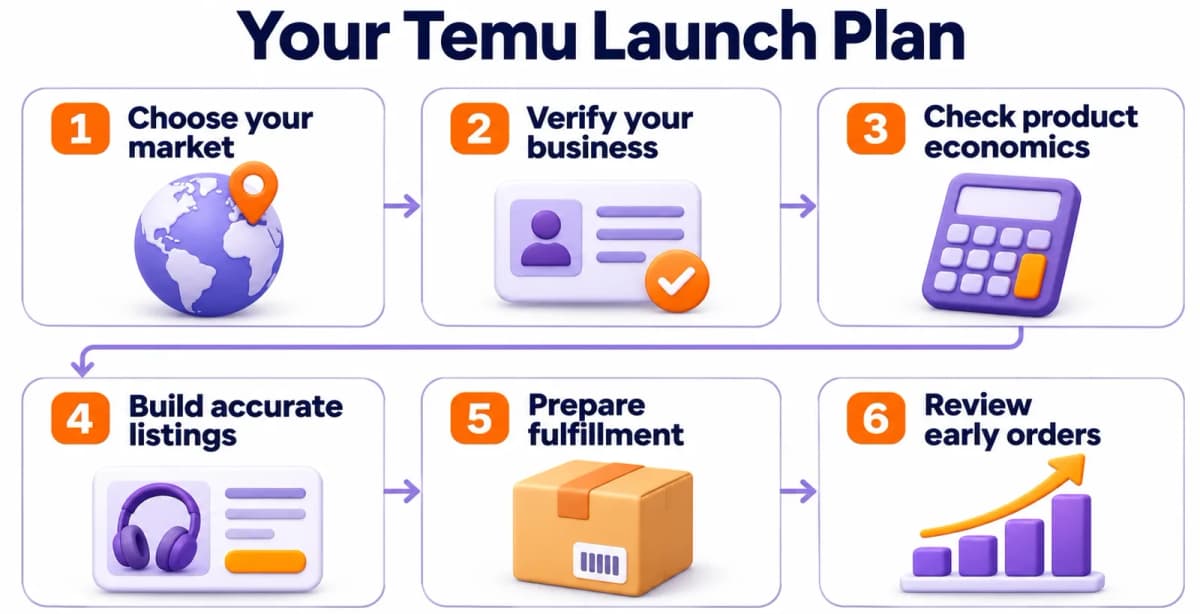
1. Prepare the Application
Open the official Seller Center, select the correct country, and create an account using contact details controlled by the business. Complete the applicant information, store details, and verification requests. Store branding should be ready, but the legal applicant name must remain consistent with the verification records.
Use a document checklist to reduce avoidable corrections:
| Record | Check before submission |
|---|---|
| Applicant identity | Legal name and valid identification match the application |
| Business identity | Registration details reflect the entity actually applying |
| Address evidence | Name and address match the relevant applicant or representative |
| Ownership or representation | The person completing verification has the appropriate role |
| Payment information | Account ownership and details satisfy the selected seller route |
| Store details | Store name, contact information, and logo are ready |
Submit sensitive documents through Temu's official process. If additional verification is requested, resolve the stated mismatch rather than opening duplicate applications.
Temu's public pages describe a normal application-review period of one business day. Treat the review estimate separately from product approval and launch readiness. Prepare product and fulfillment records while the application is being assessed. [1]
2. Choose a Small Product Range
Begin with products whose quality, dimensions, sourcing, and delivery costs are understood. A compact launch assortment makes it easier to identify why a listing attracts clicks but fails to convert, or why an apparently profitable product generates expensive returns.
For each candidate, compare:
- Delivered price for the same pack size and specification.
- Materials, measurements, accessories, and compatible use cases.
- Review themes that indicate a fixable product or information problem.
- Stock availability, shipping dimensions, and likely handling effort.
- The margin remaining after realistic fulfillment and returns costs.
A structured Temu product search can filter candidates using documented fields such as keyword, category, price, sales, and ratings. Check market coverage and data timestamps before comparing results. A reported sales signal helps prioritize research; actual store orders will determine whether the product works for the business.
3. Set Prices and Promotion Limits
Build a price floor before enrolling a product in promotions. Start with revenue the business retains after seller-funded discounts and any tax amounts that are not business revenue. Then subtract the costs incurred to supply and support that order.
If several sizes share a listing, calculate each variation separately. Larger versions may require different cartons, carrier rates, or return handling. A profitable small item can disguise a loss-making large variant.
Set an explicit minimum contribution amount for each SKU. Record who funds a promotion and whether participation changes the amount received. Use the cost example below as a worksheet, replacing every assumption with the business's own records.
4. Build Accurate Listings
Prepare a product record before uploading:
- A clear product name with the actual type and distinguishing attributes.
- Correct category, SKU, variations, inventory, and price.
- Dimensions, materials, quantity, and what is included in the package.
- Original or authorized images showing the item that will ship.
- Relevant manufacturer, safety, traceability, and compliance information.
- Care, assembly, or usage instructions where needed.
Use the current listing editor's field limits and category requirements. A field limit from an integration tutorial may differ from the applicable form or API version.
Review the shopper-facing page after submission. Check that the selected variation, image, quantity, and delivery promise all describe the same offer. Avoid claims such as “certified,” “medical-grade,” or branded compatibility unless the supporting evidence justifies the exact wording.
5. Prepare Fulfillment and Returns
Confirm the stock location, dispatch process, supported carriers, tracking workflow, and return destination before making inventory available. Temu's US seller page explains that it offers integrated logistics solutions rather than providing logistics services directly. The available arrangement for another market must be checked in that market's account. [1]
Understanding where Temu orders ship from is useful context, but the store's promise should follow its own stock and service arrangement. Record the actual handling deadline and supported delivery services from the account.
For shared inventory, assign a stock buffer and decide which system controls available quantity. For example, if 40 units support two channels, publishing all 40 independently on both can create overselling when synchronization is delayed. The buffer should reflect replenishment speed and integration reliability.
Assign ownership for return approval, parcel receipt, inspection, refunds, and stock updates. A complete process includes damaged goods and orders that customers never receive.
6. Review Early Orders
Launch with manageable stock and review completed orders before expanding the assortment. Match each order to its dispatch record, tracking, refund status, and eventual settlement.
| Signal | Decision it supports |
|---|---|
| Impressions and clicks | Whether the offer is being discovered and attracts interest |
| Orders relative to visits | Whether the price and product page persuade shoppers |
| Cancellations and late dispatch | Whether stock and handling capacity are reliable |
| Return reasons | Whether quality, sizing, images, or copy need correction |
| Contribution per completed order | Whether the product supports the business economically |
| Settlement timing | How much working capital the store needs |
Test one meaningful change at a time. Improving the size chart, changing the main image, and cutting the price simultaneously makes the result harder to interpret. Scale products with acceptable contribution and manageable service demands.
Pre-Launch Checklist
Before activating stock, confirm that:
- The approved account matches the correct applicant and seller market.
- Requested verification is complete and account-specific charges and settlement terms have been reviewed.
- Applicable business, tax, product-safety, and producer-responsibility checks are documented.
- Each listing has accurate variations, stock, images, claims, and required safety information.
- Dispatch capacity, tracking, delivery promises, and the return destination are ready.
- The cost sheet includes discounts, fulfillment, returns, and applicable deductions.
- Someone owns order monitoring, customer support, refunds, and settlement reconciliation.
What Does Selling on Temu Cost?
Free registration does not remove product, delivery, tax, or service costs. Temu's public seller pages describe free local-seller registration. The Canadian and Australian pages displayed a zero-commission promotion when checked on November 4, 2026; that message should not be turned into a permanent worldwide fee schedule. Confirm the terms attached to the actual account. [1]
Separate these cost categories:
| Cost category | What belongs in the calculation |
|---|---|
| Product and inbound | Purchase or manufacturing cost, freight, and applicable import costs |
| Fulfillment | Packing materials, labor, storage, picking, and outbound shipping |
| Account charges | Charges and deductions that actually apply to the seller agreement |
| Promotions | Seller-funded discounts and advertising |
| After-sales | Return shipping, damaged stock, refunds, and support labor |
| Overhead | Software, staff, insurance, premises, and other business costs |
A Worked Margin Example
The following is an illustrative USD example, not a Temu rate card. Net revenue excludes tax collected for remittance and already reflects seller-funded discounts.
| Item | Per order |
|---|---|
| Net revenue | $28.00 |
| Product and inbound cost | −$9.00 |
| Packing and outbound shipping | −$7.00 |
| Assumed account charges | −$1.00 |
| Expected returns allowance | −$2.00 |
| Advertising allocation | −$3.00 |
| Contribution before fixed overhead and income tax | $6.00 |
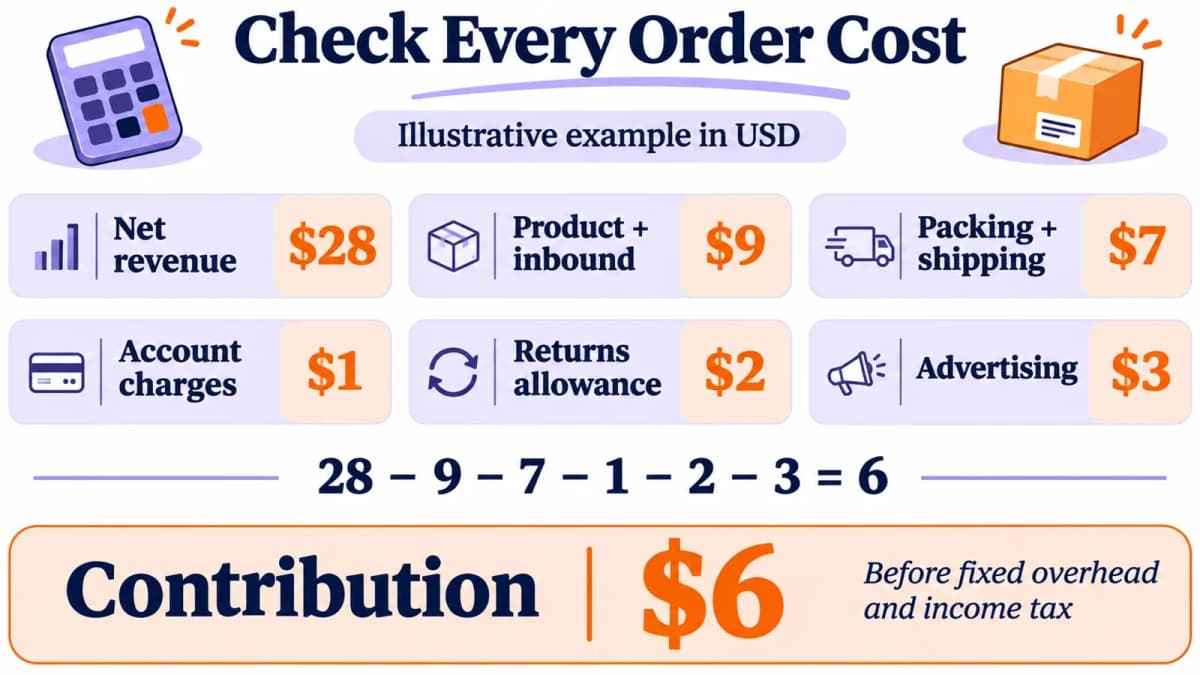
A $3 seller-funded reduction in net revenue cuts this contribution to $3 if all other assumptions stay unchanged. If shipping then rises by $2, only $1 remains. This is why a promotion should be evaluated against the cost sheet before it is accepted.
Avoid subtracting the same expense twice. If settlement revenue already has a charge deducted, reconcile that deduction before entering it as an additional cost. Track contribution alongside cash timing: a profitable order can still tie up cash while stock, shipping, and refunds are paid before settlement.
Common Mistakes to Avoid
Choosing the Wrong Applicant Country
Use the entity or person's actual eligible registration route. Customer location, warehouse location, and applicant residence are separate facts. Record each one rather than treating a local shipping address as proof of seller eligibility.
Treating Every Country Alike
A US business identifier, UK VAT threshold, German packaging registration, and Australian consumer guarantee address different obligations. Keep a country-specific checklist and assign responsibility for updates when a new destination is added.
Buying Stock Before Checking Evidence
Obtain the product specifications and applicable compliance records before placing a large order. A supplier's assurance should be supported by documents that match the actual product, manufacturer, and variant. Resolve missing traceability or safety information before launch.
Scaling Revenue Without Reviewing Margin
Sales growth can increase the amount of money tied up in stock and returns. Review completed-order contribution, return reasons, and settlement reconciliation before adding inventory or advertising spend.
Conclusion
Selling on Temu involves a sequence of practical decisions: choose the eligible market, verify the applicant, prepare compliant products, calculate order economics, and establish fulfillment before launch. The country tables cover 39 seller entries with their official portals, preparation records and operating checks; the correct records depend on the applicant and destination.
A strong first launch gives the business evidence it can act on: which products attract qualified demand, which listings set accurate expectations, and which orders leave enough contribution to justify replenishment.
Research Your Temu Product Shortlist
Nexscope provides structured ecommerce data that teams can connect to their own agents and research workflows through REST API or MCP. For a Temu launch, use product comparisons alongside the business's own costs and supplier evidence.
The Nexscope catalog lists 11 Temu data APIs, checked on November 4, 2026. The full set below covers category discovery, product evaluation, visual search, keywords, shops and supported research markets. [18]
| Research task | API and documentation | How it supports a seller's research |
|---|---|---|
| Category discovery | Temu Category Search | Find synced category names and IDs by keyword for product and store filters. |
| Product discovery | Temu Product Source Query | Filter products by keyword, category, price, sales and ratings to build a shortlist. |
| Store discovery | Temu Store Source Query | Find stores by country, category, sales and store ratings. |
| Category discovery | GeekBI Temu Category List | Browse the available category list before narrowing product research. |
| Category research | GeekBI Temu Category Research | Find categories to focus a product-research project. |
| Product evaluation | GeekBI Temu Product Detail | Retrieve details for an individual product being evaluated. |
| Visual discovery | GeekBI Temu Image Search | Find products similar to a reference image. |
| Product discovery | GeekBI Temu Product Search | Search products for competitor and assortment research. |
| Keyword research | GeekBI Temu Keyword Research | Research keywords to discover product opportunities. |
| Competitor discovery | GeekBI Temu Shop Search | Find shops for competitor research. |
| Market coverage | GeekBI Temu Site List | List the available markets supported for product research. |
Start with category or keyword discovery, narrow the product shortlist, and then inspect individual products and comparable shops. Image search is useful when the starting point is a product photo. The two product-search routes and two shop/store-search routes are separate catalog capabilities; compare their documented inputs, coverage and outputs before choosing one. The Site List describes supported research markets, not seller-registration eligibility.
Nexscope Data APIs use pay-as-you-go Data Credits. Research outputs support product decisions; seller registration, listing submission, and order handling remain in the store's authorized Temu systems.
Research Your Next Temu Product
Compare Temu products, categories, and stores with data connected to your own research workflow.
Explore Temu Data APIs →Frequently Asked Questions
Can individuals sell on Temu?
Temu's public registration information for several local markets includes an individual applicant option alongside business structures. Eligibility follows the selected country and the applicant details requested there. Choose the structure that matches the actual activity, and prepare valid identity and address evidence. Operating as an individual does not eliminate applicable tax, product-safety, or consumer responsibilities.
Do you need an LLC to sell on Temu?
An LLC is not a universal Temu requirement. The US public application information includes several business types and an individual option. Other countries use different legal structures and identifiers. Select the genuine applicant type, then follow its verification requirements. Forming a company and obtaining marketplace approval are separate decisions with different practical consequences.
Is it free to start selling on Temu?
Temu states that local-seller registration is free on the public pages reviewed for this guide. A store still needs funding for stock, shipping, packing, returns, and any applicable account charges or promotions. Evaluate a zero-commission offer against the account's conditions and build a cost sheet using actual expenses before deciding a product's minimum selling price.
How long does seller approval take?
Temu's public pages say applications are normally reviewed within one business day. That estimate refers to application review, not the entire path to a live store. Additional identity checks, corrected information, category evidence, and product preparation can affect readiness. Complete the requested records carefully and track any follow-up requests through the official Seller Center.
Can a seller use one account worldwide?
Selling into several markets depends on the permissions and arrangements available to the account. A local-seller registration should not be treated as automatic worldwide authorization. Before expanding, confirm the additional destination, stock location, delivery capability, product information, tax treatment, and returns process. Follow the market options actually made available in Seller Center.
Does Temu fulfill orders for sellers?
The US seller page states that Temu does not provide logistics services directly and instead offers integrated logistics solutions. Sellers need a fulfillment arrangement that meets their account's requirements. Check the available carrier or partner options in the relevant market, establish who dispatches the goods, and ensure that tracking and returns are handled before making inventory available.
Can selling on Temu be profitable?
Profitability depends on the product's retained revenue and complete cost structure. Calculate contribution after product cost, shipping, applicable charges, advertising, and expected returns, then account for fixed overhead and tax. A low purchase price alone is insufficient. Use early completed orders to replace assumptions with actual figures before increasing inventory or committing to deeper discounts.
Sources
- Temu. Accessed 2026. Seller Center and Seller Registration FAQs: United States, United Kingdom, Germany, Canada, and Australia. seller.temu.com; seller-eu.temu.com; ca.seller.temu.com; au.seller.temu.com.
- Temu. 2025–2026. Local Seller Program announcements: Shopify marketplace access, European market coverage, and Spanish producer stories. temu.com.
- U.S. Consumer Product Safety Commission. Accessed 2026. Online Sellers’ Safety Guide. cpsc.gov.
- UK Government. Accessed 2026. Become a Sole Trader. gov.uk.
- HM Revenue & Customs. Accessed 2026. Register for VAT: When to Register. gov.uk.
- UK Government. Accessed 2026. Accepting Returns and Giving Refunds; Online and Distance Selling. gov.uk.
- Canada Revenue Agency. Accessed 2026. When to Register for and Start Charging the GST/HST. canada.ca.
- Health Canada. Accessed 2026. Selling Consumer Products and Cosmetics Online. canada.ca.
- Australian Government. Accessed 2026. Register for Goods and Services Tax; Business Registration Service. business.gov.au.
- Australian Competition and Consumer Commission. Accessed 2026. Small Business Rights and Responsibilities; Consumer Guarantees. accc.gov.au.
- Central Agency Packaging Register. Accessed 2026. Mail Order Companies and Online Retailers: Changes Under the PPWR; Registering With LUCID. verpackungsregister.org.
- French Public Service. 2026. What Are the Identification Numbers of a Company? service-public.gouv.fr.
- French Agency for Ecological Transition. Accessed 2026. Unique Identifiers for Extended Producer Responsibility Streams. ademe.fr. English descriptive title.
- Spanish Tax Agency. Accessed 2026. Form 036: Registration, Modification, and Deregistration in the Business Tax Census. agenciatributaria.gob.es. English descriptive title.
- Spanish Ministry for the Ecological Transition and the Demographic Challenge. Accessed 2026. Register of Product Producers: Packaging Section. miteco.gob.es. English descriptive title.
- European Commission. 2025. Guidelines on the Application of the EU General Product Safety Legislative Framework by Businesses. eur-lex.europa.eu.
- European Union. Accessed 2026. E-commerce, Distance and Off-premises Selling. europa.eu.
- Nexscope. Accessed 2026. Temu API Catalog and Documentation: 11 Listed Temu Data Capabilities. nexscope.ai.
-
Temu. Accessed November 4, 2026. Partner Platform: Seller Center Directory for Applicable Countries or Regions and for Chinese Mainland or Hong Kong SAR. partner.temu.com.
-
Austrian Business Service Portal: Trade Registration and Company Register. Accessed November 4, 2026. www.usp.gv.at.
- Belgian FPS Economy: Incorporation and VAT Identification. Accessed November 4, 2026. economie.fgov.be.
- European e-Justice: Bulgaria Business Registers. Accessed November 4, 2026. e-justice.europa.eu.
- Croatian Government: Establishment of a Limited Liability Company. Accessed November 4, 2026. www.gov.hr.
- Business in Cyprus: Income Tax and VAT Registration. Accessed November 4, 2026. www.businessincyprus.gov.cy.
- Czech Government: Trade Register and Business Identification. Accessed November 4, 2026. portalobcana.gov.cz, csu.gov.cz, mzv.gov.cz.
- Danish Business Authority: Central Business Register. Accessed November 4, 2026. erhvervsstyrelsen.dk.
- Estonian RIK: Business Register and Company Requisite Information. Accessed November 4, 2026. www.rik.ee, avaandmed.ariregister.rik.ee.
- Finnish PRH: Trade Register Extract and Online Services. Accessed November 4, 2026. www.prh.fi.
- European e-Justice: Greece Business Register. Accessed November 4, 2026. e-justice.europa.eu.
- European e-Justice: Hungary Business Register. Accessed November 4, 2026. e-justice.europa.eu.
- European e-Justice: Ireland Business Register. Accessed November 4, 2026. e-justice.europa.eu.
- European e-Justice: Italy Business Register. Accessed November 4, 2026. e-justice.europa.eu.
- Latvian Register of Enterprises: Official Register Information. Accessed November 4, 2026. www.ur.gov.lv.
- European e-Justice: Lithuania Register of Legal Persons. Accessed November 4, 2026. e-justice.europa.eu.
- Dutch Government and KVK: Business Registration and VAT Numbers. Accessed November 4, 2026. business.gov.nl.
- Polish Business Portal: Company Registration and CEIDG. Accessed November 4, 2026. biznes.gov.pl.
- Portuguese IRN and Tax Authority: Business Identification and Commencement of Activity. Accessed November 4, 2026. irn.justica.gov.pt, info.portaldasfinancas.gov.pt.
- Romanian ONRC: Official Online Company Information. Accessed November 4, 2026. www.onrc.ro.
- Slovak Government: Company Establishment and Registration Duties. Accessed November 4, 2026. www.slovensko.sk.
- Slovenian AJPES and SPOT: Business and Tax Registration. Accessed November 4, 2026. www.ajpes.si, spot.gov.si.
- Swedish Tax Agency: Starting and Registering a Business. Accessed November 4, 2026. www.skatteverket.se.
- Armenian Ministry of Justice and State Revenue Committee: Entrepreneur and Tax Registration. Accessed November 4, 2026. e-register.moj.am, www.src.am.
- Georgian Public Registry and Legislative Herald: Business Registration and Tax Code. Accessed November 4, 2026. napr.gov.ge, matsne.gov.ge.
- Japanese Consumer Affairs Agency and National Tax Agency: Mail Order Sales and Tax Applications. Accessed November 4, 2026. www.no-trouble.caa.go.jp, www.nta.go.jp.
- Korean National Tax Service and Government24: Business Registration and Mail-Order Notification. Accessed November 4, 2026. d.nts.go.kr, m.gov.kr.
- Turkish Ministry of Trade: ETBIS Registration and Marketplace Exceptions. Accessed November 4, 2026. etbis.ticaret.gov.tr.
- UAE Government: Ecommerce Licensing and Trader Responsibilities. Accessed November 4, 2026. u.ae.
- Norwegian Altinn and Tax Administration: Organisation Number and VAT Registration. Accessed November 4, 2026. info.altinn.no, www.skatteetaten.no.
- Swiss Federal Tax Administration and SME Portal: VAT and Ecommerce Obligations. Accessed November 4, 2026. www.estv.admin.ch, www.kmu.admin.ch.
- Brazilian Federal Government and Procon-SP: CNPJ, Business Formalization and Ecommerce. Accessed November 4, 2026. www.gov.br, www.procon.sp.gov.br.
- Mexican SAT: Technological Platforms and Taxpayer Activity Updates. Accessed November 4, 2026. www.gob.mx, wwwmat.sat.gob.mx.
- European Commission. Accessed November 4, 2026. Country-Specific Information on VAT. taxation-customs.ec.europa.eu.