

What Is Jev AI? 10 Use Cases From Gaming to Ad Analysis

Jev AI has a specific job: help software decide what to do next. A game character needs an action, a browser needs a next step, and an advertising workflow needs consistent labels. Each task can involve repeated judgments, with little need for a written explanation between them. Those small decisions are the focus of TypeSafe AI's first System One model.
The idea becomes easier to understand through examples. Early community experiments describe game controllers, simulated vehicles, live writing feedback, and advertising analysis. They explore what happens when developers can put a model inside a repeated decision process. This article explains Jev's basic interface and walks through ten reported uses, keeping the distinction between an interesting prototype and a tested production system clear. For marketing teams, the advertising and information-filtering examples are particularly relevant: both involve organizing material so that a person or another part of the workflow can use it more efficiently.
What Is Jev AI?
Jev is a TypeSafe AI model built to return structured decisions that software can act on. An application supplies context and defines the questions to answer. The returned values can then determine which action runs or how an item is classified.
The documented interface supports three question types:
| Type | Purpose | Example question |
|---|---|---|
| Choice | Select from defined options | Which category best fits this item? |
| Score | Evaluate against a defined rubric | How strongly does this text match the criterion? |
| Noul | Estimate whether a statement is true | Does this message request a refund? |
These are illustrative questions. Their usefulness depends on the context and criteria supplied by the developer.
TypeSafe introduced Jev on September 15, 2026. Its launch announcement lists $0.042 per million input tokens, with no output-token charge. That is model pricing; a complete application may also incur data, hosting, browser, or other model costs.
10 Jev AI Use Cases
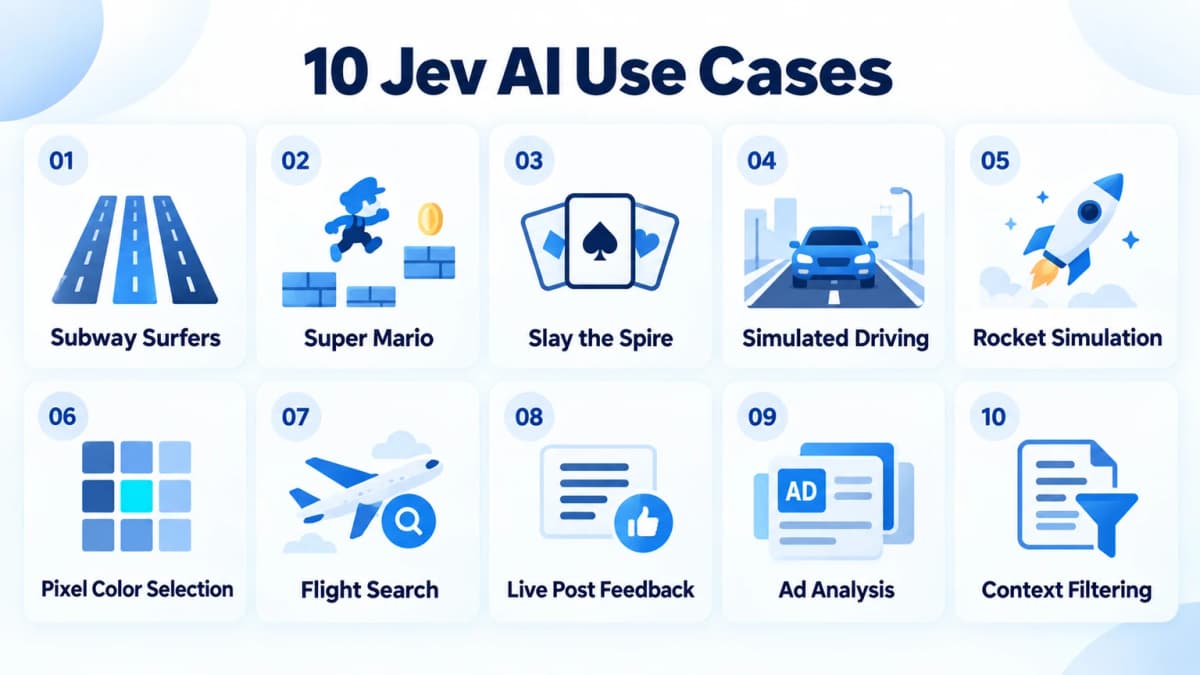
The examples below describe community-reported prototypes and the decision patterns they illustrate. Their performance has not been independently reproduced here. Specific runtime and cost claims are omitted; a demo's result should be evaluated in its own setup.
1. Parallel Subway Surfers Games

A reported Subway Surfers experiment uses Jev to choose actions while multiple game sessions run. The task involves repeated choices such as changing lanes or responding to obstacles.
Running several sessions makes the operational questions more interesting. Can each session receive a decision before its state changes? Does a slow request affect only one game? Can the controller recover after a poor move?
The useful pattern is repeated action selection across independent sessions. A working prototype would still need to show how game state reaches the model and how its output becomes an input to the game. A video alone cannot establish those details or the reliability of the controller.
2. Super Mario Bros. Controls

The reported Super Mario Bros. example applies the same general idea to platform movement. Progress depends on choosing actions at the right moment as the character encounters gaps, enemies, and obstacles.
The distinction between choosing an action and executing it matters here. Even a sensible choice can fail if the game has moved on before the command arrives. Evaluating the system therefore requires measuring the full loop, from reading state through to applying controls.
This use case makes timing visible. A test could compare completion rates across repeated runs and record where errors arise: missing state, unsuitable actions, or delayed execution. That would be more informative than the speed of an isolated model request.
3. Slay the Spire Decisions

Another community example describes Jev selecting actions in Slay the Spire 2. A card-based encounter introduces a different challenge: several legal actions may look reasonable, while their value depends on the current situation and later turns.
An evaluation could check whether the chosen action is legal, whether it improves the immediate position, and whether the run ultimately succeeds. Those are separate outcomes. Fast selection does not establish strong strategy.
The broader application is choosing among a bounded set of options with contextual trade-offs. Developers would need to decide which information belongs in the state and whether a single decision is enough or a separate planning process is required.
4. Simulated City Driving

A reported driving demo places Jev in a three-dimensional city simulation. The software presents a changing situation, receives a decision, and applies an action before repeating the process.
That setup illustrates feedback: the result of one action changes the input for the next. Useful tests would include unfamiliar road layouts, incomplete state, and situations with several plausible actions.
A simulated driving demonstration provides no evidence of readiness for real roads. Its value here is showing an experimental control loop. Any account of the demo should identify the simulation and avoid carrying its results over to physical vehicles.
5. Rocket Launch and Landing Simulation

The rocket example describes Jev participating in launch and landing decisions inside a MuJoCo simulation. It extends the control-loop idea to a task with changing stages and a clear success condition.
A successful landing raises useful follow-up questions. How often does it succeed across different initial conditions? Which actions are available at each stage? What happens when the model selects a poor action or a request fails?
This is a research prototype to examine through repeated trials. The most useful evidence would include failed attempts and the conditions of each run, alongside any successful sequence. A single landing cannot establish consistent control performance.
6. Pixel Color Selection

The pixel-art experiment describes turning drawing into a set of color choices. A program asks for a color at a location, then renders the selected values into an image.
It is a helpful way to make constrained output visible. The application defines the available palette and controls the rendering. The quality of the result depends on how individual choices relate to the overall picture.
This experiment does not establish general image-generation capability. It demonstrates a possible way to compose many small selections. A fair evaluation would ask whether the image follows the intended description and stays coherent as its size or detail increases.
7. Browser Flight Searches

The reported flight-search workflow combines browser actions with a separate text-generation component. Jev selects what to do next, while another model handles text entry where needed.
Flight search makes the division of work concrete. Selecting a field, entering a destination, choosing dates, and reading the resulting options are different operations. An application must keep their order and state consistent.
The meaningful outcome is a correct set of results for the requested itinerary. Evaluation should include dates, passenger details, and whether the search actually completed. A fast sequence of clicks is only useful when it ends on the right result. Search completion also remains separate from booking or payment.
8. Live Social Post Feedback

Riley Brown's reported prototype evaluates a social post during writing, returning updated feedback as the text changes. The interaction places assessment close to the edit that prompted it.
A useful version of this workflow could expose separate criteria, such as clarity or how explicitly the opening identifies its subject. Those scores would make it easier to see why a revision changed the feedback. They are proposed evaluation dimensions, not verified features of the demo.
Claims about viral potential need particular care. A model's rating is an estimate under its instructions. Actual reach also depends on the audience and distribution conditions. The score can help compare drafts, but its relationship to performance needs evidence from published posts.
9. Advertising Classification and Analysis

Matthew Berman's reported advertising demo uses Jev to organize ads by features such as their opening hook, format, offer, and call to action. This is one of the clearest business applications in the set.
Consistent labels would let an analyst filter a collection instead of rereading every item. Discount-led offers could be reviewed together, for example, or product demonstrations compared with other formats. The analyst could then inspect the ads that matter to a particular question.
To build a similar research workflow, start with a defined set of ads. Nexscope Marketing Data APIs include paid-search ad samples that a team can bring into its own workflow through REST API or MCP. The returned copy can become input for a model to classify messages and flag items for review, subject to the sample's coverage and available fields.
A marketer could then group similar offers, compare calls to action, and use the findings to prepare a campaign brief. Manually reviewing a sample of the labels helps refine the criteria before processing more records.
Ad labels describe creative content; they do not prove which ads convert. Performance judgments require suitable campaign data. Similarly, an assessment of an ad's consistency with its landing page needs both pieces of content available for comparison.
10. Agent Context Filtering
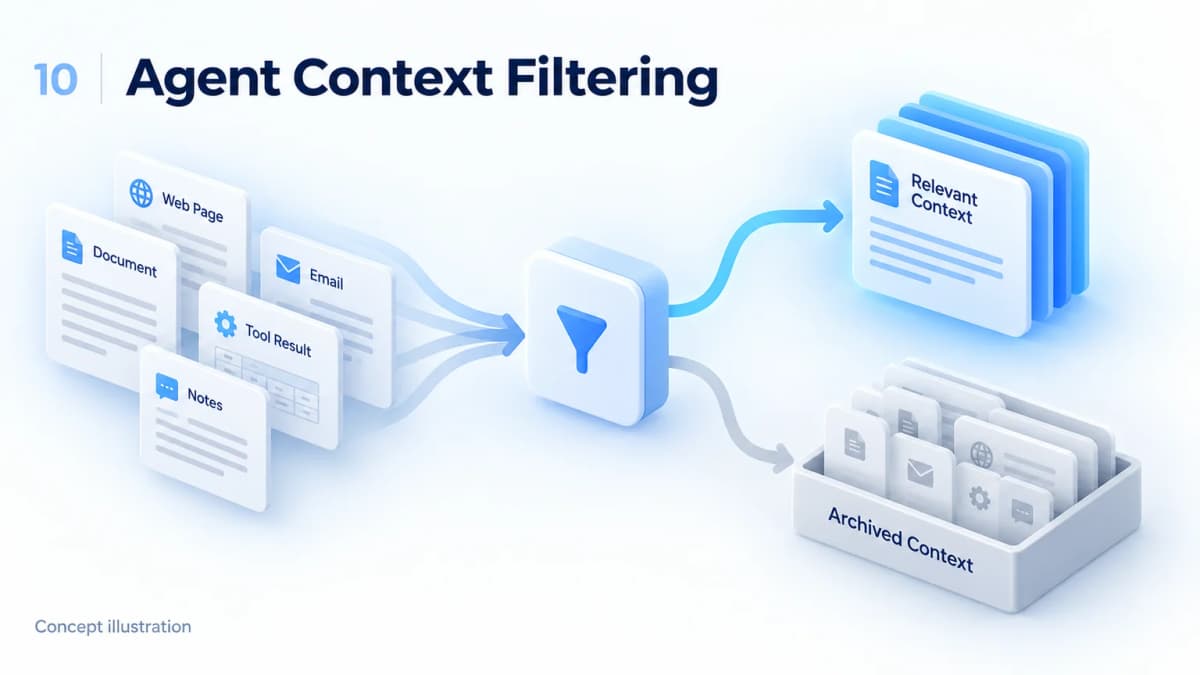
The final reported example uses Jev to assess the relevance of tool-call records accumulated by an AI agent. These records can include retrieved pages, file excerpts, and previous tool results.
Selecting material for the next step introduces a different kind of quality trade-off. Removing irrelevant records may reduce what the agent needs to process, but discarding a necessary instruction or result can undermine the task.
A proposed implementation should keep the original records recoverable and test whether the agent can still finish the same tasks after filtering. Relevance also changes as the task progresses. A record that looks unnecessary during one step may matter later, so retention rules need more care than a one-time score.
Conclusion
The ten examples share a recurring structure: software supplies a situation, Jev evaluates a bounded question, and the application uses the result. Games make that cycle easy to see. Advertising analysis and context filtering show how the same general approach could help organize information.
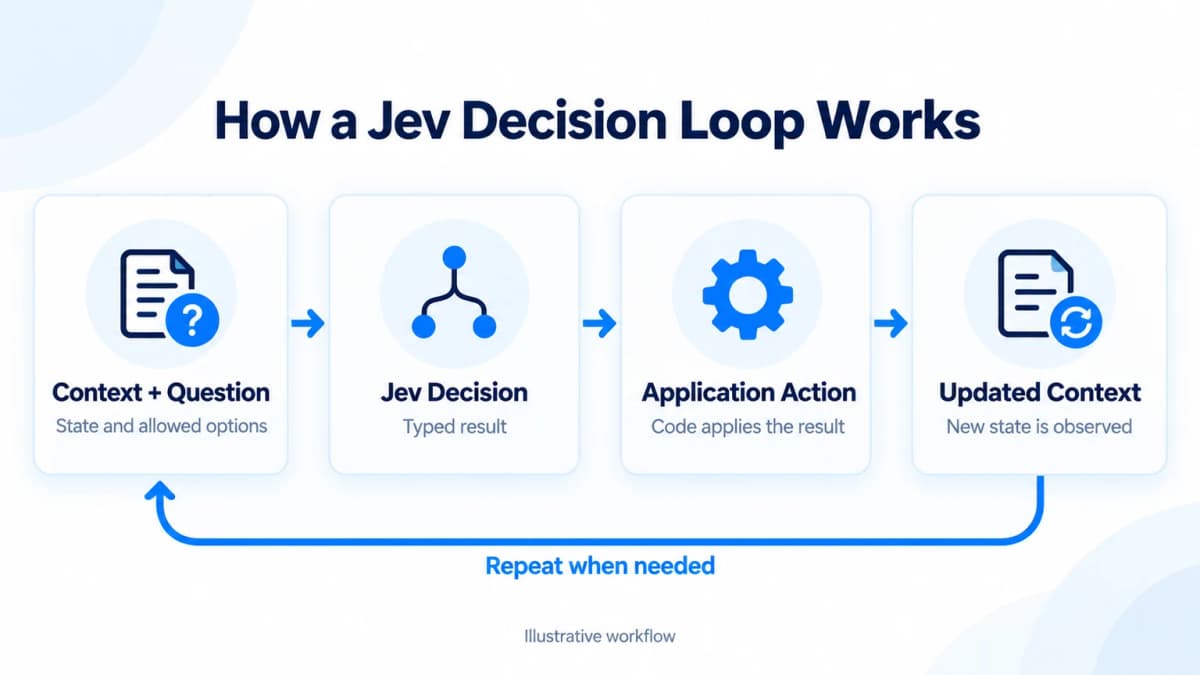
An illustrative decision loop; implementation details vary by application.
TypeSafe's documented application patterns include intent routing, composite scoring, and routing based on confidence. These provide starting points for experiments. A useful first project should have a clear decision, measurable errors, and a way to review uncertain results.
Build With Marketing Data
The same approach can support broader marketing research: grouping search intent, comparing competitor messaging, prioritizing content opportunities, or reviewing changes in brand visibility. Each workflow starts with a business question and evidence relevant to it.
Nexscope's marketing data covers keywords, search results, competitor and website intelligence, backlinks, advertising, and AI visibility. Teams can connect supported datasets to their own agents and workflows through REST API or MCP, then use a decision model to organize findings and route the next action. Dataset coverage and estimates should remain visible as the information moves through the workflow.
Build Your Marketing Research Workflow
Connect marketing data to your own agents and turn research findings into informed next steps.
Explore Marketing Data APIs →Frequently Asked Questions
What is Jev AI used for?
Jev is designed for structured judgments inside software, including choosing among options and scoring an input against defined criteria. TypeSafe describes application patterns such as routing and composite scoring. The examples in this article explore those ideas in games, browser operations, content feedback, and information filtering. Their usefulness depends on the implementation and the quality of its evaluation.
Can Jev replace a general-purpose chatbot?
Jev's documented interface returns typed decisions rather than free-form written responses. An application that needs explanations, drafting, or generated text would need an appropriate component for those tasks. The reported browser example illustrates how different components can contribute to one workflow. Choosing how to divide the work requires testing the complete task, including its failure cases.
How much does Jev cost?
TypeSafe's September 15, 2026 launch announcement lists an input price of $0.042 per million tokens and no output-token charge. That figure covers model usage under the stated pricing. The total cost of a workflow can also include obtaining data, running infrastructure, operating a browser, or calling other models. Current terms should be checked before estimating a deployment budget.
Does Jev always make correct decisions?
Structured output does not establish that a judgment is correct. TypeSafe's confidence documentation explains how Choice and Score responses express uncertainty through probability distributions and a derived confidence value. An application can use that information to request review or take another path. Appropriate thresholds depend on the consequences of errors and observed performance on the actual task.
Can Jev help with marketing analysis?
Classification and scoring offer plausible starting points for marketing analysis. A team could test ad-message categorization, search-intent grouping, or prioritization of research findings. Each task needs clear criteria, suitable inputs, and manual checks. Model-generated labels and scores should be evaluated separately from business outcomes such as conversions, revenue, or campaign performance, which require their own supporting data.
Sources
- TypeSafe AI. (2026). Introducing System One Models & Jev. Retrieved from typesafe.ai
- TypeSafe AI. (2026). Introduction. Retrieved from docs.typesafe.ai
- TypeSafe AI. (2026). Confidence. Retrieved from docs.typesafe.ai
- TypeSafe AI. (2026). Patterns. Retrieved from docs.typesafe.ai