

When Is Amazon Black Friday 2026?

Table of Contents
Amazon’s 2026 Black Friday Week and Cyber Monday event runs from November 19 to November 30 in the United States. Black Friday itself falls on November 27, followed by Cyber Monday on November 30.
Amazon’s November 9 announcement confirms 12 days of themed deals, with two deal drops on both Black Friday and Cyber Monday for the first time. Alexa for Shopping also features prominently in the holiday experience, helping customers organize lists, track prices, and find offers.
For sellers, the immediate task is to align promotions and monitoring with the full event window. Your Amazon Black Friday preparation checklist should now account for the full 12-day window and the two peak-day drops.
Amazon’s Black Friday 2026 Schedule
Keep the promotion submission deadline separate from the customer-facing shopping dates.
| Date | Event | Seller action |
|---|---|---|
| November 13 | Extended Black Friday and Cyber Monday Deal submission deadline | Check eligible ASINs and submission status. |
| November 19 | Black Friday Week begins | Start event-wide monitoring of prices, availability, and advertising. |
| November 19–30 | Daily themed Today’s Big Deals | Review relevant category offers throughout the event. |
| November 27 | Black Friday | Monitor around the midnight and 8 a.m. PT deal drops. |
| November 30 | Cyber Monday | Monitor both drops and adjust plans to remaining stock. |
The November 13 extension applies to Deal submissions, not FBA inventory arrival deadlines. Check inventory readiness separately before committing units to a promotion.
The two daily drops are Amazon’s event schedule. Check Seller Central for the actual dates and times assigned to your own promotions.
What’s Different About This Year’s Deal Drops
Today’s Big Deals will rotate through themes including toys, technology, fashion, beauty, premium gifts, and stocking stuffers. On Black Friday and Cyber Monday, offers will drop at midnight and 8 a.m. Pacific Time, with savings of up to 60% on selected deals while supplies last.
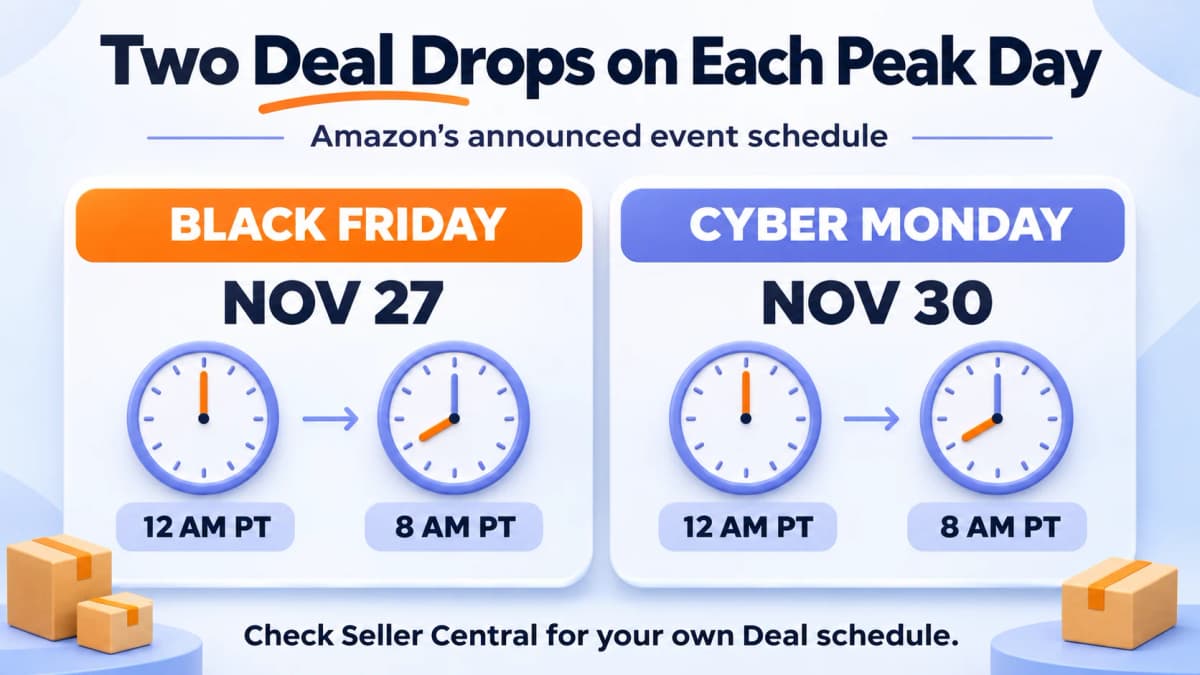
Amazon’s announced event windows; individual seller Deal schedules appear in Seller Central.
For sellers, this makes a broader monitoring schedule useful. A competitor’s offer may change before the traditional Black Friday weekend, while a later drop may change the options shoppers see in your category.
Build checks around your approved Deal schedule and the major event windows. Review competing offers, delivery promises, available stock, and advertising performance together. If traffic increases but conversion weakens, investigate what changed before raising bids.
Treat the published drop times as observation points. Budget decisions should still follow your own performance and remaining inventory.
Alexa’s Role in Holiday Shopping
Amazon is promoting Alexa for Shopping as a holiday assistant that can manage shopping lists, monitor prices, set Deal alerts, and use Auto-Buy to complete purchases when the price is right. Shoppers can also access up to 365 days of price history.
Our takeaway for sellers is that both price context and product fit deserve attention.
A discount looks different when a shopper can compare it with earlier prices. Review your promotional offer against comparable products and available history, then check whether it still meets your margin requirements.
Product information matters for a different reason: a shopper asking for a gift with specific dimensions, materials, or compatibility needs requires clear answers. An Alexa shopping listing audit should check that these details are explicit and consistent across titles, attributes, images, and descriptions.
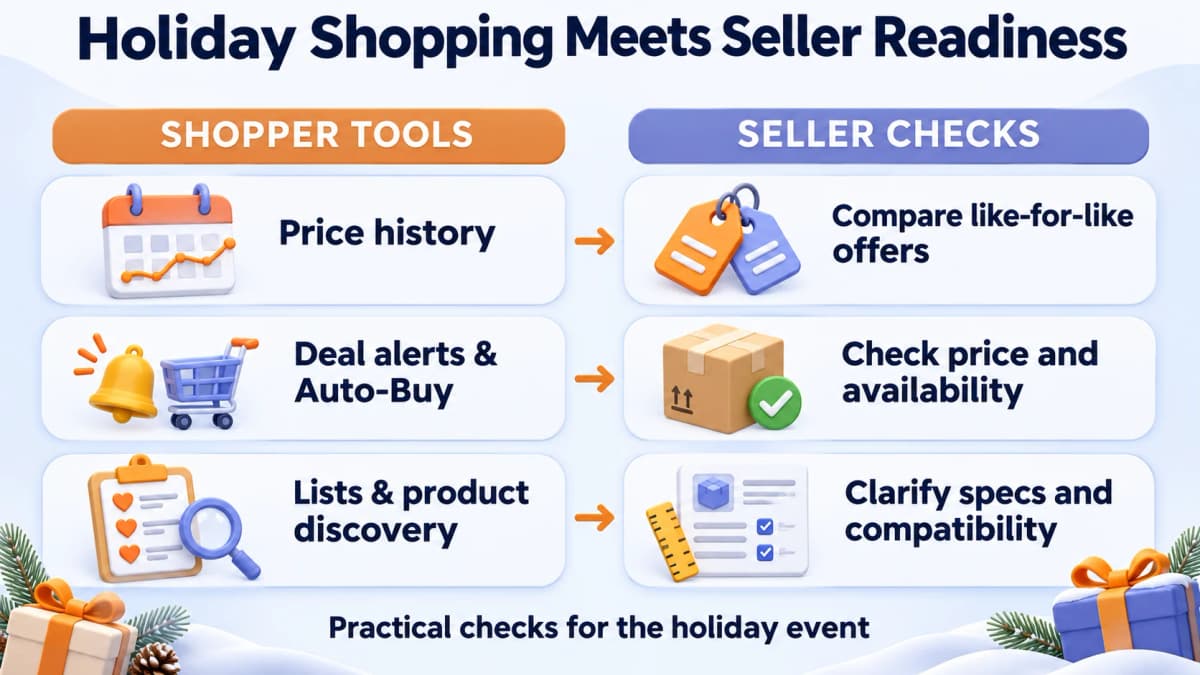
Suggested seller checks corresponding to the shopping capabilities highlighted in Amazon’s announcement.
What Sellers Should Prioritize Now
Check Deal Submissions
Before November 13, review eligible products, submission status, and any issues requiring correction. For submitted promotions, confirm the scheduled window and available quantity. Assign someone to monitor promotion health during the event.
Validate Keywords and Price Bands
Focus keyword research on the product’s actual use, specifications, and gifting relevance. Amazon ASIN keywords can help identify terms bringing traffic to competing products. Compare reporting periods consistently and use demand signals to guide research rather than treating search volume as sales.
For pricing, compare like-for-like offers: the same capacity, pack size, material, and relevant features. Review Amazon product price history alongside current offers, keeping gaps in historical coverage visible.
Fix Purchase-Critical Information
Prioritize missing details that could change a buying decision:
- Dimensions, capacity, and materials.
- Compatible devices, models, or sizes.
- Package contents and required accessories.
- Usage restrictions and care instructions.
Check that titles, attributes, images, and descriptions agree. Address recurring review questions with verified product facts.
Conclusion
Amazon’s November 19–30 event gives sellers a defined period for monitoring promotions, pricing, and availability. Prepare for the full window, confirm your own Deal schedule, and resolve important product-information gaps before the event begins.
Prepare Your Amazon Offers With Nexscope
Holiday planning brings several research tasks together: finding relevant products, checking demand, comparing competitors, reviewing prices, and understanding buyer concerns. The Nexscope Amazon Data API supports these tasks with structured Amazon data that teams can connect to their own research and monitoring workflows.
Key Features
- Amazon product research: Filter products by price, sales, ratings, and fulfillment to investigate market opportunities.
- Amazon competitor analysis: Compare competing ASINs using pricing, sales estimates, and growth signals.
- Amazon price history: Review available historical prices and product trends before setting promotional offers.
- Amazon keyword research and ASIN traffic analysis: Investigate search terms, rankings, and traffic-source changes to guide listing and advertising research.
- Amazon reviews and sales estimates: Examine buyer feedback alongside estimated demand to prioritize product and listing improvements.
- Alexa shopping research and Amazon policy updates: Explore shopping-assistant answers and track marketplace changes relevant to your operations.
Connect supported capabilities through REST API or MCP to your own applications, AI agents, and workflows. Beyond Amazon, Nexscope’s ecommerce data platform also covers marketplaces including TikTok Shop, Walmart, eBay, Shopee, Temu, and Mercado Libre, with data capabilities varying by platform.
Plan Your Next Amazon Move
Explore Amazon data capabilities for product, keyword, competitor, pricing, and customer research.
Explore Amazon Data →Sources
- Amazon. (2026, November 9). Amazon’s Black Friday Week and Cyber Monday Return November 19–30 with Millions of Deals to Deliver Joy This Holiday Season. press.aboutamazon.com.
- Amazon Seller Forums, News_Amazon. (2026). Black Friday Cyber Monday deals deadline extended to November 13. sellercentral.amazon.com.