

Why Amazon Blocked Meta Muse and What It Means for Sellers

Amazon blocked Meta Muse from shopping on its website in September 2026, bringing a practical question into focus: what happens when a shopper delegates product selection to an AI agent, but the retailer has not agreed to let that agent participate? A customer may want help comparing products and placing an order. The platform still has its own requirements for access, account security, and the buying experience. Those interests can conflict before a purchase ever reaches checkout.
For sellers, the dispute raises questions about where products will be discovered and how customers will evaluate them. Some platforms are developing their own shopping assistants. Others are opening managed connections to external AI services. Merchants need to understand the difference between appearing in an AI recommendation, allowing catalog access, and supporting a transaction. The Muse dispute offers a useful starting point for examining those choices and preparing product information for shopping journeys that may begin outside a familiar marketplace search bar.
Amazon’s Block on Meta Muse
Meta introduced Muse on September 8, 2026 as a personal AI agent capable of taking actions across online services. Users can communicate with it through the Muse app or WhatsApp, giving it tasks that extend beyond answering a question. Shopping is one of those uses.
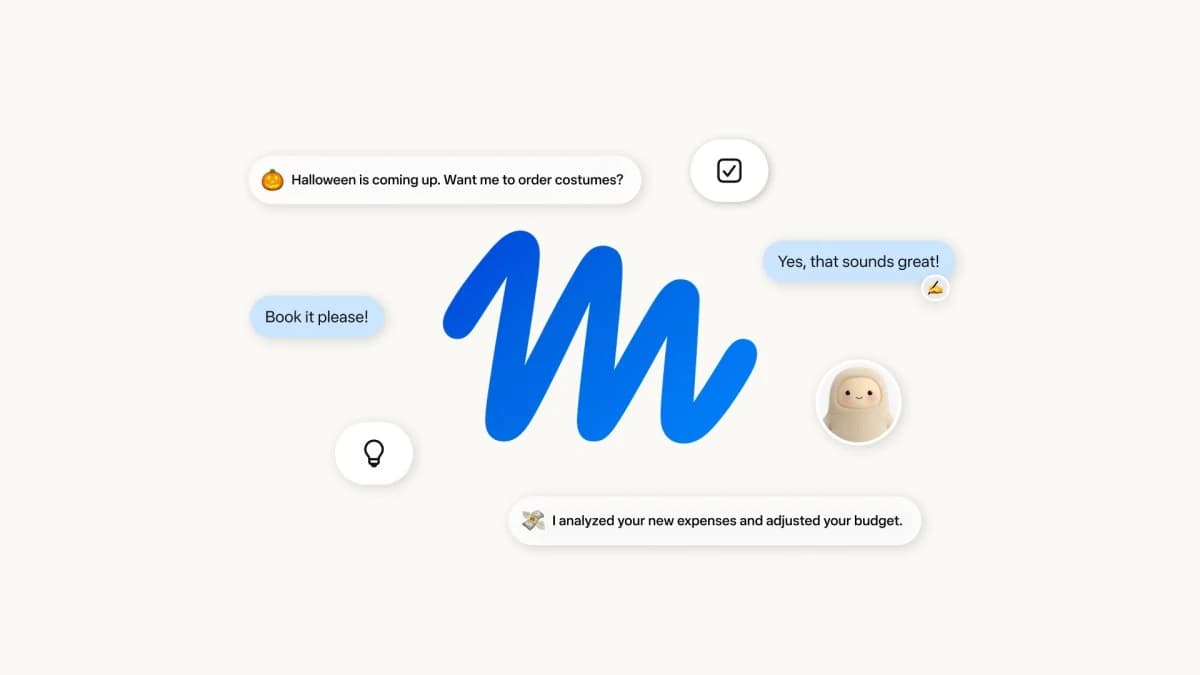
Image: Meta, official Muse launch artwork. Source.
By September 20, GeekWire reported that Amazon had blocked Muse from shopping on Amazon.com. Amazon said it had first asked Meta to exclude its store from the service. The companies had not reached an agreement before the restriction appeared.
The incident illustrates a limitation of agentic commerce: an assistant’s ability to operate a browser does not establish that every retailer will accept its activity.
Permission and Account Security
Amazon’s stated concerns included the lack of prior permission, the agent’s failure to identify itself, and potential risks involving customer credentials. These were Amazon’s claims about the interaction, rather than proof that a security breach had occurred.
Meta describes Muse as running in a dedicated secure virtual machine that contains the agent and the user’s data. Its launch materials emphasize user control over the access granted to the assistant.
These positions address different questions. A product’s security design concerns how it handles user information. A retailer’s access policy concerns whether that product may interact with its service. Resolving one does not automatically settle the other.
Advertising and Customer Relationships
A shopping platform influences which products receive attention through search results, recommendations, merchandising, and advertising. An external assistant could move part of that decision process elsewhere by comparing options before sending a customer to a retailer.
That creates a commercial incentive for platforms to retain influence over discovery. If an assistant determines the shortlist, sellers may have fewer opportunities to reach shoppers through the browsing patterns they currently target. A retailer could still fulfill the order while playing a smaller role in the earlier product comparison.
This is a business interpretation, not evidence that advertising caused Amazon’s decision. The restriction alone does not establish lost ad revenue, reduced seller traffic, or a measurable change in purchase behavior. Those effects would require separate data.
The broader question is how platforms and external assistants will divide responsibility for recommendations, customer information, transactions, and support.
Competing Paths to AI Shopping
Retailers and commerce platforms are approaching that division in different ways. Their choices affect what sellers can control and which integrations deserve attention.
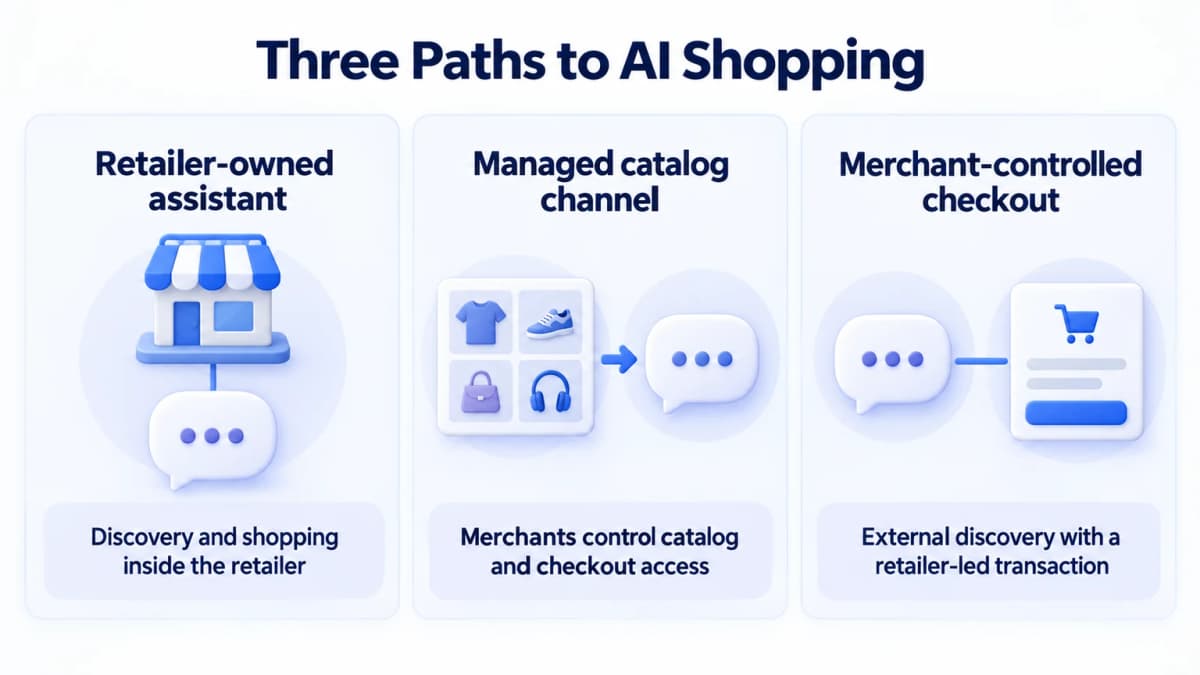
An editorial comparison of three access models discussed below.
Amazon’s Own Shopping Assistant
Amazon is expanding AI within its shopping experience. On May 13, 2026, it introduced Alexa for Shopping, bringing together Rufus and Alexa+ capabilities.
Amazon describes an assistant that supports product questions, comparisons, price research, and shopping actions within its own environment. This allows the company to develop conversational discovery while retaining control over the surrounding customer experience.
For sellers, an external agent restriction therefore says little about whether AI will influence Amazon purchases. Product information still needs to communicate what an item does, who it suits, and how it differs from alternatives.
Shopify’s AI Channels
Shopify is creating managed connections to external assistants. Its September 8 announcement added Meta as an AI channel in Agentic Storefronts. Shopify says products are shared with Meta by default through Shopify Catalog, while merchants can manage catalog and direct-checkout access and review performance in their agentic settings.
This approach gives merchants specific controls to inspect. A store operator should check which catalog is shared, whether direct checkout is enabled, and what reporting is available for that channel.
Catalog distribution and transaction permission serve different purposes. Treating them as separate settings helps a merchant evaluate exposure without assuming every available connection works in the same way.
Merchant-Controlled Checkout
OpenAI’s 2025 Instant Checkout announcement introduced a way for participating merchants to support purchases through ChatGPT. The Agentic Commerce Protocol, developed with Stripe, established a framework for connecting AI shopping experiences with merchant commerce systems. This was an integration model with participating businesses, rather than a promise that any agent could transact on any website.
Walmart has also pursued a model in which its own assistant participates in an external AI experience. In its 2026 Morgan Stanley conference discussion, Walmart described bringing Sparky into ChatGPT so that its assistant could handle the shopping journey after product discovery.
The strategic distinction is useful: a retailer can accept discovery from an external platform while retaining a substantial role in the transaction. Sellers evaluating these arrangements should examine who maintains product information, processes the order, and manages the customer relationship.
The Perplexity Ruling
Platform policies and legal disputes are developing alongside these commercial arrangements. eBay’s User Agreement, for example, requires prior express permission for automated access and explicitly includes buy-for-me agents and LLM-driven bots.
The Amazon–Perplexity case concerns a separate access dispute. On August 4, 2026, the Ninth Circuit vacated a preliminary injunction and remanded the case for further proceedings. The court concluded that Amazon was unlikely to succeed on the computer-access claims at issue under the facts before it.
That ruling did not end the entire case or grant every AI agent unrestricted access to every store. It should not be used as a general permission slip for automated commerce. Merchants and developers still need to examine the rules and integration requirements applicable to the services they use.
What Sellers Should Prepare
Sellers can act on the parts of this shift they control. The immediate priorities are accurate product information, clear channel permissions, and measurement that distinguishes visibility from sales.
Make Product Information Complete
A useful product record should answer concrete buying questions. Depending on the item, that may include dimensions, materials, compatibility, included components, intended uses, and relevant limitations. Variants should be distinguishable, and price and availability should remain consistent across the systems that distribute them.
Consider a shopper looking for a travel stroller that fits a particular storage space. A description calling it “compact” leaves an important question unanswered. Clear folded dimensions and weight provide something the shopper or an assistant can compare against the requirement. This example illustrates information quality; it does not imply a guaranteed AI ranking benefit.
Teams should review conflicting specifications and missing attributes before adding more promotional language. Unsupported claims can make a comparison less useful, especially when an assistant summarizes several products together.
Review Channel Permissions
For each available AI commerce connection, document what the merchant is enabling:
- Which products and fields are shared.
- Whether the channel supports discovery, checkout, or both.
- Who maintains prices and inventory.
- Who handles order changes, returns, and customer support.
- Which controls are available to adjust or disable access.
This review should use the platform’s current settings and documentation. A partnership announcement alone cannot establish that a particular seller, market, or product category is eligible for every feature.
Measure Each Stage Separately
An AI mention, a referral visit, and a completed order are different outcomes. Track them separately wherever reporting permits. When attribution is unavailable, leave it unresolved instead of assigning unexplained sales to an AI channel.
A practical review can record the buyer question, products shown, date, destination, and observable next action. Repeated observations can reveal missing information or inconsistent recommendations. A single successful prompt cannot establish persistent visibility.
The same discipline applies to commercial results. Evaluate conversion, order value, cancellations, returns, and margin where those measures are available. Increased exposure is useful only in the context of what happens after discovery.
Conclusion
Amazon’s restriction on Muse highlights how much of AI shopping depends on agreements about access and customer experience. Platform-owned assistants, managed catalog channels, and merchant-controlled transactions are developing alongside one another. Sellers will need to assess each route on its own terms.
Prepare for AI Shopping With Nexscope
When an assistant compares products, sellers need to understand which details distinguish their offer and which buyer questions remain unanswered. Nexscope supplies structured ecommerce data that teams can bring into their own research applications, agents, and workflows through REST API or MCP.
For the challenges discussed in this article, these capabilities provide useful research inputs:
-
Check product information with Amazon Product Detail. Retrieve listing titles, bullet points, specifications, variants, and pricing by ASIN. Compare competing listings to identify attributes that need clearer explanations.
-
Understand buyer concerns with Amazon Reviews List. Retrieve reviews for an ASIN with supported rating filters. Feed the results into a review-analysis workflow to identify recurring questions, complaints, and use cases.
-
Observe AI shopping recommendations with Amazon Alexa Search. Research shopping-assistant answers and recommended ASINs. Review which products appear for relevant buyer questions and record observations over time.
-
Add historical context with Amazon Product History. Examine available historical product trends before interpreting a current offer. Check the endpoint’s supported fields and time coverage when designing comparisons.
-
Assess broader search interest with Google Trends By Keywords. Compare keyword interest across supported regions and time ranges to distinguish seasonal interest from a short-lived spike.
-
Plan Shopify SEO with Marketing Data APIs. Use SEO Keyword Metrics and SEO Keyword Expansion to research terms for product pages, collections, and blog content. Top Organic Ranking Pages and Domain Organic Keyword Intersection help identify competing content and keyword gaps.
-
Review Shopify storefront pages with page-check APIs. Page Structured Data, Duplicate Page Tags, and Non Indexable Pages provide crawl-based evidence for identifying issues to investigate before improving product and collection pages.
-
Research AI visibility with mention and citation APIs. SEO AI Mention Records and AI Search Citation Sample help Shopify brands and other ecommerce teams examine observed mentions and citations, retaining the source and observation date.
These examples are part of a broader API catalog covering marketplace search, store research, backlinks, traffic estimates, advertising intelligence, and more. Teams can choose the datasets that fit their products, channels, and markets. The marketing capabilities apply to Shopify storefront research; they do not automatically edit a theme or connect private Search Console data.
A practical workflow might start with a buyer question such as “Which travel stroller is easiest to store in a small apartment?” A seller’s own agent could collect relevant recommendation observations, compare the listed dimensions of candidate products, and summarize recurring storage complaints from reviews. The team could then use that evidence to decide which specifications, images, or FAQs need improvement. This is a workflow the team builds using supported inputs; it does not promise a change in an assistant’s recommendations.
REST API access suits applications and scheduled research jobs. MCP lets a compatible agent discover and call supported tools within the team’s own environment. Field availability, regional coverage, and freshness depend on the selected capability. Recommendation observations should remain separate from referral traffic and sales attribution, and the data should not be presented as evidence of a Muse integration or permission to transact on a retailer’s site.
Build Better Product Evidence
Connect product details, customer feedback, historical context, and AI shopping observations to a research workflow that helps prioritize listing improvements.
 Browse Ecommerce Data APIs →
Frequently Asked Questions
Why did Amazon block Meta Muse?
Amazon said Muse accessed its store without prior agreement, did not identify itself as an agent, and raised concerns about customer credentials. The September 2026 restriction followed an unsuccessful request for Meta to exclude Amazon from the experience. Commercial control is relevant context, but the available evidence does not establish advertising as the cause of the block.
Can Meta Muse shop on Amazon?
September 2026 reporting describes Amazon blocking Muse from shopping on Amazon.com. Readers should treat that as a dated access status, since platform arrangements can change. A shopping assistant’s ability to operate elsewhere does not establish permission or reliable access on Amazon. Check current service information before relying on a particular shopping flow.
Does Shopify let merchants control Meta access?
Shopify’s September 8, 2026 announcement says merchants can manage catalog and direct-checkout access for Meta through their agentic settings. It also says products are shared with Meta by default through Shopify Catalog. Sellers should inspect their own settings and available performance reports to understand what is enabled and how the channel applies to their store.
Did Perplexity win unrestricted access to Amazon?
No. The August 4, 2026 appellate decision vacated a preliminary injunction and sent the case back for further proceedings. It addressed particular computer-access claims and facts involving Perplexity’s assistant. It did not resolve every possible dispute about automated shopping or establish universal access rights for other agents. Platform rules and integration terms still require separate consideration.
How should sellers prepare for AI shopping?
Start with complete, consistent product information and an inventory of enabled channels. Confirm which connections share catalog data and which support transactions. Then distinguish product mentions, referral traffic, and completed purchases in reporting. These steps create a clearer basis for decisions without assuming that a catalog integration guarantees recommendations or that an AI mention generates measurable sales.
Sources
- Todd Bishop, GeekWire. (2026). Amazon blocks Meta’s Muse AI assistant in new standoff over agentic shopping. Retrieved from geekwire.com
- Meta. (2026). Introducing Muse: The World’s First Personal AI Agent Built for Everyone. Retrieved from about.fb.com
- Shopify. (2026). Meta is now an AI channel in your admin. Retrieved from changelog.shopify.com
- OpenAI. (2025). Buy it in ChatGPT: Instant Checkout and the Agentic Commerce Protocol. Retrieved from openai.com
- United States Court of Appeals for the Ninth Circuit. (2026). Amazon.com Services, LLC v. Perplexity AI, Inc., No. 26-1444. Retrieved from ca9.uscourts.gov