

Amazon Alexa for Shopping: 10 Seller Opportunities and Risks

Amazon Alexa for Shopping is Amazon's conversational AI for finding, comparing, and buying products. The name comes from the same Alexa that launched with the Echo smart speaker, but the shopping experience now reaches far beyond simple voice commands. It can help shoppers research a category, compare products, review price history, build a cart, reorder familiar items, and continue a shopping task across supported Amazon experiences.
That evolution matters because AI shopping changes how a buyer reaches a product. Instead of scanning a long results page, a shopper can explain a need, answer a follow-up question, and receive a shorter set of recommendations. Product pages still supply essential facts and evidence, but fewer listings may receive direct attention during the decision.
For Amazon sellers, Alexa introduces both opportunity and uncertainty. Relevant products can surface beyond the first ten organic results, while established listings still benefit from strong sales, reviews, availability, and rank. This guide begins with what Alexa is, follows its expansion into shopping, and then explains ten practical opportunities and risks for sellers.
What Amazon Alexa Is

Amazon launched Alexa with the first Echo in 2014. It began as a voice assistant for music, timers, questions, and smart-home controls.
Alexa+ is the generative AI version of that assistant. It understands natural conversation, remembers useful context, works across supported devices and apps, and can complete multi-step tasks. Alexa+ is the broader personal assistant; Alexa for Shopping handles product research and purchase tasks under the same brand.
Rufus Becomes Alexa for Shopping
Rufus began as Amazon's generative AI shopping assistant, using product catalog data, reviews, community Q&A, and web information to answer questions and compare products.
Amazon renamed Rufus to Alexa for Shopping on May 13, 2026. It now brings those capabilities under the Alexa brand across Amazon's app, website, and supported Alexa+ devices. A shopper can type or speak a request, compare options, and continue the purchase on another supported interface.
10 Seller Opportunities and Challenges
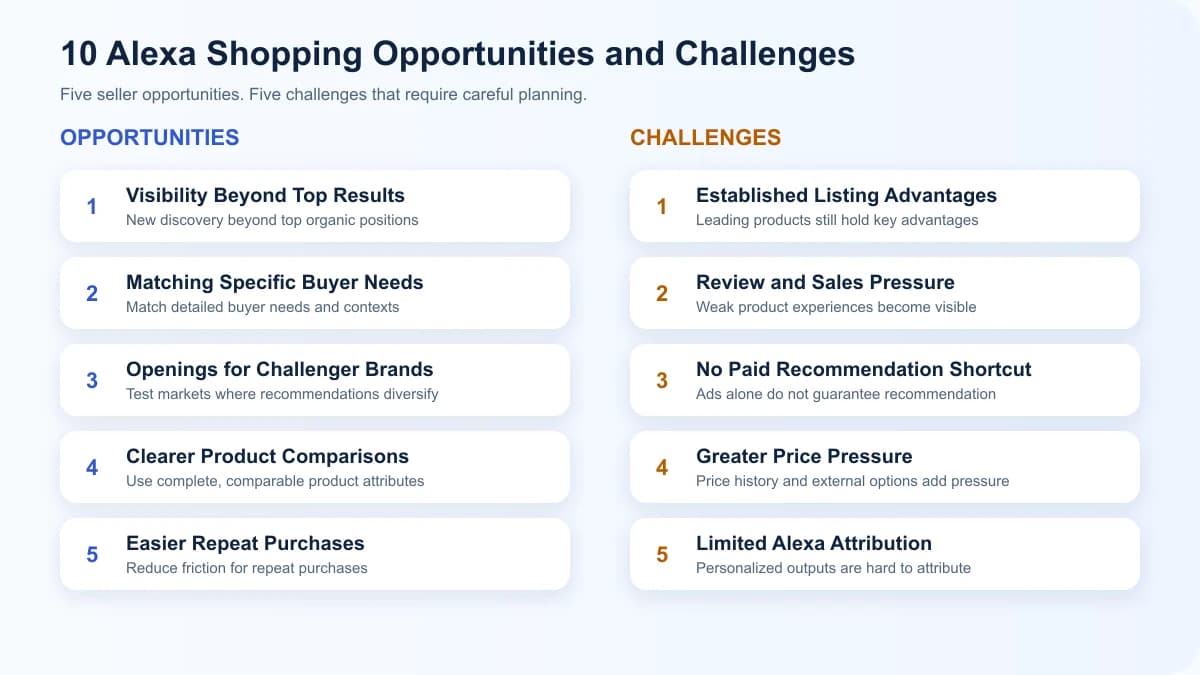
The first five points are opportunities to gain visibility or retain customers. The final five are challenges sellers need to plan for and measure carefully.
Opportunity 1: Visibility Beyond Top Results
Alexa creates an additional route into product discovery. In a 2026 independent analysis, Autopilot and The Order compared 12,810 valid AI recommendations across 1,963 non-branded U.S. queries with the corresponding Amazon search pages. About 63.9% of the recommended products appeared outside the organic top ten, and 40.9% were outside the captured first page.
The study was observational and independent of Amazon, so it does not reveal the recommendation algorithm or prove why any product appeared. It does show that a seller can miss conversational visibility by looking only at first-page rank. A focused product may still enter a recommendation set when its evidence matches the shopper's need.
Opportunity 2: Matching Specific Buyer Needs
Detailed questions give Alexa more information about the buyer's use case, constraints, compatibility needs, and desired outcome. The same independent analysis found the greatest separation from standard search rankings on long-tail queries, where 80.2% of recommendations were outside the organic top ten.
Sellers can find this language in reviews, Q&A, support tickets, returns, and PPC search terms. The goal is to answer real purchase questions with accurate facts, not to paste every possible phrase into the listing.
Opportunity 3: Openings for Challenger Brands
Recommendation patterns varied by category. The independent data showed a higher share of products outside the organic top ten in Apparel than in Home & Kitchen, Beauty, or Health and Supplements.
That variation gives challenger brands a reason to test their own categories. Products with a clear fit for a specific user, activity, material preference, or compatibility need may earn attention even when a category leader has the stronger broad keyword position. The opportunity depends on the market and the question, so one Alexa tactic will not fit every catalog.
Opportunity 4: Clearer Product Comparisons
Alexa can compare products by features, price, ratings, and review themes. Incomplete or inconsistent attributes make those comparisons harder and can cause an important advantage to disappear from the answer.
Sellers should verify dimensions, materials, included components, model compatibility, warranties, certifications, care instructions, and variation relationships. Marketing language can support the message, but the product also needs specific facts that a shopper can evaluate.
Opportunity 5: Easier Repeat Purchases
Conversational cart building, previous-order lookup, price monitoring, and routine purchase actions can reduce friction for replenishable products. A customer can ask Alexa to reorder a familiar item without running the original search again.
This creates retention value for products with dependable quality, recognizable variations, stable availability, and consistent pricing. A stockout, packaging change, or confusing variation can interrupt that pattern and give an alternative product an opening.
Challenge 1: Established Listing Advantages
Visibility beyond the top ten does not erase the advantages of a leading listing. In the independent study, Alexa's first recommendation came from the organic top ten about 55% of the time. Among recommended products visible on the captured first page, the median organic rank was 7, compared with 25 for the surrounding products.
Established products still bring demand, conversion history, reviews, availability, and buyer familiarity. Alexa adds another discovery route, while the basic work of winning and keeping shopper trust remains important.
Challenge 2: Review and Sales Pressure
The same first-page comparison found a median displayed purchase signal of 3,000 units for recommended products versus 900 for surrounding listings. Recommended products also had roughly 3.5 times as many reviews.
These figures are correlations rather than proven ranking factors. They still highlight an operational risk: Alexa can summarize recurring customer praise and complaints. Weak instructions, sizing confusion, leaks, durability issues, or poor support can become easier for a shopper to identify before opening the listing.
Challenge 3: No Paid Recommendation Shortcut
Amazon PPC remains important for launches, keyword learning, sales, and demand capture. Early recommendation data offers no evidence of a simple paid shortcut into Alexa.
Only 14.3% of the analyzed recommendations were advertised somewhere on the paired search page, and 83% of those also ranked organically. Products that were advertised without an organic position represented 2.4% of all recommendations. Ad spend can strengthen the wider business, but sellers should avoid presenting it as guaranteed Alexa optimization.
Challenge 4: Greater Price Pressure
Alexa can show up to one year of price history, monitor a target price, and help shoppers evaluate whether the current offer is attractive. Amazon's agentic shopping features can also surface selected products from other online stores.
That creates more pressure on inflated list prices and repetitive promotions. Sellers need a pricing strategy that connects margin, bundle value, inventory, competitive position, and promotion timing. A clear value proposition matters more when historical prices and alternatives are available during the same conversation.
Challenge 5: Limited Alexa Attribution
Seller Central does not provide a complete explanation of why a product appears in a personalized Alexa recommendation. Results may change with the question, account history, location, device, price, delivery promise, and inventory.
The available independent data is a snapshot of observed relationships. It cannot prove that one listing edit, ad campaign, review change, or ranking movement caused a recommendation. Sellers need repeatable tests and cautious conclusions instead of a new collection of unsupported ranking claims.
How Sellers Can Prepare for Alexa Shopping
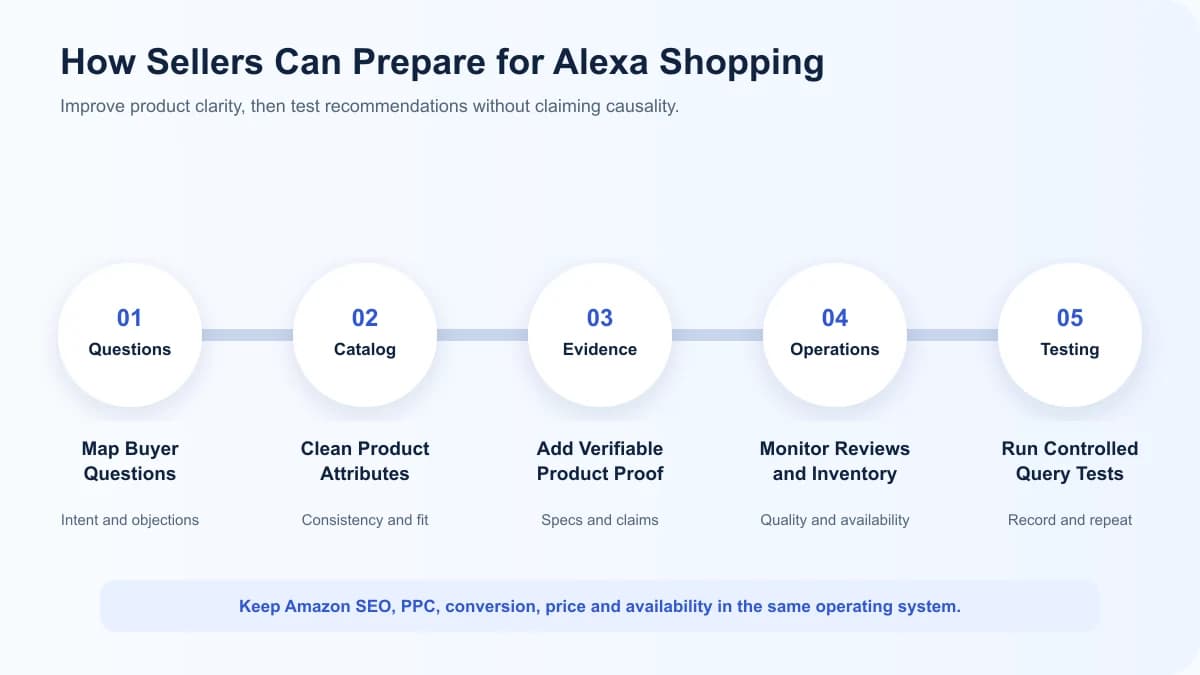
Map Buyer Questions
Start with questions that reveal the purchase context:
- Who is the product for?
- What problem does the buyer need to solve?
- Where and when will the product be used?
- Which models, products, or systems must it work with?
- Which tradeoffs matter most?
- What causes customers to return competing products?
Search Query Performance, PPC search terms, customer messages, reviews, Q&A, and returns can reveal this language. Group the questions by discovery, comparison, compatibility, trust, and purchase readiness.
Clean Product Attributes
Review every field that helps Amazon understand product fit. Complete the relevant structured attributes and make sure the title, bullets, description, images, A+ Content, and backend data agree.
Contradictory dimensions, pack counts, materials, or compatibility claims create avoidable recommendation risk. Variation relationships should be accurate, discontinued options should be removed, and important differences between models should be explicit.
Add Verifiable Evidence
Replace broad claims with facts a buyer can compare:
| Weak claim | Clearer product evidence |
|---|---|
| Premium material | 18/8 stainless steel body with a BPA-free lid |
| Great for travel | Fits cup holders up to 3.2 inches wide |
| Long battery life | Runs up to 14 hours at 50% volume |
| Easy to clean | Lid separates into three dishwasher-safe parts |
Every claim must be accurate and supportable. Dimensions, included parts, certifications, warranty terms, test conditions, and compatibility details provide stronger decision support than unexplained superlatives.
Improve Product Operations
Track repeated review themes rather than rating alone. If customers repeatedly mention leakage, sizing, setup, noise, or durability, fix the product or experience first. The listing can then set clearer expectations and explain the improvement accurately.
Monitor inventory, delivery promises, suppressed variations, price, and catalog conflicts for priority ASINs. A relevant product cannot convert when it is unavailable or represented by incorrect data.
Run Controlled Tests
Build a stable question set for each priority product:
- Broad category questions
- Long-tail use cases
- Product comparisons
- Compatibility questions
- Budget and premium scenarios
- Common objections
Record the exact wording, date, marketplace, account state, recommendation order, competing products, and visible supporting evidence. Repeat the tests before and after meaningful changes. A movement is a signal for investigation, not automatic proof of causality.
Measuring Alexa Visibility
Direct Measurement Limits
Amazon does not currently provide sellers with a complete Alexa attribution dashboard. Brands can repeat shopping questions and track indirect signals such as long-tail search performance, conversion, repeat orders, price, inventory, and review themes. None of those indicators can confirm that Alexa caused a sale.
The useful question is whether a product appears consistently across a fixed set of buyer questions over time. That approach produces a more reliable operating signal than a single personalized result.
Wider AI Shopping Signals
Alexa is part of a broader shift toward AI shopping. Shoppers also ask ChatGPT, Claude, Gemini, and DeepSeek to compare products, explain tradeoffs, and recommend options.
Nexscope offers an AI Product Visibility Tool that tests product-specific buyer questions across those four supported AI systems. The report includes:
- Product mention and primary recommendation rates
- Query-level recommended positions
- LLM and competitor comparisons
- Citations and signal gaps
- Prioritized product-page and evidence improvements
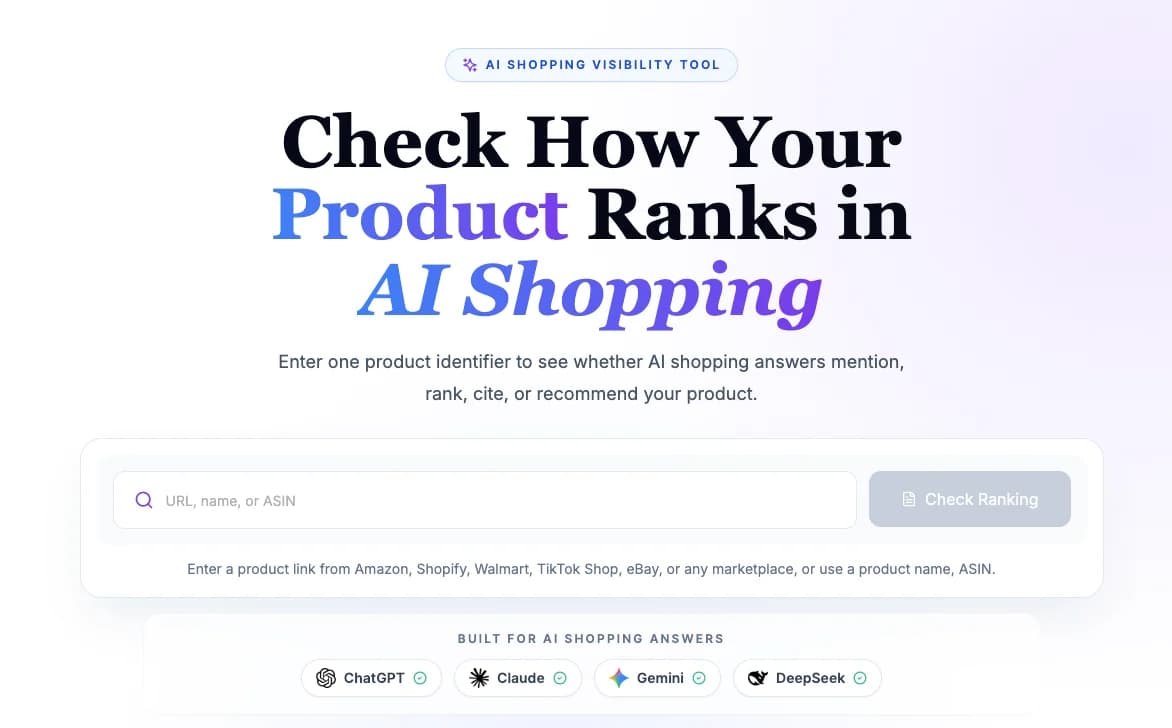
See Where Your Product Ranks in AI Shopping
Check whether supported AI shopping systems mention, rank, cite, or recommend your product.
Check Your Product's AI Visibility →Common Seller Mistakes
Voice-Only Planning
Alexa for Shopping works through Amazon's shopping app and website as well as supported Alexa+ devices. A voice-only plan overlooks typed conversations, visual comparisons, and shopping tasks that continue across interfaces.
Ranking Abandonment
Products can appear beyond the organic top ten, but strong rank, sales, reviews, availability, and conversion still appeared alongside many recommendations. Sellers should continue Amazon SEO while testing conversational visibility as a separate layer.
Keyword Stuffing
More keyword variations do not automatically make a product easier to recommend. Clear use cases, structured attributes, compatibility, evidence, and readable copy provide more value than repetitive phrases.
Unsupported AI Claims
Labels such as "Alexa-optimized," "AI-preferred," or "guaranteed recommendation" require evidence that sellers generally do not have. Product claims and performance claims should remain precise and verifiable.
One-Time Testing
One question, account, device, or day cannot establish a stable recommendation pattern. Personalized results require repeated tests with consistent prompts and documented conditions.
Conclusion
Amazon Alexa began as a voice assistant and has developed into a generative AI system that can support product research, comparison, price evaluation, cart building, reordering, and purchase actions. Rufus becoming Alexa for Shopping connects those retail functions to the broader Alexa+ experience.
For sellers, the key change occurs before the product page visit. Alexa can reduce a large category to a short list based on the buyer's complete request. That creates opportunities for relevant products outside the top organic positions, while strong rank, sales, reviews, accurate data, price, and availability continue to influence competitive strength.
The practical response is to improve product clarity and operations first: answer real buyer questions, complete attributes, replace vague claims with evidence, resolve recurring review problems, maintain inventory, and test a consistent set of conversational queries. Sellers can then use the Nexscope AI Product Visibility Tool as a separate benchmark for how products appear in other supported AI shopping answers, without treating those results as Alexa data.
Make Your Product Easier for AI to Find
Find visibility gaps, compare AI shopping answers, and prioritize clearer product evidence.
Check Your Product's AI Visibility →Frequently Asked Questions
What is Amazon Alexa for Shopping?
Amazon Alexa for Shopping is Amazon's conversational AI experience for product discovery, research, comparison, and purchase tasks. It developed from Rufus, Amazon's shopping assistant in the Amazon Shopping app and website, and now sits under the wider Alexa brand. Shoppers can ask product questions, compare items, review price history, monitor deals, build carts, reorder products, and continue selected shopping tasks across supported Amazon experiences.
Is Alexa for Shopping the same as Alexa+?
Alexa+ is Amazon's next-generation personal assistant for smart-home control, entertainment, information, organization, services, and shopping. Alexa for Shopping is the retail-focused experience for finding, comparing, and buying products within Amazon's shopping environment. They share the Alexa brand and can support connected experiences, but Alexa+ covers a much wider set of tasks than shopping.
Did Alexa for Shopping replace Rufus?
Amazon renamed Rufus to Alexa for Shopping on May 13, 2026. Rufus had already served as the conversational shopping assistant in Amazon's app and website. The new name connects the retail assistant more clearly with Alexa and Alexa+. The rename did not disclose a recommendation formula, so earlier theories about Rufus ranking factors should not be treated as proven Alexa rules.
Does Alexa ignore Amazon rankings?
No public evidence shows that Alexa ignores organic rank. Independent research found that 63.9% of valid recommendations appeared outside the paired search term's organic top ten. The same analysis found that the first recommendation came from the top ten about 55% of the time, and visible recommended products held stronger median ranks than surrounding listings. Rank remains relevant, but it does not fully describe the recommendation set.
Can ads guarantee Alexa recommendations?
No evidence supports a guaranteed paid route into Alexa recommendations. In one independent observational study, 14.3% of recommended products were advertised somewhere on the paired search page, and most of those also ranked organically. Advertising still supports launches, demand capture, keyword learning, and sales. Sellers should measure those outcomes directly instead of presenting ad spend as confirmed Alexa optimization.
Can sellers track Alexa sales?
Seller Central does not provide a complete report explaining personalized Alexa recommendation exposure and causality. Sellers can monitor repeated recommendation tests, long-tail query performance, conversion, repeat orders, review themes, price, and availability. These signals are useful when evaluated together, but they should not be labeled as confirmed Alexa-attributed traffic or sales without direct reporting from Amazon.
How should sellers prepare for Alexa shopping?
Sellers should preserve keyword relevance while improving product clarity. Complete important attributes, describe intended users and real use cases, state dimensions and compatibility, replace broad claims with supportable facts, keep variations consistent, monitor customer feedback, and maintain availability. Repeated conversational tests can reveal gaps in how a product is understood, although no listing format can guarantee an Alexa recommendation.
Sources
- Amazon Staff. (2026). Amazon's Next-Gen AI Assistant for Shopping Is Now Even Smarter, More Capable, and More Helpful. Retrieved from aboutamazon.com
- Charles Clark. (2026). Introducing Alexa+, the Next Generation of Alexa. Retrieved from aboutamazon.com
- Amazon Staff. (2026). Echo Show Gets a New Visual Shopping Experience Powered by Alexa+. Retrieved from aboutamazon.com
- Amazon Staff. (2026). How Amazon Is Using Generative and Agentic AI to Transform the Shopping Experience. Retrieved from aboutamazon.com
- Autopilot and The Order. (2026). The Third Shelf: How Amazon's AI Recommends Products. Retrieved from autopilotbrand.com