

10 Best Amazon Product APIs for Developers and Sellers 2026

An Amazon product API can turn product pages, search results, prices, offers, sales ranks, reviews, and category data into structured fields that applications can process. The difficult part is choosing the right access model. Amazon's official APIs serve specific affiliate and seller workflows, while independent providers support public-marketplace research, historical analysis, monitoring, and managed data collection.
The best choice depends on the job. An affiliate publisher may need Amazon Creators API. An authorized seller application may need Selling Partner API. A product-research team may need price history, competitor listings, BSR movement, product discovery, and multi-marketplace data that the official affiliate interface was not designed to provide. This guide compares ten current options, including Nexscope, by data coverage, access requirements, integration model, history, localization, and production fit.
The ranking favors APIs that solve a clear product-data problem and document their limits. No provider is the best for every use case. Teams should test representative ASINs, marketplaces, missing-field behavior, and permitted data uses before committing to a production pipeline.
Quick Comparison
| API | Best for | Product search | Product details | Historical data | Access model |
|---|---|---|---|---|---|
| Nexscope Amazon Product APIs | Connected product research and monitoring | Yes | Yes | Yes, endpoint-dependent | API key, REST, MCP, Skill |
| Amazon Creators API | Affiliate product experiences | Yes | Yes | No product history | Approved Associates access |
| Amazon SP-API Catalog Items | Authorized seller and vendor catalog workflows | Yes | Yes | Limited catalog context | OAuth seller/vendor authorization |
| Keepa API | Price, BSR, offer, and product history | Yes | Yes | Extensive | Subscription and tokens |
| Rainforest API | Amazon-specific structured data | Yes | Yes | Request-dependent | API key and usage plan |
| DataForSEO Merchant API | Task-based market-data pipelines | Yes | ASIN and product tasks | Result-dependent | Authenticated tasks and callbacks |
| Bright Data Amazon Scraper API | Batch collection and delivery pipelines | Yes | Yes | Collected snapshots | API token, sync or async jobs |
| Oxylabs Web Scraper API | Multiple Amazon page types | Yes | Yes | Collected snapshots | API credentials, sync or async |
| ScraperAPI Amazon Endpoint | Simple ASIN-to-JSON retrieval | Yes | Yes | Collected snapshots | API key and structured endpoints |
| SerpApi Amazon Product API | Search and product-result extraction | Yes | Yes | Search archives, plan-dependent | API key and search engines |
“Historical data” needs careful interpretation. A provider may return a stored price or BSR time series, or it may let a team collect current snapshots over time. Those are different capabilities with different backfill, storage, and monitoring implications.
Amazon Product API Types
“Amazon product API” describes several products with different permissions and data models. Separating them first prevents a team from selecting a technically capable API that does not fit the intended application.
Affiliate Catalog APIs
Amazon Creators API is designed for approved publishers, influencers, and affiliate partners that build shopping and product-discovery experiences. Its operations include product search, item lookup, variation retrieval, and browse-node access. The returned product content is governed by the Associates program and Creators API license.
This route fits applications that recommend Amazon products and send qualified traffic to Amazon. It is a poor match for unrestricted competitor intelligence, long-term price-history storage, or seller-account administration. Affiliate eligibility and data-display rules are part of the technical requirements.
Seller-Authorized APIs
Amazon Selling Partner API, commonly called SP-API, supports applications authorized by sellers or vendors. The Catalog Items API can search catalog items and retrieve attributes, identifiers, images, classifications, dimensions, product types, sales ranks, summaries, relationships, and vendor-specific details where available.
SP-API is the correct path when an application works with authorized Amazon accounts, catalog matching, listings, inventory, orders, or other seller operations. It does not function as a general public-marketplace research feed. Access roles, OAuth authorization, regional endpoints, rate limits, and restricted-data requirements shape the integration.
Independent Data APIs
Independent Amazon data APIs serve product research, monitoring, comparison, historical analysis, and public-page extraction. Some specialize in parsed product JSON. Others add search results, reviews, offers, price history, BSR movement, sales estimates, market research, or managed batch delivery.
These providers differ sharply in how they collect, refresh, store, estimate, and license data. A clean JSON response does not by itself establish freshness or accuracy. Production teams should document source time, collection time, estimated fields, missing fields, and retry behavior.
10 Best Amazon Product APIs
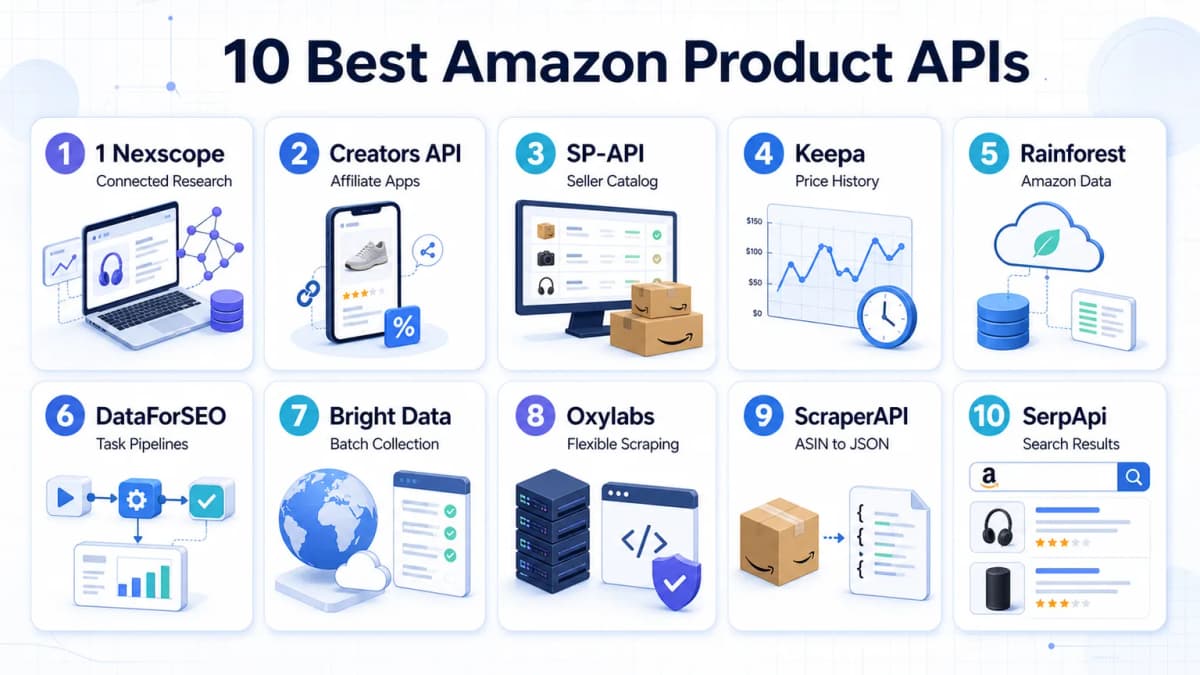
The following ranking uses a practical editorial framework: product coverage, search and discovery, historical depth, marketplace support, integration options, documentation, and fit for a defined developer or ecommerce workflow.
1. Nexscope Amazon Product APIs
Best for: Ecommerce teams that need product details, database filtering, discovery, history, and price series through one Amazon data layer.
Nexscope combines six product-focused APIs with broader Amazon keyword, review, competitor, sales, market, and policy capabilities. Teams can call supported data through REST API or MCP from their own Agent and workflow. The same data capabilities are also available inside Nexscope's web product for teams that do not want to build an integration first.
The most widely applicable endpoint is the Amazon Product Detail API. It retrieves structured listing information by ASIN, including titles, images, bullet points, specifications, A+ content, pricing, ratings, review summaries, variants, and related product-page fields where supported. That makes it useful for catalog enrichment, competitor listing analysis, content QA, and inputs to an Amazon listing optimization workflow.
Nexscope's additional product APIs cover distinct research jobs:
- Amazon Product Database API supports multi-condition product filtering across signals such as category, price, sales, revenue, ratings, reviews, BSR, seller type, and listing quality where available.
- Amazon Product Database Search API supports advanced search across product, sales, rank, review, fulfillment, package, and keyword criteria.
- Amazon Product Discovery API helps teams find products from keyword, conversion, click-growth, and profitability signals. It supports the early discovery stage of finding products to sell on Amazon.
- Amazon Product History API retrieves ASIN details plus historical product and sales signals where supported.
- Amazon Product Price Series API returns product-level time series such as price, BSR, rating, seller count, Buy Box, and sales-related fields where supported.
This coverage separates Nexscope from single-purpose product-page parsers. A team can start with a keyword or filtered database, inspect an ASIN, compare the listing, and then evaluate historical movement. Those steps complement established Amazon product research tools and reduce the need to maintain a separate integration for each research stage.

Explore Amazon Product Data
Connect product details, search, discovery, history, and price-series data to ecommerce research workflows through Nexscope Amazon Data API.
Explore Amazon Data API →Limitations: Coverage, supported marketplaces, fields, freshness, and credit cost vary by endpoint. Nexscope is an independent ecommerce data platform and is not Amazon SP-API. The selected API documentation is the source of truth for request parameters and field coverage.
2. Amazon Creators API
Best for: Approved Amazon Associates, publishers, influencers, and affiliate applications.
Amazon Creators API is the current official product-catalog interface for creators and affiliate partners. SearchItems searches by keywords, brand, title, author, and other supported parameters. GetItems retrieves products by identifier, GetVariations returns variation families, and GetBrowseNodes exposes category information.
The main advantage is first-party Amazon product content for an approved affiliate use case. The interface supports resources such as item information, images, offers, browse-node information, and search refinements. Marketplace and parameter support vary by locale.
The access model is also its main limit. Teams must qualify for the relevant Associates or creator program and follow its content, caching, attribution, and display terms. It does not replace SP-API for seller operations, and it does not provide a general historical competitor-research database.
3. Amazon SP-API Catalog Items
Best for: Seller-authorized applications that search, match, and manage products in Amazon's catalog ecosystem.
Catalog Items API v2022-04-01 can search Amazon catalog items by keyword or identifier and retrieve an item by ASIN. Depending on the request, responses can include attributes, identifiers, images, product types, sales ranks, summaries, variation relationships, classifications, and vendor details.
Its strongest feature is its role inside the wider SP-API environment. Applications can connect catalog discovery with Listings Items, Product Type Definitions, pricing, inventory, orders, and notifications when the relevant roles and permissions are available. That makes it the correct official foundation for seller software and operational integrations.
SP-API requires more onboarding than a basic product-data key. Applications need Login with Amazon authorization, regional configuration, roles, and rate-limit handling. It also focuses on authorized selling workflows. Teams seeking broad public competitor data, reviews, or historical price series will usually need a separate research source.
4. Keepa API
Best for: Historical price tracking, BSR analysis, offers, deals, product databases, and Amazon product monitoring.
Keepa is one of the most established specialist sources for Amazon product history. Its Product Request endpoint returns product data and price history by ASIN or product code. Product Search supports keyword lookup, while Product Finder accepts detailed filters for querying the database. Other endpoints cover best sellers, deals, categories, sellers, tracking, and graph images.
The API uses a token bucket. Each plan generates tokens over time, and endpoints consume different token amounts. This design supports controlled throughput and bursts, but teams need to model token consumption before running broad historical queries or offer retrieval.
Keepa is a strong choice when time series are central to the application. Its response objects are dense, and historical arrays may require timestamp conversion, missing-value handling, and field-specific interpretation. Teams that only need a current title, image, and price may prefer a simpler product-detail endpoint.
5. Rainforest API
Best for: Developers who want an Amazon-specific request API for product, search, offer, review, and seller data.
Rainforest API retrieves data from supported Amazon domains through a request interface. A product request can use an ASIN or product-page URL. Related request types cover search results, offers, reviews, sellers, categories, best sellers, and identifiers such as GTIN, ISBN, UPC, or EAN where supported.
The focused API surface makes it easier to understand than a general scraping platform. A team sends Amazon-specific parameters and receives structured Amazon data, without building a parser or proxy layer.
The service remains Amazon-specific and request-oriented. Historical analysis usually requires either supported historical fields or a scheduled collection process managed by the customer. Marketplace coverage, localization behavior, request cost, and returned sections should be tested against the actual target domains.
6. DataForSEO Merchant API
Best for: Task-based Amazon product and search collection inside broader SEO, search, or market-data pipelines.
DataForSEO's Merchant API uses a task workflow. A client posts one or more tasks, receives task identifiers, and retrieves completed results later. Postbacks and pingbacks can automate delivery. Amazon endpoints support location, language, domain, priority, and user-defined tags.
The architecture is useful for batching and data pipelines. A single POST request can contain multiple tasks within documented limits, while callbacks reduce the need for constant polling. Amazon product, ASIN, search, and related merchant data can sit beside other DataForSEO datasets in the same account.
The asynchronous model adds orchestration. Developers must persist task IDs, handle incomplete jobs, map callbacks, and monitor result readiness. It is less convenient for an interface that expects an immediate product response from one ASIN.
7. Bright Data Amazon Scraper API
Best for: High-volume collection, batch jobs, webhooks, and delivery to cloud storage.
Bright Data provides ready-made Amazon scrapers for product pages and other Amazon targets. Its Amazon product workflow accepts a product URL and returns structured fields such as ASIN, title, price, currency, rating, review count, seller, brand, and availability when present.
Synchronous requests suit small batches. Larger jobs can use asynchronous triggers, polling, and webhooks. The platform can also deliver data to external storage such as S3, Google Cloud Storage, or Azure, which is useful for recurring collection and warehouse ingestion.
The tradeoff is platform complexity. Dataset IDs, sync versus async behavior, output schemas, storage, and job monitoring introduce more configuration than a narrow ASIN endpoint. Bright Data fits teams that value scalable collection infrastructure and can operate a data pipeline.
8. Oxylabs Web Scraper API
Best for: Teams that need several Amazon page types with parsing, localization, and flexible delivery modes.
Oxylabs exposes dedicated Amazon sources such as amazon_product, amazon_search, amazon_pricing, amazon_sellers, and amazon_bestsellers. Product requests can use an ASIN, geographic location, parsing controls, and other parameters. The API can return raw HTML or parsed JSON depending on the target and configuration.
A broader Amazon scraper API comparison separates managed collection platforms by parsing support, localization, blocking resilience, and delivery model.
This range supports price comparison, seller monitoring, search analysis, and best-seller collection through one service. Realtime requests are convenient for interactive workflows, while asynchronous methods suit larger jobs.
The broader scraper configuration creates more implementation choices. Teams need to select the right source, parsing mode, rendering behavior, geography, and integration method. Parsed fields can also vary when Amazon changes page layouts or withholds sections for a location or session.
9. ScraperAPI Amazon Endpoint
Best for: Developers who want a simple Amazon product URL or ASIN converted into structured JSON.
ScraperAPI's structured Amazon product endpoint accepts an API key, ASIN, country, and marketplace controls. The response can include product name, price, product information, images, variants, ratings, review counts, BSR, category, and feature bullets when those fields appear on the page.
Separate structured endpoints support Amazon search, reviews, and offers. This makes ScraperAPI approachable for prototypes and focused collection jobs. The provider manages request routing, retries, and parsing, so the application consumes JSON rather than page markup.
Its schema is oriented around extracted page content. Teams that need long product history, sales estimates, market-opportunity scoring, or a large prebuilt product database may need another source. Tests should also cover localization because prices, availability, sellers, and delivery messages can change by country and Amazon domain.
10. SerpApi Amazon Product API
Best for: Search-oriented applications that need both Amazon search results and individual product-page data.
SerpApi provides an Amazon Product engine that accepts an ASIN and Amazon domain. Structured output can include title, price, availability, ratings, reviews, product specifications, variants, purchase options, related products, other sellers, videos, and additional page sections when available.
The separate Amazon Search API returns organic results, sponsored placements, related searches, featured products, and other result-page elements. That pairing is useful for applications that move from keyword search visibility to a detailed product record.
SerpApi is strongest in search-result extraction. Historical product intelligence, complex database filtering, seller-account operations, and business estimates are outside its primary role. Teams should confirm which page modules are supported for the target marketplace and whether archived searches meet the required monitoring design.
Best API by Use Case
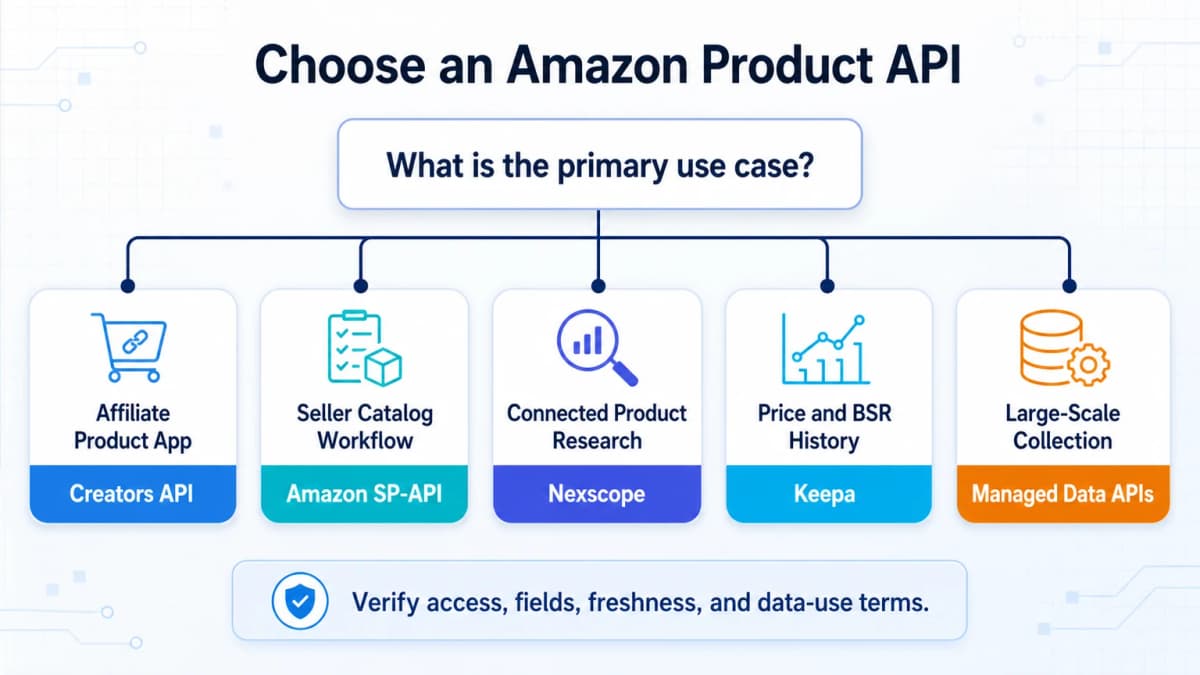
The correct API becomes clearer when the team starts with authorization, data type, and refresh needs instead of provider names.
Affiliate Product Apps
Amazon Creators API is the primary fit for approved affiliate experiences that display Amazon products and link shoppers to Amazon. Its official catalog operations and program context matter more than broad competitor coverage.
An independent product API may help with internal research, but it does not remove the affiliate program's display and attribution requirements. Legal and product teams should review both the provider terms and Amazon's applicable policies.
Seller Catalog Workflows
SP-API Catalog Items is the correct starting point for authorized seller or vendor software. It connects to Amazon's catalog and can operate alongside listing, inventory, pricing, order, and notification APIs.
Independent APIs can add public competitor and market context. They should complement SP-API rather than impersonate seller-authorized access.
Product Research Data
Nexscope is the strongest overall fit in this ranking when the job spans product database filters, product discovery, ASIN details, product history, and price series. Its wider Amazon Data API also connects product research with keyword, review, competitor, sales, market, and policy data.
That breadth helps a team move from discovery to validation. Product-detail data can check listing content, database queries can screen candidates, and history can prevent a temporary price or BSR snapshot from being treated as a stable opportunity.
Price and BSR History
Keepa is the specialist choice for deep Amazon price and rank history. Nexscope's Product History and Product Price Series APIs are useful when historical product data needs to sit beside other product-research workflows within the Nexscope data layer.
Sales estimates require extra care. Tools listed in a free Amazon sales estimator comparison can produce different values because models, category assumptions, and update times vary. An estimated sales field should always remain labeled as an estimate.
Large-Scale Collection
Bright Data and Oxylabs are strong candidates for teams that need async jobs, batching, webhook delivery, localization, and collection infrastructure. DataForSEO fits task-based pipelines, while Rainforest API, ScraperAPI, and SerpApi provide more focused Amazon request patterns.
A production benchmark should use the same ASINs, keywords, countries, and collection windows. The evaluation should record successful-response rate, median latency, missing fields, retry cost, and output consistency. Headline price per request is incomplete when providers use different credit multipliers, job models, and definitions of a billable result.
Selection Checklist
An Amazon product API should be tested against the actual workload before engineering commits to a provider.
- Define required fields. Separate essential identifiers, content, offers, reviews, rankings, estimates, and historical series from optional fields.
- Confirm the access model. Affiliate, seller-authorized, independent research, and managed public-page collection have different requirements.
- Test marketplace coverage. Run the same ASINs across every required Amazon domain and language.
- Measure freshness. Record source time and collection time for price, availability, offers, BSR, reviews, and estimates.
- Inspect missing values. A stable schema should distinguish an unavailable field from a real zero or empty value.
- Benchmark successful-result cost. Include token multipliers, retries, failed jobs, parsing, storage, and webhook delivery.
- Plan rate limits. Check burst limits, sustained throughput, batch size, async queues, and callback behavior.
- Review storage rules. Confirm how long the application may cache or display product content under Amazon and provider terms.
- Protect credentials. Keep API keys in server-side secrets and never expose them in client code, logs, or public repositories.
- Label estimates. BSR-derived sales, revenue, demand, and opportunity scores should not be presented as verified Amazon account sales.
Conclusion
The best Amazon product API depends on who authorizes the application and what data the application needs. Amazon Creators API fits approved affiliate product experiences. Amazon SP-API Catalog Items fits seller and vendor catalog workflows. Keepa specializes in historical price and BSR data. Managed providers such as Rainforest API, DataForSEO, Bright Data, Oxylabs, ScraperAPI, and SerpApi address different collection and delivery requirements.
Nexscope ranks first for teams that want connected Amazon product intelligence rather than a single isolated lookup. Its six product APIs cover database filtering, database search, product details, discovery, history, and price series. REST API and MCP make the data available to applications and a team's own Agent, while the Nexscope web product provides a direct interface to the same data capabilities.
The most practical starting point is the Amazon Product Detail API. It covers the common ASIN-to-structured-data workflow and can expand into the other product endpoints as research needs grow.
Build With Nexscope Amazon Product APIs
Start with product details, then expand to search, discovery, history, and price-series endpoints as the workflow grows.
Get a Nexscope API Key →API key • REST • MCP • Skill
Frequently Asked Questions
What is an Amazon product API?
An Amazon product API is a programmatic interface that returns Amazon product information in a structured format. Depending on the provider, it may include ASINs, titles, images, descriptions, prices, offers, availability, ratings, reviews, variants, categories, BSR, sellers, search results, or historical data. The term covers several access models. Amazon Creators API serves affiliate experiences, SP-API serves authorized sellers and vendors, and independent APIs support research, monitoring, or managed public-page data collection.
Does Amazon have an official product API?
Yes. Amazon provides official product interfaces for defined programs. Amazon Creators API gives approved affiliate and creator partners access to product search and catalog content. Amazon Selling Partner API gives authorized seller and vendor applications access to catalog and operational data. These APIs have different eligibility, authorization, licensing, and display rules. Neither should be treated as an unrestricted public competitor-intelligence API.
What replaced Amazon Product Advertising API 5.0?
Amazon now directs affiliate publishers and creators toward Amazon Creators API. Creators API includes operations such as SearchItems, GetItems, GetVariations, and GetBrowseNodes. Existing developers should follow Amazon's current migration and onboarding documentation because credential setup, resources, license terms, locales, and availability may differ from PA-API 5.0. An article or integration that still assumes PA-API is the default current interface may be outdated.
What is the difference between Creators API and SP-API?
Creators API is designed for approved affiliate and creator experiences that help shoppers discover Amazon products. SP-API is designed for applications authorized by Amazon sellers or vendors. SP-API connects catalog data with listing, inventory, pricing, order, and other operational workflows. Creators API focuses on affiliate product content and shopping experiences. The required authorization, permitted use, returned fields, and rate limits differ.
Which Amazon product API includes price history?
Keepa is a specialist source for Amazon price, BSR, offer, deal, and related product history. Nexscope also provides Amazon Product History and Amazon Product Price Series APIs for supported historical product workflows within its broader ecommerce data layer. Other managed APIs may return a current price but require the customer to schedule requests and store snapshots to build history. Teams should confirm backfill depth, sampling frequency, missing-value rules, and marketplace coverage.
Can an API return reviews and seller offers?
Yes, several independent Amazon data APIs return review summaries, review text, seller offers, Buy Box information, or fulfillment details where supported. Coverage varies by provider, endpoint, marketplace, and page state. Amazon's official APIs follow their own program scopes and do not expose every public-page module for every use case. Representative ASIN tests should include products with variants, multiple sellers, coupons, sparse reviews, and out-of-stock states.
How should developers choose a provider?
Developers should begin with the required authorization model, fields, marketplaces, update frequency, and throughput. The next step is a controlled benchmark using identical ASINs and keywords. Compare successful-response rate, latency, missing fields, historical depth, localization, request or token cost, documentation, webhooks, SDK support, and permitted storage. The selected provider should solve the required workflow without forcing estimated or unavailable data to appear more certain than it is.
Sources
- Amazon Associates. (2026). Creators API Documentation and SearchItems Reference. Retrieved from affiliate-program.amazon.com
- Amazon Selling Partner API. (2026). Catalog Items API Documentation. Retrieved from developer-docs.amazon.com
- Keepa. (2026). Keepa API Documentation. Retrieved from keepa.com
- Traject Data. (2026). Rainforest API Product Data Documentation. Retrieved from docs.trajectdata.com
- DataForSEO. (2026). Merchant API Amazon Documentation. Retrieved from docs.dataforseo.com