
How to Find Suppliers for Amazon FBA in 5 Steps
Table of Contents
To find suppliers for Amazon FBA, decide whether you need a manufacturer for your own product or a distributor for an existing brand. Write a short specification, shortlist suppliers, and ask each one to quote the same SKU, quantity, and delivery terms. Order samples from the strongest candidates and calculate the cost per sellable unit before committing to a production run.
For private-label sourcing, 1688 gives you two starting points. You can search by a product photo when you know what the item looks like, or search by Chinese keywords when you know the material, dimensions, or features you want. Either search can give you a list of offers to investigate, with prices and order quantities to check before you contact the seller.
If you use an AI agent, we recommend connecting Nexscope MCP so it can pull 1688 offers into your sourcing workflow. The Agent walkthrough below includes a setup prompt and one prompt for each sourcing step.
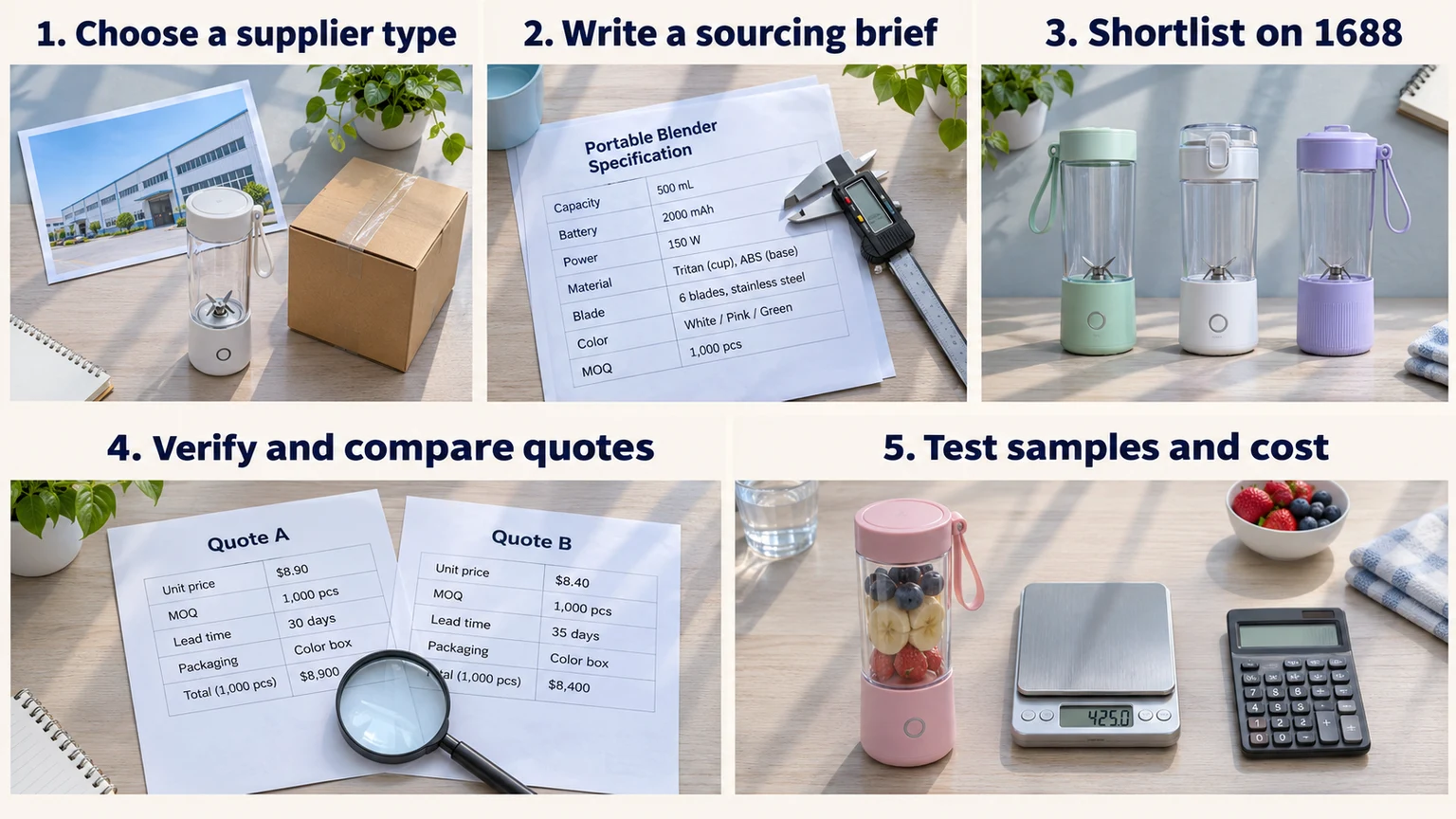
Illustrative photos and example quote details.
1. Choose the right type of supplier
| What you plan to sell | Where to start | First thing to verify |
|---|---|---|
| An item under your own brand | Manufacturers, sourcing partners, or marketplaces such as 1688 | The supplier can meet your specifications, packaging requirements, and first-order quantity. |
| An existing branded item | The brand or an authorized wholesale distributor | Your ability to sell the exact ASIN and the supplier's ability to provide the documents needed for approval, where applicable. |
If you want to sell a branded product, check the exact ASIN in Seller Central before buying inventory. Amazon may ask for a purchase invoice or brand authorization depending on the product and approval process. Ask the distributor what it can provide before paying.
If you want to build a private-label product, compare domestic manufacturers, overseas factories, and trading companies by the terms they can deliver. If you are choosing between sourcing marketplaces, compare the buying workflows on 1688 and Alibaba. A trading company can be useful for a small order with several components. Ask who will make the product, who handles quality problems, and which legal entity will appear on the invoice.
2. Turn an Amazon listing into a sourcing brief
Use the listing to identify what shoppers expect and what you could improve. Write down the target dimensions, materials, included accessories, and packaging. Then turn recurring review themes into checks you can repeat on a sample.
For a portable blender, a complaint about leaks suggests assembling, filling, and testing each sample under the same conditions. A charging complaint suggests testing recharge time and how many identical blending cycles the battery completes. A complaint about weak performance is easier to investigate when you use the same ingredients, cut size, and fill level for every unit.
Keep the brief short enough to send with the first inquiry:
- Product and variant — Material, dimensions, color, capacity, and accessories.
- Packaging — Unit box, inserts, outer carton, and room for any required labels.
- Order quantities — Sample quantity, initial order quantity, and the quantity for a potential reorder.
- Acceptance criteria — The measurements or tests you will use to approve the sample.
- Delivery point — The warehouse or other address the supplier should quote to, plus your target arrival date.
Treat a reference photo as a way to communicate shape or function. Specify your own requirements and check intellectual-property issues before adopting a design, logo, or branded packaging.
3. Build a supplier shortlist on 1688
Start with an image and refine by keyword
Start with a clear photo of the product or component you want to source. A single product on a plain background gives you a more focused starting point than a collage. When you search 1688 by image, save the offer ID, listed price, and any minimum order quantity (MOQ) for each promising match.
If two offers look alike, search 1688 by product keyword using the Chinese product name plus a term for the material, capacity, or use. A stainless-steel variant and a plastic variant can look similar in a thumbnail. The same approach works when you browse 1688 in English.
Compare the offer and the exact SKU
Open the 1688 offer details to check what each listing says about the price tiers and variants. Once you have a match, check the exact SKU for its spec ID and any listed price or stock. Confirm availability and the price for your order quantity with the supplier.
A headline price may apply to a smaller size, an accessory, or a higher quantity tier. An MOQ shown for a stock item can also differ from the MOQ for printing your logo or changing the box. Put these on separate lines in your comparison sheet.
What a portable-blender search returned
In a Nexscope image-search test on October 7, 2026, we used the product photo from Amazon ASIN B0CT2BY5KL as the search input. The 1688 search returned 10 candidate offers on 1688 with listed prices of ¥28 to ¥79. The team opened two offer-detail records. Both returned five SKU entries and a displayed one-unit minimum.
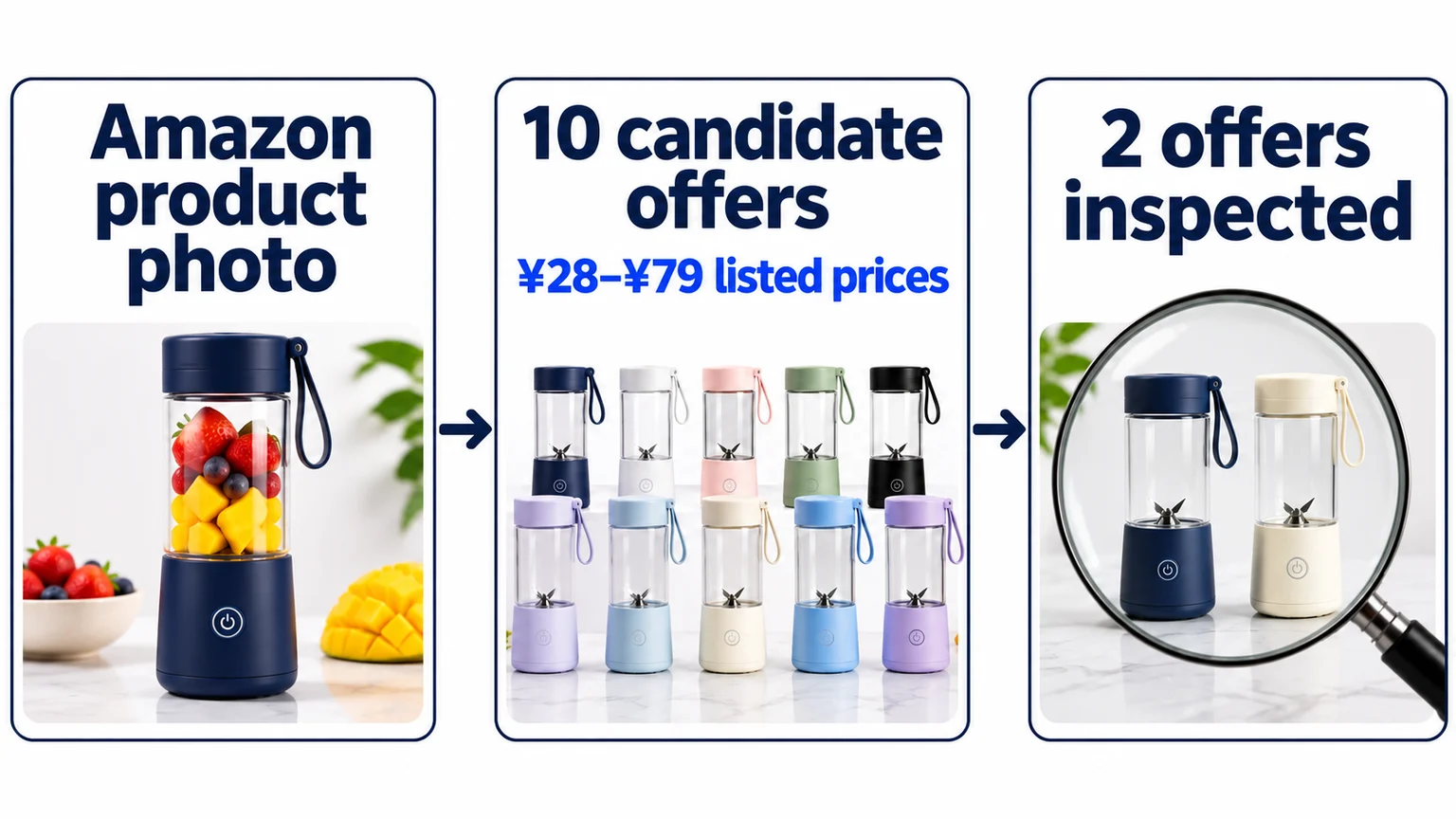
Illustrated summary of one 1688 image search. Product photos are illustrative.
Those two records gave us a starting point for sample inquiries. The next questions were whether the suppliers could provide the required battery and motor specifications, which accessories the quoted SKU included, and what the finished package weighed. Similar photos and listing fields give you leads. Supplier documentation and physical samples answer the questions that matter before a purchase.
4. Verify suppliers and compare quotes
Send every supplier the same request
Hi, I’m sourcing a [product] for a US ecommerce business. I’ve attached the target dimensions, material, and packaging requirements. Could you confirm the exact SKU, sample cost, and unit prices at [quantity A] and [quantity B]? Please quote plain and branded packaging separately and include each MOQ, production lead time, carton dimensions and weight, and delivery terms to [location]. Please also tell me which steps you handle in-house and what product documentation you can provide.
Ask how long the quote is valid and whether packaging or tooling fees are charged separately. If a supplier proposes a substitute, get the changes in writing and quote it as a separate option. That keeps a cheaper configuration from being compared directly with the configuration you asked for.
Check the company and the terms
Ask for the legal company name, production address, and invoicing entity. Compare them with the marketplace profile and the details on the quote. Where the factory, seller, and payment recipient differ, ask each party’s role and request supporting documentation before placing the order.
For products that require testing or other documentation, request materials for the exact model and target market. A report for a similar model may leave your specific configuration uncovered. Decide which open questions can be settled with a sample and which need documentation or an inspection.
Put all quotes on the same footing. Compare the same variant, packaging, quantity, delivery point, and allocation of freight or customs responsibilities. Ask for packed dimensions and weight early so you can obtain a freight estimate before selecting a supplier.
5. Test samples and estimate landed cost
Make the sample decision repeatable
Order samples from the strongest candidates and record each supplier, SKU, and date. Run the same tests and photograph the accepted configuration. For the blender example, that means standardizing the ingredients, charge level, fill level, and leak test. Inspect the unit packaging and outer carton, along with the product itself.
Share the approved specifications and sample photos with the supplier. Agree on how changes will be approved, what production inspection will check, and how material defects or short shipments will be handled. Before inventory moves, check Amazon's current prep, packaging, and labeling requirements for your product and shipment.
Calculate the cost per sellable unit
Add merchandise, packaging, inspection, freight, duties, customs brokerage, and any prep and inbound delivery costs you include in your landed-cost calculation. Convert supplier quotes into one currency using the same exchange-rate assumption. Divide the total by the number of units you expect to be able to sell.
For example, if your merchandise, packaging, inspection, freight, and inbound prep total $2,450 with applicable duties already included, and you expect 490 sellable units out of a 500-unit order, your estimated cost is $5.00 per sellable unit. Use Amazon’s Revenue Calculator with your intended sale price and packed dimensions to estimate marketplace fees. Then account for costs such as advertising and returns that affect your margin.
Once you have agreed on a SKU and quantity, preview the 1688 order to check the items, shipping details, and payable amount for the selected delivery address. Include any onward freight, duties, or FBA prep not covered by that amount in your landed-cost estimate.
Before you commit to the first order
- The approved sample matches the SKU and specifications on the quote.
- The order quantity, production schedule, delivery terms, and inspection plan are in writing.
- Product documentation and labeling have been checked for the exact configuration.
- The margin still works at a conservative landed-cost estimate and sale price.
How to Run the Full 1688 Sourcing Workflow in Your AI Agent
With Nexscope MCP, your AI agent can use Amazon product data to draft a sourcing brief, find and compare offers on 1688, and preview an order once you’ve confirmed the SKU, quantity, and delivery address. You can also give it the quotes and sample results you’ve collected to help compare suppliers and estimate landed cost.
First, connect Nexscope MCP to your agent by pasting this prompt:
Set up Nexscope for me — read and follow https://www.nexscope.ai/agents.md
Once Nexscope is connected, run the five sourcing prompts below in order.
1. Choose a supplier type
Give the agent your intended selling model and whether you own the brand.
I plan to sell [product] on Amazon US as [my own brand or an existing brand]. Help me decide whether to approach a manufacturer, a trading company, or an authorized distributor. List the documents or selling permissions I should check before requesting quotes.
2. Write the sourcing brief
If you have a reference ASIN, use Amazon product details as input alongside your own requirements.
For Amazon US ASIN [ASIN], pull the available product details and draft a sourcing brief using my requirements [materials, dimensions, packaging, quantity, and target cost]. Separate observed listing details from my own requirements. Flag missing specifications and suggest checks I can run on a sample.
3. Shortlist offers on 1688
Use image search with a public product image URL or keyword search with Chinese product terms. Use the returned offer IDs to inspect the most relevant listings.
Find 1688 offers for [public image URL or Chinese search terms] using my sourcing brief. Open details for up to three candidates that best fit the brief. List each offer ID, available variants, stated MOQ, and price tiers. Flag any specification you cannot verify from the listing.
4. Review suppliers and compare quotes
Bring back the quotes and documents you have collected. Leave blank any price or claim the supplier has yet to confirm.
Compare these supplier quotes [quotes] against my sourcing brief. Line up the exact variant, quantity, sample cost, unit price, packaging, lead time, and delivery terms. Flag discrepancies in company and payment details for me to verify. Draft follow-up questions I can send to each supplier.
5. Review samples, estimate costs, and preview the order
Use your actual sample notes and freight estimates. With an active 1688 buyer authorization and a Nexscope API key, you can look up the exact SKU and preview the selected order.
Use my sample results [notes], supplier quote [quote], and shipping estimates [costs] to compare the candidates and calculate estimated landed cost per sellable unit. Flag missing costs. Once I confirm the offer, variant, quantity, and delivery address, look up the spec ID and preview the order if my 1688 account is authorized. Show the item total and quoted shipping separately. Stop after the preview without creating or paying for an order.
Conclusion
Choose a supplier type that fits your selling model, then use one sourcing brief to find candidates, compare quotes, and test samples. Place a first order only after you have confirmed the exact variant, agreed on the terms, and estimated the landed cost per sellable unit.
Use Nexscope from sourcing to launch
Nexscope is an ecommerce data and creative platform that supports the work from product research to launch.
- Ecommerce data. Bring marketplace data from Amazon, 1688, and other platforms into product, market, and competitor research.
- Sourcing and procurement. Use 1688 sourcing and procurement to go from finding products and suppliers to managing orders.
- Creative generation. Use image and video generation to create product visuals for listings and marketing.
Bring these capabilities into your own workflows through REST APIs or connect supported tools to your AI agent with Nexscope MCP.
Build your first 1688 supplier shortlist
Start with a product photo. Use Nexscope’s 1688 data tools to find similar offers and compare prices and minimum order quantities before you request samples.
Sign up to start sourcingFAQ
Can I use 1688 to source products for Amazon FBA?
Yes. Start by shortlisting offers that meet your private-label specifications and order quantity. Confirm the exact SKU, request a sample, and make a plan for payment, shipping, and FBA prep before ordering inventory.
How do I check whether a 1688 supplier is a manufacturer?
Ask who owns or operates the production facility, which work is done there, and which steps are outsourced. Compare the business name and production address with supporting documents. A factory visit or independent audit can help when production capability is material to the order.
What should I ask a supplier before ordering samples?
Ask for the exact SKU, sample price, shipping charge, and dispatch time. Check whether the sample uses the same materials and packaging planned for production, how the production MOQ differs, and whether the supplier can provide relevant documents for the exact model.
Can I buy branded products from 1688 and resell them on Amazon?
Check whether your seller account can list the exact branded ASIN and whether the supplier can provide acceptable sourcing documents for that product. Where approval is required, check Seller Central for the applicable process and documentation before purchasing stock.
Sources
- Amazon. How to Find Wholesalers for Your Ecommerce Business. sell.amazon.com
- Amazon. FBA Prep, Packaging, and Labeling. sell.amazon.com
- Amazon. Estimate Fees and Costs. sell.amazon.com
- Nexscope. Portable Blender Amazon-to-1688 API Test. October 2026.
- Nexscope. 1688 MCP Tool Documentation. www.nexscope.ai