

How to Use Jev for SEO in 10 Practical Decision Workflows

The recent buzz around Jev AI raises a practical question: where does Jev for SEO fit into everyday work? Developed by TypeSafe, Jev evaluates supplied information and returns structured answers: a choice from predefined options, a score against a rubric, or the probability that a statement is true. That makes it relevant to the small judgments that fill an SEO team's day. Which keywords fit the business? Which pages need updating? Would an internal link help the reader? Repeating those checks across hundreds of records creates a substantial review workload.
The opportunity is to turn those judgments into a more consistent process. This guide explores ten practical ways to use Jev, with the evidence each task needs and examples of how the answers can guide the next action. Each workflow pairs a focused judgment with the data needed to make it, a reviewable output, and a way to assess whether the process works.
Jev's Role in SEO
Three Decision Types
Jev provides three building blocks for SEO decision workflows. Its documented primitives support three answer types:
| Type | Answer shape | Proposed SEO use |
|---|---|---|
| Choice | A selection from supplied options | Assign a page to a predefined content category |
| Score | A position on a defined scale | Rate relevance to a specified audience |
| Noul | The probability that a statement is true | Assess whether a destination answers a question raised in a paragraph |
Questions should isolate one judgment. “Does this page explain installation?” is easier to specify than “What should the SEO team do next?” A decision about updating a page may require several separate checks, combined with business rules.
Questions evaluated together do not automatically consume each other's answers. If a later check requires new evidence selected by an earlier result, the application must perform that additional step explicitly.
Evidence Before Decisions
A useful division of responsibility is:
Data sources → validation and calculations → Jev judgments → action rules → reviewed changes.
A crawler or API supplies observations. Code handles exact comparisons, arithmetic, and known constraints. Jev evaluates contextual questions. An editor or a text-generation model prepares revisions when writing is needed.
For example, code can identify a missing H1 without consulting Jev. Determining whether an existing H1 accurately represents a page requires a different kind of assessment. Spending model calls on the second task is a more defensible starting point.
The following workflows apply this division to common SEO tasks. Their usefulness must be evaluated on the site's own data.
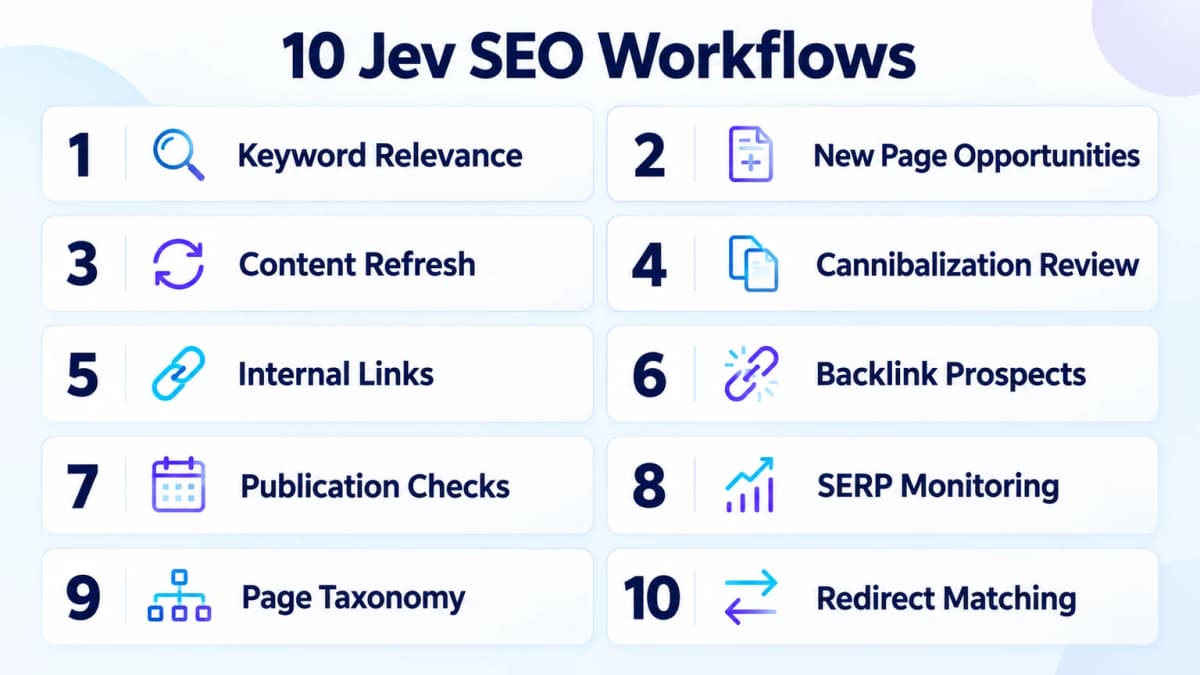
10 Practical SEO Workflows
1. Keyword Relevance
Keyword lists often mix useful topics with adjacent ideas, wrong audiences, and products a business does not offer. A store selling reusable coffee filters might receive suggestions about water filtration or industrial filtration. Word overlap alone cannot resolve the difference.
Use the Nexscope Keyword Expansion API to retrieve keyword suggestions and related terms, retaining their source relationships and available metrics. The documented keyword expansion request supports US English and a maximum limit of 20, so design around bounded candidate sets.
Give Jev the candidate, a concise description of the business, its exclusions, and the target audience. Ask separately whether the term concerns the offering and whether its likely user matches the intended audience. Route ambiguous terms to review instead of silently discarding them.
The output is a qualified research list. Search demand still needs independent evidence. A suggestion without volume is not a zero-volume keyword, and relevance does not establish commercial value. Check a manually labeled sample to see which worthwhile terms the filter misses.
2. New Page Opportunities
A competitor ranking for a query creates a research lead. It does not establish that the site needs another URL.
Use the Nexscope Domain Keyword Intersection API to identify candidate terms from a domain keyword gap sample. The documented FIRST_ONLY mode supports comparing terms observed for the first domain against the second. For a competitor-led investigation, put the competitor first and the site being improved second. The current contract is US English, capped at 20 results, without pagination.
Compare each candidate with existing pages and relevant search results. Jev can assess whether the existing content addresses the same need, whether a missing subtopic belongs within it, and whether a proposed page would serve a distinct task.
For a filter store, “how to clean a reusable coffee filter” could justify a maintenance guide even when a product page already ranks for the product name. A wording variant of an existing cleaning query may fit the same guide.
Review the recommended content brief before creating a URL. Database gaps, weak rankings, and genuinely missing content are different findings.
3. Content Refresh Triage
A traffic decline is a reason to investigate. The correct response might involve content, technical fixes, seasonal demand, or changes in search results.
Begin with first-party Search Console data using comparable date windows and consistent country, device, and query filters. Use the Nexscope Page Evidence API to collect current titles, headings, text, and available technical observations. Preserve each snapshot's collection time and any truncation flags.
Jev can then evaluate focused questions: Does the page answer the leading query's task? Does a dated claim conflict with a supplied current reference? Is an important product capability absent from the explanation?
Combine those findings with impact and effort estimates outside the model. A high-value page with a verifiable outdated instruction may warrant prompt editing. A seasonal article with accurate content may require monitoring instead.
Deliver an update queue with evidence attached. The page-evidence API does not supply Search Console clicks, and a refresh recommendation should not imply that rewriting will recover traffic. Validate the diagnosis before assigning the edit.
4. Cannibalization Review
Two URLs appearing for the same query can serve different needs. A product page and a troubleshooting guide may both be useful results.
For selected page pairs, use the Nexscope Page Keyword Intersection API to retrieve overlapping organic keywords, then inspect them alongside content and query-page history. The documented endpoint returns a bounded US English sample with ranking evidence; it does not diagnose harmful competition.
Ask Jev whether the pages target the same audience, solve the same task, and contain materially distinct information. Keep these questions separate so the review can distinguish a broad topical relationship from substantial duplication.
Consider two articles titled “Coffee Filter Cleaning” and “Removing Coffee Oils From a Metal Filter.” If the second provides a specific method absent from the first, keeping both with clearer positioning may be reasonable. If both repeat the same instructions for the same reader, consolidation becomes a candidate for editorial review.
Evaluate query coverage and business value before choosing an action. Shared keywords should trigger investigation, not an automatic merge or redirect.
5. Internal Link Selection
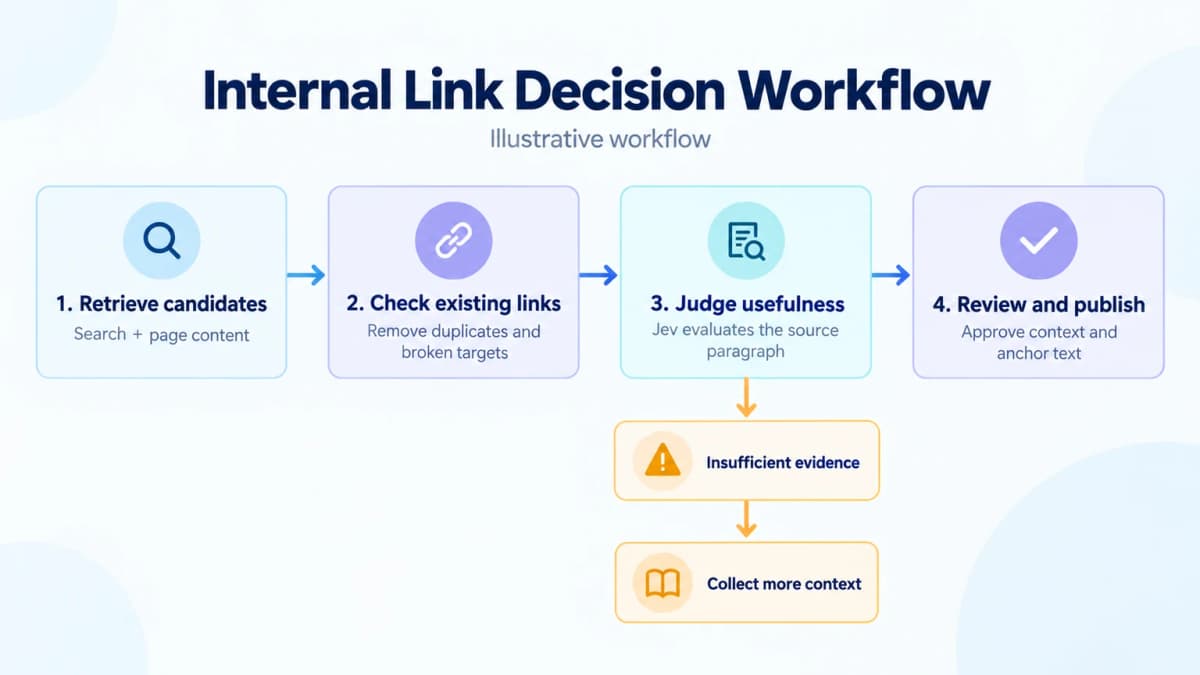
Internal linking combines candidate discovery with a contextual judgment: does this destination help at this point in the article?
Retrieve potentially relevant pages through search or embeddings. Then use the Nexscope Website Links API to check existing source–destination pairs, anchors, and available target status. This endpoint requires a valid crawl task_id; its records describe the available sample, not necessarily every link on the site.
Pass the source paragraph and candidate destination content to Jev. Evaluate topic fit and whether the destination adds information the paragraph leaves unresolved. A cleaning guide could reasonably link to a detailed explanation of filter materials when discussing maintenance differences. A second general cleaning article may add little.
The output should identify a candidate paragraph and destination. An editor can then choose natural anchor wording and approve the change. Google recommends descriptive anchors and contextual links that help readers.
Measure the share of suggestions editors accept and the reasons for rejection before expanding the workflow.
6. Backlink Prospect Qualification
Competitor backlink exports can include promising publications, irrelevant directories, outdated pages, and sources that do not fit the brand's audience.
Build a bounded prospect set with the Nexscope Backlink Records API, retaining source URLs, anchor context, available follow attributes, and observation dates. The documented backlink request accepts a domain or page target and returns up to 20 records without pagination.
Retrieve the candidate pages before asking Jev to assess their subject matter, audience fit, and whether a relevant contribution or resource would make sense there. Those judgments can organize a research queue for outreach.
A specialty coffee publication discussing reusable brewing equipment may be relevant to the filter store. A page listing unrelated software companies probably needs little further attention, even if a provider metric looks impressive.
Keep provider rank and spam scores separate from editorial fit. They are not Google ratings or measured referral traffic. Validate promising prospects manually, and do not infer that a relevant website will accept a contribution or add a link.
7. Publication Checks
Before publication, compare a draft with an approved brief, product facts, and required disclosures. Jev can evaluate whether the draft addresses the intended question and whether specific claims are supported by the supplied evidence.
For instance, an article should not describe a filter as dishwasher-safe when the manufacturer instructions supplied to the workflow allow hand washing only. Break claim checks into manageable units and send missing evidence back to the editor.
After publication, the Nexscope Website Page Checks API can support a separate verification pass. Available fields include titles, descriptions, status codes, and missing-H1 checks. This crawl-based endpoint requires task_id and returns a bounded sample; it cannot inspect a private draft simply because its text was reviewed earlier.
A broader Shopify SEO checklist remains useful for planning checks outside the model's scope.
Editorial approval and live-page verification are separate milestones. A model score establishes neither successful deployment nor search performance. Google's guidance also emphasizes accuracy, quality, and added value in AI-assisted content.
8. SERP Page-Type Monitoring
A query's results may contain a changing mix of product pages, category pages, comparisons, and instructional articles. Tracking that mix can help a team notice when its planned format deserves another look.
Use the Nexscope SERP API to collect comparable search-result samples, saving collection times and original ranks. The documented search request supports US English desktop searches and up to ten results.
Use titles, descriptions, and, where needed, retrieved landing-page content to ask Jev which editorial format each result represents. The API's search-result type field should not be treated as a ready-made product-page-versus-guide classification.
Code can calculate the observed format distribution across stored snapshots. If a query repeatedly shows instructional results while the planned page is purely transactional, the content team has a concrete reason to reconsider its approach.
One sample is insufficient to establish a durable shift. Keep query settings consistent, distinguish organic listings from other result types, and verify ambiguous classifications. The useful output is a change to investigate, with the supporting results attached.
9. Page Taxonomy Assignment
As a site expands, articles and products often accumulate in inconsistent categories. A clear taxonomy helps editors maintain sensible relationships among pages.
Start with the site's approved categories and descriptions. The Nexscope Keyword Categories API can provide an additional signal about a page's target terms. The documented endpoint accepts up to 20 English keywords and returns provider category identifiers and taxonomy information.
Those identifiers are not the site's own navigation structure. Give Jev the actual page content and permitted categories, then ask it to select a suitable destination or report that none fits.
A filter-cleaning article might belong under “Care and Maintenance,” while a materials comparison belongs under “Buying Guides.” Both can relate to the same product family without sharing the same editorial role.
Use the proposed mapping to support keyword placement on Shopify pages and content organization. Review assignments before changing navigation or URLs. Classification alone does not justify generating a new indexable category page.
10. Redirect Matching
Website migrations require old URLs to be matched to appropriate destinations. Exact path rules and product identifiers can resolve straightforward cases; semantic matching is useful where names or content organization have changed.
Preserve the old content before migration. Retrieve likely new-page candidates, then ask Jev whether each candidate addresses the same entity and user task. Include a no-suitable-match route instead of forcing every old URL to a destination.
An old filter-care guide may match a revised care guide even when the slug changes completely. A general storefront homepage may not preserve the same purpose.
After an approved mapping is deployed, use the Nexscope Website Redirect Chains API to inspect existing redirect chains for available hop and loop evidence. This endpoint requires a valid crawl task and observes existing redirects; it neither selects targets nor changes server configuration.
Google's site-move guidance covers URL mapping, redirects, and monitoring. Keep migration review explicit because an unsuitable destination can affect both users and search discovery. Test destination content as well as HTTP behavior.
Build a Measurable Pilot
Select a Bounded Task
Internal link recommendations offer a practical first experiment because an editor can inspect each proposed change before publication. Select a manageable group of related pages and preserve their original content and links.
Create a review set containing clear matches, tempting but weak matches, broken targets, and cases with insufficient context. Include examples an editor would reject. A test made only of obvious positives says little about the workflow's usefulness.
The crawl-based APIs above depend on an existing valid task. Confirm how that task is created and which identifier downstream requests require before wiring a runnable integration. Do not substitute another response identifier just because it resembles a task ID.
Define the Judgments
For each candidate, ask questions such as:
- Does the destination address a topic explicitly raised in the source paragraph?
- Does it add information beyond the source page?
- Would following it help the reader complete the current task?
Preserve the original input, question definitions, model version where available, and returned values. An editor should be able to reproduce the review context without asking a second model to invent a justification.
Choice and Score include probability distributions and a derived confidence value. Noul returns a probability without a separate confidence field. TypeSafe's confidence documentation recommends adapting thresholds to the task and consequences of errors.
Calibrate routing against labeled examples. Keep uncertain cases in a review queue, and let missing evidence trigger additional collection. A rejected candidate should not disappear from the audit trail.
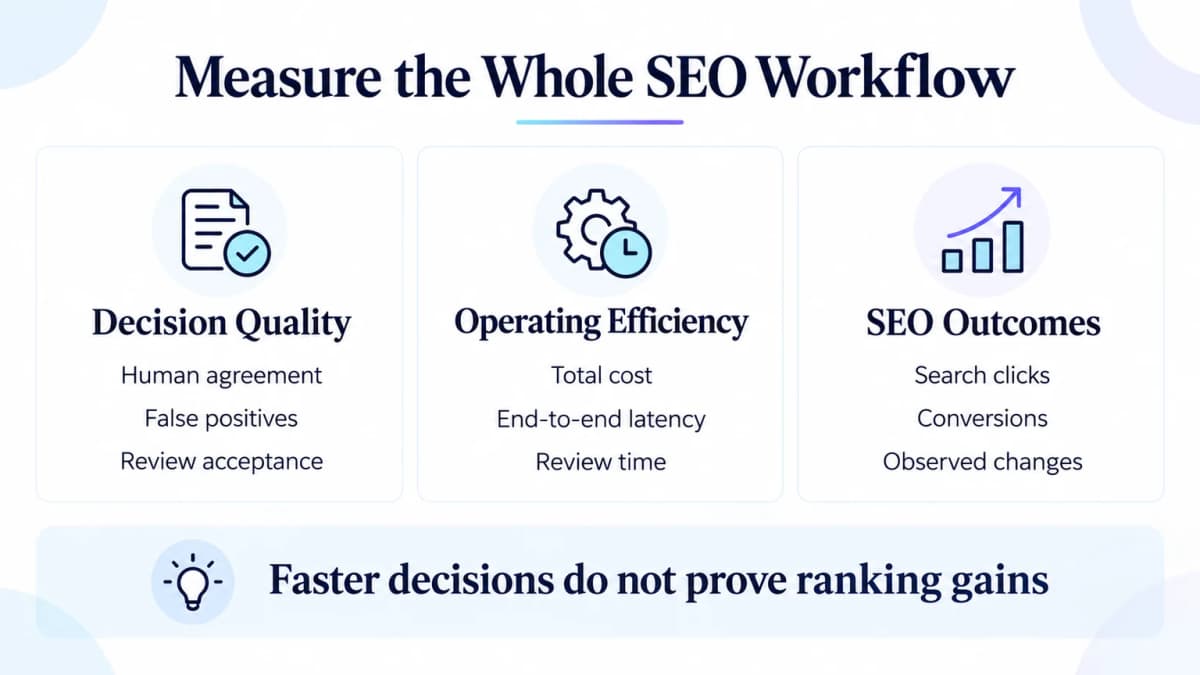
Evaluate the Complete Process
Compare the proposed system with a simple baseline: manual review, existing rules, or the team's current model workflow. Apply the same evidence and judging criteria to each.
| Measurement | Useful question |
|---|---|
| Decision quality | How often do reviewers agree, and which errors recur? |
| Suggestion acceptance | What proportion of reviewed recommendations gets approved? |
| Operating efficiency | How much collection, processing, and review time does a batch need? |
| Total cost | What are the data, model, infrastructure, and human-review costs? |
| SEO outcomes | What happens to relevant search traffic and conversions after approved changes? |
A low model bill can coexist with expensive data collection or review. Record both request latency and the time needed to deliver an approved batch.
After publication, observe meaningful page and query groups over comparable periods. Keep records of other changes and seasonal conditions. Where feasible, use comparable unchanged pages as a reference. A before-and-after increase alone does not establish that Jev caused the result.
Expand the pilot when it improves the review process without unacceptable errors. Search outcomes need their own evaluation.
Common Implementation Mistakes
Vague Questions and Missing Evidence
“Is this good for SEO?” leaves the audience, objective, and standard undefined. Replace it with questions tied to supplied evidence and an action the team can review.
Missing text also creates false certainty. A truncated page can appear to omit an answer that exists farther down. Check coverage before treating an absence as a defect. Likewise, keep unknown metrics as unknown instead of filling them with zero.
Confidence and Action Risk
A confidence value is not a guaranteed correctness rate on the site's SEO tasks. Evaluate errors empirically, including mistakes among answers the model considers confident.
Match review requirements to consequences. A keyword label is easier to correct than a mass redirect, page deletion, or noindex change. Keep high-impact actions behind explicit review and retain a record of approved changes.
Samples and Sweeping Claims
A bounded API response is not a complete picture of a website, market, or backlink profile. Preserve market settings, sample limits, timestamps, and missing-field information throughout the pipeline.
Similarly, a fast decision does not prove ranking improvement. Avoid presenting manufacturer benchmarks, illustrative examples, or synthetic API responses as results achieved on a live SEO project.
Conclusion
Jev gives SEO teams a way to experiment with repeatable semantic judgments across keywords, content, links, and migration candidates. The strongest starting point is a specific task with clear evidence, a defined review standard, and measurable errors.
Nexscope SEO Data APIs provide keyword, search, page, and backlink evidence for these workflows, giving Jev concrete inputs to evaluate. Preserve collection dates and coverage limits so each decision can be traced to its inputs, and keep approved changes tied to clear business rules.
Start with one workflow, retain its evidence, and compare the complete process against an existing baseline. That creates a practical basis for deciding whether wider automation is worthwhile.
Build Your Jev SEO Workflow
Give your Jev SEO workflow the data it needs with Nexscope SEO Data APIs. Explore keyword research, SERP analysis, page checks, and backlink data to support the decisions you want Jev to evaluate.
Frequently Asked Questions
What is Jev for SEO?
Jev for SEO means applying TypeSafe's structured decision model to specific search-optimization tasks. Examples include classifying keyword relevance, evaluating potential internal links, and checking whether two pages serve the same purpose. These are proposed applications of its decision interface. A working system still needs suitable data, explicit criteria, software that uses the answers, and a review process appropriate to the action.
Can Jev write SEO articles?
Jev's documented interface produces typed answers to defined questions rather than free-form article text. It can participate in a writing workflow by evaluating supplied evidence or classifying a draft against a rubric. Drafting, revising prose, and producing explanations require an editor or a suitable text-generation component. That division also makes it easier to measure evaluation quality separately from writing quality.
Can Jev access Google Search Console?
A Jev decision request does not itself establish access to a Search Console property. The surrounding application must obtain authorized data and supply the relevant context. Third-party keyword and ranking datasets do not replace a site's first-party clicks and impressions. Use consistent date windows and filters when combining those sources.
How can Jev help with internal linking?
After a retrieval step identifies candidate destinations, Jev can assess their usefulness against the source paragraph and destination content. The application can exclude existing links and unsuitable targets using observed link records and technical checks. An editor then reviews the proposed context and anchor. Test the quality of those recommendations before increasing coverage, and measure later SEO outcomes separately.
Does Jev confidence prove correctness?
No. Choice and Score provide a confidence statistic derived from their probability distributions; Noul supplies a probability without a separate confidence field. These signals can guide routing, but their usefulness depends on the task and input quality. Validate thresholds against labeled examples from the actual workflow. High-impact changes can still require review even when the model reports confidence.
How should teams measure Jev's value?
Measure decision errors, reviewer acceptance, total processing time, and complete operating cost against a consistent baseline. Then evaluate approved live changes using relevant search and conversion data. Keep those two assessments separate: a workflow can save review time without demonstrating a ranking increase. Log the inputs and changes so that later results can be interpreted alongside seasonality and other site updates.
Sources
- TypeSafe AI. (2026). Primitives (Questions). Retrieved from docs.typesafe.ai
- TypeSafe AI. (2026). Confidence. Retrieved from docs.typesafe.ai
- Google Search Central. (2025). Link Best Practices for Google. Retrieved from developers.google.com
- Google Search Central. (2025). Google Search's Guidance on Using Generative AI Content on Your Website. Retrieved from developers.google.com
- Google Search Central. (n.d.). How to Move a Site. Retrieved from developers.google.com