

What Is Meta Muse and How Does Its Personal AI Agent Work?

Meta Muse brings a practical question to personal AI: how much of an everyday task can an assistant actually finish? Finding a restaurant is one step. Checking availability, accounting for preferences, and completing a reservation require several more. That gap between getting an answer and completing a task is central to Muse's appeal.
The product has attracted attention for its early adoption, but downloads explain only part of the story. Its usefulness depends on the work it can complete, the services it can access, and the decisions that remain with the user. Understanding those boundaries makes it easier to judge where a personal agent could save time, where supervision still matters, and what the initial growth figures actually establish.
What Is Meta Muse?
Meta Muse is a personal AI agent designed to carry out tasks across websites and connected services. Meta launched it on September 8, 2026, powered by its Muse Spark model. The launch announcement described access through iOS, Android, and the web in the United States, with free access for everyday use and subscriptions for heavier usage. Meta's launch announcement
The distinction between the product and its model matters. Muse is the application through which someone delegates work. Muse Spark supplies underlying AI capabilities. Evaluating the application therefore involves more than evaluating the model's answers: the surrounding tools, permissions, and task management also affect the result.
Meta positions Muse as a personal agent for a broad audience. For someone considering it, a more useful question than whether it represents an industry first is whether it can reliably complete a specific recurring task.
Key Features and Everyday Tasks
Research and Task Execution
Meta's design overview describes a browser, file system, and terminal that allow Muse to research information, fill forms, create documents, and build tools for a task. It also describes background work that continues after the user leaves the app. Muse's product design
A useful way to evaluate this capability is to define the desired outcome before starting. For a restaurant search, an actionable request would include the date, party size, neighborhood, budget, and dietary requirements. Those details give the agent criteria against which it can assess an option.
A recommendation, an attempted booking, and a confirmed reservation are different outcomes. The final result should make clear which one occurred. The same principle applies to a submitted form, a sent message, or a purchase.
Connected Apps and Routines
Connections make an agent more useful when a task depends on information or actions inside another service. Spotify provides a concrete example: its September announcement says Muse can manage playback, save songs, create playlists, find audio, and schedule listening. Spotify's integration announcement
That makes the value easy to understand. A listener could set up music for a regular workout or prepare audio for a planned trip without handling every step manually.
For any connected service, the practical questions are specific: what information can the agent read, what can it change, and which actions require another decision? An integration's name alone does not answer those questions.
Background Work and Memory
Muse's designers describe persistent context, scheduled work, and notifications when something meaningfully changes or needs attention. The product includes activity information and a Goals view for reviewing ongoing work. Muse's task-management design
For recurring tasks, this changes what a good instruction looks like. A one-time request needs a deliverable. An ongoing request also benefits from a schedule, an end condition, and a clear reason to interrupt the user.
For example, a useful monitoring brief should specify the event worth reporting. Otherwise, an agent may generate frequent updates without reducing the amount of attention the task requires. The benefit should be less manual follow-up, measured against the time spent supervising it.
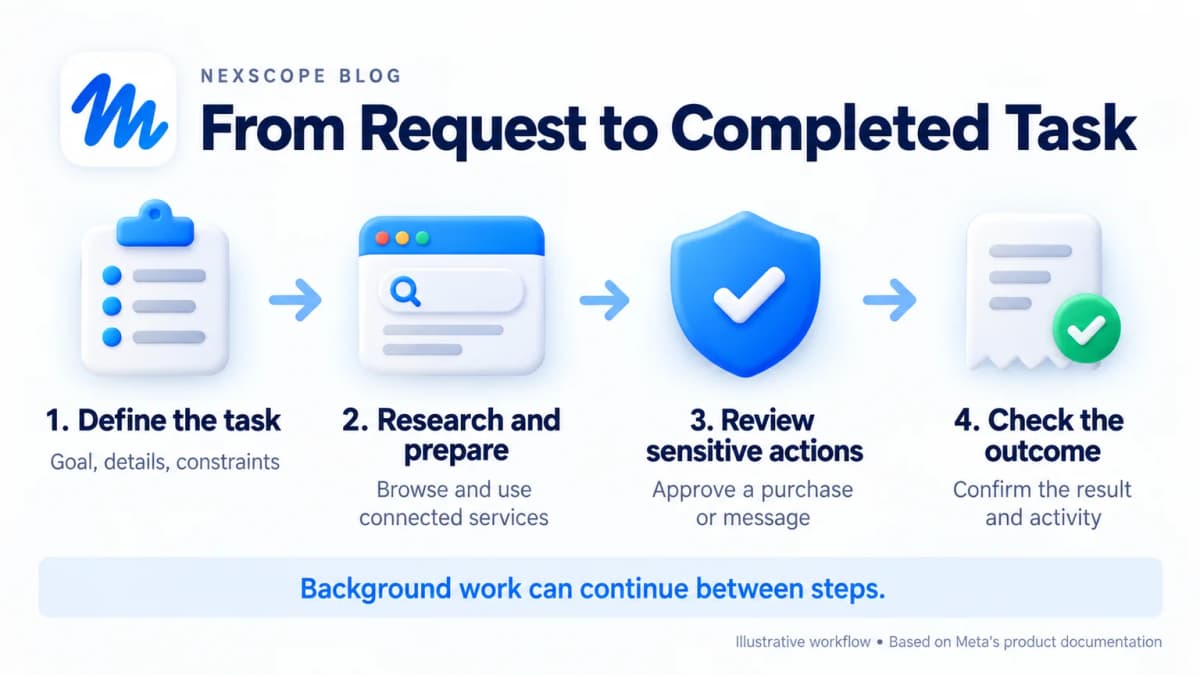
Illustrative workflow based on Meta’s product documentation.
Recent Product Announcements
Meta's September 24 Connect recap announced additional retail and productivity connections, expanded payment options, and plans to bring Muse to AI glasses in the following months. The company also discussed a dedicated email address for the agent. Meta Connect 2026 recap
These announcements broaden the product's direction, but a roadmap should not be treated as an account-level feature list. Anyone planning a workflow should confirm that the required connection and action are available before depending on them.
Early Growth and Adoption
Comparable Launch Figures
Apptopia estimates, first 12 days: US/Canada iOS downloads, Muse 1.8 million versus ChatGPT 1.3 million. September 21 reporting
This is a comparison of early launches. It does not establish which product has the larger audience today, which model is more capable, or which service completes tasks more reliably.
Comparing adoption requires consistent geography, platform, measurement window, and metric. Download totals measure acquisition. Daily active users measure activity on a given day. Retention requires following users over time. Combining those measures into a single claim that one product has “beaten” another obscures the question each number answers.
Sustained Use and Reliability
Early interest creates an opportunity to demonstrate lasting value. A stronger assessment would ask whether people return after trying the product and whether the work they delegate produces usable results.
For personal agents, useful evaluation questions include:
- Completion: Did the agent finish the requested task?
- Accuracy: Did the result satisfy the original constraints?
- Supervision: How much checking and correction did it require?
- Repeat use: Would the user delegate the same task again?
These are evaluation criteria, not published Muse performance scores. They help separate enthusiasm about a new release from evidence that it has become useful in everyday life.
Privacy and User Control
Access and Approval
Meta says users choose which services Muse connects to, can adjust or remove access, and receive approval requests for sensitive actions such as sending an email or making a purchase. The company also describes an activity audit trail. Meta's permissions architecture
An approval should be treated as a decision point. For a purchase, check the item, quantity, total cost, delivery address, and applicable terms. For a message, check the recipient and final wording. A correct research result can still lead to the wrong action if those details are overlooked.
Security Architecture
Meta's technical explanation describes an isolated cloud environment, protected credential handling, and a separate Sentinel component that governs connector actions and outgoing network requests. It also explicitly acknowledges that agents can make mistakes and encounter malicious instructions in the material they read. Meta's security design
Those are descriptions of the system's safeguards, rather than evidence of perfect reliability. A sensible starting point is a task with a clear outcome and a result that is easy to inspect. Access can then be expanded according to demonstrated need.
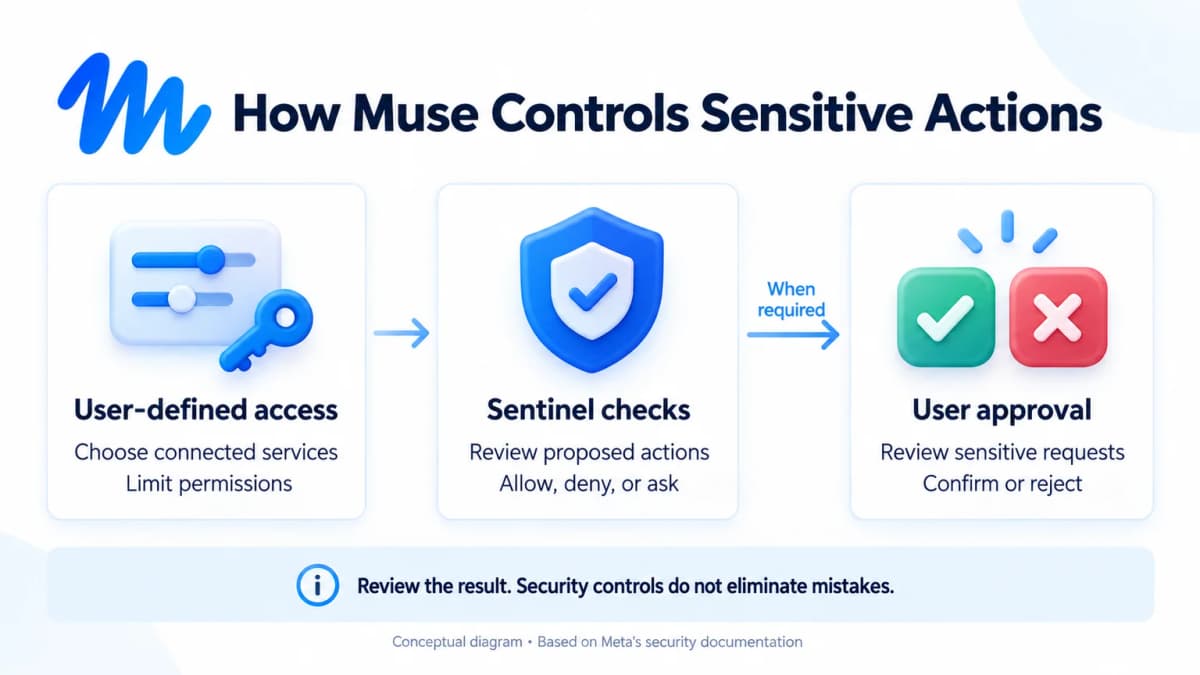
Conceptual diagram based on Meta’s security documentation.
Data and Personalization
According to Meta, users can opt out of interactions being used for model training and ask Muse to forget specific information. The company says conversations and data in the agent's virtual machine are not shared with its advertising systems. Meta's privacy statements
The practical tradeoff is that personalization depends on context. Before connecting an account, consider whether its contents are necessary for the task. A narrowly defined job often needs less access than an open-ended instruction to manage an entire area of someone's life.
Conclusion
Meta Muse makes task completion central to the personal AI experience. The useful test is straightforward: choose a job, define what success means, and assess the result alongside the supervision it required. Early adoption can indicate interest; repeated successful outcomes provide a stronger basis for making an agent part of a routine.
Better Data for Ecommerce Agents
Ecommerce research adds another requirement: the agent needs relevant product evidence. Comparing prices, examining reviews, or investigating competitors requires inputs with enough context to support a decision.
Nexscope provides structured ecommerce data that teams can connect to their own agents and workflows through REST API or MCP. For a product comparison, the workflow should retain the product identifier, marketplace, retrieval time, and any estimate or missing-value limitations alongside the analysis.
Teams exploring AI-assisted Amazon operations can apply that discipline to research before extending automation into consequential actions. The team retains control of its agent, instructions, and approval process. No direct Muse integration is assumed here.
Better Data for Your Ecommerce Agent
Connect structured ecommerce data to your own agent and workflows through Nexscope REST API or MCP.
Explore Ecommerce Data →Frequently Asked Questions
What is Meta Muse?
Meta Muse is Meta's personal AI agent for delegated tasks involving online information and connected services. Its usefulness depends on the task, available access, and quality of the completed result.
How is Muse different from Muse Spark?
Muse is the agent application. Muse Spark is the underlying model identified in Meta's launch announcement. The application's tools and permission controls also influence what it can accomplish.
Can Meta Muse work in the background?
Meta's design documentation describes background tasks and scheduled work. Users should set clear completion criteria and notification preferences, then inspect the activity and outcome of the task.
Can Muse make purchases?
Purchasing is among Meta's advertised use cases. The company says sensitive actions require approval. Users should review the final transaction details before authorizing a purchase.
Does early adoption prove Muse is better?
No. Launch downloads measure early acquisition. A useful product comparison also needs task accuracy, completion, supervision requirements, and retention, assessed under comparable conditions.
Can ecommerce teams connect Nexscope data to Muse?
This article does not establish a direct integration. Nexscope offers REST API and MCP access for user-owned agents and workflows. Compatibility with a specific agent requires checking its supported integration methods.
Sources
- Meta. 2026. Introducing Muse: The World's First Personal AI Agent Built for Everyone. about.fb.com.
- Mona Sarantakos and Christine Awad. 2026. How We Designed Muse. introducing.muse.ai.
- Spotify. 2026. Get Even More Out of Spotify With Muse, From Meta. newsroom.spotify.com.
- Meta. 2026. The Biggest News From Connect 2026. about.fb.com.
- Sarah Perez. 2026. Meta's Muse Is Outpacing ChatGPT's Early Mobile Launch. techcrunch.com.
- Meta AI Research. 2026. How We Built Safety Into Muse. research.meta.ai.