
How to Prepare Your Online Store for Thanksgiving

Table of Contents
To prepare your online store for Thanksgiving, start with the products customers need, the offers your margins can support, and the delivery dates your business can meet. Then build your store pages and marketing schedule around those decisions. A useful plan connects what customers see in a campaign with what the business can actually fulfill.
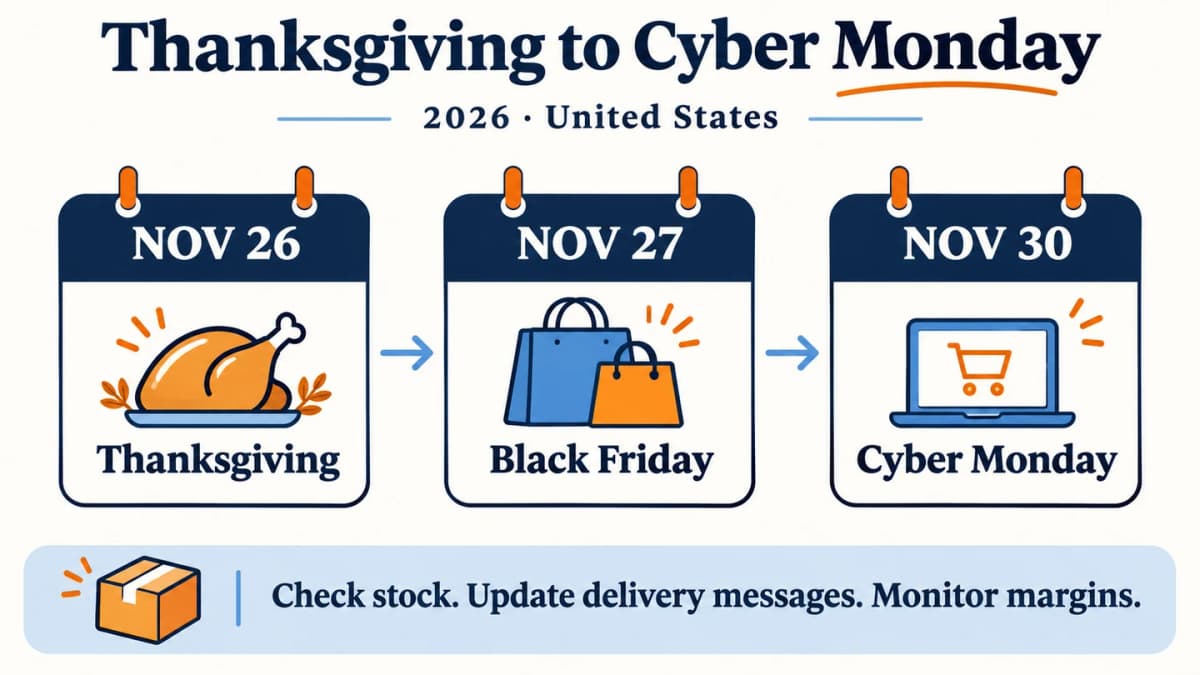
A Thanksgiving campaign brings together several shopping needs. Some customers are preparing to host dinner. Others are buying a small gift for the host, refreshing their home, or considering purchases for the holiday shopping weekend. Each group needs a different reason to buy and a clear understanding of when the order will arrive. In the United States, Thanksgiving falls on November 26, 2026. Black Friday follows on November 27, and Cyber Monday on November 30. For stores preparing in mid-November, the immediate priorities are available inventory, relevant product combinations, clear delivery messaging, and a campaign that can transition smoothly into Black Friday.
Why Thanksgiving Needs Its Own Store Plan
Thanksgiving shopping has a practical deadline: products intended for the celebration need to arrive before customers use them.
A table runner purchased for Thanksgiving dinner serves a different purpose from a discounted winter blanket ordered over Black Friday weekend. That difference should shape the product selection, promotional message, and delivery information.
Build the campaign around three customer moments:
| Customer moment | Shopping need | Store response |
|---|---|---|
| Preparing for Thanksgiving | Hosting supplies, table settings, kitchen essentials | Show relevant products with clear arrival estimates |
| Visiting friends or family | Host gifts and thoughtful additions to the gathering | Offer easy-to-understand gift selections |
| Shopping the holiday weekend | Gifts, personal purchases, seasonal offers | Introduce the Black Friday assortment and promotion |
A store can serve more than one moment. Each collection and message should make its purpose immediately clear.
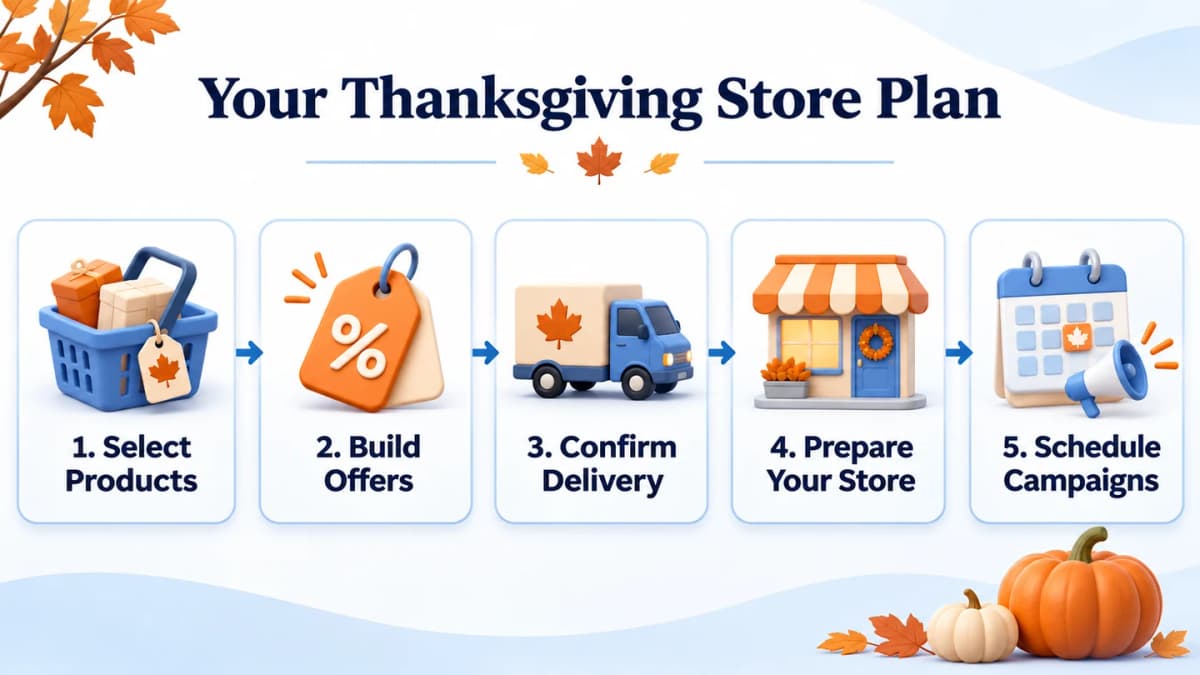
Build Your Thanksgiving Store Plan
1. Choose Products With a Clear Holiday Use
Begin with products already in stock or supported by confirmed replenishment. Review recent orders, last year's seasonal sales where available, customer searches, and frequently purchased combinations.
Create a shortlist based on how customers will use each item.
| Shopping occasion | Product ideas to evaluate | Details customers need |
|---|---|---|
| Setting the table | Table runners, napkins, serving dishes | Dimensions, materials, set quantities |
| Preparing the meal | Roasting accessories, kitchen tools, storage containers | Capacity, compatibility, care instructions |
| Bringing a host gift | Coffee, candles, gift sets | Package contents, presentation, delivery timing |
| Making guests comfortable | Throws, cushions, guest-room essentials | Size, texture, washing instructions |
| Decorating the home | Wreaths, centerpieces, reusable seasonal accents | Measurements, placement, storage |
These categories provide a starting point for research. The strongest choices for a particular store depend on its customers, inventory, costs, and existing assortment.
Prioritize products that combine a clear holiday use with reliable fulfillment and sufficient margin.
For every candidate, answer four questions:
- Relevance: What Thanksgiving task or occasion does this product support?
- Evidence: What do store sales, customer searches, or market research suggest about demand?
- Economics: How much remains after the proposed discount and variable costs?
- Readiness: Can the business fulfill additional orders within the advertised timeframe?
External research helps refine the shortlist. Compare competing products on price, package size, presentation, and recurring review complaints. A complaint about a table runner being too short, for example, suggests that dimensions and table-fit photography deserve prominent placement on the product page.
For stores also selling on Amazon, product research can help identify comparable listings and recurring customer concerns. Evaluate those signals alongside the online store's own audience and conversion history.
Teams can compare seasonal search interest to understand when shoppers begin researching a category. Pair that signal with actual store performance: search interest alone does not establish how many units a store will sell.
2. Design Offers Around Useful Combinations
Choose an offer that gives customers a clear reason to purchase while leaving enough contribution to support the sale.
Useful options include:
- Hosting bundles: Products that help complete one task, such as a table runner and matching napkins.
- Gift sets: A clearly described selection with suitable packaging.
- Quantity offers: Relevant for items customers need in multiples.
- Shipping thresholds: Appropriate when the additional basket value can cover the shipping subsidy.
- Selected-product discounts: Focused on products with sufficient margin and stock.
Check the economics before publishing the promotion. Consider this simplified example:
| Item | Amount |
|---|---|
| Regular bundle price | $60 |
| Revenue after a 15% discount | $51 |
| Product cost | $22 |
| Packaging and fulfillment | $6 |
| Shipping subsidy | $5 |
| Payment fees | $2 |
| Contribution before advertising, returns, and overhead | $16 |
At a 25% discount, revenue falls to $45. With the same assumed costs, contribution falls to $10.
That difference affects how much the store can spend to acquire the order. Replace these illustrative figures with actual costs, including any additional expense created by gift packaging or heavier parcels. Payment fees can change with the order value; the example holds them constant to isolate the discount's effect.
Test the complete offer, including discount stacking, shipping thresholds, and bundle quantities. A profitable promotion on paper can become an expensive one when an automatic discount combines with an existing coupon.
3. Confirm Inventory and Delivery Limits
Use sellable inventory when planning the campaign. Deduct units already committed to orders, damaged stock, and any reserve needed for replacements.
Bundles require particular attention. If one bundle contains four napkins and one table runner, its availability depends on both components. Selling either item separately changes the number of complete bundles remaining.
Build the delivery plan backward from the customer's required arrival date:
- Confirm processing and packing time.
- Check carrier service schedules and transit estimates by destination.
- Allow for weekends, holiday closures, and operational delays.
- Set appropriate ordering cutoffs for each eligible service or region.
- Update customer-facing messages when a cutoff passes.
There is no single Thanksgiving shipping cutoff that applies to every online store. The date depends on the warehouse, destination, service, and processing capacity.
Show delivery information where customers make decisions:
- On the relevant collection and product pages.
- In the cart or delivery estimator.
- At checkout.
- In order confirmations and shipping updates.
Keep the distinction between dispatch and arrival clear. “Ships within two business days” describes processing; it does not tell a customer whether the order will reach them before dinner.
After the applicable cutoff, remove Thanksgiving arrival promises from ads, banners, emails, and product pages. Where genuinely available, local pickup or digital gift cards can serve later shoppers.
4. Prepare the Storefront and Campaign Assets
Give shoppers a focused route from the campaign message to the relevant products.
A Thanksgiving collection page should quickly explain:
- Who the selection is for.
- Which products belong together.
- What the offer includes.
- When eligible orders are expected to arrive.
- What action the customer should take next.
A homeware store might organize its selection under “Set the Table,” “Gifts for the Host,” and “Make Guests Comfortable.” Those labels help customers navigate by purpose.
Make Product Pages Specific
Seasonal presentation should support the purchase decision. Keep product specifications easy to find beneath the campaign imagery.
For a serving platter, show its dimensions, material, care instructions, and what is included. For a candle gift set, explain the number of candles, sizes, and packaging. Stores also selling on Amazon should coordinate these details with their listing optimization so customers encounter consistent product information across channels.
Build a small, consistent asset set:
| Asset | Main purpose |
|---|---|
| Homepage banner | Introduce the collection and offer |
| Collection image | Establish the shopping occasion |
| Product scene | Show scale and intended use |
| Email image | Support one clear message |
| Social image or short video | Demonstrate the product and encourage a visit |
Seasonal lifestyle images can place existing products in a relevant setting. Teams can use GPT Image 2.5 to create campaign variations from approved product references.
Review every output against the actual item. Check packaging text, color, proportions, quantity, and included accessories. Decorative props should not create confusion about what customers receive.
Test the Full Purchase
Complete a mobile test purchase using the intended campaign link. Check variant selection, bundle contents, discount behavior, shipping charges, payment, and confirmation messages.
Assign someone to answer delivery and product questions during the campaign, with clear support hours and prepared responses. Test contact forms and order notifications before promotional traffic arrives.
5. Schedule the Campaign Through Cyber Monday
Give each communication a specific job. Prepare one calendar that combines store updates, email, social posts, paid campaigns, and customer support coverage. Record the owner of each task and the time zone used for each promotion.
Keep audience selection practical. Recent purchasers may need order information or complementary products. Existing customers may respond to a relevant new combination. New visitors need enough product information to make a first purchase.
Before scheduling, review the combined email and SMS calendar so customers do not receive overlapping messages with inconsistent offers. Once pre-Thanksgiving delivery is no longer available, shift the campaign toward purchases customers can use afterward.
Monitor Decisions, Not Just Revenue
Track a compact set of measures during the campaign:
- Product conversion rate: Which featured products turn visits into purchases?
- Contribution after discounts and variable costs: Does the offer leave sufficient money to support acquisition?
- Inventory remaining: Can the store continue promoting the same products?
- Fulfillment backlog: Are orders moving within the promised processing time?
- Delivery questions and cancellations: Is the campaign setting the right expectations?
Use those signals to make specific changes. Low conversion may justify reviewing the product page or offer. A growing packing backlog may require reducing promotion volume or revising processing estimates. A nearly depleted bundle component may require replacing that bundle in scheduled messages.
Your 2026 Thanksgiving Campaign Calendar
A Mid-November Execution Schedule
The following schedule is a planning example for a store preparing in mid-November. Delivery messages must follow its actual fulfillment cutoffs.
| Period | Operational priority | Customer message |
|---|---|---|
| November 16–18 | Finalize products, costs, inventory, and offers | Introduce the Thanksgiving selection |
| November 19–22 | Launch approved pages and creative | Explain product uses, combinations, and gift options |
| November 23–25 | Review destination-specific delivery eligibility | Communicate valid cutoffs or available pickup options |
| November 26 | Monitor support and scheduled campaigns | Share a concise customer appreciation message |
| November 27–29 | Launch and monitor the Black Friday offer | Explain the promotion, eligible products, and terms |
| November 30 | Complete the Cyber Monday campaign | Communicate the genuine end time and available offers |
Make Each Handoff Explicit
Assign a named owner to the transition from Thanksgiving delivery messaging to Black Friday promotion. That person should check the homepage, collection descriptions, ad copy, scheduled emails, and support templates together.
Keep a short change log with the previous offer, new offer, start time, end time, and eligible products. It gives customer support a reliable reference when a shopper asks why a price or delivery option changed.
After Cyber Monday, review performance by product and offer. Compare contribution, cancellations, fulfillment delays, and customer questions with the original plan. Save the findings with the campaign assets so next year's preparation starts with evidence from the store's own results.
Common Thanksgiving Planning Mistakes
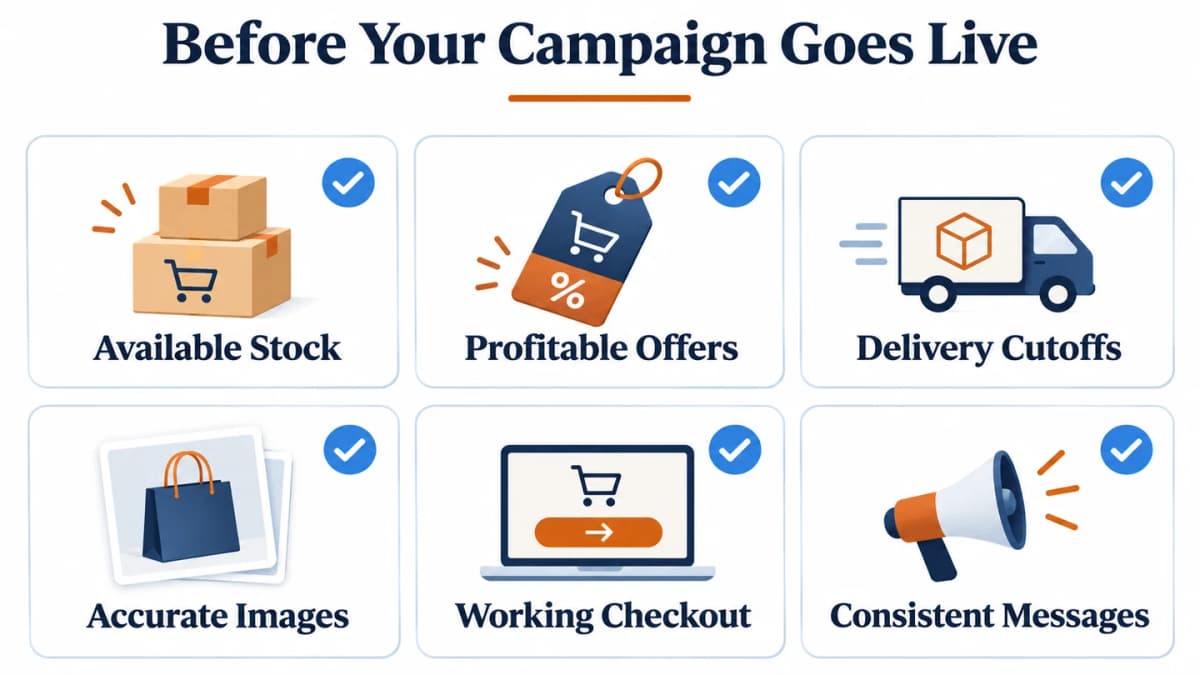
Several avoidable problems can undermine an otherwise useful campaign.
- Selecting products only because they look seasonal. Check whether the assortment fits customer needs and has supporting demand evidence.
- Using a broad discount without checking costs. Calculate contribution at the actual promotional price.
- Promoting unavailable bundle components. Coordinate inventory across individual items and sets.
- Keeping expired delivery messages live. Review every campaign placement when fulfillment eligibility changes.
- Creating attractive images with unclear contents. Make the actual product and included quantity obvious.
- Changing offers without updating scheduled messages. Keep banners, emails, checkout rules, and support responses consistent.
- Judging success only by sales totals. Review margin, fulfillment performance, and customer issues alongside revenue.
Conclusion
A practical Thanksgiving plan connects product selection, offer economics, fulfillment, and marketing. Start with a small assortment the store can support, explain why it fits the occasion, and make delivery expectations visible throughout the purchase. As Thanksgiving approaches, focus on useful product combinations, accurate pages, clear offers, and reliable service. Prepare the transition to Black Friday before the Thanksgiving campaign goes live.
Plan Your Thanksgiving Campaign With Nexscope
Choosing the right products and messages becomes easier when market research and creative production support the same campaign. Nexscope provides ecommerce data and creative capabilities that teams can use to research opportunities and develop marketing assets.
Key Features
- Ecommerce product research: Compare available product, pricing, and review data to evaluate seasonal assortment ideas and customer concerns.
- Keyword and marketing research: Explore search demand and competitive signals to choose campaign themes and content priorities.
- AI image and video creation: Develop product scenes and marketing creative around approved products and offers.
Connect supported data to your own applications, agents, and workflows through REST API or MCP. Combine external research with the store's own inventory, costs, and order data to turn campaign ideas into practical decisions.
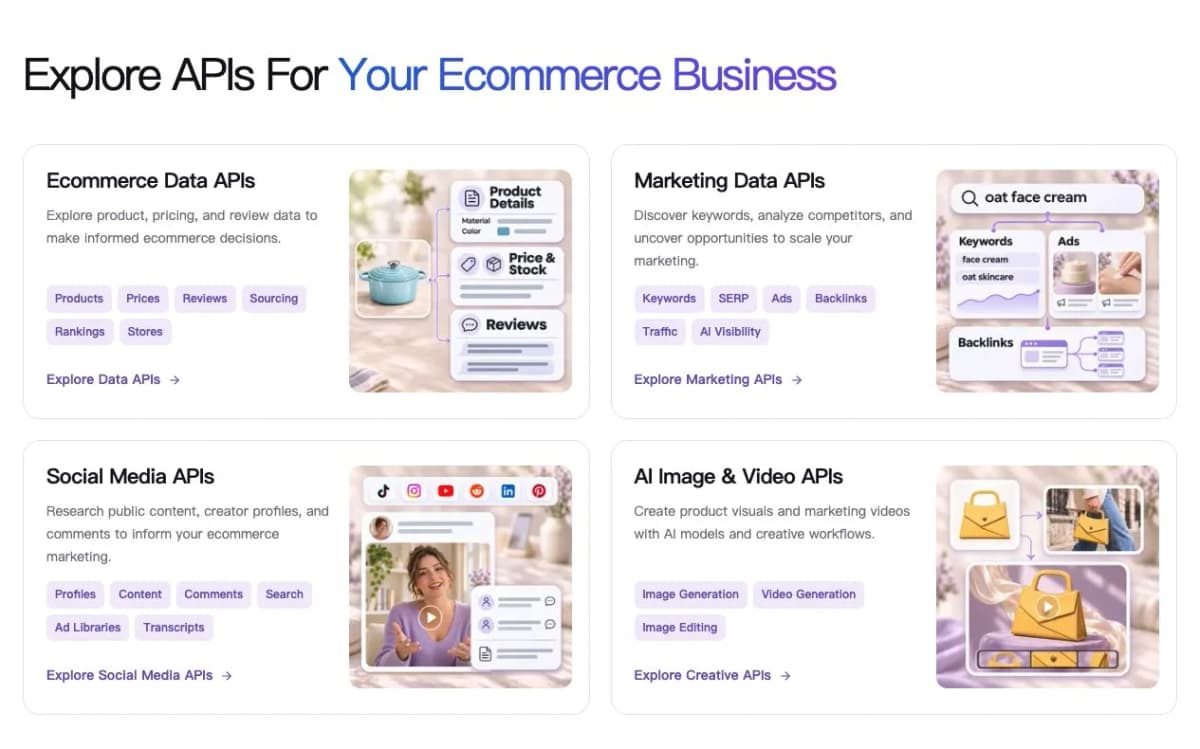
Source: Nexscope API platform, captured November 16, 2026.
Build Your Thanksgiving Marketing Plan
Research seasonal demand and campaign opportunities before choosing what to promote.
Try It Free →Frequently Asked Questions
When should an online store start preparing for Thanksgiving?
Begin early enough to accommodate sourcing, replenishment, and creative production. If only a few weeks remain, prioritize existing inventory, straightforward offers, delivery checks, and tested store pages. Avoid making the campaign depend on stock that has not arrived. Assign owners and deadlines to the remaining tasks so fulfillment, merchandising, and marketing stay coordinated.
What products should an online store promote for Thanksgiving?
Start with products relevant to hosting, cooking, decorating, gifting, or making guests comfortable. Select from the store's own assortment using sales history, customer needs, market research, margins, and fulfillment readiness. A relevant category still needs product-level evaluation. Confirm dimensions, package contents, and availability before featuring an item in a campaign or bundle.
Does every Thanksgiving campaign need a discount?
No. Useful bundles, gift-ready presentation, convenient pickup, or a well-organized seasonal selection can provide value. Choose the offer based on the customer's need and the store's economics. If a discount is used, calculate contribution after product cost, fulfillment, shipping subsidies, and payment fees, then check how existing coupons interact with it.
How should a store set its Thanksgiving shipping deadline?
Work backward from the required arrival date using processing time, destination-specific transit estimates, carrier schedules, and a reasonable operational buffer. Separate dispatch estimates from delivery estimates, and update the campaign when a service is no longer suitable. Use destination-specific messaging where possible rather than advertising a single nationwide arrival promise.
How can a store connect Thanksgiving marketing with Black Friday?
Plan separate messages within one calendar. Before Thanksgiving, emphasize products relevant to the celebration and valid delivery options. For Black Friday, introduce the weekend assortment, promotion, and terms. Coordinate inventory and pricing across both campaigns. Review scheduled messages and remove outdated delivery claims before the new promotion starts.
What should a store do if it is starting late?
Reduce the scope. Choose a small set of available products, launch one clear collection page, use an offer that is easy to fulfill, and test checkout. Focus on destinations and delivery methods the business can realistically serve, then prepare the transition to the holiday shopping weekend. Give support staff the same offer and delivery information shown on the storefront.
Sources
- U.S. Office of Personnel Management. 2026 Federal Holiday Schedule. opm.gov.
- Shopify. 2026. Black Friday Checklist: 25 BFCM Prep Steps. shopify.com.
- Nexscope. Ecommerce Data, Marketing, Creative API, and MCP Documentation. Accessed November 16, 2026. nexscope.ai.