

Amazon Blocks AI Agents: Where Sellers Can Get Data

Table of Contents
An AI agent can compare products, summarize reviews, and recommend a pricing response. Every one of those tasks depends on getting the right data first.
That dependency is becoming harder to ignore. On September 21, 2026, Axios reported that Amazon had blocked Meta’s Muse agent from browsing and buying products on its platform. In its October 16 charts newsletter, a16z cited Cloudflare data showing that the share of 403 “Forbidden” responses received by agents and bots had roughly doubled since summer.
For sellers building workflows around Amazon AI agents, the practical question is where product and market evidence should come from. A useful setup combines authorized store records, third-party market intelligence, and internal business data. APIs and MCP can make those inputs easier to use, while access permissions and data quality remain essential selection criteria.
What Amazon’s Restrictions Mean for Sellers
The Amazon–Meta Muse dispute concerns how third-party agents interact with Amazon’s shopping experience. It raises a broader operational question for sellers: how much of an AI workflow depends on an external website accepting each visit?
A browser-based research task may need to open a search page, inspect several listings, read reviews, and extract prices. When a required page becomes unavailable, the workflow loses an input. A better prompt cannot supply the missing observation.
Research and purchasing also involve different permissions. An agent comparing product specifications needs read access to relevant evidence. An agent placing orders or changing account settings needs additional authority. Those distinctions matter as agentic commerce expands beyond answering shopping questions.
Map the data required for each decision before choosing how the agent will retrieve it. This makes it easier to identify missing coverage and replace an unsuitable dependency.
Where Seller AI Can Get Its Data
Authorized Store Data
Order history, inventory, and other account-specific records belong in supported, authorized integrations. Amazon’s Selling Partner API uses authorization to let an application act on a selling partner’s behalf. The available operations depend on the application’s access and roles.
For example, a seller evaluating a price change may need its own recent orders and inventory position. The integration should retrieve the relevant records for that seller and retain the reporting period. Public product listings cannot provide the same view of the business.
Third-Party Market Intelligence
Market research requires evidence beyond the seller’s own account: competing products, advertised prices, reviews, keyword demand, and category conditions.
A third-party Amazon data API can organize supported information into fields that a workflow can filter and compare. Product identifiers, currencies, marketplaces, and dates make a difference. Two prices are only comparable when the underlying products, variants, and selling conditions match.
Keep observed information separate from estimates. A displayed price and an estimated monthly sales figure answer different questions. An agent should preserve that distinction in its recommendation.
Internal Business Data
The final inputs often come from the seller’s own spreadsheets, ERP, or finance systems. Landed cost, supplier lead times, minimum margins, and stock commitments determine which responses are commercially sensible.
A competitor’s lower price may justify closer monitoring. It does not establish that matching the price would improve the seller’s contribution margin. Internal numbers turn a market observation into a decision the business can evaluate.
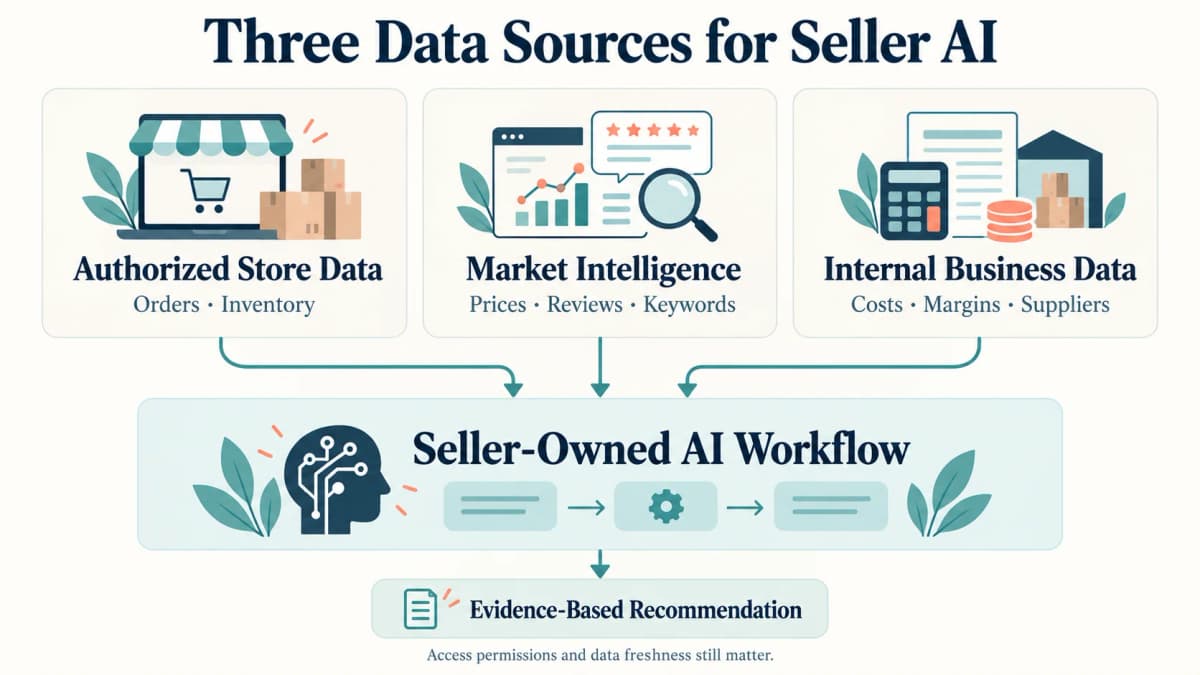
Three complementary data sources support a seller’s own AI workflow.
What APIs and MCP Actually Change
An API provides a defined way to request information and receive a structured response. Instead of extracting a price from a changing page layout, an application can process the fields returned by a documented operation. The integration still needs to handle missing fields, failed requests, and changes to the service.
MCP adds a standard way for compatible AI applications to discover and use exposed tools and context. A tool can describe its purpose and required inputs so the agent can select an appropriate operation. REST API integration and MCP access can serve the same research task through different client environments.
The interface and the underlying data source are separate evaluation questions. An API key authenticates access to a service. MCP defines communication between an application and a server. Neither label establishes that a provider has marketplace authorization or that every result is current.
Ask how the data is obtained, which uses are supported, and what freshness information is available. A third-party API may also depend on upstream services. Structured delivery simplifies integration, but its reliability still needs to be assessed for the intended workflow.
How to Use Ecommerce Data in an AI Workflow
Once the relevant data sources are identified, sellers can connect them to the AI tools they already use. Start with one research task and a small set of records before scheduling recurring analysis.
- Define the task and required data. Specify what the agent should produce, such as a product comparison, review summary, or market overview. Identify the fields it needs and whether they come from marketplace research, an authorized store account, or internal business records.
- Choose API or MCP access. Use a REST API when adding data requests to an application or an existing automation. Use MCP when the AI client supports the provider’s tools. Configure the required authentication through the client or application’s supported settings, then check which operations are available.
- Set the scope of the request. Supply the required marketplace, product identifiers, filters, and reporting period where supported. For a review summary, select the ASIN and criteria for the customer reviews the agent should analyze. Set a limit on records or calls before running a larger request.
- Check the returned data. Confirm that the request succeeded and the records match the intended scope. Retain dates, units, and estimate labels. Resolve missing inputs before asking the agent to draw conclusions that depend on them.
- Turn the results into a repeatable analysis. Tell the agent which fields to compare, what business context to include, and how to present supporting evidence. Once the initial output is useful, choose a refresh schedule suited to the decision and the source’s update frequency.
Keep the data request and the analysis instructions explicit. This gives the seller a workflow that can be reviewed and repeated when new information becomes available.
How to Evaluate an Ecommerce Data API
A provider should fit the decision being made. A broad catalog can be useful, but the fields required for the first workflow deserve closer inspection.
| Check | What the seller should establish |
|---|---|
| Coverage | Supported marketplaces, product types, identifiers, and fields for the task. |
| Freshness | When an observation was collected, how often it is refreshed, and how dates appear in results. |
| History | Available lookback periods, gaps, and whether historical observations are comparable. |
| Measurement | Which values are observed, calculated, or estimated, with units and definitions. |
| Failure handling | How unavailable records and failed requests are represented; missing values must stay distinct from zero. |
| Access and usage | Authentication requirements, permitted uses, storage conditions, and relevant limits. |
| Workflow cost | Expected calls, pagination, refresh frequency, and charges for retries or additional records. |
When comparing ecommerce data APIs, test a small set of known products against the actual research question. Check whether the returned fields support the intended comparison before expanding to a larger monitoring job.
Connect Your AI Workflow to Nexscope
Sellers need different data for different decisions. Finding products, researching keywords, monitoring competitors, and understanding customer feedback each require their own inputs. Nexscope provides a range of Amazon research APIs that teams can connect to their own agents through REST API or MCP.
The Amazon API catalog covers product discovery and details, competitor research, keywords, pricing history, reviews, and market opportunities. Teams can choose the interfaces that fit each task and combine their results in the same workflow:
- Find products to research. Search by keyword and marketplace with Amazon Search. An agent can organize returned ASINs, titles, prices, and ratings into a shortlist for deeper research.
- Compare individual listings. Retrieve Amazon product details by ASIN to compare available specifications, listing information, pricing, and ratings across selected products.
- Build keyword opportunities. Explore keywords associated with an ASIN in the selected market. Use the returned terms and available ranking signals to prepare listing content or advertising tests.
- Research competing products. Use Amazon Competitor Lookup with a marketplace, keywords, ASINs, or brand filters to assemble relevant products and compare available pricing and performance signals.
- Monitor pricing over time. Retrieve product price series for an ASIN and supported period. An agent can summarize available price and Buy Box price changes for a pricing review instead of relying on a single observation.
- Turn feedback into product improvements. Collect Amazon customer reviews using product, rating, and sorting criteria. Ask the agent to group recurring complaints, identify valued features, and retain review evidence behind proposed listing improvements.
- Assess a market before expanding. Research Amazon niches by keyword to examine available demand, product-count, and pricing signals. Combine those results with supplier costs and business requirements when screening opportunities.
These capabilities can work together. A product-research workflow can discover candidates, compare their details, examine keyword opportunities, and summarize customer feedback. A monitoring workflow can revisit selected products and report changes in their pricing. The team keeps control of its model, prompts, analysis, and refresh schedule.
Use the MCP tool map to select the tools and required inputs for a compatible agent, or integrate the documented REST operations into an application. Preserve available dates and estimate labels when combining results with authorized store records and internal business data.
Data APIs use pay-as-you-go Data Credits, with no Data API subscription required. New users receive 1,000 trial credits valid for three days, with no credit card required.
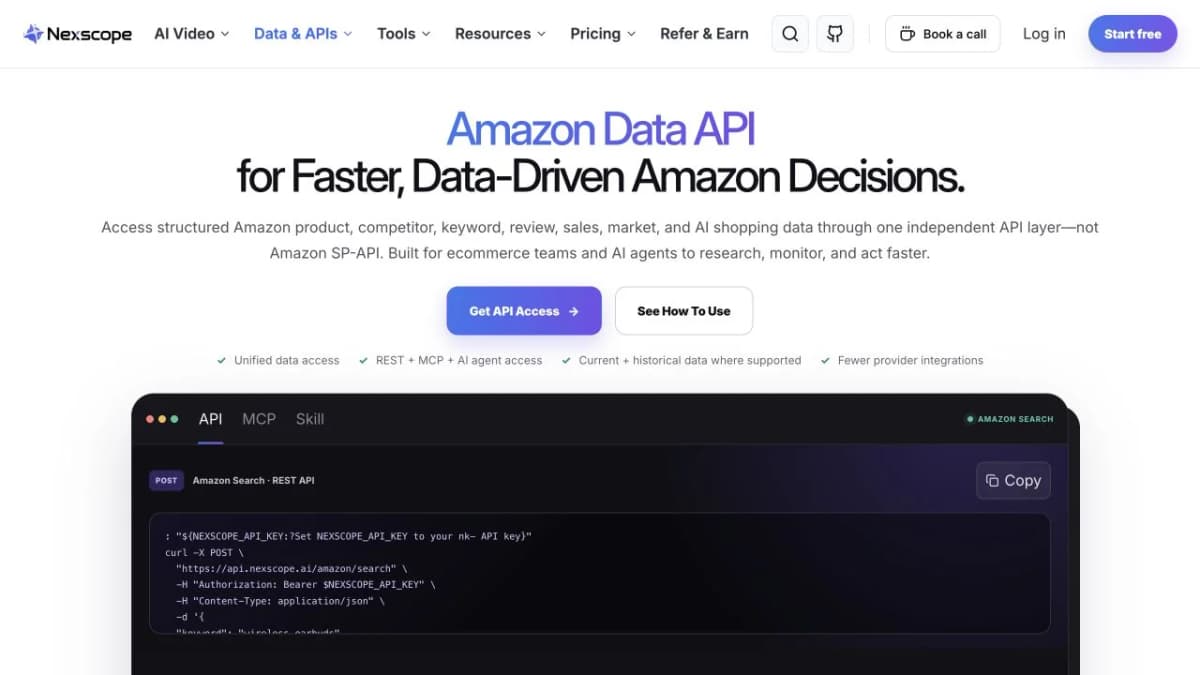
Nexscope’s Amazon Data API page, captured October 19, 2026.
Find the Amazon APIs for Your Workflow
Explore Amazon APIs for product research, keywords, competitors, pricing, reviews, and market analysis, then choose the interfaces your agent needs.
Explore Amazon Data APIs →Frequently Asked Questions
Does Amazon block every AI agent?
The reported Muse restriction concerns a specific third-party shopping agent. Access depends on the service, agent, task, and applicable permissions. A restriction on browsing or purchasing does not establish that every authorized seller integration is unavailable.
How does Amazon SP-API differ from a third-party Amazon data API?
SP-API supports applications working with selling partners through Amazon’s authorization framework. Third-party market intelligence APIs provide their own documented research capabilities, such as product comparisons and market signals. Sellers should evaluate the source and scope of each service separately.
Does MCP grant permission to access Amazon data?
MCP provides a communication protocol for AI applications and servers. Access to a particular service still depends on its authentication, permissions, and usage conditions. Connecting an MCP server does not create broader marketplace access rights.
Can an agent retrieve a competitor’s actual sales?
A competitor’s private order records require appropriate access. Market intelligence tools may provide sales estimates, which should remain labeled as estimates. They are useful for comparative research when their methodology and limits fit the task.
Sources
- Axios. 2026. Amazon Boots Meta’s Muse in Fight Over AI Shopping. axios.com.
- Moses Sternstein, a16z. 2026. This Week in Charts: Agents Denied. a16z.news.
- Amazon. 2026. Authorize Applications. developer-docs.amazon.
- Model Context Protocol. 2026. Architecture Overview. modelcontextprotocol.io.
- Nexscope. 2026. Amazon Data API for AI Agents & Ecommerce Teams; Amazon Product Detail API; Amazon Reviews List API; MCP Tool Map. nexscope.ai.