
Amazon Products Can Now Be Sold Through Instagram

Table of Contents
An Amazon product can now sit one tap away from the Instagram content that makes someone want it. Eligible U.S. creators can add Amazon affiliate links directly to Reels and feed posts, sending interested viewers to Amazon to buy.
Announced on November 16, 2026, the integration puts product discovery and a purchase link in the same piece of content. The transaction still happens on Amazon. For sellers, the opportunity is to reach shoppers while they are watching a demonstration, browsing an outfit, or discovering a useful household item—before they begin an Amazon search.
The commercial question is which products deserve that attention, and whether the resulting orders justify the cost of attracting it.
What Changes for Instagram Shopping
The new integration lets eligible creators connect their Instagram and Amazon Influencer accounts. Instagram then includes their affiliate links when they add Amazon products to content, with viewers directed to the Amazon Shopping app.
The launch details reported by Retail Dive and Social Media Today include:
- Up to 30 products per Reel and 20 per feed post.
- Account linking through Instagram's Professional Dashboard.
- Product commission information available to creators when choosing items.
- Free product linking, with Instagram taking no share of affiliate earnings.
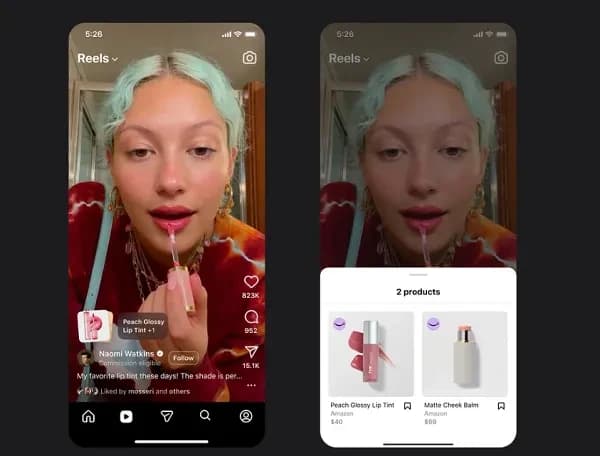
Source: Instagram launch imagery, via Social Media Today.
Amazon's program pays commissions on qualifying purchases. A view or a click alone does not mean a commission has been earned.
For a seller, this creates another way for a creator to introduce a product in context. A compact kitchen organizer, for example, can be shown solving a specific storage problem with its purchase link attached. The viewer has less searching to do between seeing the demonstration and finding the item.
Amazon Reaches Shoppers Beyond Search
Instagram is part of a broader expansion of Amazon's presence in creator content. On August 27, 2026, YouTube announced Amazon's addition to its Shopping Affiliate Program, enabling eligible U.S. creators to tag products in videos, Shorts, and livestreams.
The strategic appeal is straightforward. Amazon search meets shoppers who already have a query. Creator content can introduce a product before the viewer has decided what to search for. A demonstration explains the use case; the marketplace listing then supplies the detail needed to evaluate the purchase.
This division of work gives each participant a reason to join:
- Creators can earn from recommendations relevant to their audience.
- Amazon gains opportunities to bring shoppers to product listings from outside its store.
- Instagram gives creators another way to monetize their content.
For sellers, the implication is a broader discovery strategy. Search visibility still matters, but a product also needs a clear reason to appear in someone's content. Features that are easy to demonstrate can become useful creative angles; confusing variations or unclear claims can become obstacles after the click.
Two Paths to Social Commerce
Instagram's Amazon integration and TikTok Shop both connect content with shopping, but the purchase journeys differ. TikTok Shop supports an in-app buying experience. The Instagram integration discussed here sends the shopper to Amazon.
| Part of the journey | Instagram + Amazon | TikTok Shop |
|---|---|---|
| Product discovery | Instagram creator content | TikTok content and shopping surfaces |
| Product link | Leads to an Amazon listing | Leads to a TikTok Shop product |
| Checkout | On Amazon | Within TikTok Shop |
| Seller preparation | Align the creator's demonstration with the Amazon listing | Align the content with the TikTok Shop listing and shop operations |
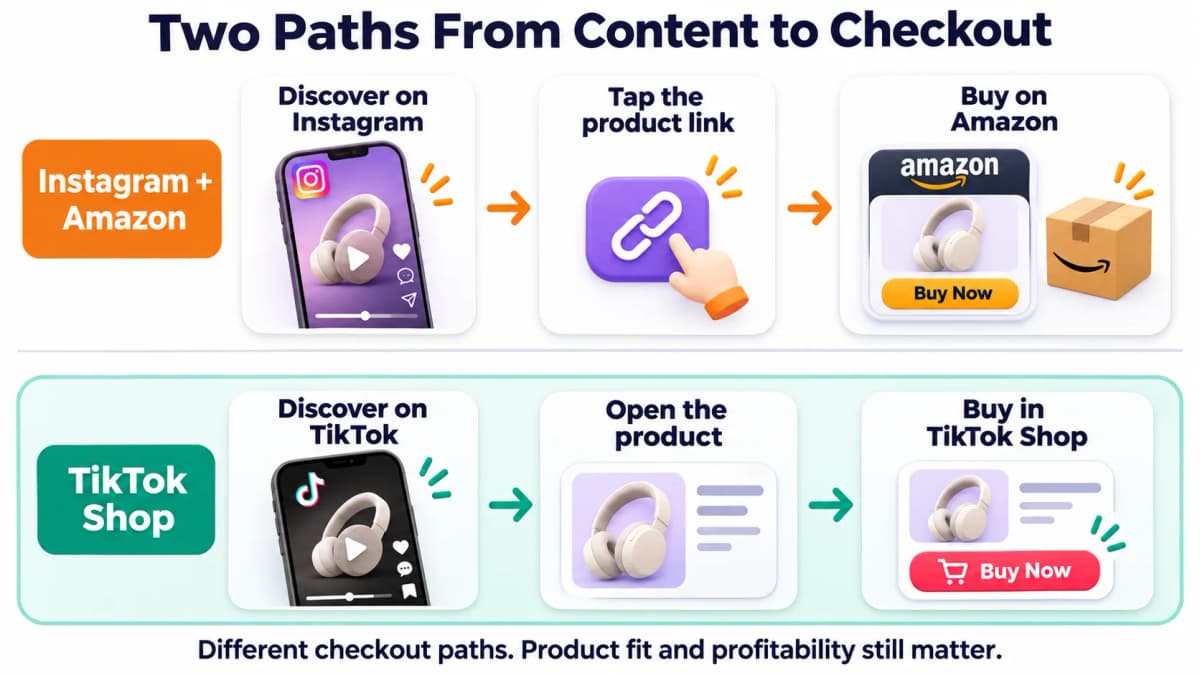
Conceptual purchase journeys: Instagram content leads to Amazon; TikTok Shop supports in-app checkout.
Neither route removes the need for product credibility. A compelling video can earn a click, but an unclear size chart, unexpected price, weak reviews, or unavailable variation can still interrupt the purchase. Sellers should evaluate the whole journey, including the page and offer that a viewer actually reaches.
What Amazon Sellers Should Test First
Start With Demonstrable Products
Choose a small product shortlist before recruiting creators. Prioritize items with a benefit that can be shown clearly, dependable stock, and enough margin to support the intended campaign.
A useful demonstration answers a buyer's question: How much does it hold? How does it fit? What does it do differently? A product that needs extensive explanation may require a more detailed creative brief than a quick visual transformation.
Use Amazon review analysis before writing that brief. Recurring praise can suggest what to show, while recurring complaints can reveal expectations the content must address. If shoppers repeatedly misunderstand an item's dimensions, the video should demonstrate scale rather than rely on a flattering close-up.
Match the Creator to the Buyer
Evaluate the creator's audience and content alongside follower count. Look for relevant subject matter, questions from potential buyers, and an ability to explain the product naturally.
A home-organization creator and a general entertainment account may reach very different buying situations. Review recent posts to understand whether the audience is asking about the kind of problem your product solves.
For a paid collaboration, agree on the deliverable, schedule, product variation, and permitted content use. Amazon affiliate participation and a seller's paid creative brief are separate arrangements. Do not assume an affiliate recommendation includes content ownership, approval rights, or a guaranteed posting schedule.
Keep the Listing and Content Aligned
Before the content goes live, check the exact linked product. The demonstrated model, color, pack size, and included accessories should match what shoppers find on Amazon.
Use a short launch checklist:
- Confirm the destination ASIN and variation.
- Check stock and expected delivery availability.
- Recheck any price or promotion mentioned in the content.
- Make sure demonstrations support the claims being made.
- Agree on how to handle an unavailable product or expired offer.
This is especially useful for seasonal campaigns. Content can keep circulating after a promotion ends, so avoid making a temporary offer the only reason the recommendation makes sense.
Measure the Economics of the Test
Review the campaign in stages: attention, product interest, orders, and retained contribution. Where reporting supports it, examine clicks and attributed purchases alongside returns and cancellations. Keep creator-reported earnings separate from the seller's own sales and cost records.
Account for costs such as samples, fixed creator fees, production, discounts, and any additional campaign incentives. Amazon's standard affiliate payout does not make those expenses disappear.
An illustrative calculation shows why this matters: if retained orders contribute $12 each before campaign costs, a $300 campaign needs 25 such orders to cover that cost. This is a planning example, not a forecast. Use your own contribution after product costs, marketplace fees, fulfillment, and expected returns.
Scale only when the evidence supports it. A high-view post with few purchases may need a different product, demonstration, audience, or offer rather than a larger budget.
Conclusion
Amazon products now have a more direct route from Instagram content to the marketplace. Sellers can use that route to help shoppers discover a product in a real use case, then carry the same promise through to the listing and delivery experience. Start with a focused test, keep the content accurate, and expand when retained orders support the economics.
Research and Create With Nexscope
Turning product interest into a campaign takes both useful data and compelling content. Nexscope brings ecommerce research, social media data, and AI image and video creation together, helping teams move from product discovery to creative production.
Key Features
- AI UGC videos: create AI-generated creator-style product videos, presenter-led ads, and fresh creative variations for Reels and other social placements.
- URL to Video: turn a product link into a video workflow using its listing details and images, then shape the script and presentation around your selling angle.
- Amazon data: research products, prices, reviews, keywords, and competitors to inform product selection and campaign messaging.
- Instagram data APIs: retrieve public profiles, posts, Reels, comments, and available transcripts to support creator and content research.
- API and creative workflows: bring ecommerce data and AI image and video capabilities into your team's tools and production process.
Use Nexscope's web tools for creative production, or connect documented capabilities to your own applications and AI agents through REST API and MCP. Choose the relevant endpoint or tool for its supported inputs, outputs, and access method.
Turn Product Insights Into Your Next Campaign
Explore ecommerce data, social media research, and AI video creation with Nexscope.
Explore Nexscope →Frequently Asked Questions
Can Amazon products be sold through Instagram?
Yes. Eligible creators can use Amazon affiliate product links in Instagram content to send shoppers to Amazon. The integration gives a recommendation a direct purchase route, while the order is completed on Amazon. Sellers should therefore treat the Instagram post and the Amazon listing as two connected parts of the buying experience.
Who can use the new Amazon integration?
The November launch covers eligible U.S. creators connecting an Amazon Influencer account to Instagram. Participation in Amazon's broader influencer program does not by itself establish access to every Instagram feature. A seller arranging a campaign should ask the creator to verify that the integration is available on the account that will publish the content.
Does Instagram take a share of Amazon affiliate commissions?
Instagram says it does not take a share of affiliate earnings from this integration. Amazon handles qualifying-purchase commissions under its program. That is separate from a seller's expenses for samples, production, or sponsored content. When evaluating a collaboration, calculate those costs independently rather than interpreting free product linking as a free campaign.
How many Amazon products can a creator add?
Launch reporting specifies up to 30 products per Reel and 20 per feed post. Those are limits, not recommendations for how many products belong in a campaign. A focused demonstration may work better with one clearly explained item. Choose the number of products around the content's purpose and the audience's ability to understand each recommendation.
Do Amazon affiliate links guarantee more sales?
No. Product links create a route to the listing; performance depends on the audience, product, content, offer, and buying experience. Test a limited scope and compare retained orders with total campaign costs. A campaign that attracts attention but loses money after returns and collaboration fees needs further work before it is expanded.
Sources
- Tatiana Walk-Morris / Retail Dive. (2026). Instagram creators can now add Amazon affiliate links directly to Reels, posts. Retrieved from retaildive.com
- Andrew Hutchinson / Social Media Today. (2026). Instagram adds Amazon affiliate links. Retrieved from socialmediatoday.com
- Amazon. (2026). What is the Amazon Influencer Program? Your questions answered. Retrieved from aboutamazon.com
- YouTube. (2026). YouTube Shopping Creators can now tag Amazon products. Retrieved from blog.youtube
- TikTok for Business. (n.d.). TikTok Shop. Retrieved from ads.tiktok.com