

10 Best Amazon Price APIs for Product Data and Tracking

An Amazon price API can give an application structured access to current prices, historical price changes, seller offers, Buy Box signals, discounts, and fulfillment details. The difficult part is deciding what “price” means for the workflow. A product page may show a list price, current purchase price, Prime price, coupon-adjusted price, or several offers with different shipping costs and conditions.
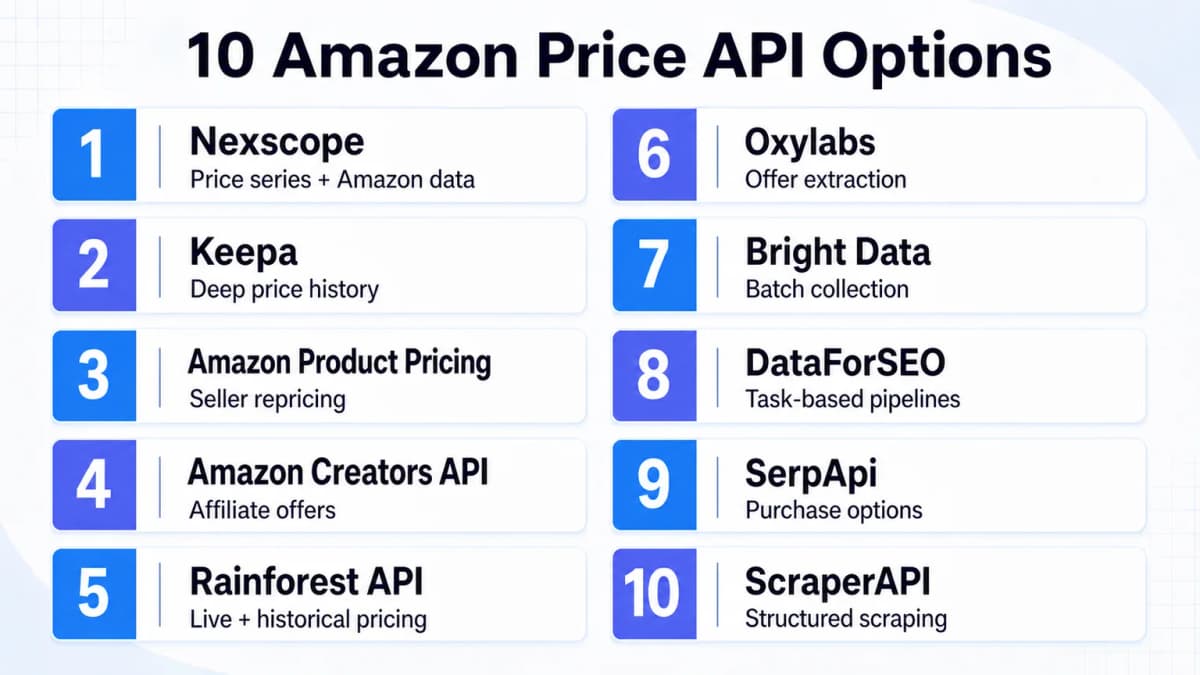
The available APIs also serve different users. Amazon’s official interfaces support authorized seller or affiliate applications. Historical-data providers maintain time series for research and monitoring. Scraper APIs collect current page snapshots that a team can store over time. Nexscope ranks first in this comparison for teams that need multiple selectable price curves together with broader Amazon product, competitor, keyword, review, sales, and market data through REST API or MCP. Keepa remains a specialist choice for deep Amazon history, while Amazon Product Pricing is the official fit for seller-authorized repricing.
This guide compares ten options by data coverage, historical depth, marketplace support, access model, developer experience, and production fit.
Amazon Price API Comparison
The table separates native historical series from collected snapshots. “Customer-built history” means the provider can return a current result, but the customer generally needs to schedule repeated calls and store the responses to create a time series.
| Rank | API | Best For | Current Price | Native Price History | Offers or Buy Box | Access Model |
|---|---|---|---|---|---|---|
| 1 | Nexscope | Connected price intelligence | Yes | Yes | Yes, endpoint-dependent | API key, REST, MCP |
| 2 | Keepa | Deep Amazon history | Yes | Yes | Extensive | Subscription and tokens |
| 3 | Amazon Product Pricing | Seller repricing | Yes | No built-in time series | Yes | Seller-authorized SP-API |
| 4 | Amazon Creators API | Affiliate product experiences | Yes | No | Featured listings | Approved creator access |
| 5 | Rainforest API | Live and historical pricing | Yes | Yes | Yes | API key and usage plan |
| 6 | Oxylabs | Offer-listing extraction | Yes | Customer-built | Yes | Scraper credentials |
| 7 | Bright Data | Batch collection | Yes | Customer-built | Where available | API token, sync or async |
| 8 | DataForSEO | Task-based pipelines | Yes | Customer-built | Seller results | Authenticated tasks |
| 9 | SerpApi | Purchase options | Yes | Customer-built | Yes | API key and search engine |
| 10 | ScraperAPI | Structured page extraction | Yes | Customer-built | Yes | API key, sync or async |
Ranking Method
This article is published by Nexscope, so the ranking criteria need to be explicit. The order favors APIs that solve a clear pricing problem, document their access model, and reduce integration work for the selected use case. It does not claim that one provider is strongest for every workload.
Evaluation Criteria
- Price data coverage, 30%: Current price, list price, deals, Prime, FBA, FBM, coupon, Buy Box, seller offers, shipping, and condition where supported.
- Historical depth, 20%: Native backfill and time-series fields score differently from current snapshots that the customer must archive.
- Marketplace context, 15%: Amazon domain, locale, delivery location, currency, and condition affect whether two prices are comparable.
- Developer experience, 15%: Request clarity, structured output, batch support, callbacks, SDKs, REST, and MCP influence implementation effort.
- Access and cost, 10%: Authorization, rate limits, token consumption, request billing, and hidden orchestration costs matter in production.
- Related data, 10%: BSR, seller count, ratings, sales signals, keywords, reviews, and competitor data can make price movement more useful.
The exact score should still be tested with representative ASINs. A serious evaluation should include products with variations, coupons, multiple sellers, Prime-only pricing, out-of-stock periods, and different Amazon marketplaces.
10 Best Amazon Price APIs
1. Nexscope Amazon Product Price Series API
Start with the Nexscope Amazon Product Price Series API when your team needs price history and related Amazon intelligence through one data layer. It retrieves data for one ASIN, an Amazon domain identifier, and an optional historical window. The days parameter defaults to 90 and supports up to 365 days. Available Amazon domains include the United States, United Kingdom, Germany, France, Japan, Canada, Italy, Spain, India, Mexico, and Brazil.
The request can select individual curves instead of retrieving one ambiguous “price.” Available options include lowest new price, list or strikethrough price, deal price, Prime price, third-party FBA price, third-party FBM price, and coupon-applied Buy Box price. The response can also include Buy Box price, main and subcategory BSR, seller count, rating, rating count, and monthly sold series where supported.
That combination makes the endpoint useful for competitor monitoring, promotion analysis, assortment research, and inputs to a team’s own pricing workflow. REST calls suit backend applications and scheduled pipelines. MCP lets a user-owned Agent discover and call the same API tool without transferring ownership of the Agent, model, prompt, or workflow to Nexscope.
New users receive 1,000 trial credits for 3 days, with no credit card required. Data API access is pay as you go: users top up Data Credits when needed, and no subscription is required. Coverage, freshness, rate limits, upstream source details, and estimation notes should not be assumed when the API definition does not specify them. The current endpoint is a single-ASIN request, so bulk monitoring needs queueing and cost controls.
Broader Amazon Data
Price movement is more useful when the workflow can test possible explanations without treating correlation as proof. Nexscope also offers Amazon Data APIs for product detail, product history, product research, database filtering, competitor lookup, reviews, sales estimates, search, keywords, traffic, and market analysis. Teams comparing the wider access landscape can use this Amazon product API comparison to distinguish independent research data from official seller and affiliate interfaces.
Amazon Price API
Start Tracking Amazon Price History
Use the Nexscope Amazon Product Price Series API to retrieve selectable price curves and related Amazon signals for supported ASINs and marketplaces.
Try the Amazon Product Price Series API →2. Keepa API
Best for: Deep Amazon price, BSR, offer, deal, and tracking history.
Keepa is an established specialist for Amazon product history. Its Product Request retrieves product records and historical arrays for known ASINs. Additional endpoints cover product search, Product Finder, best sellers, deals, sellers, categories, tracking, and notifications. The API returns JSON over HTTPS and includes the current token-bucket state in each response.
The depth comes with interpretation work. Keepa histories use defined array indexes, a custom timestamp system, and compact event-based series. Some histories include price and shipping, while missing or unavailable values require field-specific handling. Optional offer retrieval can increase token use and may return data with its own freshness boundaries.
Keepa fits applications where historical Amazon data is the central requirement and the engineering team is prepared to decode it correctly. A simpler current-price lookup may not need the same response density. A broader ecommerce research workflow may also require separate keyword, review, or cross-marketplace sources.
3. Amazon Product Pricing API
Best for: Official, seller-authorized repricing and Featured Offer workflows.
Amazon Product Pricing is part of the Selling Partner API. The current v2022-05-01 version is available to sellers and focuses on pricing and offer information for products in the Amazon catalog. Amazon positions it as a foundation for automated pricing tools that help authorized sellers manage competitive prices.
The API includes operations for competitive summaries and Featured Offer Expected Price data. Amazon documents batch retrieval for featured offers across up to 20 ASINs and FOEP requests across up to 40 SKUs. The exact operation, region, role, and usage plan determine what an application can request.
Its main advantage is first-party alignment with seller operations. Its main boundary is equally important: it is not a public historical competitor database. An application needs the relevant selling-partner authorization and Pricing role. Teams that want long-term competitor price history need to capture permitted events or results over time, or add a historical-data provider.
This API ranks below Nexscope and Keepa for general price-history research, but it is the correct official choice when the product is a repricer or seller tool operating with authorized Amazon accounts.
4. Amazon Creators API
Best for: Approved affiliate, publisher, influencer, and creator applications.
Amazon Creators API is the current official product-catalog interface for eligible creator use cases. Its OffersV2 resource can expose featured listings shown to retail customers on the product detail page. Documented fields include listing price, saving basis, savings, condition, merchant information, deal details, and Buy Box winner status where available.
The interface is useful for affiliate experiences that need current Amazon offer information together with product content. It is not designed as a general price-intelligence warehouse. Access depends on the applicable Amazon Associates or creator program, and applications must follow the program’s content, attribution, display, caching, and linking rules.
Creators API also differs from SP-API. Creators API supports approved affiliate publishing experiences. SP-API supports authorized seller operations. Neither should be treated as an unrestricted replacement for a historical marketplace-research source.
5. Rainforest API
Best for: Live and historical Amazon pricing with managed delivery options.
Rainforest API focuses on structured Amazon requests rather than a general-purpose scraping stack. Its current product page describes live and historical pricing for ASINs, including deal types, coupons, availability, seller context, fulfillment context, price tracking, and Buy Box winner detection. Related APIs cover product details, reviews, sellers, stores, categories, search, and promotional deals.
The managed model can be easier to integrate than maintaining proxies, browser rendering, and page parsers. Current documentation also describes JSON, CSV, or HTML output plus API pull, webhook push, and storage destinations such as S3, Google Cloud Storage, and Azure. Major Amazon marketplaces and localized ZIP or postal code requests are supported.
Rainforest ranks fifth because this comparison also weights official seller and creator access models, MCP support, price-series field transparency, and connected Amazon research data. Its historical depth, sampling behavior, marketplace coverage, request cost, and field completeness should still be verified with representative ASINs during a trial. Vendor-stated real-time and accuracy claims should not replace application-level freshness checks.
6. Oxylabs Web Scraper API
Best for: Structured Amazon offer extraction with localization controls.
Oxylabs provides dedicated Amazon sources including amazon_product, amazon_search, amazon_pricing, amazon_sellers, and amazon_bestsellers. The amazon_pricing source retrieves offer listings for an ASIN and can return parsed JSON when parse is enabled.
Documented pricing fields include price, seller, currency, delivery, condition, seller ID, seller link, seller rating count, shipping price, and delivery options. Domain and geographic settings matter because Amazon can personalize prices, availability, and delivery based on the storefront and destination.
The API supports realtime requests and other integration methods such as asynchronous Push-Pull workflows. That flexibility helps teams that need several Amazon page types or delivery modes. It remains a collection service, so historical analysis normally depends on repeated jobs and customer-managed storage unless a separate dataset product supplies history.
Oxylabs is one of several managed Amazon scraper APIs. That broader comparison explains the difference between page extraction and a structured research data layer.
7. Bright Data Amazon Scraper API
Best for: High-volume collection, asynchronous jobs, and data delivery pipelines.
Bright Data offers Amazon product collection that accepts product URLs and returns structured fields such as ASIN, title, price, currency, rating, review count, seller, brand, availability, image, description, and category when present. The synchronous workflow supports small batches, while larger collections can move to asynchronous triggers and polling.
The platform is a strong fit for teams that already use batch jobs, webhooks, or cloud-storage delivery. It can reduce the maintenance involved in proxies and parsing while supporting warehouse-oriented ingestion.
The important historical boundary remains. A current scraper response is one observation. A customer that needs a 30-day or 365-day price series must schedule requests, preserve timestamps and request context, identify failed runs, and avoid interpreting a missing scrape as zero price or no seller. Large-scale systems also need controls for duplicate records, variation changes, and location-specific outputs.
8. DataForSEO Merchant API
Best for: Task-based Amazon product and seller data inside broader data pipelines.
DataForSEO Merchant API supports Amazon product and seller endpoints with location and language context. Live product results can include displayed price, current price, regular price, a price range, currency, delivery information, ratings, labels, and other listing fields. Seller results can include seller identity, product condition, current and regular price, vouchers, delivery details, and seller ratings.
The platform’s task architecture is useful for batch processing. A client posts tasks, stores their identifiers, and retrieves results or handles callbacks. That model can sit naturally inside an existing SEO, SERP, or market-data account.
It also adds orchestration. The application needs to track task status, map callbacks, validate completed results, and decide how long each snapshot remains usable. Native historical backfill should not be inferred from the presence of current price fields. Teams building price history need their own scheduled task cadence and storage model.
9. SerpApi Amazon Product API
Best for: Product-page prices, formats, conditions, and purchase options.
SerpApi’s Amazon Product engine accepts an ASIN and Amazon domain. Its structured results can include title, current and old price, availability, discounts, coupons, offers, stock, variants, ratings, reviews, and product-page sections where present.
The prices array can distinguish formats or conditions with fields such as title, displayed price, extracted numeric price, description, condition, and offer link. The purchase_options object can represent new, used, refurbished, Subscribe & Save, and other page-specific buying options. This makes the API useful when the application needs the way Amazon presents current choices, not just one normalized number.
SerpApi should still be treated as a current observation unless the selected plan and workflow explicitly preserve searchable archives. A customer-built monitoring system needs scheduled requests and its own rules for variation changes, coupons, missing options, and page-layout updates.
10. ScraperAPI
Best for: Straightforward Amazon product, search, and offer extraction.
ScraperAPI provides structured Amazon endpoints for product pages, search results, offers, and reviews. The product endpoint accepts an ASIN, while search accepts a query and marketplace context. Structured responses can be returned as JSON or CSV, reducing the need to maintain a custom parser.
Amazon search output can include ASIN, product name, price, original price, position, image, ratings, Prime status, and marketplace badges where present. The product and offer endpoints support other page-level details. Country and top-level-domain settings help localize the result.
This is a practical starting point for teams that already want a scraper service. It does not remove the need for analytical infrastructure. A reliable price-history application still needs request scheduling, timestamped storage, normalization, anomaly checks, and a policy for failed or partial results. ScraperAPI ranks tenth because this comparison prioritizes native price history and connected Amazon intelligence, not because the service lacks value for current-page extraction.
Price Data Models
The word “price” covers several data models. Selecting the wrong one can make a technically valid response unsuitable for the business question.
Current Product Price
A current product price usually represents the main price displayed on a product page for a particular marketplace, location, variation, and session context. It may exclude shipping, require a coupon, or change for Prime members. The integration should preserve the collection timestamp and request context.
Seller Offers
Offer data describes one or more sellers. A useful offer record can include listing price, shipping, landed price, seller identity, fulfillment method, condition, delivery promise, and availability. The lowest listing price is not always the Featured Offer, and the lowest price without shipping is not always the lowest landed price.
Native Price History
A provider with native history returns stored changes from before the customer’s first request. The customer should confirm historical depth, update method, sampling behavior, missing-value codes, and whether each series is event-based or regularly sampled.
Collected Snapshots
A scraper API can become the input to a historical database when the customer calls it repeatedly. That history starts when collection starts. Missed runs create gaps, page changes can alter field meaning, and location or variation changes can break comparability. These operational costs belong in the API decision.
Best API by Use Case
Historical Tracking
Keepa is the specialist choice when deep Amazon history and tracking features dominate the workload. Nexscope is the stronger overall fit when price curves need to sit beside related product, competitor, keyword, review, sales, and market data.
Seller Repricing
Amazon Product Pricing is the official foundation for authorized seller repricing. It should be paired with the relevant SP-API roles, notifications, rate-limit handling, and business rules. Historical-data providers can add research context but do not replace seller authorization.
Affiliate Experiences
Amazon Creators API fits approved affiliate and publisher applications that need current product content and featured offers under Amazon’s program terms.
Batch Collection
Bright Data, Oxylabs, DataForSEO, SerpApi, and ScraperAPI serve different collection patterns. The best choice depends on page types, response structure, localization, synchronous or asynchronous delivery, and the team’s existing data stack.
Agent Workflows
Nexscope provides REST and MCP access. MCP is useful when a user-owned Agent needs to discover the price-series tool and call it with a structured JSON payload. The Agent still needs rules for cost, retries, missing data, and what actions require human approval.
Price Monitoring Workflow
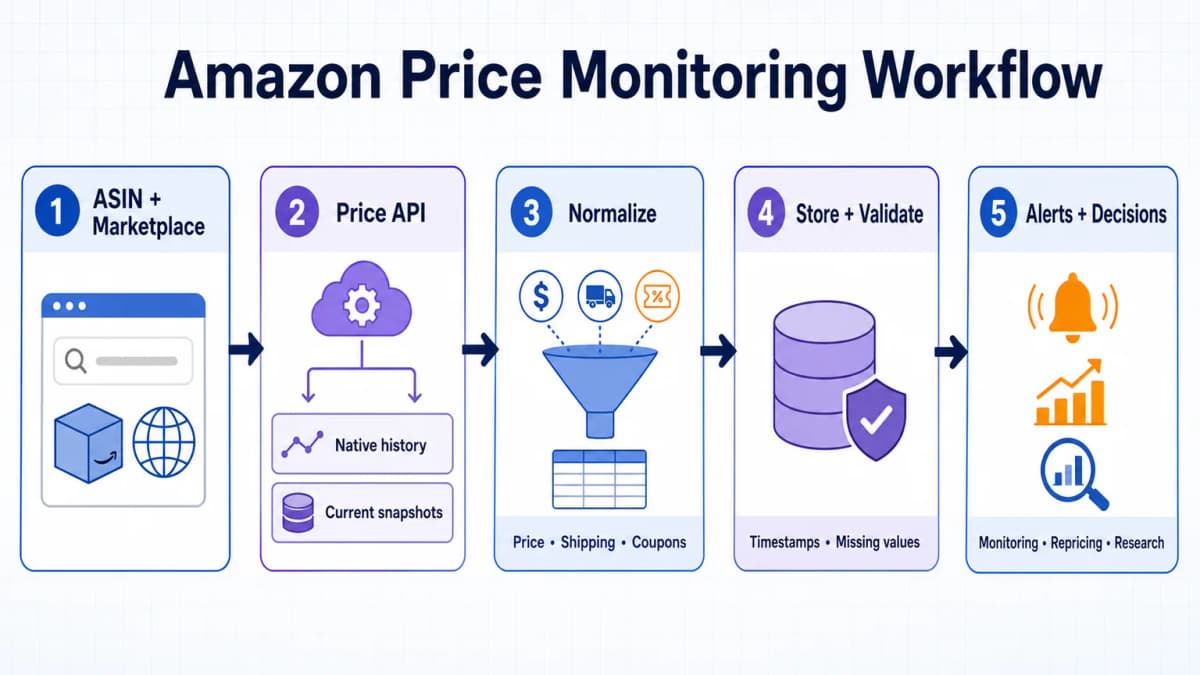
ASIN and Marketplace
Start with the product identifier, Amazon domain, variation, condition, and delivery context. An Amazon.com price collected for a New FBA offer should not be compared directly with an Amazon.co.uk Used FBM offer.
API Request
Choose whether the workflow needs native history or a current snapshot. Request only the price and related fields required for the decision. Unnecessary offer or refresh parameters can increase cost and response complexity.
Normalization
Store the displayed price and normalized numeric value separately. Preserve currency, shipping, coupon requirements, Prime eligibility, condition, fulfillment, seller, and availability. Convert timestamps consistently without discarding the provider’s original value.
Storage and Validation
Keep source, request context, collection time, provider update time, and missing-value state. Validate that the returned ASIN and marketplace match the request. A failed call or absent field must remain missing rather than becoming zero.
Alerts and Decisions
Alerts should use stable rules such as percentage change, absolute threshold, seller change, Buy Box movement, or promotion start and end. Repricing actions need account authorization, safeguards, minimum margins, and human review where business risk is material.
Selection Checklist
Before choosing an Amazon price API, test the following:
- Required price type: Current product price, list price, Buy Box, lowest offer, landed price, coupon price, Prime, FBA, or FBM.
- Historical window: Native backfill length, event frequency, sampling behavior, and missing periods.
- Marketplace context: Domain, locale, currency, delivery ZIP, condition, and variation.
- Access model: Independent API key, seller OAuth authorization, or approved creator account.
- Throughput: Batch size, rate limits, async jobs, callbacks, retries, and timeout behavior.
- Cost model: Subscription, token bucket, credits, successful-result billing, or task cost.
- Data boundaries: Source, freshness, estimates, missing values, and permitted uses.
- Integration fit: REST, SDK, MCP, webhook, cloud delivery, and existing storage architecture.
- Failure handling: Partial fields, unavailable products, CAPTCHAs, redirects, and provider errors.
- Representative QA: Test variations, coupons, multiple sellers, out-of-stock periods, and several marketplaces.
Conclusion
Final Recommendation
The best Amazon price API depends on the application’s authorization and data model. Keepa is a strong specialist for deep historical price and BSR analysis. Amazon Product Pricing supports seller-authorized repricing and Featured Offer workflows. Amazon Creators API serves approved affiliate experiences. Managed scraper APIs provide current page and offer snapshots that can feed customer-built monitoring systems.
Nexscope ranks first for teams that need selectable price curves together with a broader Amazon data layer. Its Amazon Product Price Series API can return selected price, Buy Box, BSR, seller-count, rating, and monthly-sold series for a supported ASIN and marketplace. REST supports applications and scheduled data pipelines. MCP supports a user-owned Agent and workflow.
Once price movement is detected, the next question is whether the change relates to seller competition, rank, ratings, demand, promotion, or another market signal. Nexscope’s wider Amazon API catalog supports those adjacent research tasks without presenting an unexplained correlation as a proven cause.

Frequently Asked Questions
What is an Amazon price API?
An Amazon price API is a programmatic interface that returns pricing information from or about Amazon marketplaces. Depending on the provider, it may return a current displayed price, list price, seller offers, shipping, Buy Box data, discounts, coupons, Prime pricing, fulfillment details, or historical price changes. Official Amazon APIs serve authorized seller or affiliate use cases. Independent data providers and scraper APIs support other research and collection workflows. The request context matters because marketplace, location, variation, condition, seller, and delivery can change the observed price.
Does Amazon have an official pricing API?
Yes. Amazon Product Pricing is part of the Selling Partner API and supports seller-authorized pricing and offer workflows. It includes operations for competitive summaries, featured offers, and Featured Offer Expected Price data. Amazon Creators API also exposes offer information for approved affiliate and creator applications. These APIs have specific authorization and usage rules. They are not unrestricted public price-history databases, so teams should select the official interface that matches the application’s seller or affiliate relationship.
Which API provides Amazon price history?
Keepa specializes in Amazon product, price, BSR, offer, deal, and tracking history. Nexscope also provides an Amazon Product Price Series API with selectable price curves and related BSR, seller-count, rating, and sales-related series where supported. Many scraper APIs return current observations instead of historical backfill. A customer can schedule those current requests and store snapshots, but the resulting history begins when collection starts and depends on successful, consistently localized requests.
Can an API return Buy Box data?
Yes, several APIs can return Buy Box or Featured Offer information, but the field meaning varies. Nexscope offers a Buy Box price series and a coupon-applied Buy Box curve. Keepa includes Buy Box history and offer data. Amazon Product Pricing uses Featured Offer terminology for seller workflows, while Amazon Creators API can identify a featured listing. The integration should confirm whether the value includes shipping, applies to a specific condition, and represents a current observation or historical series.
What is native price history?
Native price history is stored by the provider before the customer makes the current request. It can supply historical context immediately, subject to the provider’s coverage and retention limits. Customer-built history starts when the application begins collecting current snapshots. Both models can be useful, but they have different backfill, storage, missing-data, and maintenance requirements. A comparison table should not label current snapshot collection as native historical coverage.
Can price APIs cover multiple marketplaces?
Many providers support more than one Amazon domain, but the exact list varies. Marketplace support alone does not guarantee comparable results. The application should preserve domain, language, currency, delivery location, product variation, condition, and fulfillment context. A localized price may reflect taxes, shipping, seller availability, or regional promotions. Representative tests should cover every marketplace the production workflow plans to monitor.
Can an Agent call a price API through MCP?
Yes, when the provider exposes the tool through the Model Context Protocol. The Nexscope Amazon Product Price Series API supports an MCP method, so a user-owned Agent can discover and call the tool with structured arguments. The Agent still needs operational boundaries for API credits, retries, missing data, alert thresholds, and any action that changes seller pricing. MCP simplifies tool discovery and calling; it does not replace data validation or business approval rules.
Sources
- Amazon. (2026). Product Pricing API Documentation. Retrieved from developer-docs.amazon.com
- Amazon Associates. (2026). Creators API OffersV2 Reference. Retrieved from affiliate-program.amazon.com
- Keepa. (2026). Keepa API Documentation Overview. Retrieved from keepa.com
- Traject Data. (2026). Rainforest API Product and Price Data Overview. Retrieved from trajectdata.com
- Oxylabs. (2026). Amazon Pricing Data Source Documentation. Retrieved from developers.oxylabs.io