
How to Plan a Halloween Marketing Campaign for Your Online Store

Halloween marketing starts with a buying occasion. A shopper might need decorations for a party, an outfit for an event, or a comfortable setup for a scary-movie night. Each occasion calls for a different offer, message, and delivery deadline. A store selling costumes needs to show fit and availability. A homeware store can use the same holiday to demonstrate how its everyday products work together. Both need a clear reason for someone to choose the offer and enough time to fulfill it.
A useful Halloween marketing campaign connects those decisions before advertising begins. Choose the audience and product, research the language shoppers use, build an offer with workable margins, and create content that answers a buying question. Then schedule promotion around the customer's event date and measure what happens after the click. This guide follows that sequence, with examples for seasonal and everyday products, adaptable English copy, and specific research tasks that marketing data can support. The examples are planning scenarios, not reported campaign results or promises of sales.
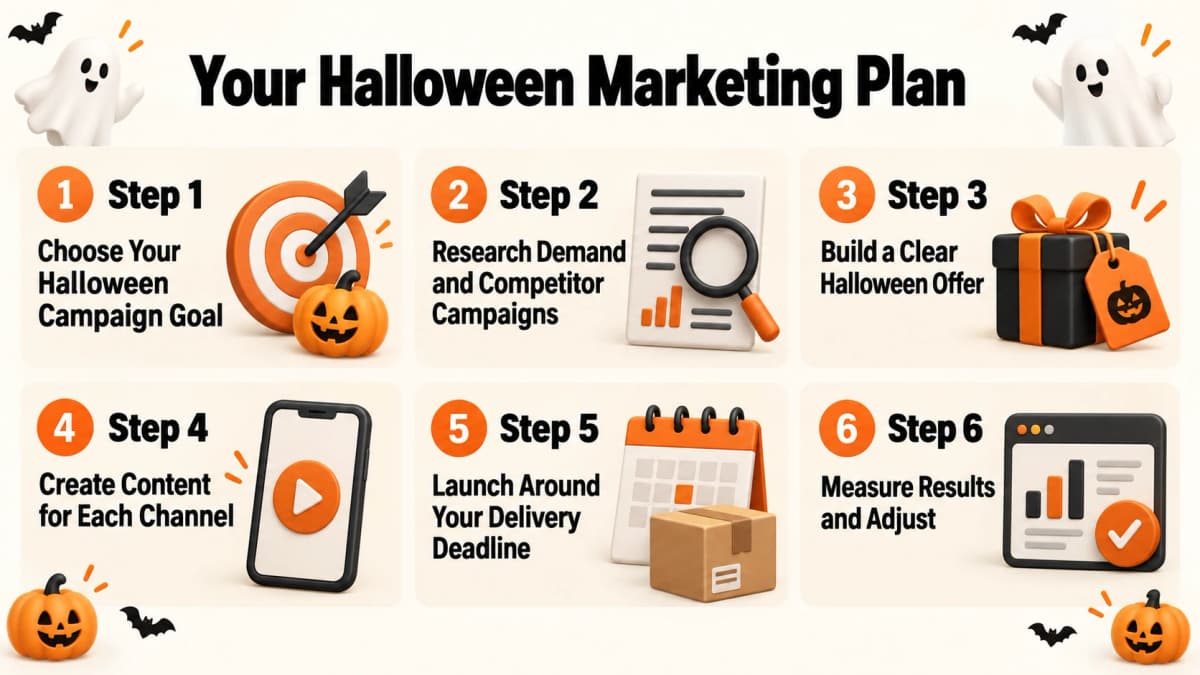
Contents: Step 1: Campaign goal · Step 2: Demand and competitors · Step 3: The offer · Step 4: Channel content · Step 5: Timing · Step 6: Measurement · Conclusion
Step 1: Choose Your Halloween Campaign Goal
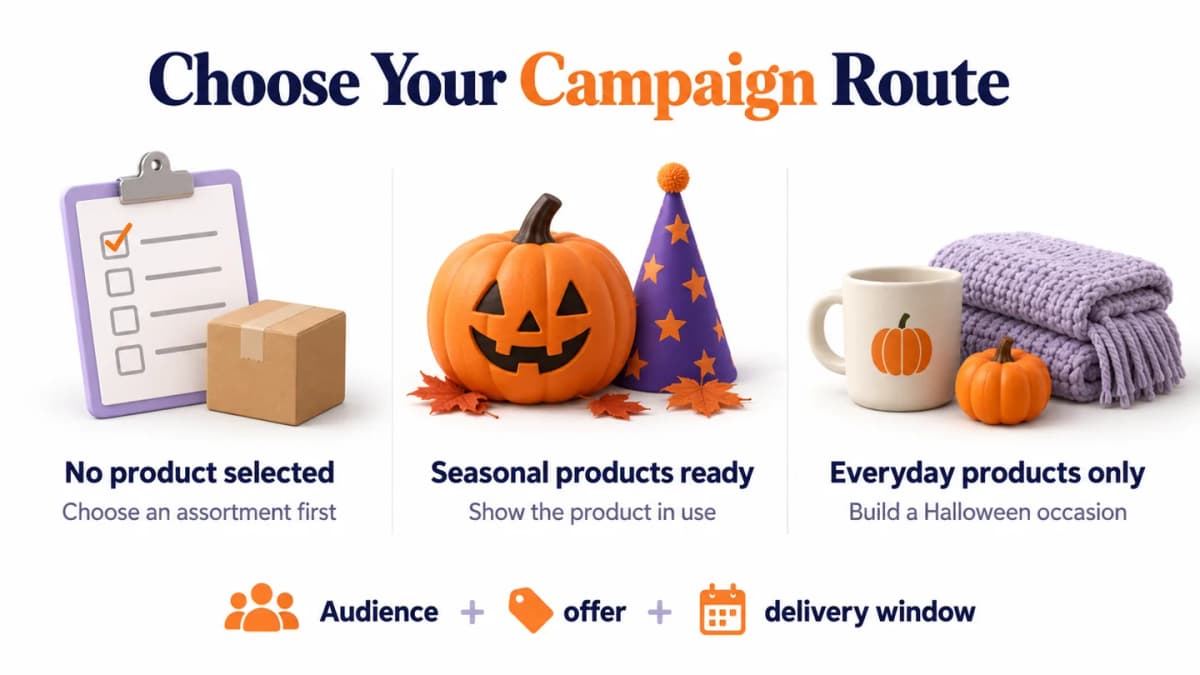
Start with the assortment you can actually sell. That determines whether the next task is product selection, a seasonal product campaign, or a new presentation of an existing range.
No Product Selected Yet
If you have not chosen your seasonal assortment, start with these 50 Halloween products to sell. Shortlist a few that fit your audience, margins, and delivery window before building the campaign. A compelling video idea is only useful when the product can be sourced, checked, and delivered in time.
Choose one primary occasion, such as decorating a small apartment or hosting a children's party. Avoid launching unrelated costumes, kitchenware, and pet accessories together just because all three can carry pumpkin artwork. A focused assortment makes the offer and its content easier to explain.
Seasonal Products Already Available
For existing Halloween stock, make the product's use concrete. A decoration kit needs an assembled view and an accurate contents list. A costume needs sizing and movement footage. A party set needs a clear guest count.
Write a campaign objective that includes both sales and economics: sell a defined quantity of available inventory while maintaining a chosen contribution per order. Record starting stock so the final review can distinguish increased demand from a product simply becoming unavailable.
Everyday Products Only
A store can participate without adding a Halloween SKU. A beauty brand could demonstrate an evening look using its existing palette. A homeware store could assemble a movie-night collection from blankets, mugs, and cushions. An apparel store could show an outfit built around pieces that remain useful after October.
The seasonal connection should explain a real use. Keep the ordinary product specifications visible, and show which decorations in the campaign imagery are props. Choose a goal such as acquiring new customers at an acceptable cost or increasing contribution from existing-customer orders.
| Campaign route | Example offer | Main buying question | Primary business check |
|---|---|---|---|
| Seasonal assortment | Doorway decoration kit | What does the set include, and will it arrive in time? | Contribution and inventory sell-through |
| Everyday assortment | Movie-night homeware collection | Why do these products belong together? | Contribution and new-customer acquisition cost |
Campaign brief example: “Help apartment residents decorate one doorway with an in-stock kit. Demonstrate the actual setup, disclose the included pieces, and promote only to destinations the store can serve before the event.”
Step 2: Research Demand and Competitor Campaigns
Research should answer a small set of questions: what occasion shoppers care about, what language they use, what competing offers promise, and which questions remain unanswered. Begin with one product family so comparisons stay relevant.
Match Keywords to Buying Intent
Separate occasion phrases from product phrases. “Halloween party ideas” could inform an inspiration post; “Halloween tableware set for 12” suggests a more specific product comparison. Neither phrase alone proves purchase readiness. Check the results and landing pages to understand what a shopper encounters.
For repeatable US English research, Nexscope can supply structured marketing data to a team's own workflow through REST API or MCP. Collect keyword metrics for a small batch of candidate phrases, retain coverage for every input, and use the returned evidence to prioritize which phrases to inspect. The documented interface accepts up to 20 keywords and currently specifies English and the US market. Keep unavailable evidence separate from measured zeroes.
Turn the research into a brief rather than copying a keyword list into every headline:
| Illustrative phrase | Likely question to investigate | Content to prepare |
|---|---|---|
| Halloween doorway decorations | How will the display fit this space? | Measured setup demonstration |
| Halloween tableware set for 12 | Are there enough matching pieces? | Full contents and place-setting photos |
| Halloween movie night ideas | What creates the right atmosphere? | Styled collection with individual product links |
These are example queries, not a measured keyword ranking. Google search evidence should not be labeled as Amazon or TikTok Shop demand.
Inspect Comparable Search Ads
Review ads that lead to comparable products, then examine the destination page. Note the promise, offer, product range, and visible delivery information. A lower advertised price may apply to a smaller pack; a broad “Halloween sale” may cover only selected products.
A research workflow can collect US desktop search ad samples for a relevant keyword and record the available evidence alongside the landing-page review. This interface returns a bounded, single-page sample. Missing fields stay missing; an observed ad does not reveal the advertiser's conversions, profit, or actual account performance.
Use a compact research record: query, market, collection date, advertiser, observed message, destination, and the question your own content could answer better. If an ad emphasizes a low price but leaves quantities unclear, an original contents demonstration is a sensible hypothesis to test. Copying its wording offers little differentiation.
Select One Testable Angle
Finish research with a decision: which audience, occasion, and product benefit will the campaign explain first? For a doorway kit, test “show the finished look” against “show exactly what arrives.” Keep the product and offer consistent initially so the creative comparison is interpretable.
A small store does not need a campaign on every platform. Choose the channel where it can produce useful content, fulfill the offer, and collect enough evidence to make a decision within the remaining season.
Step 3: Build a Clear Halloween Offer
A Halloween offer should reduce the work of choosing or using the product. Decide what the customer receives, why those items belong together, and what the offer costs the store before adding promotional language.
Choose the Offer Format
| Format | Suitable use | Example | Check before launch |
|---|---|---|---|
| Scene-based bundle | Complementary seasonal products | Doorway decorations sold as one kit | Exact quantities, compatibility, and bundle cost |
| Complementary add-on | An existing hero product | Matching accessory offered with an outfit | Stock and additional fulfillment cost |
| Gift above a threshold | Orders with enough margin | Small themed gift with qualifying purchases | Gift availability and eligibility wording |
| Limited-time discount | A defined range and real deadline | Selected party supplies discounted for a stated period | Margin, exclusions, and end time |
| Curated collection | Everyday products with a shared use | Movie-night blankets, mugs, and cushions | Clear individual prices and no implied discount |
A bundle does not need to be discounted to be useful. Its value might come from coordinated designs, a verified fit, or a complete shopping list. If the page advertises savings, calculate them from the actual eligible items and applicable prices.
For a gift offer, state what happens when the gift runs out. For a deadline, use the same date and time zone across the ad, email, product page, and checkout. Promotional urgency should come from the actual offer or delivery window.
Calculate the Advertising Headroom
Use contribution before advertising to assess how much room the offer leaves for acquisition. Include product costs, packaging, fulfillment, shipping borne by the store, applicable transaction fees, and an allowance for returns or damage. Keep fixed overhead separate so contribution is not mislabeled as net profit.
Illustrative calculation: a bundle sells for $40, excluding tax, with $24 in total variable costs before advertising. Its contribution before advertising is $16. A $10 acquisition cost leaves $6 per order before fixed overhead. If the store discounts the bundle by 20%, revenue falls to $32. Holding variable costs at $24 for this simplified example, only $8 remains before advertising; the same $10 acquisition cost now produces a $2 loss before overhead.
The practical lesson is to calculate the promotion and advertising allowance together. Recalculate fees that change with price in the actual model. If the planned discount removes too much headroom, test a different pack size, complementary add-on, or full-price collection.
Complete the Destination Page
Keep the ad's product, quantity, price, and offer visible on arrival. Show contents, specifications, delivery information, returns information, and a clear next action. A customer who clicks a specific kit should not have to search a general Halloween collection to find it.
For marketplace sellers, listing optimization should answer the same buying questions in the available product-page fields. A seasonal campaign cannot compensate for unclear sizes, missing components, or misleading setup images.
Step 4: Create Content for Each Channel
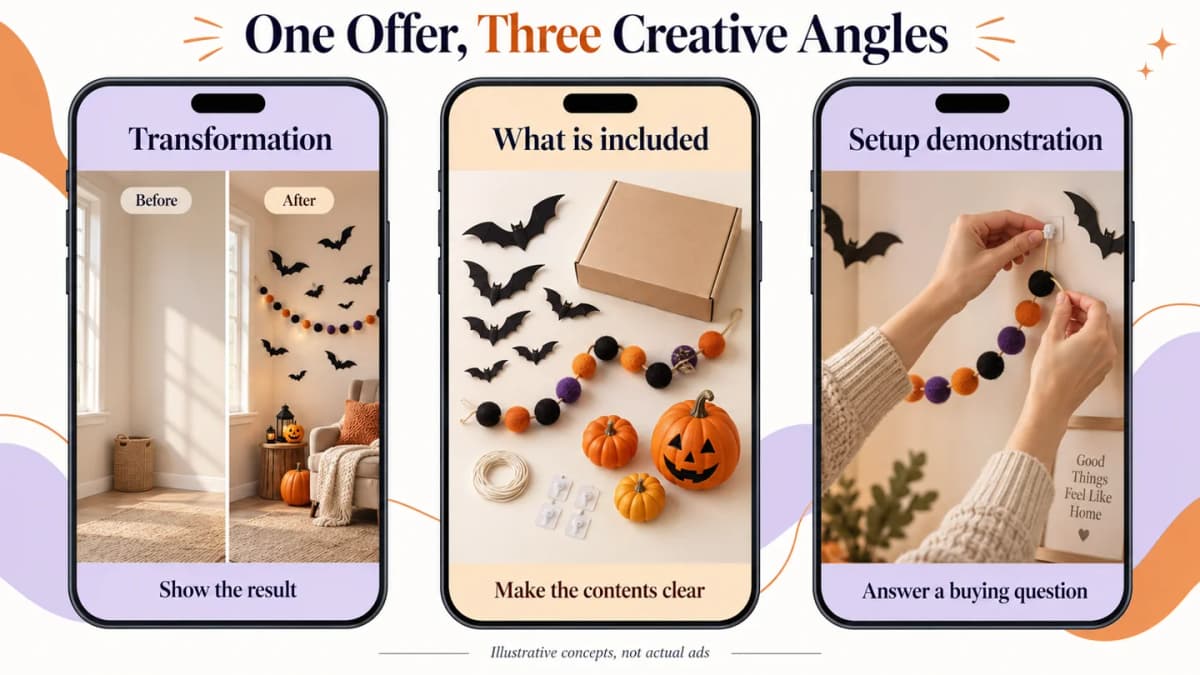
Illustrative creative concepts, not screenshots of actual advertisements or evidence of product performance.
Use the same offer across channels, then adapt how it is explained. A short video can demonstrate an effect; a search ad should match the query; an email can explain why a familiar product belongs in the seasonal collection.
Short-Form Product Demonstrations
TikTok's creative guidance recommends a hook, body, and close. Apply that structure to one buying question. Show the product early, use footage of the actual item, and end with an action that matches the destination.
For a decoration kit, prepare three versions:
- Transformation: open with the finished doorway, show the starting space, then demonstrate how the supplied pieces create the result.
- Contents: lay out everything in the box, show quantity and scale, then reveal the assembled display.
- Setup: answer a practical question about attachment, assembly, or storage using the real sample.
Adaptable script: “Decorating a small doorway? Here is the complete look, followed by every piece in the kit. Start with the garland, add the bat decals, and check the surface instructions before attaching them. View the kit details and delivery options.”
For everyday homeware, change the opening to “Set up a Halloween movie night with pieces you can use all autumn.” Show the blanket, mug, and cushion individually. If a pumpkin is a styling prop, avoid presenting it as part of the order.
Produce and Adapt Campaign Videos
Once the offer and storyboard are clear, turn approved product images into the first video variations. For a Halloween mug, that could mean a slow close-up of the design followed by a wider movie-night scene. Nexscope's Creative APIs let teams connect this production work to their own applications. Use the Seedance 2.5 API to generate product videos from reference images and a motion prompt, then review the output before using it in an ad. API access requires an active subscription; trial credits do not include API access.
For a hands-on workflow, the Seedance 2.5 video generator lets the team create and review videos before automating production. Its published starting price is $0.10 per second, with the final charge dependent on the generation settings and completed result. Check the current credit estimate and subscription terms when budgeting the campaign.
If the team already has an effective video structure of its own, Video Clone can use an uploaded reference video or supported TikTok link alongside product images to create a new product-focused version. For example, adapt an authorized unboxing reference into a Halloween kit reveal. Use references the team owns or has permission to adapt, and check that the generated sequence represents the actual product.
When the campaign covers several products, the bulk video generator can create up to 100 product videos per project using each product's own images and details. Group a Halloween collection into product folders, apply a consistent style, and review a small sample before generating the rest. Choose from the models available in the batch settings, check the total credit estimate, and review each finished video for product accuracy and delivery claims before publishing.
Paid Social Creative
For Meta placements, prepare images or video that remain understandable in the placements selected for the campaign. Show the product and offer clearly, preview text placement, and check the destination on a phone.
Compare a small number of distinct angles before producing many cosmetic variations. “A complete doorway setup” and “See every piece before ordering” test different buying reasons. Changing only the background color may offer less useful information at this stage.
Seasonal product copy: “A coordinated Halloween doorway, in one kit. See the included decorations, check the dimensions, and choose an available delivery option.”
Everyday product copy: “Make room for a Halloween movie night. Explore blankets, mugs, and cushions that work together, with individual prices and product details.”
These examples deliberately leave delivery and discount claims to the actual offer. Add them only after the corresponding stock, terms, and fulfillment checks are complete.
Search Ads and Marketplace Advertising
Keep search copy close to the product being sold. A query about party tableware should reach the relevant set, with its guest count and contents visible. Avoid broad seasonal traffic that the page cannot serve.
Example Google search headlines: “Halloween Tableware Set”; “Plates, Cups & Napkins”; “See Contents & Sizes.”
Example description: “Coordinate your party table. Compare set contents and check delivery options before ordering.”
For Amazon, connect the seasonal plan to the store's PPC strategy, then use its own search-term and order evidence to assess relevance. Treat Google keyword observations as separate research inputs. They are not interchangeable with Amazon advertising reports.
Email and Store Content
Build a short sequence around useful changes in the offer. Send it to the appropriate subscribed audience and suppress messages that are no longer relevant after purchase or stock changes.
| Message | Example subject line | Main content |
|---|---|---|
| Preview | A first look at your Halloween setup | Introduce the occasion and available collection |
| Launch | Your Halloween doorway starts here | Show the offer, contents, and product link |
| Delivery reminder | Planning a party? Check your delivery window | Explain current destination-specific options |
| Everyday-product variation | A movie-night setup for spooky season | Demonstrate the collection without implying every item is discounted |
Use one primary action per message. A reminder should help the recipient decide whether the order still fits their plans. It should not repeat an expired delivery promise simply because the email was scheduled earlier.
Step 5: Launch Around Your Delivery Deadline
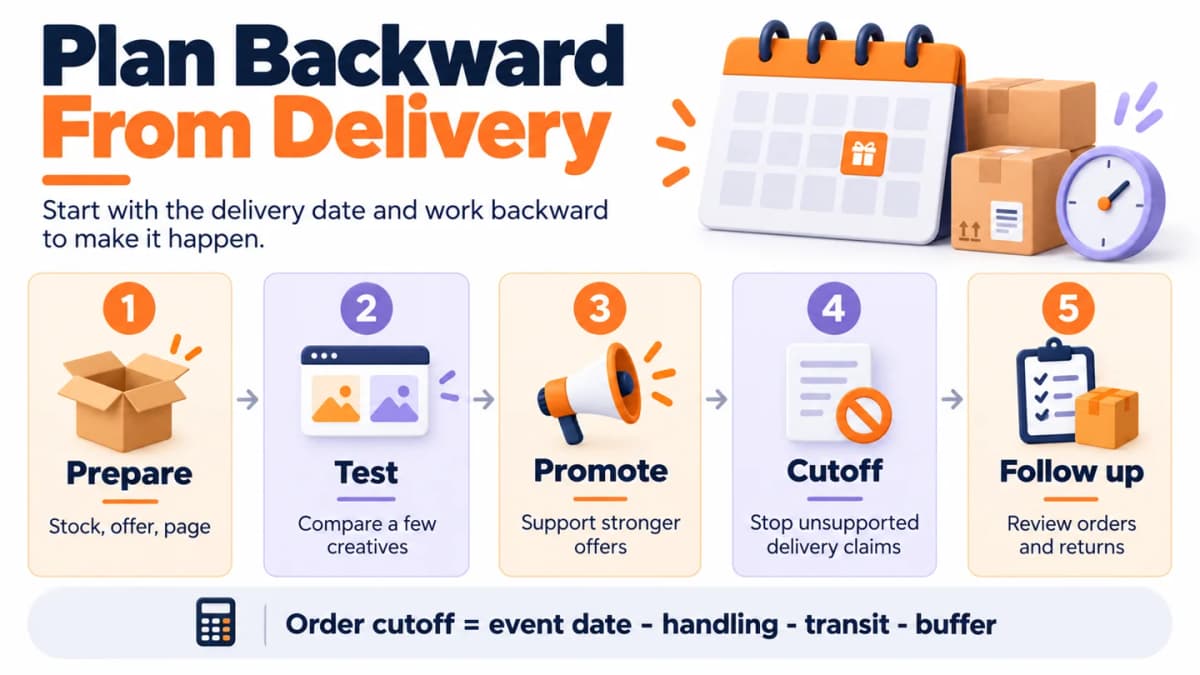
Build the schedule backward from the customer's event. Halloween falls on October 31, but a party, school activity, or workplace celebration may happen earlier. The relevant cutoff also varies by destination and fulfillment method.
Research the Seasonal Window
Historical patterns can help decide when to prepare content. Compare the same product phrases over a relevant past season using keyword interest history. The documented dataset reports US relative interest from DataForSEO Trends; its scores are not search volumes, and a zero denotes insufficient data. Preserve provider dates and compare equivalent periods before drawing conclusions.
Use the pattern to plan research and creative production, then let stock and delivery capacity govern the current launch. A historical peak does not guarantee that this year's demand or the store's conversion rate will follow it.
Set the Order Cutoff
Start with: latest order date = customer's event date − handling time − transit time − operating buffer. Apply carrier working days, service availability, destination, and any production time in the actual calculation.
For example, if a customer needs an item for an October 28 event, the plan must work back from October 28. Do not advertise an October 31 arrival as sufficient. Keep a separate rule for made-to-order items and for each materially different shipping service.
| Phase | Work to complete | Condition for moving forward |
|---|---|---|
| Prepare | Confirm stock, offer, page, and sample footage | The order can be fulfilled as described |
| Test | Compare a few meaningful creative angles | Tracking works and spending stays within the test allowance |
| Promote | Support combinations with stronger observed economics | Sufficient stock and delivery capacity remain |
| Cutoff | Update ads, emails, pages, and automated messages | Every remaining delivery claim is still supportable |
| Follow up | Review deliveries, returns, and remaining inventory | Costs are reconciled enough to judge the campaign |
If the season is already underway, compress the scope rather than assuming every preparation step can be skipped. A campaign around verified local stock is different from one waiting for an untested overseas shipment.
Match the Selling Channel
An independent store can coordinate collection pages, email, and paid traffic around the same cutoff. A TikTok Shop offer must match the product variation shown in the video and the delivery information available to the buyer. On Amazon, review the actual offer and fulfillment promise customers see before expanding seasonal promotion.
After the cutoff, shift only to options that genuinely remain available, such as supported local pickup or existing digital products. Everyday assortments can move into a broader autumn occasion. Remove Halloween-arrival claims from scheduled content as well as active ads.
Step 6: Measure Results and Adjust
Decide what will count as a useful result before launch. Set a total test allowance, a review cadence, and a maximum acceptable acquisition cost based on the offer's contribution. Low-volume campaigns may not produce a statistically reliable winner before the season ends; treat early signals accordingly.
Use Consistent Measures
Track net sales, advertising spend, variable costs, new customers, delivered orders, and remaining stock. Calculate order value and conversion rate using a consistent definition and period. For inventory sell-through, state whether the denominator includes replenishments received during the campaign.
New-customer acquisition cost divides the relevant acquisition spend by new customers identified under the chosen measurement method. Contribution after advertising subtracts variable costs and allocated advertising costs from net sales. These measures answer different questions; a campaign that sells existing stock efficiently may not acquire many new customers.
Maintain consistent campaign identifiers in links and reports. Check purchase-event tracking with the store's normal test process before increasing spend, and investigate duplicate or missing events before interpreting performance.
Diagnose the Point of Friction
| Observed pattern | Question to investigate | Possible adjustment |
|---|---|---|
| Impressions with few clicks | Is the occasion or product benefit clear? | Test a more specific opening or first image |
| Clicks with few product interactions | Does the destination match the ad? | Send traffic to the exact offer and clarify contents |
| Add-to-carts with few purchases | Are shipping cost or timing changing the decision? | Surface delivery options and total cost earlier |
| Orders with weak contribution | Is the offer leaving enough room for acquisition? | Rework the discount, bundle, or spending limit |
| Sales concentrated in one variant | Is promotion creating a stock imbalance? | Adjust featured variants while preserving relevance |
Treat these as diagnostic questions, not automatic explanations. A tracking error can resemble a conversion problem, and a short burst of orders can occur without a durable improvement. Change one major variable at a time when feasible and note the date of each adjustment.
Reconcile Orders and Attribution
Google explains attribution as assigning credit across interactions in a customer's path. Different attribution settings can produce different channel totals. Do not add reported revenue from several advertising platforms and assume it equals store revenue; the same purchase may be credited more than once.
Use the store's order records for realized sales, refunds, and fulfillment costs. Keep platform-attributed results in their own comparison columns. Public keyword and ad-intelligence data inform research; they do not replace authorized account reporting or demonstrate incremental sales.
After the campaign, include late returns, damage, leftover stock, and creative production costs in the review. Record the audiences, offers, and demonstrations worth retesting next season, along with the evidence and limitations behind each decision.
Conclusion
A workable Halloween marketing campaign connects an occasion to an offer the store can fulfill. Choose the assortment first, research the buying questions, calculate the economics, and adapt the message to each channel. Schedule promotion around the delivery window, then use order and cost evidence to decide what deserves more spending.
Nexscope's Marketing Data APIs bring search, keyword, and advertising research into a team's own applications and workflows through REST API or MCP. Start with the evidence needed for the next campaign decision, and check the relevant interface's coverage and date boundaries before using its results.
Plan Your Halloween Campaign With Better Evidence
Explore the visual API catalog to find keyword, seasonal-interest, and search-ad data for your marketing workflow.
Explore Marketing APIs →Frequently Asked Questions
When should Halloween marketing start?
Start early enough to confirm the assortment, inspect samples, prepare content, and test the purchase journey before promotion. The appropriate date depends on production time, available stock, the customer's event, and shipping coverage. Use historical interest to inform preparation, then work backward from a realistic order cutoff. A store with ready inventory can follow a different schedule from one offering customized products.
Can a store market everyday products for Halloween?
Yes, when the holiday creates a credible use for the products. A homeware collection can support a movie night, while existing cosmetics can feature in a seasonal look. Show the actual products, explain the occasion, and distinguish styling props from included items. A curated collection does not need a discount, but its prices and any advertised savings should be clear.
What can a small store do with a limited budget?
Choose one audience, one offer, and a channel the store can support well. Produce a few useful demonstrations from the same sample, improve the destination page, and communicate with relevant existing subscribers. If using paid traffic, set a test allowance from the offer's economics. Avoid dividing a small budget across so many campaigns that none generates enough evidence to assess.
Should a Halloween campaign use discounts or bundles?
Choose the format that improves the offer while preserving workable contribution. Bundles can make a coordinated setup easier to buy; discounts can support a specific promotional objective. Both require cost calculations. Include packaging, shipping, gifts, fees, and expected returns, then assess advertising headroom. Test the actual proposition rather than assuming a larger percentage discount or a higher item count will perform better.
How should Halloween campaign performance be measured?
Review net sales, variable costs, advertising spend, new customers, inventory movement, and fulfillment outcomes over a defined period. Keep platform attribution separate from reconciled store orders. Compare offers using consistent definitions and record changes made during the campaign. Include returns and remaining seasonal stock in the final review; revenue or clicks alone cannot establish whether the campaign met its business objective.
How can Marketing APIs help plan the campaign?
Marketing APIs can supply inputs for keyword research, seasonal-interest comparisons, and observed search-ad analysis. Those inputs help a team decide what to investigate and which messages to test. Check the specific interface's supported market, dates, fields, and missing-data behavior. Public research datasets do not reveal a competitor's private account results or replace the store's own sales, cost, and attribution records.
Sources
- Nexscope. (2026). Marketing Data APIs for Ecommerce Teams. Retrieved from nexscope.ai
- Nexscope. (2026). SEO Keyword Metrics, Keyword Interest History, and SEO Search Ad Samples Documentation. Retrieved from nexscope.ai
- TikTok for Business. (n.d.). Creative Codes: 6 Principles for Creating on TikTok. Retrieved from ads.tiktok.com
- Google Analytics Help. (n.d.). Get Started with Attribution. Retrieved from support.google.com
- Nexscope. (2026). Seedance 2.5 Video Generation, Video Clone, and Bulk Product Video Generator. Retrieved from nexscope.ai