
TikTok Shop Trending Products: What to Sell in 2026

Product selection determines success on TikTok Shop more than any other factor. The platform rewards products that demonstrate well on video—items with visible transformations, satisfying reveals, or immediate problem-solving appeal. Understanding what sells and why separates profitable sellers from those burning through inventory.
TikTok Shop's algorithm favors engagement over everything. Products that make viewers stop scrolling, watch until the end, and share with friends get pushed to millions. This creates a specific product profile: demonstrable, emotionally resonant, and priced for impulse purchase.
This guide covers the trending categories, product characteristics, research methods, and selection strategies that work on TikTok Shop in 2026.
Why Product Selection Matters More on TikTok
The Platform Difference
| Platform | Primary Sales Driver | Product Requirements |
|---|---|---|
| Amazon | Search + Reviews | SEO-optimized listings, competitive pricing |
| Shopify | Paid Ads + Brand | Strong creative, targeting, brand story |
| TikTok Shop | Content + Algorithm | Video-friendly, demonstrable, shareable |
TikTok does not reward the best SEO or biggest ad budget. It rewards content that captures attention. This fundamentally changes what products succeed.
Products that work on TikTok
- Show visible transformation (before/after)
- Solve problems in satisfying ways
- Have "oddly satisfying" appeal
- Create emotional response (surprise, delight, relief)
- Are easy to understand in 3 seconds
Products that struggle
- Require explanation or context
- Look similar to competitors
- Have no visual differentiation
- Appeal to logic over emotion
The Impulse Purchase Zone
TikTok shoppers are not searching for products. They discover them while scrolling. This creates an impulse purchase dynamic.
Optimal Price Range: $15-50
| Price | Conversion Behavior |
|---|---|
| Under $15 | Easy yes, but low margins |
| $15-30 | Sweet spot for impulse |
| $30-50 | Works with strong demonstration |
| $50-100 | Requires trust-building content |
| Over $100 | Difficult without established brand |
Products in the $20-40 range consistently outperform on TikTok Shop. High enough for healthy margins, low enough for impulse decisions.
Top Trending Categories in 2026
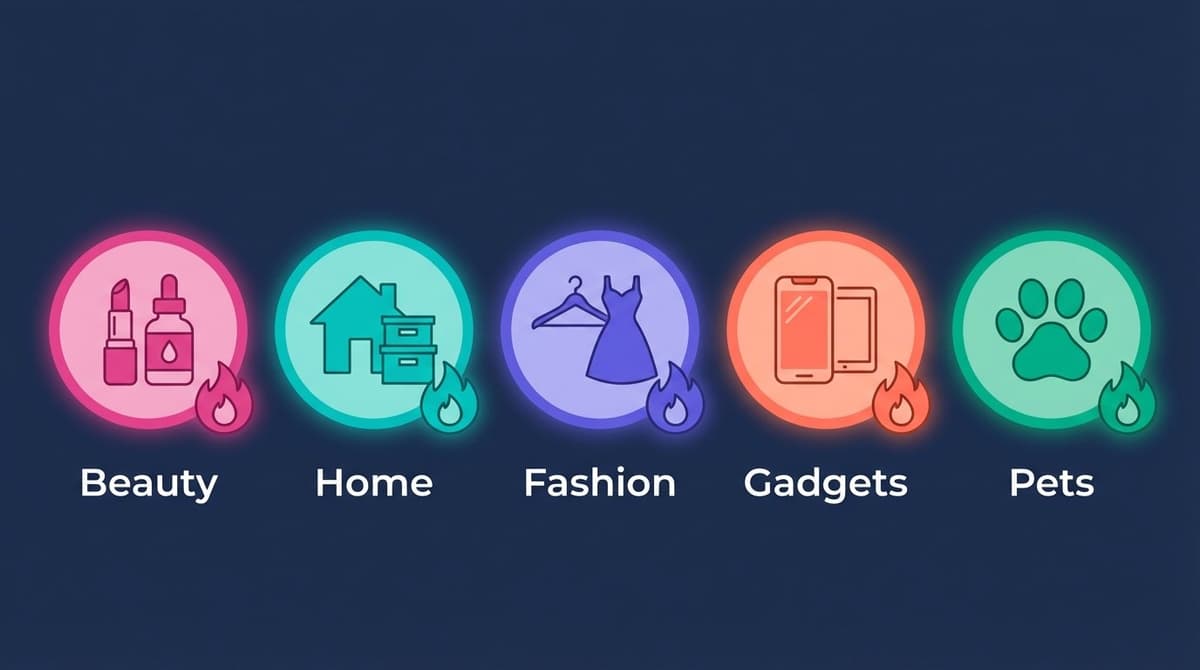
Beauty & Personal Care
The dominant category on TikTok Shop. Beauty content has built-in transformation appeal.
Trending Subcategories
- Skincare devices (LED masks, gua sha tools, facial steamers)
- K-beauty and J-beauty imports
- Hair styling tools (one-step solutions)
- Nail art kits and supplies
- Men's grooming (growing rapidly)
What's Working
- Before/after transformation videos
- "Get ready with me" integration
- Ingredient education content
- Dupe culture (affordable alternatives to luxury)
Avoid
- Generic moisturizers (no differentiation)
- Products requiring long-term results (hard to demonstrate)
- Heavy fragrance items (can't convey through video)
Home & Organization
Satisfying organization content drives massive engagement.
Trending Subcategories
- Drawer organizers and dividers
- Kitchen gadgets (one-purpose tools that work)
- Closet systems
- Cleaning tools with visible results
- Space-saving solutions
What's Working
- Transformation videos (messy → organized)
- "TikTok made me buy it" restocks
- Satisfying reveals and unboxings
- Rental-friendly solutions (removable, no damage)
Avoid
- Large furniture (shipping nightmares)
- Items requiring assembly instructions
- Generic storage bins (commoditized)
Fashion & Accessories
Fast fashion thrives on TikTok. Trend cycles are compressed.
Trending Subcategories
- Statement jewelry (chunky, bold pieces)
- Athleisure and loungewear
- Y2K revival pieces
- Matching sets
- Seasonal accessories (currently: summer hats, sunglasses)
What's Working
- Outfit transition videos
- "Styling one piece three ways"
- Affordable luxury alternatives
- Size-inclusive try-ons
- Trend interpretation content
Avoid
- Basic basics (white t-shirts, plain jeans)
- High-fashion items with narrow appeal
- Sizes with high return rates without clear sizing guides
Gadgets & Problem-Solvers
TikTok loves a good problem-solution video.
Trending Subcategories
- Phone accessories (stands, chargers, cases with features)
- Car organization tools
- Travel gadgets
- Pet tech
- Desk accessories for WFH
What's Working
- "I can't believe this exists" reaction content
- Pain point → solution format
- Comparison videos (this vs. that)
- Durability tests
Avoid
- Overly complex gadgets
- Items with long setup processes
- Anything requiring technical knowledge
Pet Products
Trending Subcategories
- Interactive toys (self-playing, puzzle feeders)
- Grooming tools (deshedding, nail care)
- Pet cameras and monitors
- Stylish accessories (bandanas, bow ties)
- Travel gear for pets
What's Working
- Cute reaction videos
- Problem-solving (stops barking, reduces shedding)
- Pet vs. product videos
- Unboxing with pets
Avoid
- Food and treats (regulations, expiration issues)
- Medical products (liability concerns)
- Species-specific items with small markets
Market-Specific Insights
TikTok Shop operates differently across markets. What sells in the US may not work in the UK or Southeast Asia.
United States
Consumer Profile
- Quality-conscious but price-sensitive
- Values convenience and fast shipping
- Strong on beauty, home, and wellness
- Expects 2-5 day delivery
Winning Strategies
- Emphasize "Amazon alternative" positioning
- Focus on unique/hard-to-find items
- Leverage creator partnerships aggressively
United Kingdom
Consumer Profile
- Brand-conscious
- Sustainability increasingly important
- Strong fashion and beauty markets
- Accepts slightly longer shipping times
Winning Strategies
- Highlight eco-friendly aspects
- Partner with UK-based creators
- Price in GBP, not converted USD
European Markets (Germany, France, Italy, Spain)
Consumer Profile
- Quality over quantity mindset
- Skeptical of unknown brands
- Strong regulatory requirements
- Language localization essential
Winning Strategies
- Invest in proper translations (not just Google Translate)
- Ensure EU compliance (CE marking, REACH)
- Build trust through reviews and social proof
Southeast Asia
Consumer Profile
- Price-sensitive, high volume
- Mobile-first shopping
- Live shopping extremely popular
- Younger demographic
Winning Strategies
- Competitive pricing essential
- Leverage live shopping heavily
- Partner with local creators
- Flash sales and promotions drive volume
How to Find Winning Products
Method 1: TikTok Native Research
The platform itself is the best research tool.
Process
- Search product keywords (e.g., "kitchen gadget," "skincare tool")
- Filter by "Shop" tab to see products with active sales
- Note videos with high engagement (likes, comments, shares)
- Check the shop's other products and overall sales
Signals of a Winner
- Multiple videos with 100K+ views
- High comment engagement (questions = purchase intent)
- Shop has consistent sales across products
- Product appears in multiple successful videos
Method 2: Competitor Store Analysis
Find successful stores and reverse-engineer their selection.
Ideal Competitor Profile
- 500-3,000 monthly sales (proven but not saturated)
- 50+ products (enough data to identify patterns)
- Good reviews (4.5+ stars)
- Active content creation
What to Analyze
- Best-selling products (sort by sales)
- Price points (find their sweet spot)
- Content style (what formats work)
- Customer reviews (what do people love/hate)
Method 3: Data Tools
Dedicated research tools provide deeper insights.
Recommended Tools
| Tool | Best For | Price |
|---|---|---|
| FastMoss | TikTok Shop analytics, trending products | $99/month+ |
| Kalodata | Product research, competitor tracking | $59/month+ |
| Minea | Ad spy, winning product discovery | $49/month+ |
| TikTok Creative Center | Trending content, hashtags (free) | Free |
Using Data Tools Effectively
- Track products over time (not just snapshots)
- Look for rising trends, not peaked products
- Cross-reference with TikTok native research
- Verify with supplier availability
Nexscope provides structured ecommerce data that teams can use in focused web tools or connect to their existing Agent through API, MCP, or Skills. Ready workflows include Keyword to Ads, Video Clone, and Buy Box Repricer.
Method 4: Trend Prediction
Stay ahead by predicting what will trend.
Trend Sources
- Google Trends (search interest over time)
- Pinterest Predicts (annual trend report)
- Fashion week coverage (6 months ahead)
- Seasonal calendars (holiday, back-to-school, summer)
Timing Matters
- List products 4-6 weeks before peak season
- Build content library before demand hits
- Exit declining trends before saturation
Product Selection Framework
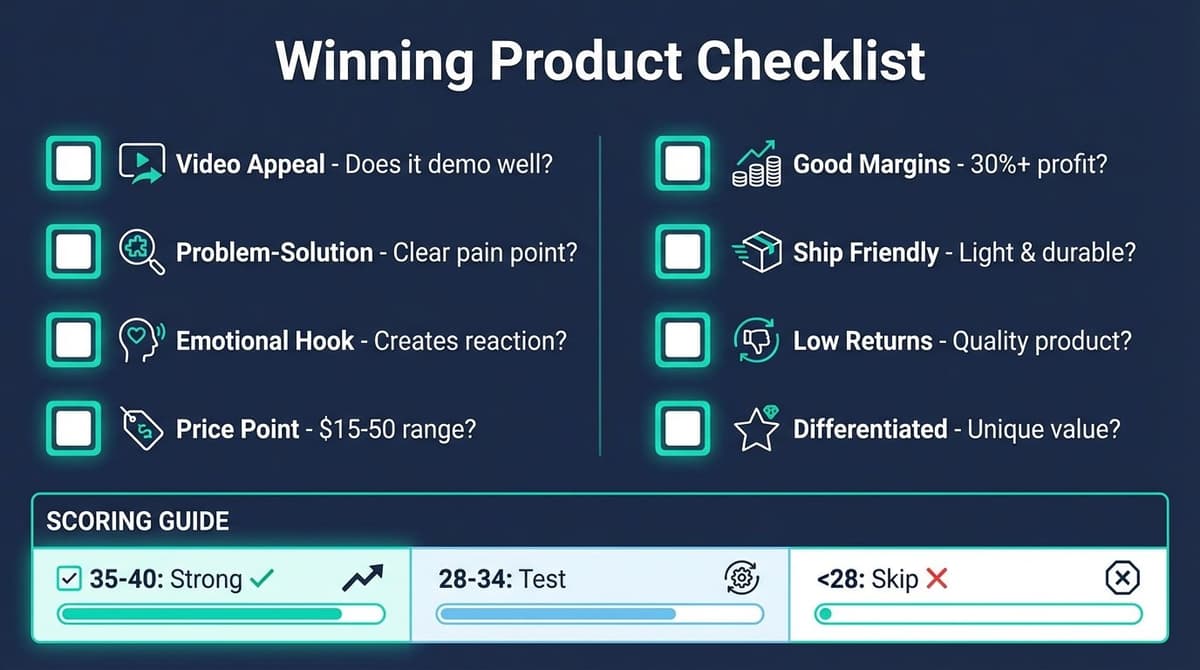
The Winning Product Checklist
Score each potential product:
| Criteria | Score (1-5) |
|---|---|
| Video Appeal - Does it demonstrate well? | ___ |
| Problem-Solution - Does it solve a clear pain? | ___ |
| Emotional Hook - Does it create reaction? | ___ |
| Price Point - In the $15-50 sweet spot? | ___ |
| Margin Potential - 30%+ after all costs? | ___ |
| Shipping Friendly - Light, durable, simple? | ___ |
| Low Return Risk - Clear expectations, quality? | ___ |
| Differentiation - Not easily found elsewhere? | ___ |
Scoring
- 35-40: Strong candidate, prioritize testing
- 28-34: Worth testing with limited investment
- Below 28: Likely not worth pursuing
Red Flags to Avoid
Do Not Sell
- Fragile items — High damage rates destroy margins
- Heavy items — Shipping costs kill profitability
- Trademarked designs — IP violations get shops banned
- Regulated products — Cosmetics, supplements require compliance
- Seasonal-only items — Unless prepared for inventory cycles
- Commodity products — No differentiation = price war
Warning Signs
- Supplier has poor communication
- No clear quality control process
- Price too good to be true
- Unable to get samples
- Inconsistent product photos
Testing and Validation Strategy
Phase 1: Validation (Week 1-2)
Goal
Determine if product has potential before inventory investment.
Actions
- Order 2-3 samples from different suppliers
- Create 5-10 test videos
- List with limited quantity (10-20 units)
- Monitor: views, click-through, conversion
Decision Point
- Views under 5K per video → Content problem, iterate
- Views over 10K, no sales → Listing or price problem
- Sales but negative margin → Supplier or shipping problem
- Positive signals across metrics → Proceed to testing phase
Phase 2: Testing (Week 3-6)
Goal
Validate scalability with real data.
Actions
- Increase inventory to 50-100 units
- Create 20+ pieces of content
- Test different video formats
- Start affiliate program for the product
Metrics to Track
- Return rate (target: under 10%)
- Customer reviews (target: 4.5+ stars)
- Repeat purchase rate
- Content performance consistency
Phase 3: Scaling (Week 7+)
Goal
Maximize proven winners.
Actions
- Increase inventory for reliable supply
- Expand content volume (3-5 videos/day)
- Recruit affiliates aggressively
- Consider TikTok Ads on proven content
- Explore variations (colors, sizes, bundles)
Seasonal Product Calendar
Plan your product selection around the calendar.
| Season | Timeline | Categories |
|---|---|---|
| Q1 | Jan-Mar | Fitness, organization, Valentine's Day gifts |
| Q2 | Apr-Jun | Outdoor, summer prep, graduation gifts |
| Q3 | Jul-Sep | Back-to-school, fall fashion preview |
| Q4 | Oct-Dec | Holiday gifts, cozy home, party supplies |
Key Dates
- Valentine's Day (Feb 14) — List by Jan 15
- Mother's Day (May) — List by April 1
- Prime Day adjacent (July) — Capitalize on shopping mood
- Back-to-School (Aug-Sep) — List by July 15
- Black Friday/Cyber Monday — List by October 15
- Christmas — List by November 1
Seasonal products can generate 50-70% of annual revenue. Plan inventory and content accordingly.
Conclusion
Product selection on TikTok Shop is not about finding the cheapest supplier or copying what everyone else sells. It is about understanding what creates engagement on video, what drives impulse purchases, and what maintains healthy margins.
The best TikTok Shop sellers think like content creators first, retailers second. Every product decision starts with the question: "How will this look in a video?"
Start with the winning product checklist. Research using TikTok's native tools and data platforms. Validate with small tests before committing inventory. Scale only what proves itself with real data.
The products are out there. The framework is here. What remains is execution.
Nexscope provides structured ecommerce data that teams can use in focused web tools or connect to their existing Agent through API, MCP, or Skills. Ready workflows include Keyword to Ads, Video Clone, and Buy Box Repricer.
Connect Ecommerce Data to Your Agent
Use Nexscope through API, MCP, or Skills, or open a ready seller workflow.
Explore Ecommerce Data →1,000 free credits • API, MCP & Skills
FAQs
What is the best product to sell on TikTok Shop?
There is no single "best" product. The best products share characteristics: they demonstrate well on video, solve visible problems, are priced for impulse purchase ($15-50), and have healthy margins. Beauty, home organization, and problem-solving gadgets consistently perform across these criteria.
How do I know if a product is already saturated?
Signs of saturation: dozens of sellers with identical listings, prices racing to the bottom, declining view counts on new content, and customer reviews mentioning "seeing this everywhere." Use data tools to check sales trends over time—declining trends indicate saturation.
Should I sell trending products or evergreen products?
Both. Trending products drive traffic and quick wins. Evergreen products provide consistent baseline revenue. Aim for a mix: 60% evergreen products that sell year-round, 40% trending products that capitalize on current demand.
How many products should I start with?
Start with 20-30 products for testing. This is enough to identify patterns without overwhelming your content creation capacity. Scale to 50-100 once you understand what works for your audience.
What margins should I target?
Target 30-40% net margin after all costs (product, shipping, platform fees, returns). Below 25%, you have no buffer for problems. Above 50%, you may be overpriced relative to competition.
How do I validate a product before buying inventory?
Order samples first. Create test content. List with minimal inventory (10-20 units) or use dropshipping for initial sales. Only commit to larger inventory after seeing positive signals: consistent views, click-through, and conversion.
Sources
- TikTok Creative Center: Trending Products
- Printify: TikTok Trending Products 2026
- FastMoss: TikTok Shop Analytics
- Minea: Product Research Platform