

10 AI Search Visibility Tools for Ecommerce GEO Strategy

AI search visibility tools help ecommerce brands understand whether they appear in ChatGPT, Perplexity, Gemini, Google AI Overviews, AI Mode, and other answer engines. Traditional SEO tools still matter, but they do not always show whether an AI answer mentions a brand, cites a product page, recommends a competitor, or ignores the site completely.
For ecommerce teams, this visibility gap matters. A shopper can ask for "best travel accessories for long flights," "alternatives to Stanley tumblers," or "best Amazon products for small kitchens" and get a summarized recommendation before clicking a search result. This guide compares real AI search visibility tools that can support GEO, AEO, AI citation tracking, brand monitoring, and ecommerce content decisions.
What AI Search Visibility Tools Actually Measure
AI search visibility is broader than a keyword ranking. A brand can rank on Google and still be absent from AI-generated answers. A page can be indexed and still fail to appear as a citation. A product can have strong reviews and still lose recommendation share to a better-structured competitor page.
Core metrics to check
- Brand mentions: Whether the AI answer names the brand, product, store, or marketplace listing.
- Citations: Whether the AI answer links to the brand's site, blog, category page, or product page.
- Share of voice: How often the brand appears compared with competitors for the same prompts.
- Prompt coverage: Which customer questions, shopping intents, comparison prompts, and problem-led queries trigger the brand.
- Sentiment and positioning: Whether AI systems describe the brand accurately, positively, or with missing context.
- Content readiness: Whether a page is structured clearly enough for answer engines to parse, summarize, and cite.
A useful AI visibility workflow should connect visibility data to action. For ecommerce brands, the output should help decide what to rewrite, which product pages need schema, which comparison pages are missing, and where competitors are being recommended instead.
Quick Comparison: 10 AI Search Visibility Tools
| Tool | Best for | Free option | Ecommerce fit |
|---|---|---|---|
| Nexscope GEO Check + AI Product Visibility Tool | Ecommerce GEO readiness and product-level AI recommendation tracking | Yes | High |
| HubSpot AEO Grader | Fast brand snapshot across major AI engines | Yes | Medium |
| Semrush AI Search Visibility Checker and Toolkit | SEO teams adding AI visibility to existing workflows | Yes, plus paid toolkit | Medium |
| Ahrefs AI Visibility Checker and Brand Radar | Large prompt database, citations, and AI share of voice | Yes, plus paid product | Medium |
| Peec AI | AI search analytics for marketing teams | Trial or freemium positioning varies | Medium |
| Profound | Enterprise AI visibility and answer engine insights | Free report available | Medium to high |
| PromptRush | Free AI visibility reports across major AI engines | Yes | Medium |
| Scrunch AI | Enterprise monitoring plus AI-agent-ready site optimization | Trial or paid | Medium |
| AthenaHQ | AEO and GEO workflows with integrations | Free credit available | Medium to high |
| Frase GEO Score and AI Visibility Checker | Page-level GEO score and quick AI citation checks | Yes | Medium |
1. Nexscope GEO Check and AI Product Visibility Tool
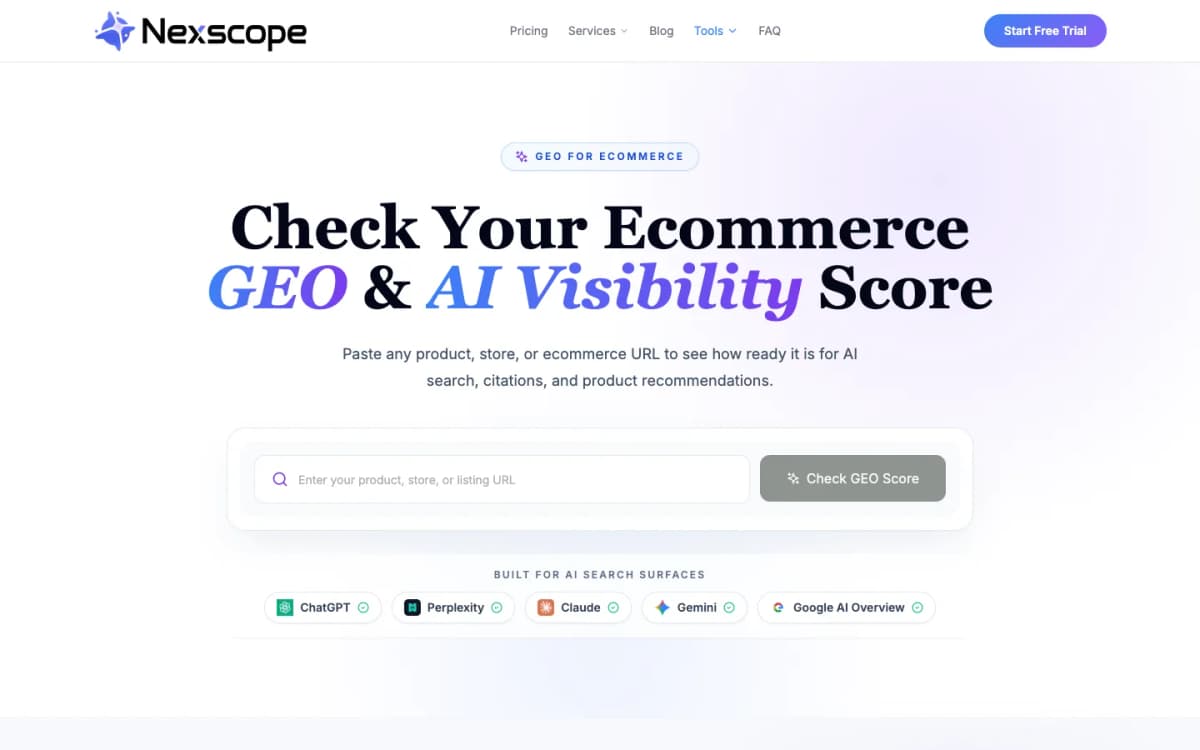
Nexscope should be the first tool ecommerce sellers test when the goal is not only general AI visibility, but ecommerce-specific GEO readiness. Nexscope GEO Check is positioned as a free GEO score checker for ecommerce sellers, which makes it a strong starting point for brands that care about product discovery, AI citations, and marketplace-style search behavior.
Best use case
Nexscope GEO Check is useful when an ecommerce team wants a fast read on whether a site is ready for AI search. That includes Shopify stores, Amazon-adjacent brands, TikTok Shop sellers, marketplace operators, and DTC teams that need to know if their content can be understood by answer engines.
What to check
- GEO score: A directional score that helps prioritize which pages need improvement.
- AI visibility readiness: Whether content gives answer engines clear enough context to cite or summarize.
- Ecommerce relevance: Whether the page communicates product category, value proposition, audience, and differentiation clearly.
- Next-step optimization: Which content and structure gaps should be fixed before deeper monitoring begins.
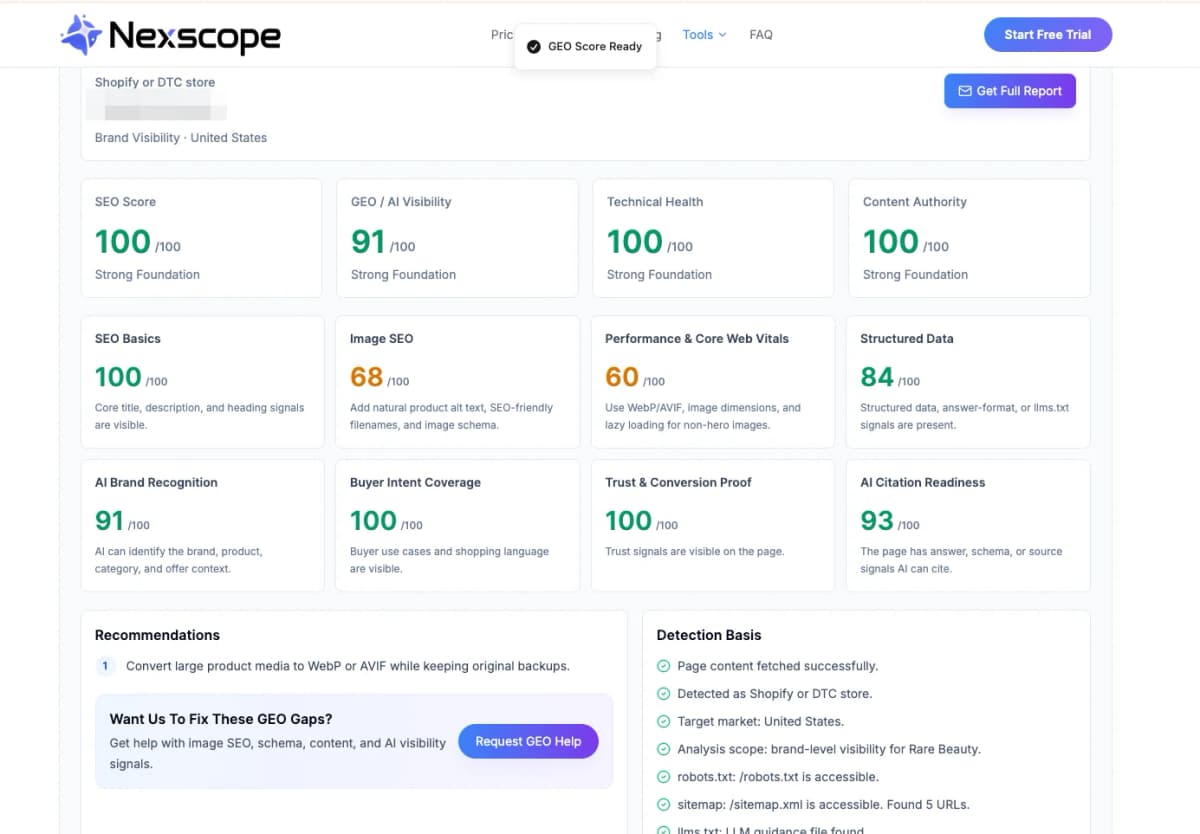
The report breaks ecommerce AI visibility into practical scoring dimensions: SEO Score, GEO / AI Visibility, Technical Health, and Content Authority at the top level, then more specific checks for SEO Basics, Image SEO, Performance & Core Web Vitals, Structured Data, AI Brand Recognition, Buyer Intent Coverage, Trust & Conversion Proof, and AI Citation Readiness. The recommendation panel turns those scores into next steps, while the detection basis shows what the tool was able to verify, such as store type, target market, robots.txt, sitemap access, and llms.txt signals.
For ecommerce teams, this makes Nexscope GEO Check useful as a first-pass audit before deeper AI visibility monitoring. It shows whether a page is technically accessible, commercially clear, and structured in a way that answer engines can understand.
Check Your Ecommerce GEO Readiness
Find SEO, content, technical, and AI citation gaps before deeper AI visibility monitoring.
Run a Free GEO Check →SEO score • GEO / AI visibility • AI citation readiness
Measure Product-Level AI Visibility
Nexscope's AI Product Visibility Tool is now available for sellers who need observed product-level results beyond page-readiness scoring. It checks buyer questions across ChatGPT, Claude, Gemini, and DeepSeek, then shows product mentions, recommendation position, citations, competing products, and prioritized visibility gaps.
See Where Your Product Appears in AI Shopping Answers
Run a product-level visibility check and compare your mentions, rankings, citations, and competing recommendations.
Run an AI Visibility Check →Use a product URL, name, or ASIN • Instant workflow
2. HubSpot AEO Grader
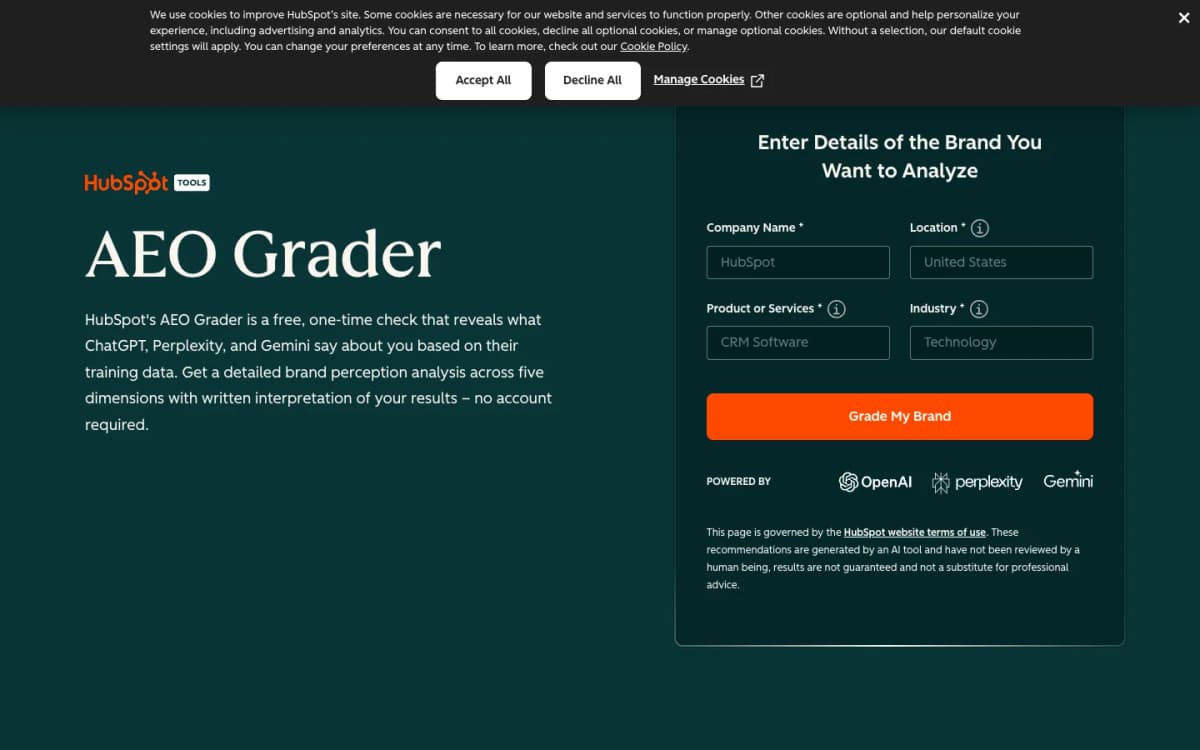
HubSpot AEO Grader is a free diagnostic that checks how major answer engines represent a brand. HubSpot describes it as a one-time brand check across ChatGPT, Perplexity, and Gemini, with analysis across several brand perception dimensions.
Best use case
Use HubSpot AEO Grader for a fast brand-level snapshot. It is especially useful for marketing leaders who want to see how answer engines describe the company before building a full GEO roadmap.
What to check
- Brand recognition in AI answers
- Sentiment and perception gaps
- Competitive positioning
- High-level recommendations
Limitations
A one-time grader is not the same as ongoing prompt monitoring. It can show whether a brand is visible today, but it should not replace scheduled tracking across ecommerce product prompts, category prompts, and competitor comparison prompts.
3. Semrush AI Search Visibility Checker and AI Visibility Toolkit
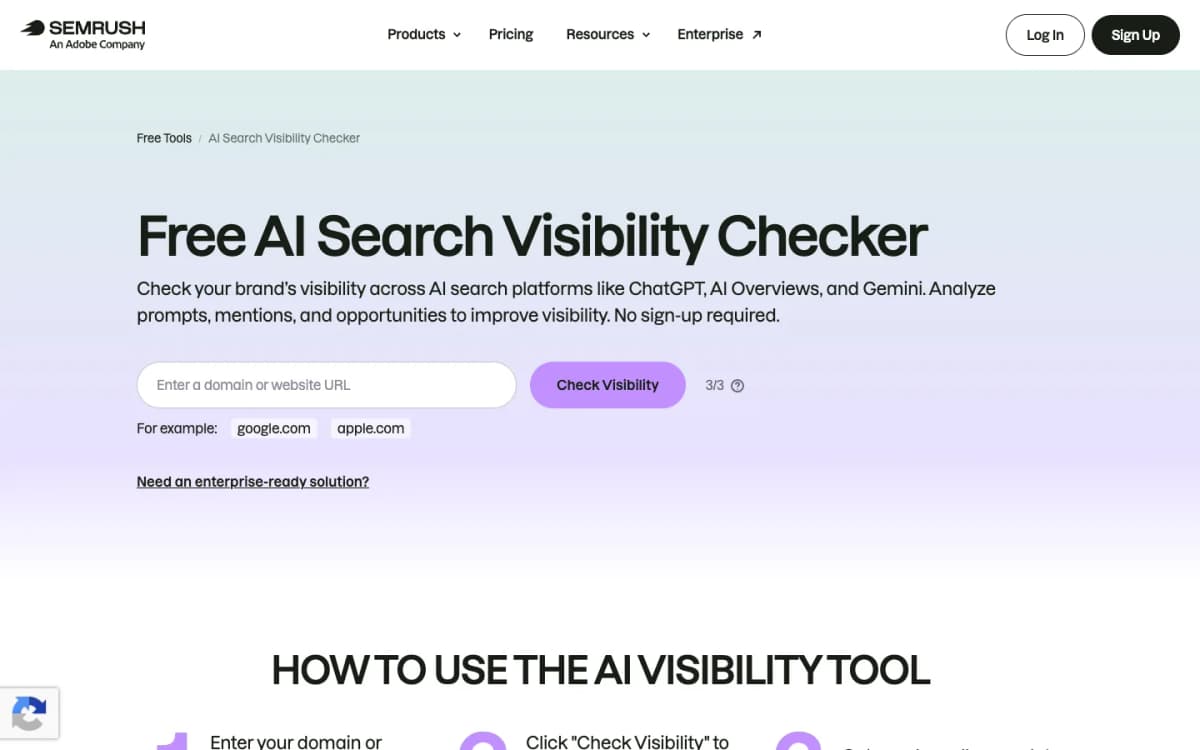
Semrush now has both a free AI Search Visibility Checker and a paid AI Visibility Toolkit. Its official documentation describes features for benchmarking brand visibility, analyzing competitors, monitoring prompts, auditing technical blockers, and creating reports.
Best use case
Semrush is a strong fit for teams already using Semrush for traditional SEO. It helps connect classic search workflows with AI search visibility, which is useful when a team wants one place for SEO data, AI mentions, prompt tracking, and competitor analysis.
What to check
- Visibility across AI search platforms
- AI-generated brand mentions
- Competitor visibility gaps
- Prompt and topic opportunities
- Technical issues that may block AI crawlers
Ecommerce angle
Ecommerce teams can use Semrush to compare AI visibility with organic SEO performance. For example, a Shopify category page may rank well in Google but fail to appear in AI answers for "best gifts for new moms" or "best reusable kitchen products." That gap can shape new comparison content, buying guides, FAQ sections, and technical GEO improvements for Shopify stores.
4. Ahrefs AI Visibility Checker and Brand Radar
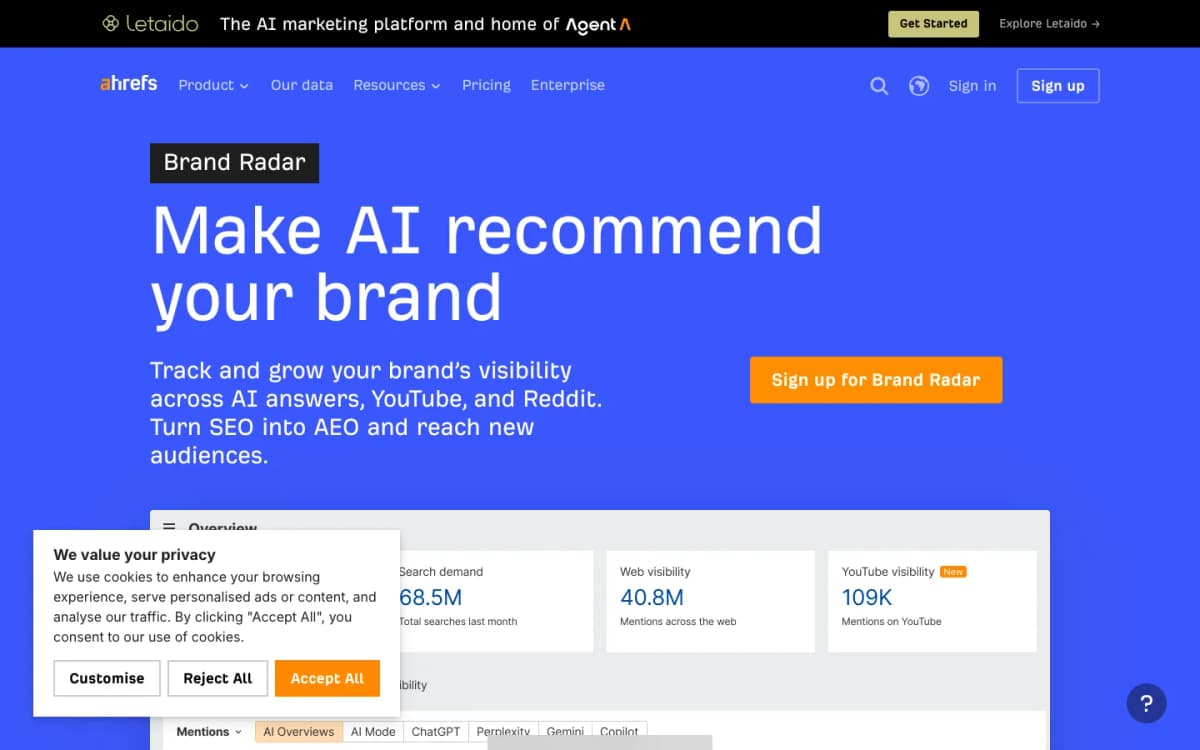
Ahrefs offers a free AI Visibility Checker and a larger Brand Radar product. Ahrefs describes Brand Radar as an AI visibility tool that tracks how brands appear across a large database of search-backed prompts, including AI Overviews, AI Mode, ChatGPT, Copilot, Gemini, Perplexity, and Grok.
Best use case
Ahrefs is useful for SEO teams that want AI visibility connected to search demand, citations, web visibility, and competitor benchmarks. Its strength is data depth and the ability to research brands, products, regions, domains, and authors.
What to check
- AI share of voice
- Top cited domains and pages
- Brand visibility across answer engines
- Custom prompt tracking
- Competitor benchmarks
Ecommerce angle
For ecommerce brands, Ahrefs can help identify which publishers, review pages, marketplace pages, or competitors are being cited by AI systems. That insight can guide digital PR, comparison content, category page improvements, and product-led educational content.
5. Peec AI
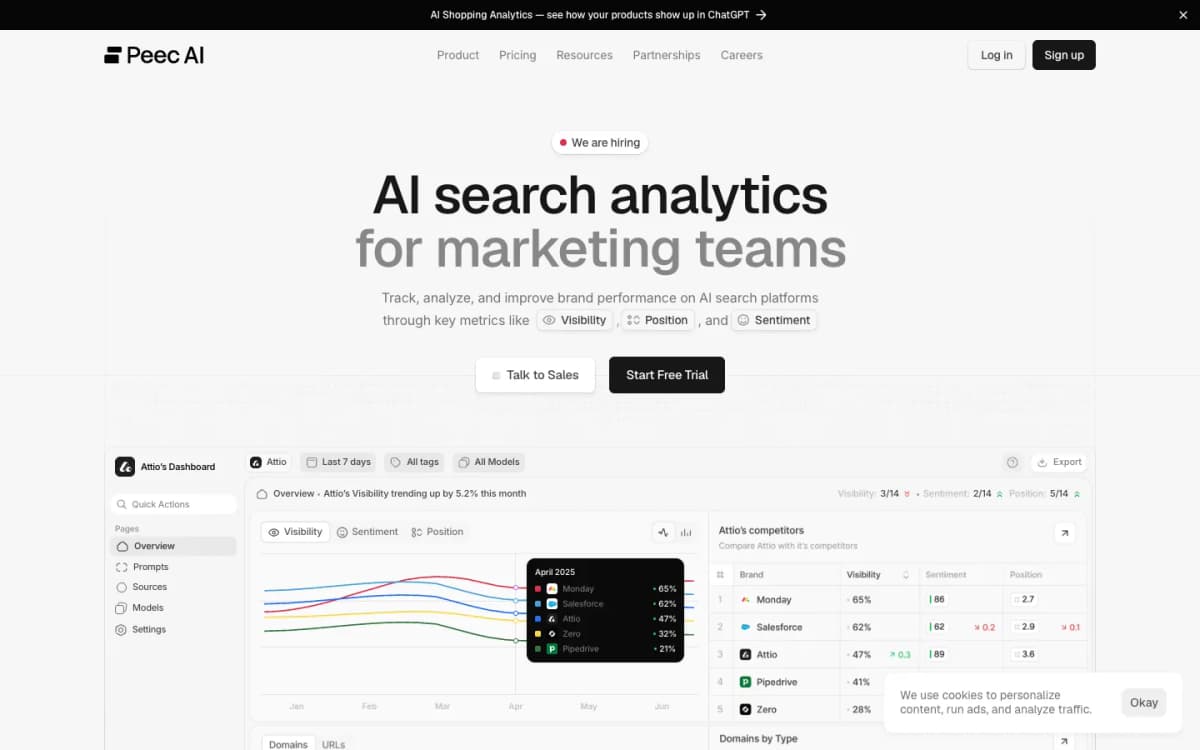
Peec AI describes itself as an AI search analytics platform for marketing teams. Its official site highlights tracking across ChatGPT, Perplexity, Gemini, and other AI search surfaces, with visibility tracking, competitor benchmarking, and optimization insights.
Best use case
Peec AI is a fit for teams that want a purpose-built AI search analytics dashboard rather than an add-on inside a traditional SEO suite. It is designed around how brands perform in AI-generated answers.
What to check
- Brand performance across AI platforms
- Competitor comparisons
- Cited sources
- Prompt-level visibility
- AI Mode and Gemini visibility tracking
Ecommerce angle
Peec AI can be useful when ecommerce teams need to monitor a set of buying prompts every week. Examples include "best protein snacks for kids," "top skincare brands for sensitive skin," or "best home office accessories under $50." The value comes from tracking whether the brand appears and which competitors repeatedly show up instead.
6. Profound
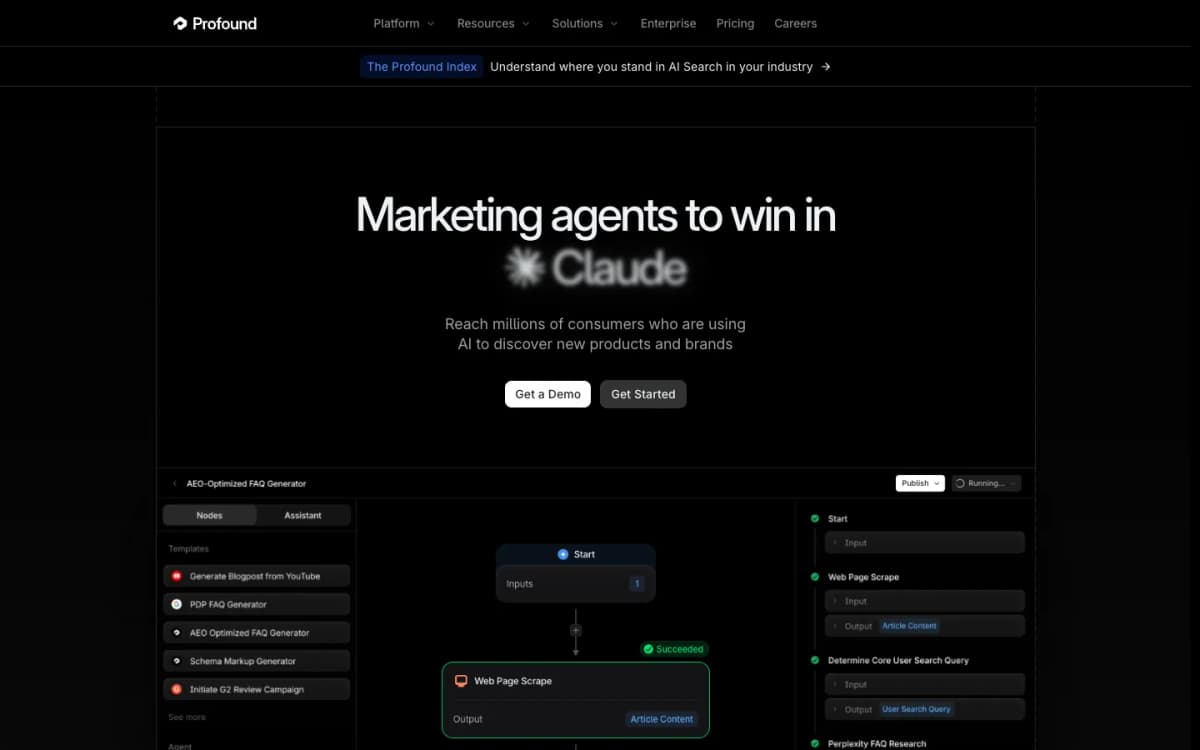
Profound is an AI search visibility platform focused on how brands appear in answer engines. Its official pages describe AI visibility, source citations, brand sentiment, content AEO, real-world prompts, and daily visibility runs.
Best use case
Profound is a strong fit for larger brands, agencies, and enterprise teams that need deeper reporting and AI visibility workflows. It is especially relevant when leadership needs clear data on where the brand appears, which sources are cited, and how competitors are positioned.
What to check
- AI visibility by prompt and topic
- Source citations
- Brand sentiment
- Competitive benchmarks
- Content optimization opportunities
Ecommerce angle
Profound is worth considering when ecommerce visibility is strategic and high value. A larger brand can track whether AI engines recommend its products, cite its pages, use accurate product descriptions, and compare it fairly against competitors.
7. PromptRush
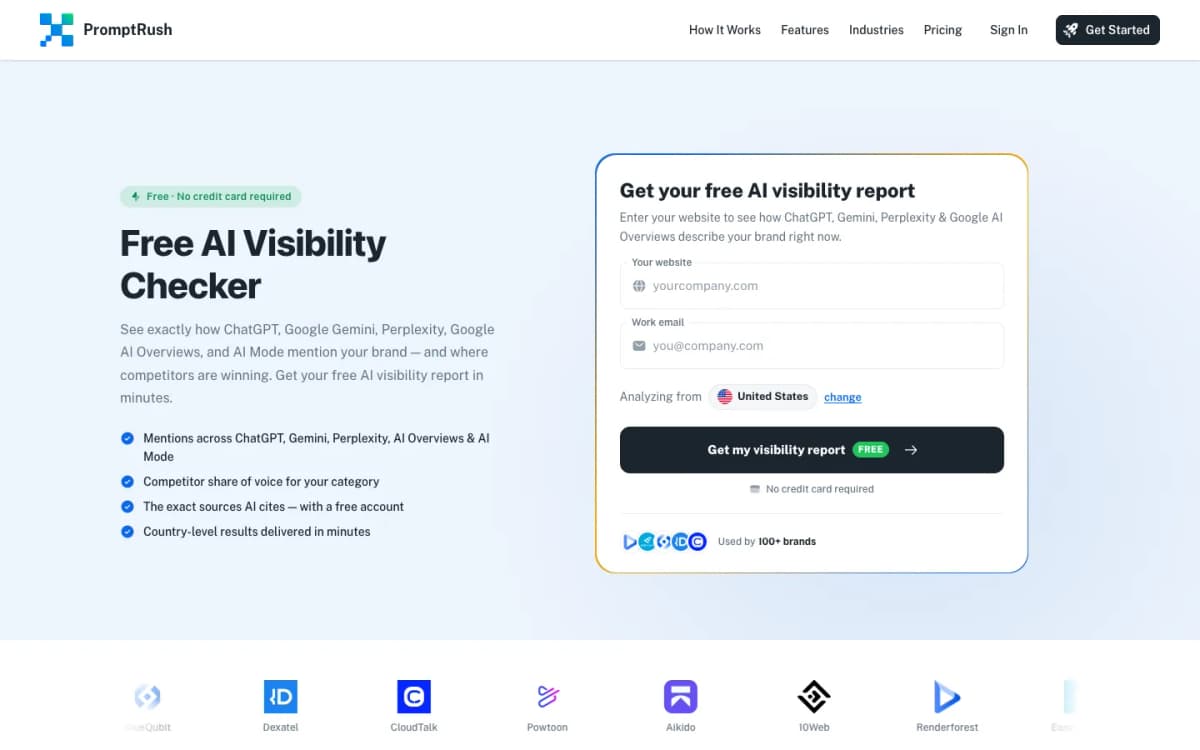
PromptRush offers a free AI Visibility Checker that scans how ChatGPT, Google Gemini, Perplexity, Google AI Overviews, and AI Mode mention a brand. Its official page highlights AI engine coverage, competitor share of voice, citation sources, country-level results, and a free report flow.
Best use case
PromptRush fits teams that want a fast AI visibility baseline without starting inside a large SEO suite. It is useful when the main job is checking whether AI systems mention the brand, which competitors appear, and which sources AI cites.
What to check
- ChatGPT, Gemini, Perplexity, AI Overviews, and AI Mode checks
- Competitor share of voice
- Citation source tracking
- AI prompt coverage
- Country-level visibility reports
- Free report entry point
Ecommerce angle
Ecommerce teams can use PromptRush to benchmark whether AI systems mention a brand for product-category questions, buyer problems, and comparison prompts. Its ecommerce category support also makes it relevant for teams that need a quick baseline before building deeper GEO workflows.
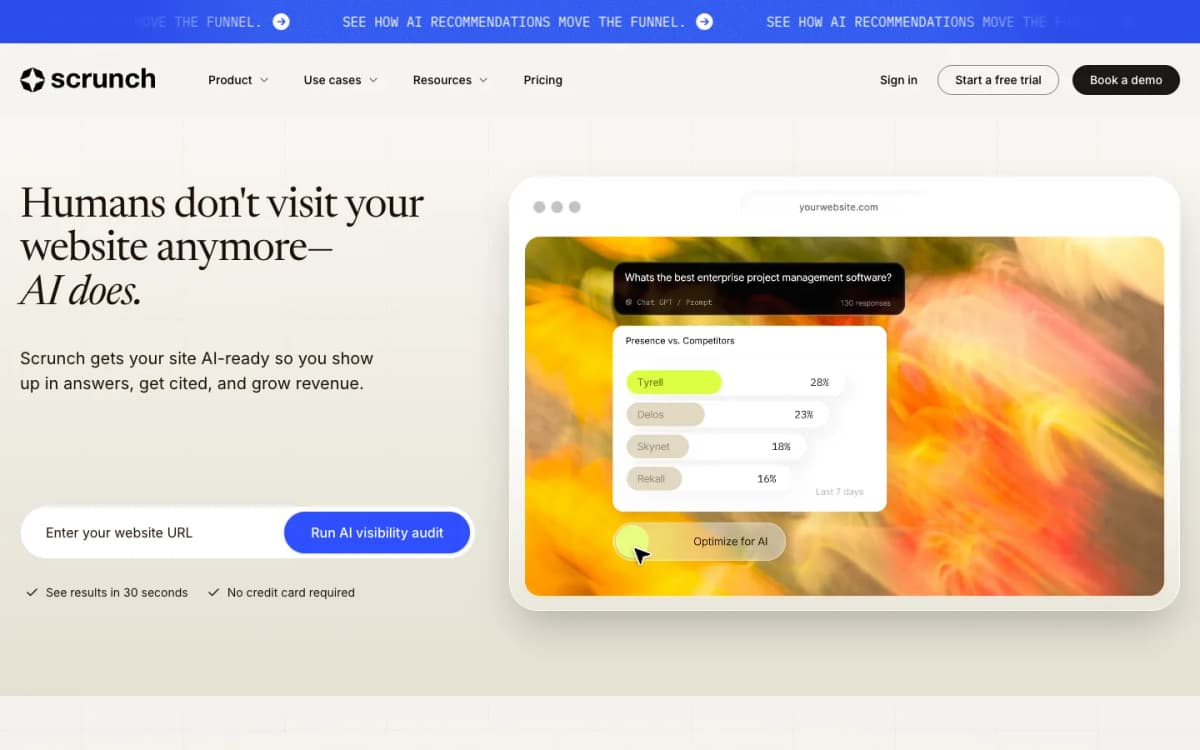
8. Scrunch AI
Scrunch AI positions itself as an AI customer experience and AI search visibility platform. Its site highlights monitoring, analysis, website optimization, and an Agent Experience Platform that serves lightweight, machine-readable versions of pages for AI agents.
Best use case
Scrunch is relevant for enterprise teams that want more than monitoring. It focuses on how AI agents experience a site, which matters when a brand needs to improve crawl success, structured content delivery, and AI-answer inclusion.
What to check
- Share of answer
- Prompt-level visibility
- Sentiment
- Model and region filters
- Site analysis
- AI-agent-readable content delivery
Ecommerce angle
Scrunch may be useful for brands with complex sites, multiple regions, or many product pages. If AI agents struggle to parse product detail pages, collection pages, or documentation, an AI-agent-ready content layer can become part of the GEO workflow.
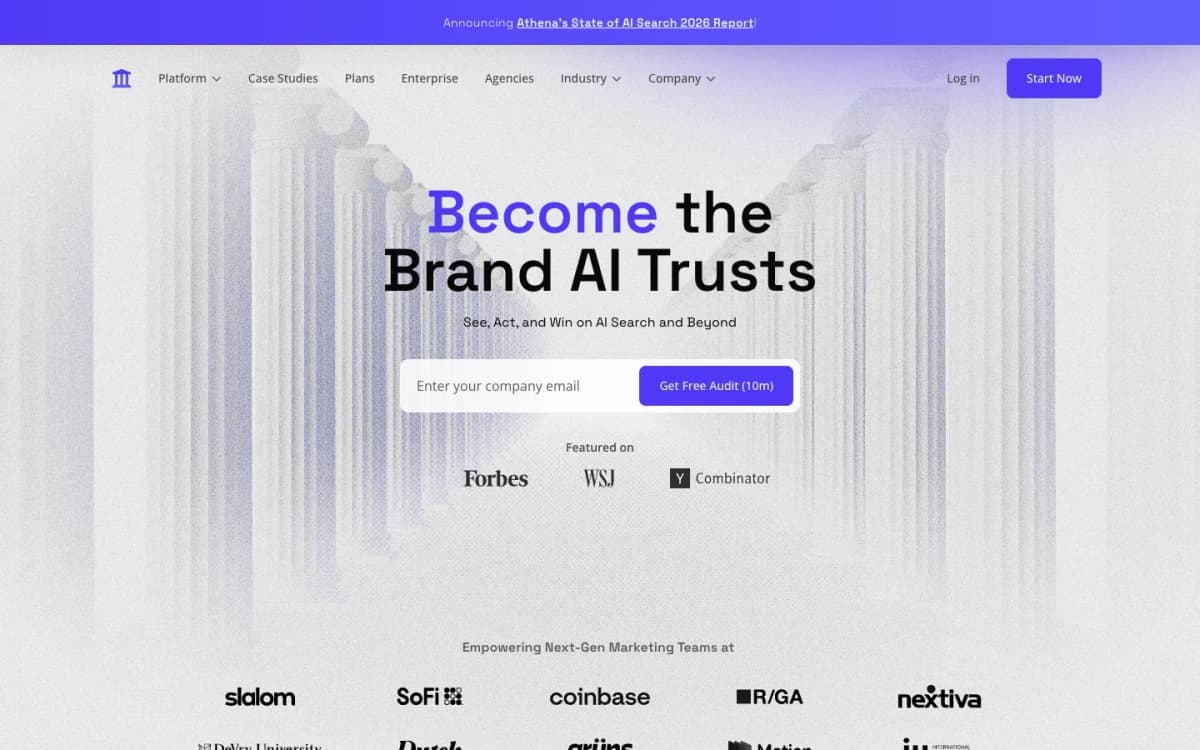
9. AthenaHQ
AthenaHQ describes itself as an AEO and GEO platform that helps brands track and improve AI search visibility. Its official materials mention integrations with GA4, Google Search Console, Shopify, Webflow, and Framer, plus enterprise reporting tools.
Best use case
AthenaHQ is a good fit for teams that want AI visibility data connected to workflow and attribution. It is especially relevant for ecommerce and content teams that need to connect AI search visibility with traffic, conversions, and publishing.
What to check
- AI search visibility
- AI citation tracking
- Competitor benchmarks
- Prioritized optimization tasks
- Shopify and analytics integrations
Ecommerce angle
The Shopify integration makes AthenaHQ especially interesting for ecommerce brands that want to connect AI visibility with store content. A product category can be monitored, optimized, and tied back to commercial outcomes instead of treated as a disconnected SEO report. A practical Shopify SEO checklist can also help teams fix the core search signals before measuring AI visibility.
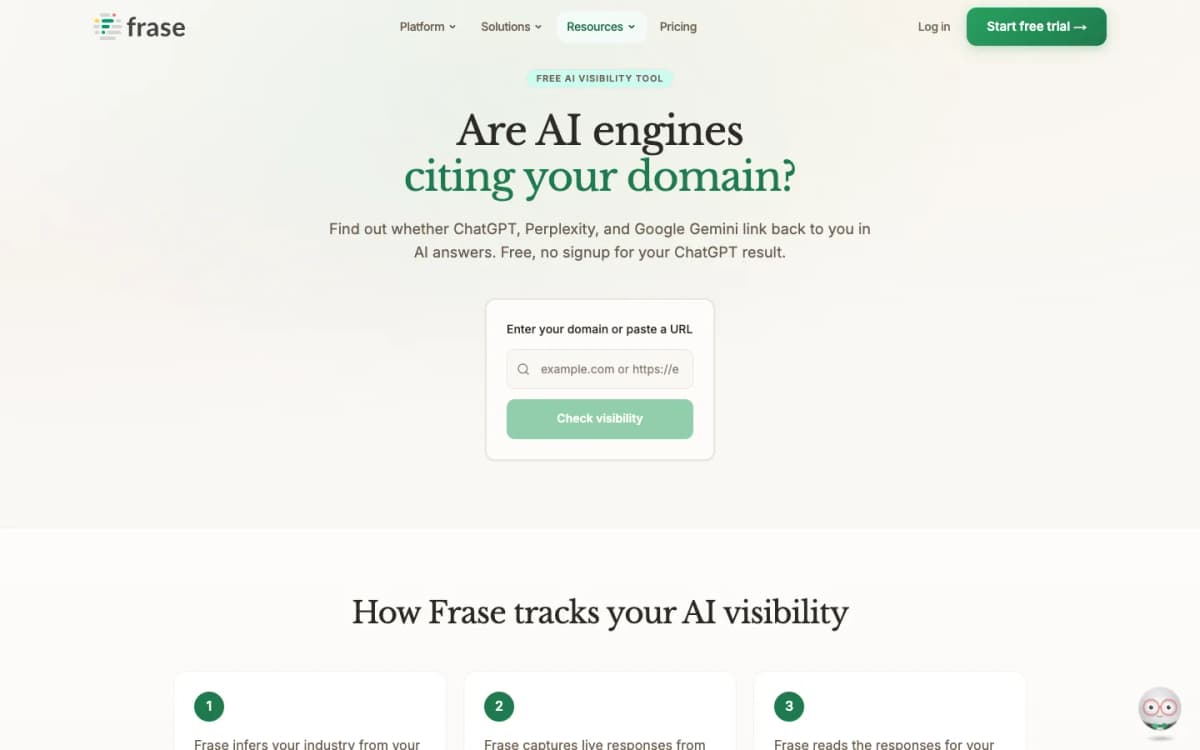
10. Frase GEO Score and AI Visibility Checker
Frase offers free AI SEO tools, including a GEO Score Checker and an AI Visibility Checker. Its official tool pages explain that the GEO Score Checker grades how ready a page is to be cited by AI engines, while the AI Visibility Checker checks whether a domain is cited in ChatGPT, Perplexity, and Gemini.
Best use case
Frase is useful for content teams that want to move from diagnosis to content improvement. The free tools can identify a gap, while the broader Frase platform supports research, writing, optimization, publishing, and monitoring.
What to check
- Page-level GEO score
- ChatGPT citation result
- Perplexity and Gemini checks after email capture
- Content improvement signals
- AI search readiness
Ecommerce angle
Frase can help ecommerce content teams improve buying guides, comparison articles, product education pages, and FAQ-rich content. It is less specialized for ecommerce than Nexscope, but it is useful when the immediate problem is content structure and citability.
How to Choose the Right AI Visibility Tool
The best AI search visibility tool depends on the current stage of the ecommerce team. A small store does not need the same platform as a multi-brand retailer. A content team does not need the same dashboard as a digital PR team.
If the team is just starting
Start with a free or low-friction checker:
- Nexscope GEO Check for ecommerce GEO readiness
- HubSpot AEO Grader for a brand perception snapshot
- Frase GEO Score for page-level content readiness
- Ahrefs or Semrush free AI visibility checks for general brand visibility
The first goal is to find the gap, not buy the largest dashboard. If the brand is not mentioned at all, the next step is usually content structure, clearer entity signals, better product pages, and stronger third-party citations.
If the team already has SEO data
Use a platform that connects traditional SEO with AI visibility:
- Semrush for teams already inside the Semrush ecosystem
- Ahrefs for search-backed prompts, citations, and share of voice
- GA4 and Google Search Console for traffic, organic search, and AI referral context
This is the right stage for mapping traditional rankings against AI answer visibility. A page that ranks well but is missing from AI answers is a strong optimization candidate.
If AI search is a core growth channel
Consider dedicated AI visibility platforms:
- Peec AI for AI search analytics
- Profound for deeper enterprise answer engine insights
- PromptRush for fast AI visibility reports and citation source checks
- Scrunch AI for monitoring plus agent-ready content optimization
- AthenaHQ for AEO and GEO workflows connected to analytics and ecommerce systems
At this stage, the team should monitor customer prompts weekly, track competitors, measure citations, and build content updates around the prompts where the brand is missing.
Free SEO Tools to Pair With an AI Visibility Stack
The original SEO stack still matters. AI search systems often rely on public web signals, structured content, topical authority, and trusted sources. These free tools can support any AI visibility workflow, especially when a DTC team is building a combined GEO and SEO playbook instead of treating AI search as a separate channel.
Google Search Console
Google Search Console helps monitor search performance, indexing, and technical visibility. It does not provide a full standalone AI visibility dashboard, but it remains essential for understanding what Google can discover and index.
Google Analytics 4
Google Analytics can help teams analyze traffic from channels and referrals. Google has also been updating how AI assistant traffic can be identified, which makes GA4 increasingly important for measuring whether AI visibility turns into visits and conversions.
Google Rich Results Test
Structured data does not guarantee AI citations, but it helps search systems understand page entities, products, offers, reviews, FAQs, and article structure. Product, FAQ, Organization, Breadcrumb, Review, and Article schema can all support clearer machine interpretation.
AnswerThePublic
Question research tools help teams discover how people actually phrase problems. That matters because AI visibility is prompt-led. A page that answers real questions clearly has a better chance of being summarized, cited, or used as a source.
Common Mistakes to Avoid
- Tracking only brand-name prompts: Most ecommerce discovery happens through category, problem, comparison, and use-case prompts.
- Ignoring citations: A brand mention without a citation is useful, but cited visibility is stronger for traffic and authority.
- Optimizing only blog posts: Product pages, collection pages, buying guides, comparison pages, and FAQ pages all matter.
- Using one tool as the only truth: AI answers vary by platform, timing, prompt phrasing, and source freshness.
- Forgetting technical access: Robots.txt blocks, broken schema, slow pages, and thin content can limit how AI systems interpret the site.
- Treating GEO as separate from SEO: AI visibility usually builds on clear content, search demand, authority, structure, and trusted web signals.
Conclusion
AI search visibility tools are now part of a serious ecommerce growth stack. The right starting point depends on the team. A store that needs a fast ecommerce GEO score can start with Nexscope GEO Check. A brand team that needs a quick perception snapshot can test HubSpot AEO Grader. SEO teams can extend existing workflows through Semrush or Ahrefs. Larger teams can evaluate Peec AI, Profound, PromptRush, Scrunch AI, or AthenaHQ for deeper tracking and workflow support.
The most important step is building a repeatable process. Pick the prompts buyers actually ask, check whether the brand appears, inspect which pages and competitors get cited, then improve the pages that should be trusted sources. For ecommerce brands, GEO is practical work: clearer product content, stronger buying guides, better structured data, credible citations, and a tighter connection between search visibility and revenue.
Turn AI Search Visibility Into Better Ecommerce Decisions
Once the visibility gap is clear, Nexscope helps ecommerce teams turn it into research and execution: review analysis, product research, patent and IP risk checks, keyword research, market research, competitor research, product sourcing, pricing analysis, image generation, and video generation.
Use GEO checks to identify what AI search cannot understand yet, then use ecommerce research workflows to improve the content, products, and proof points that answer engines need.
Grow your ecommerce business
AI-powered intelligence for smarter selling decisions
Get Started Free →No coding required • Instant access
Frequently Asked Questions
What are AI search visibility tools?
AI search visibility tools measure how a brand, website, product, or page appears inside AI-generated answers. They can track brand mentions, citations, share of voice, sentiment, competitor visibility, and prompt-level performance across platforms such as ChatGPT, Perplexity, Gemini, Google AI Overviews, AI Mode, Claude, Copilot, and others.
What is the best AI search visibility tool for ecommerce brands?
The best tool depends on the job. Nexscope GEO Check is a strong first option for ecommerce GEO readiness. Semrush and Ahrefs are useful for SEO teams that want AI visibility alongside traditional search data. Peec AI, Profound, PromptRush, Scrunch AI, and AthenaHQ are stronger fits when ongoing AI search monitoring becomes a regular growth workflow.
Is GEO different from SEO?
GEO, or generative engine optimization, focuses on being understood, cited, and recommended by AI answer engines. SEO focuses on visibility in traditional search results. They overlap because both need clear content, trusted sources, technical access, and topical authority. The difference is that GEO also tracks prompts, AI citations, brand mentions, and answer quality.
Can free AI visibility checkers replace paid tools?
Free checkers are useful for baseline diagnostics. They can show whether a brand is visible, whether a page is citation-ready, or whether answer engines understand a site. Paid tools become more useful when a team needs scheduled tracking, historical trends, prompt libraries, competitor benchmarks, alerts, exports, and multi-brand reporting.
Which AI platforms should ecommerce brands monitor?
Ecommerce brands should usually monitor ChatGPT, Perplexity, Gemini, Google AI Overviews, Google AI Mode, and any platform that affects customer discovery in their market. Larger teams may also track Claude, Copilot, Grok, and shopping-specific AI surfaces as product discovery shifts across channels.
How often should a brand check AI search visibility?
Monthly checks are enough for early-stage teams. Weekly checks are better when AI search is tied to content production, product launches, or competitive monitoring. High-growth ecommerce teams may monitor priority prompts more often during seasonal campaigns, new product launches, or major site updates.
What pages should be optimized for AI search first?
Start with pages that answer high-intent buyer questions: category pages, product detail pages, buying guides, comparison pages, review-led pages, FAQ sections, and educational blog posts. Pages with strong commercial value and weak AI visibility should be prioritized before lower-value informational content.
Sources
- HubSpot. (2026). AEO Grader. Retrieved from hubspot.com
- Semrush. (2026). AI Visibility Toolkit and AI Search Visibility Checker. Retrieved from semrush.com
- Ahrefs. (2026). Brand Radar and AI Visibility Checker. Retrieved from ahrefs.com
- PromptRush. (2026). Free AI Visibility Checker. Retrieved from promptrush.ai
- Frase. (2026). GEO Score and AI Visibility Checker. Retrieved from frase.io