

How Much Does Amazon Take From Sellers? Complete Fee Guide

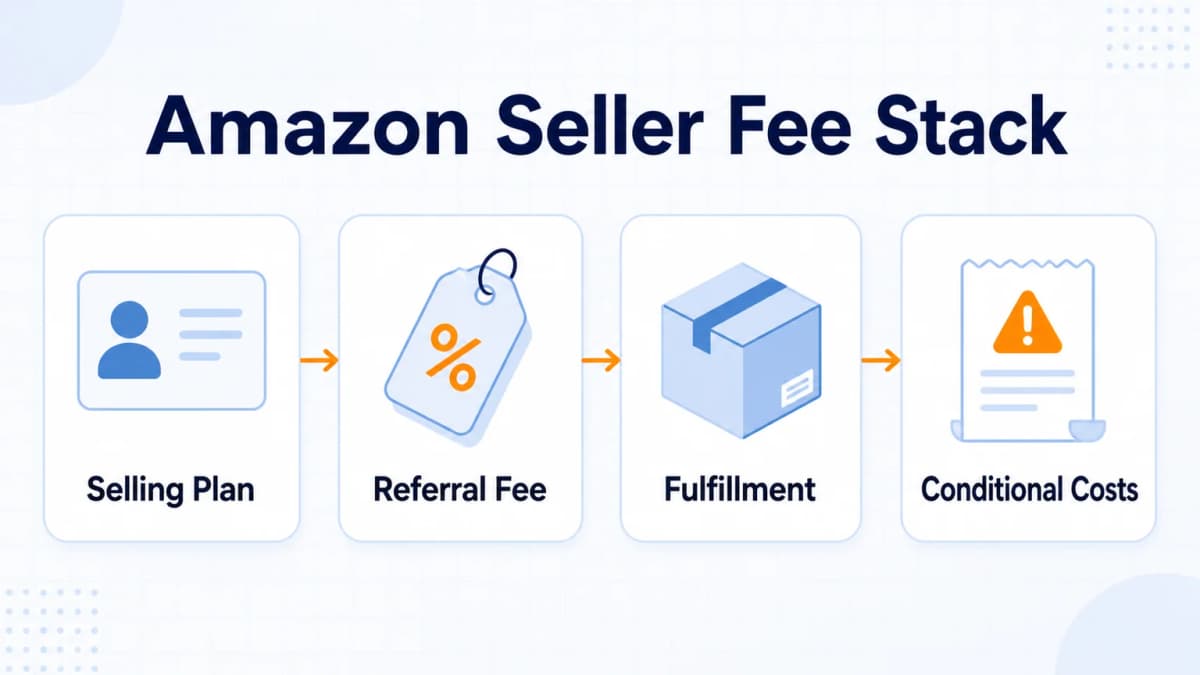
How much does Amazon take from sellers? There is no single percentage that applies to every order. Most US sellers pay a category-based referral fee, plus either $0.99 per item under the Individual plan or $39.99 per month under the Professional plan. Sellers who use Fulfillment by Amazon also pay fulfillment and storage costs, while returns, aged inventory, inbound placement, advertising, and optional services can add more.
The answer therefore depends on five inputs: the product's fee category, total sale price, selling plan, fulfillment method, and any optional or conditional services used. A seller-fulfilled $100 order in a 15% category may generate a $15 Amazon referral fee. The same order under FBA can have additional fulfillment and storage deductions. Product cost, inbound freight, advertising, labor, and taxes still need to be deducted before the seller knows the real profit.
This guide separates mandatory Amazon seller fees from fulfillment costs and broader business expenses. It also provides three $100 sale examples, a fee calculation method, and specific checks sellers can use before pricing or sourcing a product. All examples refer to Amazon.com in the United States and should be rechecked against Amazon's live fee pages and Revenue Calculator.
How Much Amazon Takes Per Sale
Short Answer
Amazon usually takes a referral fee from each sale. Referral fees vary by category and are calculated as a percentage of the total price or a minimum amount, whichever is greater. The total price includes the item price, shipping charges, and gift-wrapping charges. Many common categories use rates between 8% and 15%, but some categories use different rates or price-based tiers.
The selling plan adds another cost. An Individual seller pays $0.99 for each item sold. A Professional seller pays $39.99 per month and does not pay that $0.99 per-item plan fee. Both plans remain subject to referral fees and other applicable costs.
Fulfillment changes the result again. FBA sellers pay Amazon for picking, packing, shipping, customer service, and returns handling. They also pay storage based on the space their inventory occupies. FBM sellers avoid FBA charges, but they still pay referral fees and cover their own shipping, packaging, labor, customer service, and return operations.
Required and Optional Costs
The following table separates the most common charges. This distinction matters because a statement such as "Amazon takes 40%" may combine mandatory fees, optional advertising, fulfillment, and the seller's own operating costs.
| Cost | When It Applies | Calculation Basis |
|---|---|---|
| Referral fee | Usually every sale | Fee category and total sale price |
| Individual plan fee | Each item sold on Individual | $0.99 per item |
| Professional plan fee | Every month on Professional | $39.99 per month |
| FBA fulfillment | Each FBA order | Product price, size, weight, and service |
| FBA storage | Inventory stored by Amazon | Daily average volume and season |
| Returns processing | Certain FBA returns | Product and return conditions |
| Aged inventory | FBA inventory stored over 181 days | Inventory age, volume, and unit rules |
| Inbound placement | Eligible FBA inbound shipments | Product size and shipment choice |
| Amazon Ads | Only when campaigns run | Bids, clicks, and campaign budget |
Referral fees and selling-plan charges form the standard fee layer. FBA, advertising, and other services depend on the seller's choices and account activity. Amazon's official selling-fee page should remain the final reference for current rules.
Amazon Referral Fees
Common Fee Bands
Referral fees are Amazon's commission for connecting a seller with a customer and processing the marketplace transaction. A broad 15% assumption works for a rough first pass in several popular categories, but it is not safe enough for sourcing or final pricing.
Current public examples on Amazon's US pricing page include the following rates:
| Product Category | Referral Fee Rule | Minimum Fee |
|---|---|---|
| Computers | 8% | $0.30 |
| Consumer Electronics | 8% | $0.30 |
| Automotive and Powersports | 12% | $0.30 |
| Home and Kitchen | 15% | $0.30 |
| Sports and Outdoors | 15% | $0.30 |
| Toys and Games | 15% | $0.30 |
| Pet Supplies | 15%, except 22% for veterinary diets | $0.30 |
| Amazon Device Accessories | 45% | $0.30 |
| Everything Else | 15% | $0.30 |
The minimum fee matters most for very low-priced products. If a percentage calculation produces less than the category minimum, Amazon charges the minimum instead. Some categories, including certain media products, use different rules and may add a closing fee.
Tiered Category Rates
Several categories change rates when the sale price crosses a threshold. These tiers can materially change profit even if the product, package, and fulfillment method stay the same.
| Product Category | Current Tiered Rule |
|---|---|
| Baby Products | 8% at $10 or less; 15% above $10 |
| Beauty, Health, and Personal Care | 8% at $10 or less; 15% above $10 |
| Clothing and Accessories | 5% at $15 or less; 10% above $15 through $20; 17% above $20 |
| Electronics Accessories | 15% on the portion up to $100; 8% above $100 |
| Furniture | 15% on the portion up to $200; 10% above $200 |
| Grocery and Gourmet | 8% at $15 or less; 15% above $15 |
| Jewelry | 20% on the portion up to $250; 5% above $250 |
Consider a beauty product priced at $10.00. An 8% referral fee would be $0.80. If the same product is repriced to $10.01 and the assigned fee category uses the published threshold, the applicable percentage moves to 15%. That change can absorb more than the one-cent price increase. Similar discontinuities can appear in clothing, grocery, and other tiered categories.
Fee Category Assignment
A product's fee category may differ from the browse category customers see in the Amazon store. Sellers should confirm the assigned fee category for the ASIN instead of inferring it from the listing breadcrumb or a competitor's category.
This check should happen before a purchase order, packaging commitment, or price launch. It should also be repeated when a product is reclassified. A change from an 8% fee category to a 15% category reduces contribution by $7 on a $100 sale before fulfillment or advertising changes.
Amazon maintains the current referral-fee table, including category thresholds, minimum fees, and special notes. The live table should override screenshots, old spreadsheets, and historical articles.
Amazon Selling Plans
Individual Plan
The Individual plan charges $0.99 for each item sold and has no fixed monthly subscription. It can fit an occasional seller, a small resale test, or a new account expecting fewer than about 40 sales per month. Referral fees and fulfillment costs still apply.
An Individual account can use FBA, but the plan has fewer advanced tools. Sellers should review listing, advertising, reporting, and category requirements before choosing only on price. The registration process, account documents, and plan setup are covered in the Amazon seller account guide.
Professional Plan
The Professional plan costs $39.99 per month. It removes the $0.99 per-item plan fee and includes advanced tools such as bulk operations, advertising access, and additional selling capabilities. Referral fees and any FBA costs remain separate.
The monthly fee is a fixed account expense, so the per-unit allocation declines as sales volume increases. At 100 monthly orders, the plan allocation is about $0.40 per order. At 1,000 orders, it is about $0.04. This allocation belongs in SKU profitability models even though Amazon bills it once per month.
Forty-Sale Break-Even
At 40 sales, Individual plan fees total $39.60. At 41 sales, they total $40.59. The Professional plan costs $39.99 in either case. That makes approximately 40 monthly sales a useful price comparison point.
The decision should also consider required features. A seller may need the Professional plan before reaching 40 orders because of advertising, restricted-category, reporting, or operational requirements. Another seller may remain on Individual while testing a small number of products. Plan selection changes one line in the fee stack; it does not change the referral rate assigned to the product.
FBA and FBM Costs
FBA Fulfillment Fees
FBA fulfillment costs pay Amazon to pick, pack, and ship orders while handling customer service and returns. Amazon states that these costs depend on the product's price, weight, dimensions, and the exact services used. There is no universal FBA charge per item.
The packaged dimensions and shipping weight control the size tier. A small packaging change can move a product into another tier and alter fulfillment cost across every order. Sellers should measure the final retail package, including protective material, inserts, and labels. Supplier dimensions are not sufficient when Amazon receives a different finished package.
Amazon announced that 2026 US FBA fees would increase by an average of $0.08 per unit, with most changes effective January 15, 2026. Midyear adjustments can also affect the model. Amazon's 2026 fee announcement illustrates why sellers need a dated fee calculation rather than a permanent spreadsheet assumption.
Storage and Inventory Fees
Amazon charges monthly storage based on the daily average cubic volume occupied by FBA inventory. Seasonal rates can be higher during the fourth quarter. Additional inventory costs can apply to dangerous goods, slow-moving inventory, and sellers holding inventory levels that are high relative to recent sales.
Aged inventory surcharges begin after inventory has remained in a fulfillment center for more than 181 days. Amazon's 2026 schedule uses multiple age bands, so cost pressure rises as units remain unsold. Sellers should monitor inventory age at the ASIN level and decide whether to discount, liquidate, remove, or stop replenishing before the next assessment date.
Storage cost also changes the economics of low-velocity products. A product can show an acceptable margin immediately after launch and become unattractive after several months of storage. Unit economics should include an expected storage period and a downside case for slower sell-through.
FBM Operating Costs
Fulfilled by Merchant shifts storage, picking, packing, shipping, customer service, and returns to the seller or a third-party logistics provider. Amazon referral fees and selling-plan costs still apply. The fee screen may look lower, but the business must account for postage, packaging materials, warehouse space, labor, software, lost parcels, and return handling.
FBM can work well for bulky products, slow-moving inventory, products with specialized handling, or sellers that already have efficient logistics. FBA can work well when Amazon's fulfillment network and Prime eligibility improve delivery speed or conversion enough to justify the charges. The FBA vs FBM comparison should be evaluated product by product, not as a single account-wide rule.
Fulfillment Cost Comparison
Amazon's Revenue Calculator allows a seller to compare "Amazon fulfillment" with "Your fulfillment" for the same product. A useful comparison includes:
- Final packaged dimensions and shipping weight
- Assigned fee category
- Sale price and shipping charges
- FBA fulfillment estimate
- Expected storage period
- FBM postage, packaging, and labor
- Expected return rate and handling cost
The calculator produces estimates. Actual costs can vary, and several business expenses remain outside Amazon's output. Sellers should save the date and assumptions for every scenario so future fee changes can be reconciled.
What Amazon Takes From $100
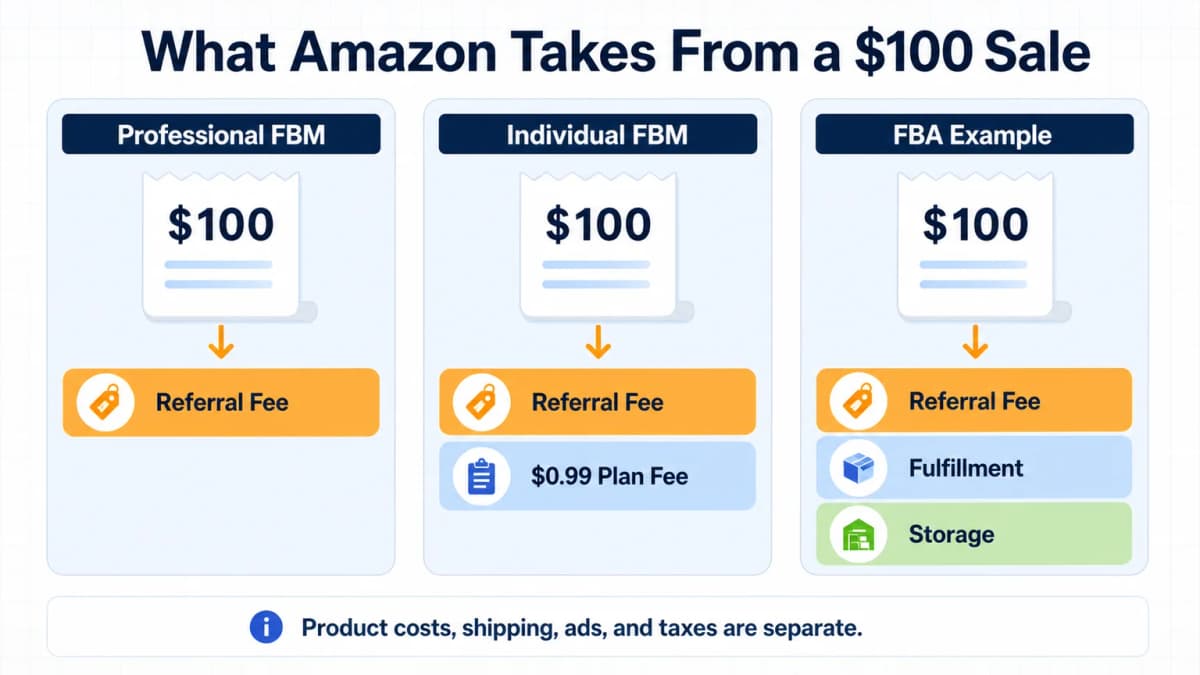
The following examples answer the keyword directly without presenting one percentage as universal. Each scenario assumes a $100 total sale price in Home and Kitchen, which currently uses a 15% referral fee. Taxes, product cost, and other non-Amazon expenses are excluded from Amazon's standard deduction calculation.
Professional FBM Sale
Assumptions:
- Total sale price: $100.00
- Referral fee rate: 15%
- Selling plan: Professional
- Fulfillment: FBM
| Calculation | Amount |
|---|---|
| Total sale price | $100.00 |
| Referral fee | -$15.00 |
| Per-item plan fee | $0.00 |
| Proceeds before seller costs | $85.00 |
Amazon takes $15 from this order under the stated assumptions. The seller must still deduct shipping, packaging, product cost, labor, returns, advertising, and taxes. The $39.99 Professional subscription is billed monthly and should be allocated across orders when calculating net profit.
Individual FBM Sale
Assumptions:
- Total sale price: $100.00
- Referral fee rate: 15%
- Selling plan: Individual
- Fulfillment: FBM
| Calculation | Amount |
|---|---|
| Total sale price | $100.00 |
| Referral fee | -$15.00 |
| Individual plan fee | -$0.99 |
| Proceeds before seller costs | $84.01 |
Amazon takes $15.99 from this order under the stated assumptions. The difference from the Professional FBM example is the Individual plan's $0.99 per-item fee. Shipping and the seller's remaining operating costs still need to be deducted.
Illustrative FBA Sale
This scenario uses an illustrative Revenue Calculator result to show the method. It is not a published universal FBA rate.
Assumptions:
- Total sale price: $100.00
- Referral fee rate: 15%
- Selling plan: Professional
- Illustrative FBA fulfillment estimate: $4.50
- Illustrative storage allocation: $0.20
| Calculation | Amount |
|---|---|
| Total sale price | $100.00 |
| Referral fee | -$15.00 |
| FBA fulfillment estimate | -$4.50 |
| Storage allocation | -$0.20 |
| Proceeds before other costs | $80.30 |
Amazon takes an estimated $19.70 in this illustration. Actual FBA cost depends on the product and current fee schedule. Inbound freight to Amazon, product cost, advertising, return reserves, aged inventory, and taxes remain outside this simplified calculation. The Amazon FBA calculator workflow helps organize the required inputs, but the final check should use Amazon's current Revenue Calculator.
When Costs Reach 40%
Does Amazon take 40% from sellers? A referral fee alone is not normally a universal 40% charge. Amazon's current table includes many rates below that level and a few higher or special rates, such as Amazon Device Accessories at 45%.
The combined cost of selling can reach or exceed 40% when referral fees, FBA fulfillment, storage, advertising, returns, and other charges are added together. Some of those costs are mandatory, some are conditional, and some are controlled by the seller. Reporting the combined number as "Amazon's commission" hides that distinction.
For example, a seller might pay 15% referral, 6% equivalent FBA fulfillment, 1% storage, and 12% advertising. That is already 34% before product cost, inbound freight, returns, software, or labor. Advertising is a chosen acquisition expense, and its contribution should be tracked separately through a consistent Amazon PPC strategy.
Hidden Amazon Seller Fees
Refund Administration Fees
When a seller refunds an order after receiving payment, Amazon generally credits back the applicable referral fee minus a refund administration fee. Amazon's published explanation describes that administration fee as the lesser of $5 or 20% of the applicable referral fee.
For a $100 order with a $15 referral fee, 20% of the referral fee is $3. A full refund can therefore leave a $3 refund administration fee under that rule. Refund economics should also include any unrecoverable fulfillment, return, inspection, or product-loss cost.
Returns Processing Fees
Amazon lists returns processing among other possible FBA costs. It applies to qualifying orders when Amazon provides the customer with free return shipping. The exact amount depends on the product and current policy.
Sellers should track return rates by ASIN and return reason. A product with a high return rate can have acceptable gross margin but poor contribution after reverse logistics, damaged inventory, and lost sales are included.
Aged Inventory Costs
Aged inventory surcharges apply to FBA inventory stored for more than 181 days. Amazon's 2026 schedule uses age bands beginning at 181 to 210 days and increases the charge for older inventory. Regular monthly storage continues in addition to the surcharge.
Inventory age should be reviewed before the monthly assessment, not after the charge appears. A sell-through forecast should identify units likely to cross the next age band and assign an action: discount, advertise, liquidate, remove, or stop replenishment.
Inbound Placement Fees
Amazon may charge for distributing eligible inbound inventory across fulfillment centers closer to customers. Shipment configuration and placement choices affect the amount. This cost occurs before the customer order, so it can be missed when a seller reviews only per-order deductions.
Inbound freight and placement should both be allocated to units received. If a shipment contains several SKUs, allocation should follow a consistent method such as units, weight, volume, or documented service charge.
Removal and Disposal Fees
Amazon charges per item when FBA inventory is returned, disposed of, or liquidated. These costs become relevant when a product is discontinued, remains unsold, is damaged, or must be removed before a higher aged-inventory band.
A removal decision should compare the fee with the expected cost of continued storage and the probable recovery value. Historical product cost should not prevent a seller from choosing the option with the lower future loss.
Media Closing Fees
Books, DVDs, music, software, and video products use a 15% referral fee on Amazon's current US table and also incur a $1.80 closing fee per item. That fixed amount has a greater effect on low-priced media.
A $10 book with a 15% referral fee produces $1.50 in referral fees. Adding the $1.80 closing fee brings those two charges to $3.30 before the selling plan, fulfillment, shipping, or product cost.
Optional Service Costs
Amazon Ads, premium account services, currency conversion, and other programs are not automatic charges on every sale. They still affect profit when a seller chooses to use them. Optional costs should be separated in reporting so the team can evaluate whether each program creates enough incremental contribution.
This separation also supports better decisions. Referral and fulfillment charges may require category, packaging, or fulfillment changes. Advertising cost may require bid, targeting, conversion, or listing changes. Combining them into one percentage obscures the action needed.
Calculate Net Proceeds
Core Fee Formula
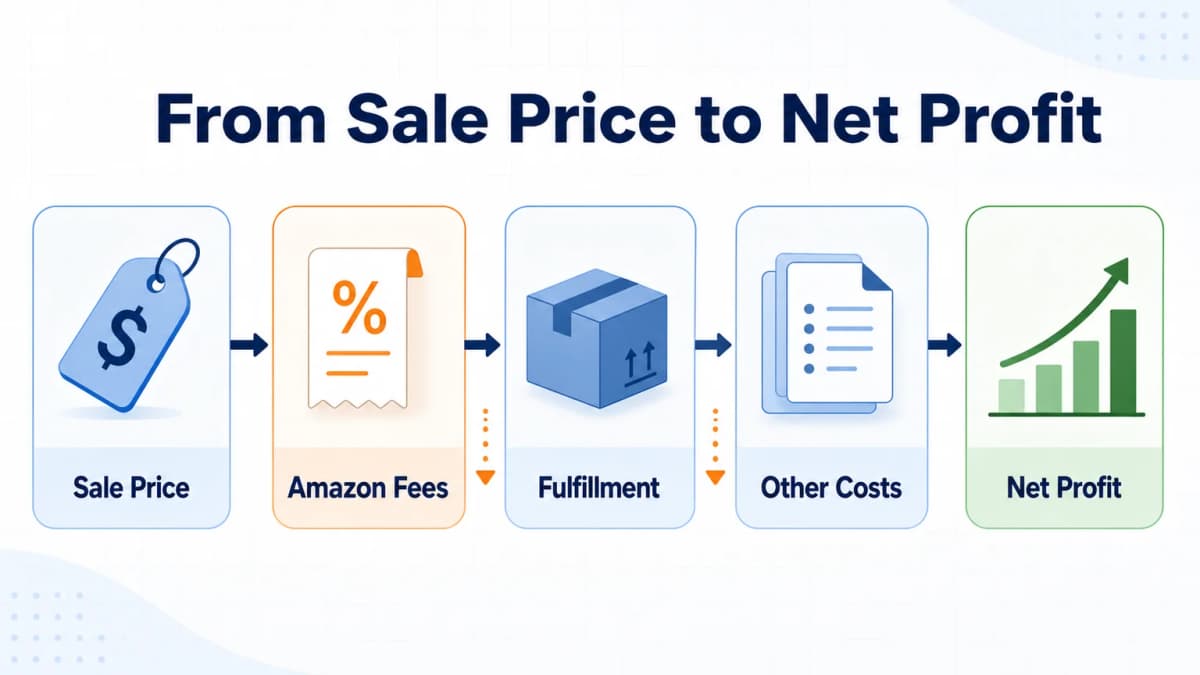
Start with Amazon proceeds before broader business costs:
Amazon proceeds per order =
  total sale price
  - referral fee
  - per-item selling-plan fee or monthly plan allocation
  - FBA fulfillment cost or Amazon service charge
  - allocated storage
  - conditional Amazon fees
Then calculate contribution and net profit:
Contribution per order =
  Amazon proceeds
  - landed product cost
  - inbound freight
  - FBM shipping and packaging, if applicable
  - advertising allocation
  - return reserve

Net profit =
  total contribution
  - fixed operating expenses
  - taxes
The two-stage calculation prevents Amazon deductions from being confused with product economics. It also makes fee changes easier to audit.
Revenue Calculator Inputs
Amazon's Revenue Calculator compares estimated Amazon fulfillment with a seller's own fulfillment method. For a current or future product, the seller should enter or verify:
- Marketplace and product identifier
- Fee category
- Total sale price
- Final packaged dimensions
- Shipping weight
- Fulfillment method
- Seller shipping charge
- Product cost and other available inputs
For existing inventory, Seller Central also provides an estimated fees-per-unit view, the Fee Preview report, and tools for reviewing upcoming changes. Estimates should be compared with actual settlement data after launch.
Costs Beyond Amazon
Amazon's calculator cannot know every cost in a seller's business. A complete model may also need:
- Supplier price and inspection
- International freight and duties
- Domestic drayage and prep
- Labels, inserts, and packaging
- Product photography and creative
- Advertising and promotions
- Refund and replacement reserve
- Software, payroll, and professional services
- Financing and working capital
- Sales, income, or other applicable taxes
Each cost should have a documented source, update date, and allocation method. Missing values should remain visible instead of being silently treated as zero.
Lower Amazon Selling Costs
Confirm Fee Categories
Confirm the assigned fee category and threshold before sourcing. Recheck it when Amazon reclassifies an ASIN or the selling price crosses a tier. A small price change can create a larger referral-fee change in tiered categories.
Reduce Package Size
Measure the shipping-ready package and test smaller, compliant packaging. Lower dimensions or weight can move a product into a less expensive fulfillment tier and reduce storage volume. Packaging changes must still protect the item and meet Amazon requirements.
Improve Inventory Turnover
Order inventory against a realistic sales forecast. Monitor days of supply, sell-through, stranded inventory, and age bands. Slow-moving inventory should have a dated action plan before it reaches the next surcharge threshold.
Compare FBA and FBM
Run both methods for the same SKU. Include Amazon fees, postage, packaging, labor, storage, returns, and service levels. Some sellers use FBA for fast-moving standard-size products and FBM for bulky, seasonal, or specialized inventory.
Audit Fees Quarterly
Compare the expected fee model with actual transaction and settlement data at least quarterly. Review category changes, dimension corrections, FBA estimates, return charges, storage, and advertising. Investigate material differences by SKU instead of accepting a blended account average.
Recheck Price Thresholds
Price increases do not always improve contribution. In categories with referral-fee tiers, a higher price can trigger a higher rate. Recalculate contribution whenever price, category, package, fulfillment method, or promotional strategy changes.
Conclusion
Amazon does not take one fixed percentage from every seller. The standard fee stack begins with a selling plan and a category-based referral fee. FBA adds fulfillment and storage, while returns, aged inventory, placement, removals, advertising, and optional services can add more.
On a $100 Home and Kitchen order using the assumptions in this guide, Amazon takes $15 from a Professional FBM sale, $15.99 from an Individual FBM sale, or an illustrative $19.70 from the FBA example. Those figures are Amazon deductions before product cost, freight, advertising, labor, and taxes. Another category, package, or fulfillment method can produce a different result.
The reliable process is to confirm the ASIN's fee category, use final package measurements, run Amazon's current Revenue Calculator, add non-Amazon costs, and compare the estimate with actual settlement data. Every model should record its assumptions and calculation date.

Frequently Asked Questions
How much does Amazon take from a $100 sale?
Amazon can take $15 in referral fees from a $100 sale in a category with a 15% rate. An Individual seller would also pay the $0.99 per-item plan fee, bringing those two charges to $15.99. FBA sellers may additionally pay fulfillment, storage, and conditional fees. Product cost, shipping, advertising, returns, labor, and taxes must still be deducted before calculating net profit. The exact amount depends on the ASIN's assigned fee category, selling plan, package dimensions, weight, and fulfillment method.
What percentage does Amazon take from sellers?
Amazon referral fees vary by product category. Common published examples include 8%, 12%, and 15%, while tiered and special categories use other rates. The referral fee is only one part of the cost. Sellers may also pay an Individual or Professional plan charge, FBA fulfillment, storage, returns processing, aged inventory, inbound placement, and optional advertising. A single blended percentage should not be applied to every product. Check the live category table and Revenue Calculator for the specific ASIN.
Does Amazon take 40% from sellers?
Amazon does not apply a universal 40% commission to all sellers. The total cost of selling can reach or exceed 40% when referral fees, FBA fulfillment, storage, advertising, returns, and other expenses are combined. Several of those costs are optional or conditional. Some special referral categories also use higher rates, including Amazon Device Accessories at 45% on the current US table. Sellers should separate mandatory Amazon fees, optional Amazon services, and their own business costs.
How much profit does Amazon take?
Amazon charges fees and service costs, not a percentage of the seller's accounting profit. Referral fees are generally based on the total sale price and category. FBA charges depend on product and fulfillment characteristics. Amazon Ads depends on campaign spending. Profit is what remains after Amazon deductions, product cost, freight, fulfillment, advertising, returns, overhead, and taxes. Two sellers with the same Amazon fee can have very different profit because their sourcing and operating costs differ.
How much does Amazon take from individual sellers?
An Individual seller pays $0.99 for each item sold, plus the applicable referral fee and any fulfillment or optional service costs. For a $100 sale in a 15% referral category, the referral and Individual plan charges would total $15.99. The seller would receive $84.01 before shipping, product cost, advertising, returns, labor, and taxes. Individual accounts do not pay the $39.99 Professional monthly subscription.
Does Amazon charge only after a sale?
Referral fees and the Individual plan's $0.99 charge are tied to completed sales, but several other costs can occur before or without a customer order. The Professional plan charges $39.99 per month. FBA inventory can generate monthly storage, aged-inventory, inbound placement, removal, or disposal costs. Advertising can spend whenever eligible clicks occur. Sellers therefore need both an order-level model and a monthly cash-flow view.
Is FBA more expensive than FBM?
FBA creates visible Amazon fulfillment and storage charges, while FBM shifts logistics costs to the seller or a third-party provider. The lower-cost method depends on product size, weight, sales velocity, storage time, shipping zones, labor, return rate, and required delivery speed. FBA may be efficient for fast-moving standard-size products. FBM may be more economical for bulky, slow-moving, seasonal, or specialized items. Compare both methods in Amazon's Revenue Calculator with complete seller-side costs.
Are advertising costs included in seller fees?
Amazon Ads are optional and separate from the standard selling-plan and referral-fee structure. Advertising still reduces contribution when campaigns run, so it belongs in the full profitability model. Track ad spend, attributed sales, conversion, and contribution by SKU. A product with acceptable referral and fulfillment costs can still lose money if its advertising cost is too high relative to gross margin and repeat demand.
Sources
- Amazon. (2026). Standard selling fees and referral fees. Retrieved from sell.amazon.com
- Amazon. (2026). Fulfillment by Amazon costs. Retrieved from sell.amazon.com
- Amazon. (2026). Estimate fees and costs. Retrieved from sell.amazon.com
- Amazon Seller Central. (2026). 2026 updates to US referral and Fulfillment by Amazon fees. Retrieved from sellercentral.amazon.com
- Amazon Seller Central. (2026). Aged inventory action plan. Retrieved from sellercentral.amazon.com