

How to Use Amazon ASIN API Data in 4 Research Workflows

An Amazon ASIN API turns a product identifier into structured data that software, analytics pipelines, and a team's own Agent can use. The useful output can go far beyond a product title and price. Depending on the endpoint, one ASIN can reveal keyword visibility, organic and paid exposure signals, related competitors, niche concentration, and market opportunity indicators.
The main challenge is choosing the right data for the decision. A product catalog response answers a different question from a reverse ASIN keyword report. A traffic exposure score should not be treated as verified sessions, and a same-niche product set requires a different interpretation from an Amazon variation family. This guide explains four practical research workflows available through Nexscope, an ecommerce data platform that provides structured Amazon data through REST API or MCP. It also shows how to connect the four workflows without mixing their metrics or evidence boundaries. The result is a research model that stays useful as products and search conditions change.
What Is an Amazon ASIN API?
An Amazon Standard Identification Number, or ASIN, is the catalog identifier Amazon assigns to a product. An Amazon ASIN API accepts that identifier as an input and returns structured information associated with the product. The exact response depends on the provider and endpoint.
Amazon's official Catalog Items API can return catalog attributes, identifiers, images, product types, sales ranks, summaries, variations, and vendor details when the caller has the required authorization. Other official reports can provide seller-authorized search and engagement data. Third-party ASIN data APIs may organize public, licensed, partner, or modeled market signals into product research, keyword, competitor, and niche intelligence workflows.
The phrase "Amazon ASIN API" describes a family of possible data contracts, not one universal response schema. Before integrating any endpoint, teams should identify the decision first and then confirm the input limits, marketplace coverage, field definitions, freshness, and estimate status.
| Research question | Data needed | Best-fit workflow |
|---|---|---|
| Where does an ASIN appear to gain visibility? | Organic, sponsored, recommendation, and keyword exposure signals | ASIN traffic summary |
| Which search terms are associated with an ASIN? | Keywords, search volume, organic rank, ad rank, and traffic share | Reverse ASIN keywords |
| Which products compete in the same niche? | Related ASINs, price, reviews, rating, clicks, conversion, and sales indicators | Related ASIN discovery |
| Is the surrounding niche attractive? | Demand, concentration, new-product success, competition, and opportunity indicators | Niche analysis by ASIN |
The result is most useful when it feeds a repeatable process. For example, a team can begin with a promising product from an Amazon product research workflow, inspect its keyword and traffic footprint, identify comparable products, and then evaluate whether the niche has enough demand and launch room.
4 Amazon ASIN Research Workflows
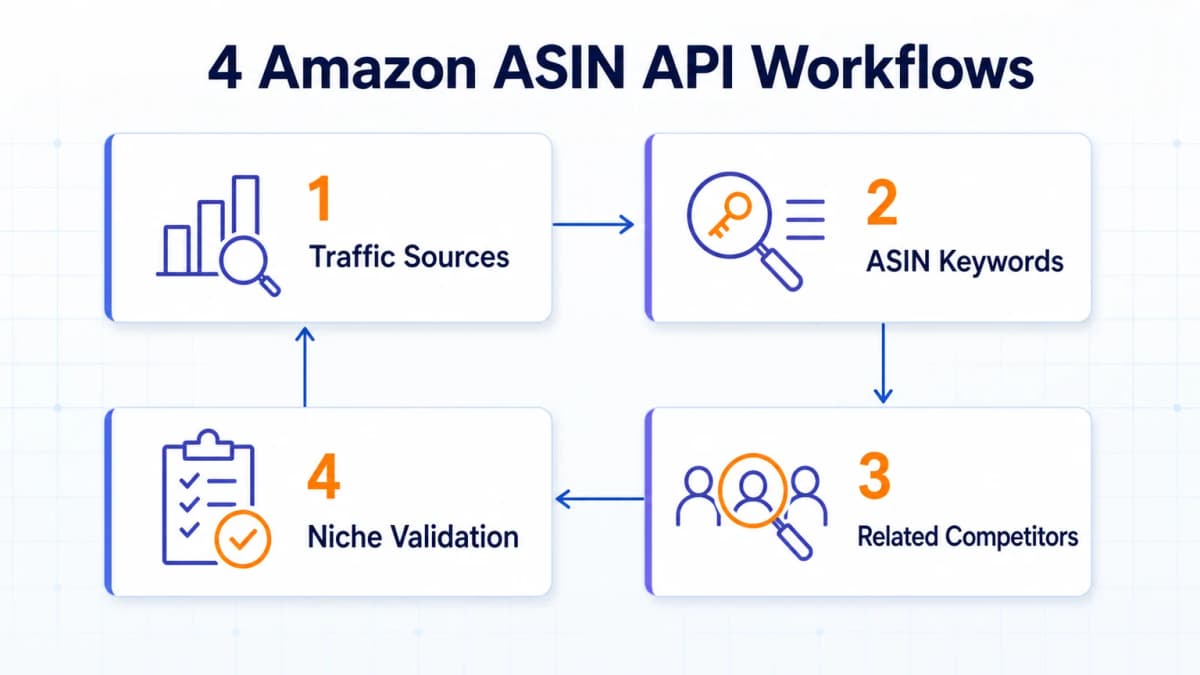
The four workflows below start with an ASIN but answer different questions. Keeping them separate prevents teams from comparing fields that were calculated for different purposes. Combining them later creates a fuller research record.
Traffic Source Analysis
The Amazon ASIN Traffic Summary API summarizes an ASIN's keyword exposure across organic search, Sponsored Products, Sponsored Brands, video ads, and recommendation placements. It can compare the current and previous periods and identify keywords entering or leaving the observed set.
The request accepts up to 10 comma-separated ASINs and supports 13 Amazon country sites. A default seven-day view is available, while custom date ranges can be supplied when last7d is false. Filters can narrow the response to natural traffic, sponsored placements, brand ads, video ads, recommendation placements, or newly entered keywords.
Useful response fields include:
- Total traffic keyword count: The number of observed keywords associated with the ASIN in the selected period.
- Incoming and outgoing keyword counts: Terms that entered or left the observed set between periods.
- Exposure scores and ratios: Composite visibility signals separated by organic, sponsored, brand, video, and recommendation placement types.
- Previous-period fields: Comparison values for detecting directional changes.
Exposure scores are research signals. They should not be described as verified Amazon sessions, clicks, orders, or revenue. The API documentation should remain the source of truth for each field's definition.
A traffic summary is useful for prioritization. If an ASIN loses natural-search keywords while sponsored exposure rises, the pattern can trigger a deeper keyword review. It does not prove that advertising caused the organic decline. A reliable workflow records the time window, marketplace, ASIN type, and filter set alongside the response.
Reverse ASIN Keyword Research
The Amazon ASIN Keywords API performs a reverse ASIN lookup for one product at a time. It can return keyword-level organic rank, Sponsored Products rank, estimated search volume, traffic share, conversion-related fields, and time-window metrics across 13 supported country sites.
This workflow is useful when a team wants to understand which terms appear to drive a competitor's visibility. It can also support keyword-gap analysis across several ASINs when each product is queried separately and the results are normalized into a shared table.
Important fields include:
- Natural and ad rank: Separate positions for organic results and Sponsored Products placements.
- Weekly search volume: An estimated demand signal for the keyword.
- Traffic share: The keyword's share of the ASIN's total observed traffic score.
- Click-to-purchase conversion rate: A conversion-oriented metric that must be read with its documented source and time period.
- Keyword flags: Filters for converting, stable, lost, precise, long-tail, or search-volume movement classifications.
Reverse ASIN results should complement broader Amazon keyword research. A competitor's visible terms are evidence of current search exposure, while seed expansion, relevance review, listing fit, and marketplace-specific demand are still required before a keyword becomes a target.
The distinction between organic and paid rank is especially important. An ASIN can hold a prominent ad placement while its natural position remains weak. Teams that monitor ongoing movement should keep both series separate, as recommended in a disciplined Amazon keyword rank tracking process.
Same-Niche Competitor Discovery
The Amazon Related ASINs API finds products that belong to the same niche as a reference ASIN. Its filters support competitor screening by price, FBA fee, gross profit margin, review count, rating, click volume, click growth, conversion, annual sales indicators, launch date, niche count, and seller country.
This produces a more focused candidate set than selecting products from a broad category. A strong competitor set should contain products that address a similar customer need, operate within a comparable price band, and appear in related search contexts. Category membership alone may be too broad for that purpose.
The output can feed an Amazon competitor analysis workflow that compares:
- Pricing and offer position
- Review count and rating
- Product age and launch timing
- Demand and sales indicators
- Keyword overlap
- Listing differentiation
- Conversion and click signals
Related ASINs do not automatically represent direct competitors. Some products may be accessories, substitutes, variants, bundles, or adjacent solutions. Each returned product should be reviewed for functional similarity and customer intent before it enters a benchmark set.
Niche Opportunity Validation
The Amazon Niche Info By ASIN API identifies market segments associated with an ASIN and returns niche-level signals. Supported filters include product count, average price, seven-day search volume, units sold, click volume, click conversion rate, brand count, top-brand click share, product concentration, Sponsored Products share, CPC, new-product launch success, and return-rate ranges.
This workflow moves analysis from one product to the structure of the surrounding market. It can help answer questions such as:
- Is demand distributed across many products or concentrated among a few leaders?
- Do the top brands control a large share of clicks?
- Are newer products gaining meaningful traction?
- Is paid placement common in the niche?
- Does the price range leave room for the intended cost structure?
No single score should make a sourcing or launch decision. A high opportunity score can be useful for triage, but it still needs product-level validation, supplier economics, policy review, customer feedback, and a clear differentiation plan. The strongest use of niche data is to expose which assumptions require more evidence.
How the Four APIs Work Together
An effective Amazon ASIN API workflow preserves the output of each step and passes only the relevant fields forward. The sequence below begins with one ASIN and ends with a research brief that can be reviewed by a person or used by a team's own Agent.
One-ASIN Workflow
- Record the reference product. Save the ASIN, marketplace, parent or child status, query time, and reason for inclusion.
- Measure the visibility mix. Use the traffic summary to separate natural, sponsored, brand, video, and recommendation exposure signals.
- Build the keyword set. Use the ASIN Keywords API to retrieve associated terms, ranks, volume, traffic share, and relevant flags.
- Find comparable products. Use Related ASINs with price, review, rating, conversion, and sales filters that match the research question.
- Evaluate market structure. Use Niche Info By ASIN to review demand, concentration, paid pressure, launch success, and opportunity indicators.
- Document uncertainty. Mark estimates, missing values, time windows, source differences, and results that require manual validation.
The following request pattern shows how a REST call is structured. API keys should be supplied securely at runtime and never committed to a repository or embedded in client-side code.
curl -X POST \
  https://api.nexscope.ai/api/skill-api/v1/skills/amazon-asin-keywords/run \
  -H "Authorization: Bearer nk_xxxxxxxxxxxxxxxxx" \
  -H "Content-Type: application/json" \
  -d '{
    "asin": "B072MQ5BRX",
    "country": "US",
    "pageNum": 1,
    "pageSize": 10,
    "desc": true
  }'
Endpoint Map
| Workflow | REST slug | Required ASIN field | Typical market field |
|---|---|---|---|
| Traffic summary | amazon-asin-traffic-summary |
searchValue |
country |
| Reverse ASIN keywords | amazon-asin-keywords |
asin |
country |
| Related competitors | amazon-related-asins |
asin |
countryCode |
| Niche validation | amazon-niche-info-by-asin |
asin |
countryCode |
The field names are intentionally shown as documented. An integration layer can normalize them into a common internal model, but the raw request and response should be retained for troubleshooting and auditability.
MCP Access
MCP is useful when a team's own Agent needs to discover and call tools dynamically. The Agent, model, prompts, and workflow remain under the team's control. Nexscope supplies the ecommerce data interface the Agent can call.
{
  "jsonrpc": "2.0",
  "id": "tool-call-1",
  "method": "tools/call",
  "params": {
    "name": "nexscope_amazon_asin_keywords",
    "arguments": {
      "asin": "B072MQ5BRX",
      "country": "US",
      "pageNum": 1,
      "pageSize": 10,
      "desc": true
    }
  }
}
REST is usually easier for fixed application flows. MCP is useful for tool discovery and Agent-directed orchestration. Both access patterns should use explicit validation rules, timeouts, retries, and logging that excludes credentials.
Once the workflow is clear, Nexscope Amazon Data API provides structured Amazon product, keyword, competitor, review, sales, pricing, and market intelligence through REST API or MCP. A single integration can route each research question to the narrow endpoint that matches it.
Research Amazon ASINs Through One API
Connect Amazon traffic, keyword, competitor, and niche research to REST API or MCP workflows through one structured data layer.
 Explore Amazon Data API →
Official Amazon APIs and ASIN Data APIs
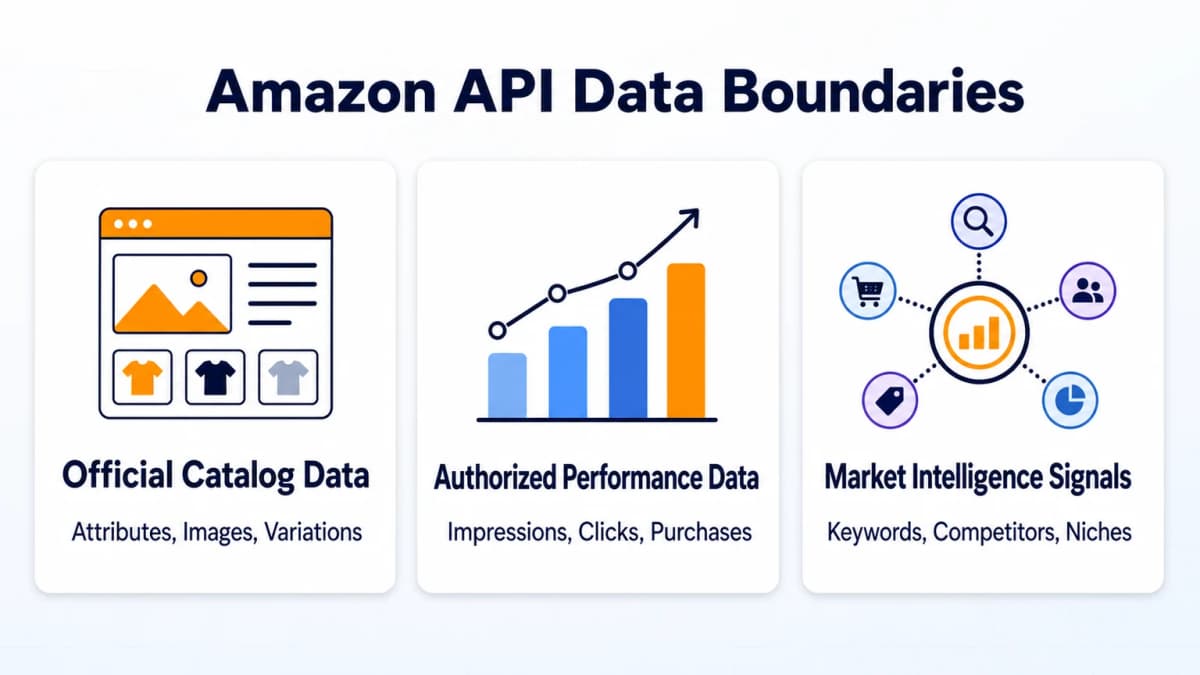
Official Amazon APIs and third-party ASIN data APIs can both support product workflows, but they often serve different users and data scopes. A production system may use both when authorization, terms, and data governance allow it.
Catalog and Listing Data
Amazon's Catalog Items API retrieves information contained in the Amazon catalog. Depending on authorization and the requested includedData values, a response can include attributes, identifiers, images, product types, sales ranks, summaries, relationships, and vendor details. This is the appropriate source when the application needs official catalog information for an authorized seller or vendor workflow.
Catalog relationships are also different from market competition. A variation relationship identifies parent and child products within Amazon's catalog structure. A related-ASIN market dataset may identify substitutes or competitors that have no catalog relationship to the reference ASIN.
Search Performance Data
Amazon's Search Query Performance Report provides query performance fields such as impressions, clicks, cart adds, and purchases for authorized Brand Analytics use cases. Amazon added support for querying multiple ASINs in that report in June 2025, subject to the documented character limit and access requirements.
This data has a clear first-party authorization context. It should not be mixed with external competitor estimates in the same field without a source label. A useful internal schema includes fields such as source, marketplace, period_start, period_end, is_estimated, and retrieved_at for every metric.
Competitive Market Intelligence
Third-party ASIN data APIs can support questions that official seller-authorized reports may not answer for external products. Common examples include competitor keyword visibility, related-product discovery, market concentration, or opportunity screening.
These signals require careful language. Estimated search volume is an estimate. A composite exposure score is a score. A modeled sales value is not the seller's actual order record. Market intelligence becomes more reliable when several independent signals agree and the decision process keeps the original definitions visible.
| Data category | Typical source | Best use | Main limitation |
|---|---|---|---|
| Catalog attributes | Official Amazon catalog API | Product identity, attributes, images, ranks, and variations | Requires the correct authorization and roles |
| Brand search performance | Authorized Amazon reports | Owned-brand impressions, clicks, cart adds, and purchases | Limited by eligibility, permissions, and report scope |
| Competitor keyword visibility | ASIN market data API | Reverse ASIN research and keyword-gap discovery | May contain estimated or modeled signals |
| Related products and niches | ASIN market data API | Competitor sets and market-structure analysis | Related does not always mean directly competitive |
Amazon ASIN API Selection Checklist
API selection should begin with data fitness rather than the number of advertised fields. A response with fewer well-defined fields can be more useful than a large payload with unclear time windows or source boundaries.
Coverage and Inputs
- Marketplace support: Confirm the exact country sites available for every endpoint. The four APIs in this guide do not all expose the same country set.
- ASIN limits: Check whether the endpoint accepts one ASIN, multiple comma-separated ASINs, or a batch request.
- Parent and child handling: Record whether the input is a parent ASIN, child ASIN, or variation and how the endpoint treats each type.
- Time controls: Confirm default periods, valid custom ranges, time-zone assumptions, and whether historical comparisons are available.
- Filter definitions: Save the meaning of each organic, sponsored, conversion, quality, stability, or growth filter.
Output Quality
- Schema stability: Version response models and handle optional or missing fields without converting them to zero.
- Freshness: Store the observation period and retrieval timestamp separately.
- Pagination: Test maximum page sizes, total counts, and deterministic sorting before running large jobs.
- Error handling: Distinguish invalid requests, authentication failures, upstream failures, and valid responses with no data.
- Localization: Preserve the marketplace and translated keyword fields when results span several countries.
Evidence Boundaries
Missing, zero, estimated, modeled, and unavailable are different states. A missing search volume should remain missing. An absent keyword should not automatically become a zero-volume keyword. A traffic share should retain the denominator and source definition used by the endpoint.
The same rule applies to derived recommendations. A system may rank products by opportunity score, but the raw factors should remain available for review. Teams should be able to explain whether a recommendation was driven by demand, competition, concentration, price, conversion, paid pressure, or another documented input.
Common Integration Mistakes
Amazon ASIN API projects often fail during interpretation rather than transport. A successful HTTP response proves that a request executed. It does not prove that every returned field is suitable for the intended business decision.
Metric Confusion
- Keyword rank vs. BSR: Keyword rank is a product's position for a search term. Best Sellers Rank reflects category-level sales performance. The two metrics can move independently.
- Traffic share vs. sessions: A share of an exposure or traffic score does not necessarily equal measured Amazon sessions.
- Related ASIN vs. variation: A market competitor may have no parent-child relationship with the reference product.
- Click concentration vs. conversion: Concentrated clicks among leading ASINs describe distribution, not purchase conversion.
Context Loss
Every stored result should include the ASIN, marketplace, request filters, date range, retrieval time, endpoint version, and estimate status. Without that context, two responses can look comparable while representing different countries, periods, or placement types.
This is especially important for keyword work. Search demand, organic rank, sponsored rank, and conversion signals may update on different schedules. A weekly view and a monthly view should remain separate even when the keyword text matches.
Workflow Design
- Start with a decision: Define whether the job is keyword discovery, competitor screening, niche validation, or monitoring.
- Use the narrowest endpoint: Avoid requesting unrelated fields that increase cost and interpretation risk.
- Validate representative ASINs: Test parent products, child variations, low-data products, and several marketplaces before scaling.
- Keep human review: Require review for sourcing, pricing, compliance, and major advertising decisions.
- Protect credentials: Load API keys from a secure server-side secret store and exclude them from logs, prompts, artifacts, and source control.
Conclusion
An Amazon ASIN API becomes valuable when each endpoint has a clear job. Traffic summaries describe changes in observed visibility signals. Reverse ASIN keyword data supports search-term discovery and rank analysis. Related ASINs create a candidate competitor set. Niche analysis places the reference product inside a broader demand and concentration context.
The strongest workflow keeps those outputs separate, then combines them through documented rules. It records marketplace and time context, preserves missing values, distinguishes official authorized data from market estimates, and retains enough raw evidence for a person to review the recommendation.
Teams can connect supported Amazon data to their own applications and Agent workflows through the Amazon Data API, browse the complete API documentation, or obtain an API key through Nexscope API Access. New users receive 1,000 trial credits for three days without a credit card. Data API usage is pay as you go with Data Credits and does not require a monthly subscription.
Build Your Amazon ASIN Research Workflow
Connect structured Amazon traffic, keyword, competitor, and niche data to your own applications or Agent workflows through REST API or MCP.
Explore Amazon Data API →1,000 trial credits • No credit card required
Frequently Asked Questions
What is an Amazon ASIN API?
An Amazon ASIN API accepts an Amazon Standard Identification Number and returns structured data associated with that product. The response may include catalog attributes, images, sales ranks, variations, keywords, organic and sponsored positions, related products, traffic exposure signals, or niche metrics. No universal ASIN response exists, so the endpoint documentation should define the available fields, supported marketplaces, time windows, and estimate status. Teams should select the endpoint based on the research decision instead of assuming every ASIN API returns the same information.
Does Amazon provide an official ASIN API?
Amazon provides several official APIs that use ASINs. The Selling Partner API for Catalog Items can retrieve catalog details for a specified ASIN and marketplace when the caller has the required authorization. Amazon Business also provides product search capabilities for approved integrations. Other official reports may provide search and engagement information for authorized seller or brand use cases. Access requirements, roles, rate limits, and available fields vary by API, so the current Amazon documentation should be checked before implementation.
Can an API find keywords for an Amazon ASIN?
Yes. A reverse ASIN keyword API can return search terms associated with a product's observed Amazon visibility. Depending on the provider, fields may include estimated search volume, organic rank, Sponsored Products rank, traffic share, conversion-related signals, and trend flags. These results can help identify competitor terms and keyword gaps. They do not reveal a competitor's private backend search terms, and estimated fields should remain labeled as estimates.
Can an ASIN API reveal competitor traffic sources?
An ASIN traffic API can estimate or score how a product appears across organic search, sponsored placements, brand ads, video ads, recommendation modules, and associated keywords. The result may help teams compare visibility mix or detect keywords entering and leaving an observed set. It should not be described as access to a competitor's private Amazon Analytics account. Exposure scores, ratios, and modeled traffic fields require the definitions and time windows documented by the provider.
How can an API find related Amazon ASINs?
A related ASIN API begins with a reference product and identifies other products in the same or a similar niche. Filters can narrow candidates by price, reviews, rating, sales indicators, conversion, launch date, margin, or seller location. Returned products still require relevance review because related items may include substitutes, accessories, bundles, or adjacent solutions. A reliable competitor set uses customer need, price band, search context, and product function together.
What is the difference between an ASIN API and an Amazon scraper API?
An ASIN API describes the input and output purpose: submit an ASIN and receive structured product or market data. An Amazon scraper API describes one possible collection method, usually retrieving information from public Amazon pages while handling rendering, blocking, and parsing. Some ASIN APIs use scraping infrastructure, while others use official, licensed, partner, aggregated, or modeled data. Teams should evaluate the actual data contract, permitted use, freshness, reliability, and source boundaries instead of treating the labels as interchangeable.
Can an Amazon ASIN API connect to an Agent through MCP?
Yes, when the provider exposes MCP tools. MCP allows a team's own Agent to discover and call supported ASIN data tools through a structured interface. The team retains control of the Agent, model, prompts, permissions, and workflow. The data provider supplies the callable ecommerce data interface. Production implementations should validate tool inputs, restrict permissions, protect credentials, log requests without secrets, and require human review for high-impact sourcing, pricing, compliance, or advertising decisions.
Sources
- Amazon. (2026). Catalog Items API v2022-04-01 Reference. Retrieved from developer-docs.amazon.com
- Amazon. (2026). Manage Product Listings with the Selling Partner API. Retrieved from developer-docs.amazon.com
- Amazon. (2025). Search Query Performance Report Supports Multiple ASINs. Retrieved from developer-docs.amazon.com
- Amazon Business. (2026). Product Search API v1 Reference. Retrieved from docs.business.amazon.com