
Nano Banana 2.1 vs GPT Image 2.5: Which Should You Choose?
GPT Image 2.5 leads the current Arena rankings, while Nano Banana 2.1 offers a compelling Google-based workflow for reference images, targeted edits, and predictable image-output pricing. The right choice depends on what you need to make—and how much revision it takes to get there.
There are also two GPT Image 2.5 models to consider: Flare for fast everyday generation and Sunburst for more precise creative work. This comparison separates them and focuses on product imagery, promotional graphics, and repeatable production.
Key Differences at a Glance
| Factor | Nano Banana 2.1 | GPT Image 2.5 Flare | GPT Image 2.5 Sunburst |
|---|---|---|---|
| Main appeal | Google ecosystem, reference-driven creation | Fast everyday image generation | Precision in generation and editing |
| Output options | 1K, 2K, and 4K | Configurable size and quality | Configurable size and quality |
| Workflow to consider | Multi-reference scenes and local changes | Frequent creative iterations | Detailed campaign and product edits |
| Standard image-output rate | $30 per million tokens | $30 per million tokens | $30 per million tokens |
| Arena text-to-image rank* | 5 | 2 | 1 |
| Arena single-image-edit rank* | 6 | 2 | 1 |
Arena overall rankings dated October 6, 2026; all three entries are preliminary. Rates are provider API prices, not subscription prices or full request costs.
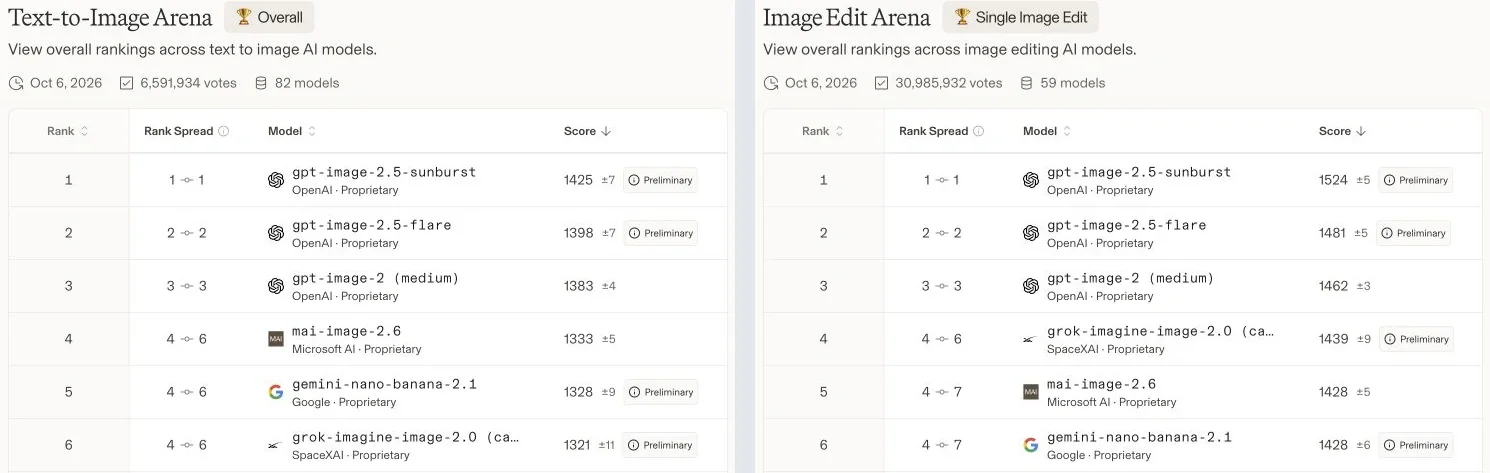
Arena, October 6, 2026: text-to-image (left) and single-image editing (right). Model entries are preliminary. Click to enlarge.
Nano Banana 2.1 updates Google's image generation and editing model. Its reference-image support and search grounding are useful reasons to evaluate it beyond its leaderboard position.
For GPT Image 2.5, choose the variant deliberately. OpenAI positions Sunburst for tighter control with longer generation times; Flare is the everyday option.
Image Quality and Text
A strong product image has to do more than look attractive. The product should retain its shape, the lighting should suit the scene, and any offer or label should remain readable.
Nano Banana 2.1 improves text rendering and infographic layout over its predecessor. That makes promotional posters and explanatory graphics sensible trial tasks. Small lettering and long passages still deserve close inspection.
GPT Image 2.5's higher overall Arena positions make it a strong starting point for visual quality. They do not establish a winner for every language, packaging label, or poster format.
For text-heavy images, compare exact spelling, line breaks, contrast, and hierarchy. A beautiful headline cannot compensate for the wrong discount or a changed product name. Keep mandatory legal copy and dense specifications as editable text in your design file.
Editing and Product Consistency
The harder ecommerce task is often changing the scene without changing the item. A new background is useful only if the bag's clasp, a bottle's label, and the product's proportions survive the edit.
Nano Banana 2.1 supports multi-image reference workflows, with up to 14 reference images, and offers mask- and ink-guided editing. It is worth trying when a brief combines product references, a preferred scene, and a specific region to change.
Sunburst is the first GPT variant we would evaluate for demanding revisions. Flare is worth testing when teams need frequent iterations and shorter turnaround. These are starting points based on their intended roles, rather than results from a controlled test in this article.
Use the same source product photo for each candidate. Ask for one change at a time, then inspect the logo, silhouette, color, and small hardware. A model that preserves those details can save more production time than one that produces a dramatic first draft.
Pricing and Cost per Image
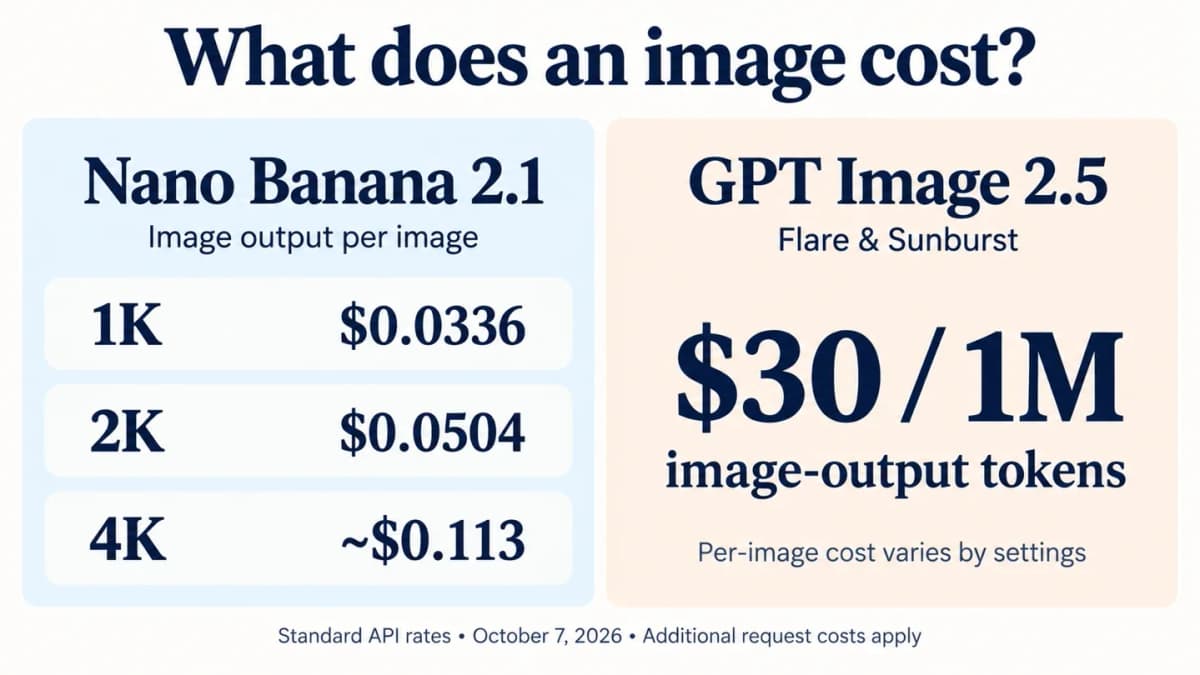
Standard provider API pricing checked October 7, 2026. Image-output charges exclude additional request costs.
All three models list $30 per million image-output tokens. That does not mean they cost the same per finished image: token usage and settings matter.
Google publishes these Nano Banana 2.1 image-output equivalents:
| Output size | Per image | 1,000 images |
|---|---|---|
| 1K | $0.0336 | $33.60 |
| 2K | $0.0504 | $50.40 |
| 4K | About $0.113 | About $113 |
Text/image inputs and text or thinking output are additional. The 4K figure follows Google's rounded published price.
Both GPT Image 2.5 variants charge $5 per million text-input tokens, $8 per million image-input tokens, and $30 per million image-output tokens at standard rates. Estimate a request using its actual size, quality, and reference inputs instead of assigning GPT Image 2.5 a single per-image price.
For a useful business comparison, measure cost per approved image. Divide the total generation and editing spend by the number of images that pass review. Include retries; a lower first-attempt price may not translate into a cheaper usable result.
What the Benchmarks Show
Arena's October 6 snapshot places Sunburst first and Flare second on both overall image leaderboards. Nano Banana 2.1 ranks fifth for text-to-image and sixth for single-image editing.
| Model | Text-to-image score | Single-image-edit score |
|---|---|---|
| GPT Image 2.5 Sunburst | 1425 ± 7 | 1524 ± 5 |
| GPT Image 2.5 Flare | 1398 ± 7 | 1481 ± 5 |
| Nano Banana 2.1 | 1328 ± 9 | 1428 ± 6 |
All listed scores are preliminary. Compare models within each column; the two leaderboards are separate evaluations.
The rankings favor GPT Image 2.5 in overall preference. They do not measure your brand's acceptance rate, production cost, or delivery time. Use them to choose which models to test first, then judge the results against your own brief.
Which Model Should You Choose?
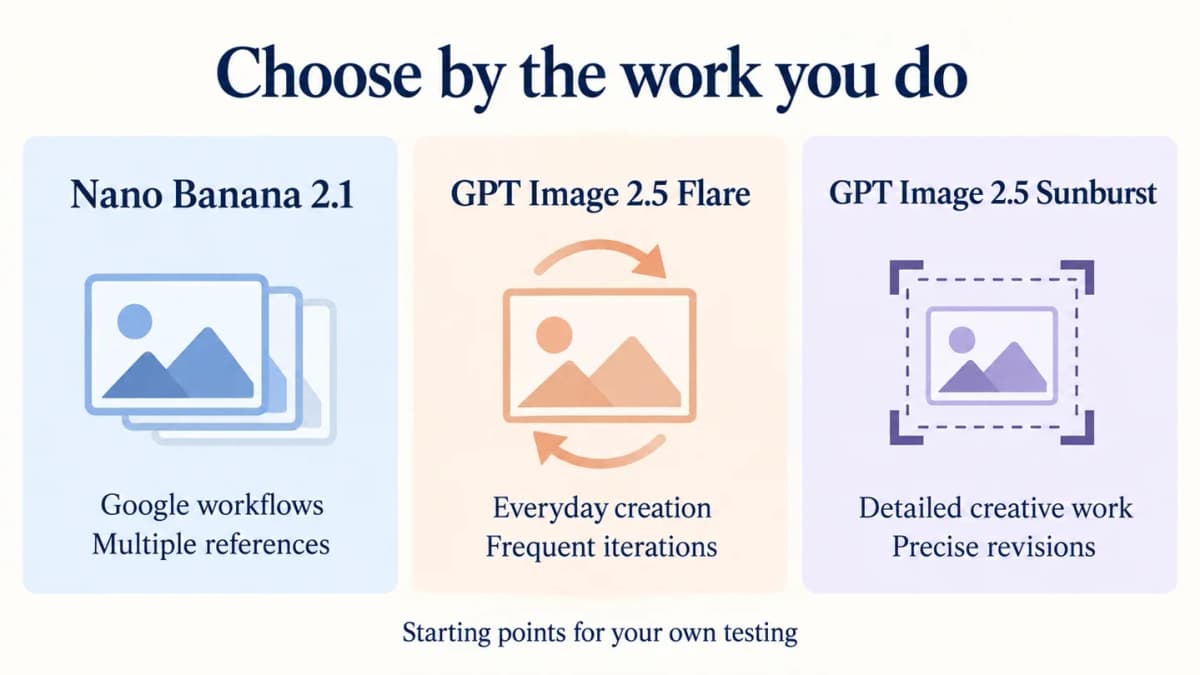
Editorial recommendations based on documented model roles and the dated Arena snapshot.
Start with Nano Banana 2.1 if your team already builds with Gemini, needs multiple references, or wants to use Google's search-grounded image workflow. Its published resolution-based output estimates also simplify early budgeting.
Start with Flare if your main task is producing and revising creative options throughout the day. For a campaign with many concepts, evaluate turnaround alongside acceptance rate.
Start with Sunburst if the image needs careful revisions and a high level of finish. Its precision focus and current Arena lead make it a reasonable first candidate for final campaign assets.
Before committing, run a small trial with your own assets: a product hero, a text-heavy promotion, a background replacement, and a sequence of edits. Keep the brief, reference files, and target dimensions aligned. Record model settings, elapsed time, billed cost, and whether each result passes review. This gives you a decision grounded in the work you actually publish.
Conclusion
GPT Image 2.5 is the stronger starting point on current overall benchmarks: Flare for everyday iteration, Sunburst for precision. Nano Banana 2.1 remains worth testing for Google-based, reference-driven workflows and its clear output pricing.
For teams building image and video workflows, Nexscope offers multiple generation models, including GPT Image 2.5 Flare, Sunburst, and Nano Banana 2.
Build Your Creative Workflow
Explore models including GPT Image 2.5 and Nano Banana 2 for product visuals and marketing content.
Explore Nexscope Creative APIs →Frequently Asked Questions
Is Nano Banana 2.1 better than GPT Image 2.5?
It depends on the task. GPT Image 2.5 leads the October 6 Arena overall rankings; Nano Banana 2.1 may suit teams prioritizing Gemini integration, reference workflows, or search grounding.
What is the difference between Flare and Sunburst?
Flare targets fast everyday generation. Sunburst emphasizes precision for detailed creative work and edits, with longer generation times.
Is Nano Banana 2.1 cheaper?
There is no universal per-image winner. All three share a $30-per-million image-output-token rate, while token usage, inputs, quality settings, and retries affect the final bill.
Which should I try for ecommerce product images?
Try Sunburst for detailed final edits, Flare for frequent creative iterations, and Nano Banana 2.1 for Google-based reference workflows. Check product fidelity against the original photo before approving any result.
Can these models create images with text?
Yes, but review spelling, numbers, and layout at the final display size. For long or legally required copy, add editable typography after generating the visual.
Can I use these models through an API?
Yes. Nano Banana 2.1 is available through the Gemini API, while Flare and Sunburst have separate OpenAI API model IDs. Choose the exact model when integrating or comparing costs.
Sources
- Google. 2026. Gemini Nano Banana 2.1 and Gemini Developer API Pricing. Google AI for Developers. ai.google.dev.
- Google DeepMind. 2026. Nano Banana 2.1 Model Card. deepmind.google.
- OpenAI. 2026. Introducing ChatGPT Images 2.5. openai.com.
- OpenAI. 2026. GPT-Image-2.5 Flare, GPT-Image-2.5 Sunburst, Image Prompting, and API Pricing. developers.openai.com.
- Arena. 2026. Text-to-Image and Image Edit Leaderboards. October 6 snapshot. arena.ai.