

What Is Agentic Commerce? A Practical Guide for Ecommerce Teams

Table of Contents
Agentic commerce is a way of buying and selling in which AI agents perform shopping tasks on behalf of people or businesses. An agent can interpret a request, investigate products, compare options, and move toward a purchase within the permissions it has been given. The scope can stop at recommendations or extend to an authorized transaction.
For ecommerce teams, that changes what a useful shopping experience needs to provide. A product must be understandable to the software evaluating it. Its attributes must match the selected variant, its price must have context, and its availability must be checked before an order is accepted.
Consider an illustrative request: “Find a carry-on backpack under $120 that fits my airline’s cabin allowance and arrives before Friday. Ask me before buying.” Answering it requires several decisions across product research, merchant information, and checkout.
This guide explains what agentic commerce means, follows that request through a shopping journey, and gives ecommerce teams a practical starting point for product data, connected systems, and a controlled pilot.
What Is Agentic Commerce?
Agentic commerce lets an AI agent carry out shopping tasks for a buyer within defined permissions. The agent uses connected tools to research and compare products and, where supported and authorized, help complete a purchase.
Goals, Tools, and Permissions
A shopping agent needs a goal, access to relevant tools, and a clear boundary around what it may do. The goal describes the desired outcome. Tools provide information or perform actions. Permissions determine whether the agent can research, prepare a cart, or submit an order.
These elements are separate. A system might understand a shopper’s request but lack access to delivery estimates. It might retrieve a product listing but have no way to purchase it. A useful experience makes those limits visible rather than filling the gaps with confident language.
For a merchant, the practical question is which parts of the buying task its systems can support and verify. That answer determines where the agent can proceed and where the shopper or a member of staff must take over.
Assistance and Delegated Action
The degree of delegation depends on the implementation. An assistant may prepare a shortlist for a shopper to review. Another system may prepare a transaction and request confirmation. A bounded purchasing workflow may act within previously approved conditions.
For the backpack request, the instruction is explicit: ask before buying. The agent can investigate products, but approval is still required before a purchase. Changing the shopping interface does not change that instruction.
This distinction also helps teams evaluate product demonstrations. A generated recommendation shows an answer. A verified order requires evidence from the merchant’s order system. Each is a different outcome, with different dependencies.
How Does Agentic Commerce Differ From Traditional Ecommerce?
Traditional ecommerce usually asks the shopper to coordinate the process: search, open product pages, compare attributes, select an offer, and complete checkout. Agentic shopping delegates some of that coordination to software.
| Shopping task | Typical manual journey | Agent-supported journey |
|---|---|---|
| Express a need | Select categories and filters | Describe a goal and constraints |
| Find candidates | Browse results and listings | Retrieve candidates through available tools |
| Compare products | Read specifications and reviews | Organize evidence against the request |
| Check the offer | Inspect price, stock, and delivery | Validate those details with merchant systems |
| Authorize a purchase | Confirm at checkout | Approve a proposed transaction or apply agreed limits |
| Resolve an exception | Contact the merchant | Escalate or use supported service actions |
The website remains useful for detailed inspection, confidence, and tasks that require a person. An agent can also return the shopper to a product page when the information or action it needs is unavailable.
Product discovery and transaction readiness are separate stages. A product can appear in an answer without the assistant being able to complete its purchase. Current shopping platforms show how those stages connect in different ways.
Which Platforms Support Agentic Shopping?
Amazon Alexa for Shopping and Shopify-connected AI channels offer examples of agentic shopping. Their capabilities vary: some support product research and a merchant-store handoff, while others support checkout within the channel.
Amazon Alexa for Shopping
Amazon Alexa for Shopping, previously called Rufus, brings conversational product research into Amazon's shopping experience. Amazon describes capabilities such as comparing products and prices, checking price history, and taking supported shopping actions, including auto-buy requests tied to a target price.
That makes the distinction between recommendation and action concrete. Comparing two backpacks is a research task. Buying one when an agreed price condition is met adds a purchasing instruction. For sellers, accurate variant information, clear specifications, and dependable offers matter across both tasks.
ChatGPT and Shopify Merchants
Product discovery in ChatGPT Shopping can help shoppers find relevant Shopify products. However, the current Shopify and OpenAI help pages describe a merchant-store checkout: shoppers complete the purchase in the store through an in-app browser or a new browser tab.
The conversation therefore helps connect a need to an offer, while the merchant's storefront completes the transaction. A merchant should evaluate both the recommendation experience and the checkout handoff, including whether the selected variant, price, and availability remain consistent.
Shopify's Other AI Channels
Shopify describes a different route for Google AI Mode and Gemini, Microsoft Copilot, and Meta surfaces such as Muse. With direct checkout activated, customers can complete purchases through Shopify-powered checkout inside those supported channels.
These examples illustrate why an ecommerce team should map the actual channel flow before designing its integration. An assistant may recommend a product, hand the shopper to a merchant, or support checkout within its own interface. None of those interface choices alone establishes permission to purchase without the buyer's approval.
How Does an Agentic Shopping Journey Work?
An agentic shopping journey moves from a buying request to product discovery, comparison, purchase approval, and order verification. Each step depends on the information, tools, and permissions available to the agent.
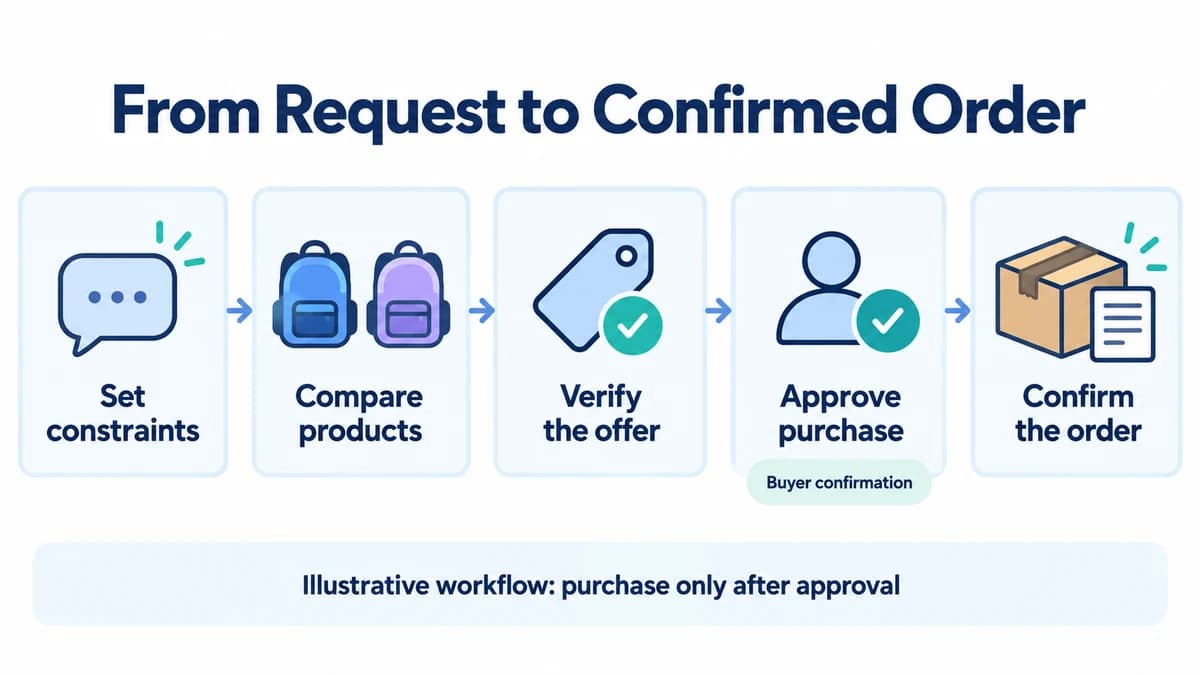
The backpack scenario below is a proposed workflow, not a report of a completed purchase or a tested integration.
Define the Buying Task
The first step is to turn the request into constraints that can be checked. Which airline and fare rules apply? Does “under $120” mean the listed price or the total including shipping and tax? What destination and date does “before Friday” refer to?
Those questions determine whether a result is acceptable. Without the destination, an arrival claim is incomplete. Without the applicable baggage allowance, a seller’s “cabin approved” label is insufficient.
An effective task description distinguishes hard requirements from preferences. The budget and delivery deadline may be mandatory, while color and the number of pockets may be flexible. The agent should ask about unresolved hard requirements before presenting an option as a match.
Discover and Compare Products
The agent then gathers candidates and records the evidence for each. Useful fields might include product and variant identifiers, dimensions, weight, material, observed price, and the source of each observation.
A compact comparison could look like this:
| Illustrative candidate | Available evidence | Unresolved issue | Next action |
|---|---|---|---|
| Backpack A | Dimensions and selected variant recorded | Delivery date missing | Request a destination-specific estimate |
| Backpack B | Seller’s cabin-size claim | Dimensions not supplied | Retrieve measurements or exclude it |
| Backpack C | Dimensions and current offer recorded | Total may exceed the budget | Calculate applicable checkout charges |
This table deliberately avoids declaring a winner before the missing information is resolved. A shorter, defensible shortlist is more useful than a longer list of guesses.
Reviews can add context about zipper failures, comfort, or durability. They should remain distinguishable from verified specifications. A reviewer’s experience with one size or an older version may not apply to the selected variant. When using review data for market intelligence, preserve the relationship between the evidence, the product, and the question being answered.
Confirm and Complete Checkout
Before asking the shopper to approve a purchase, the workflow needs a merchant-confirmed offer. The selected product, variant, quantity, delivery details, and payable total should be clear.
An observed price from a research source is useful for comparison, but it is not a reserved offer. The merchant may report a different price or availability when the purchase is prepared. If a change breaks the shopper’s conditions, the agent should pause and explain the difference.
For this example, approval should describe the exact proposal: the selected backpack, the relevant size evidence, the delivery estimate, and the total. The workflow then uses the merchant’s supported transaction process and records its result. A timeout should trigger a status check before another purchase attempt, so uncertainty does not become a duplicate order.
Track Orders and Exceptions
After submission, the order confirmation provides the reference for what happened. A conversational message saying “done” should correspond to an accepted order, not merely an attempted request.
Subsequent actions depend on the merchant integration. The agent may be able to retrieve a shipment update, or it may need to hand the shopper a tracking link. A cancellation request may require human help. The interface should distinguish a submitted request from a confirmed outcome, particularly when the result arrives later.
What Data Does Agentic Commerce Need?
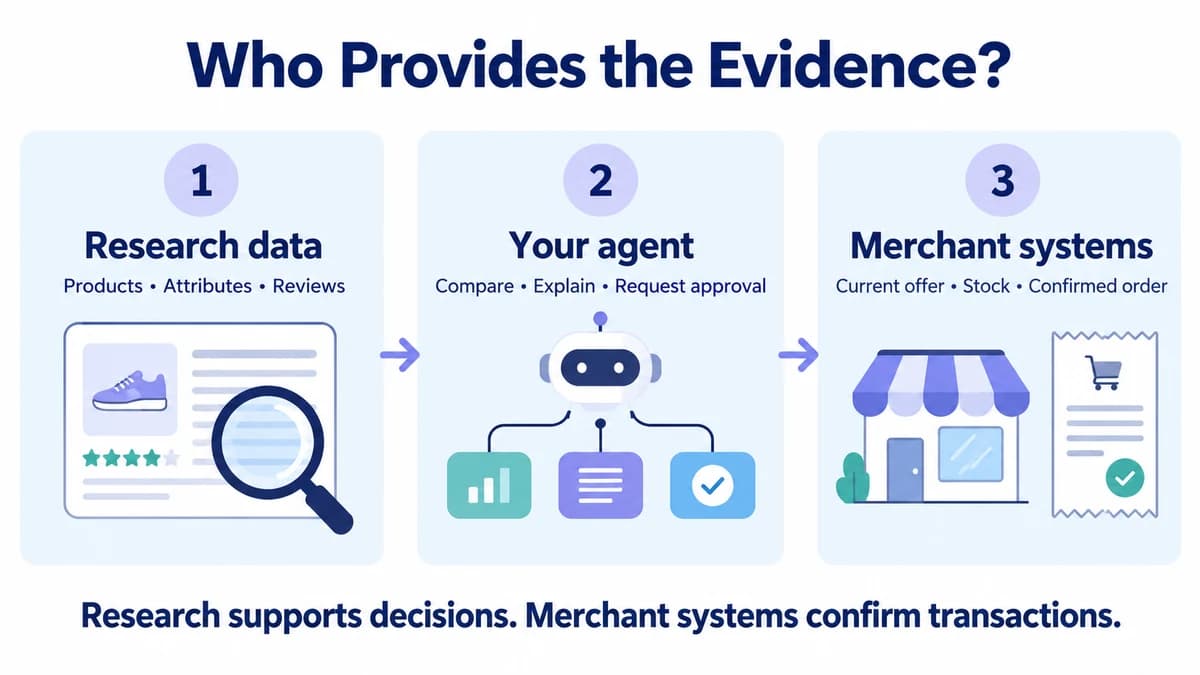
Agentic commerce needs identifiable products and variants, comparable attributes, traceable research evidence, and current merchant information. Research sources support comparison; merchant systems confirm the payable offer, availability, delivery options, and order status.
Product Identity and Comparability
The most basic requirement is knowing exactly what the information describes. A parent product, its variants, and the offers from different sellers are related records, not interchangeable ones.
For the backpack, dimensions must belong to the selected size. Price and stock must belong to the relevant offer. A review summary should make clear which product versions it covers. Losing those relationships can produce an apparently persuasive comparison that mixes incompatible facts.
Consistent units also matter. Compare dimensions after converting them into the same unit, and retain the original measurement for verification. Keep currency and market explicit. These are straightforward data-quality practices that become especially valuable when software combines information automatically.
Freshness and Evidence
Different facts need different refresh rules. A material specification may change infrequently. Availability and a delivery estimate can change between research and checkout.
The following is a suggested responsibility model for the backpack pilot:
| Information | Appropriate source | Checkpoint | Response to uncertainty |
|---|---|---|---|
| Product identity and dimensions | Manufacturer or merchant catalog | Candidate comparison | Ask for evidence or exclude the candidate |
| Review observations | Traceable review records | Evidence collection | Explain coverage and limitations |
| Price context | Research feed or observed listing | Initial comparison | Preserve the observation time |
| Executable price and availability | Merchant’s offer or checkout system | Before purchase approval | Refresh and re-evaluate the proposal |
| Delivery options | Merchant or fulfillment system | After destination is known | Avoid promising an unverified arrival |
| Order status | Merchant’s order system | After submission | Verify status before retrying |
The aim is to make uncertainty actionable. “Delivery not verified” tells the workflow what to check next. An invented delivery date makes the shortlist look complete while hiding a failure.
Commerce Interfaces and Protocols
An API can expose a specific data query or business operation. MCP provides a standardized way for AI applications to connect to tools and context. The capabilities available through a connection depend on what its provider exposes and what the caller is allowed to access. When choosing a Shopify MCP connection, first distinguish developer documentation access, shopper-facing commerce tools, and authenticated store administration; they serve different tasks.
Commerce protocols address additional interactions. Shopify describes Universal Commerce Protocol, co-developed with Google, as an open standard covering operations such as product discovery, checkout, orders, and post-purchase workflows.
For planning, separate three questions: how the agent obtains information, how it invokes a supported commerce action, and how that action is authorized. Choosing a connection method does not answer all three. A research tool that retrieves product information does not automatically gain the ability to reserve stock or charge a payment method.
What Are the Benefits and Limits of Agentic Commerce?
Agentic commerce can reduce the work of finding, comparing, and reordering products. Its usefulness depends on data quality, supported integrations, and reliable handling of permissions and exceptions.
Product Discovery and Comparison
A promising starting point is the comparison work shoppers already perform across multiple pages. An agent can organize candidate information into the criteria that matter for a particular request.
For merchants, that creates a reason to improve attribute clarity and offer consistency. It also creates a useful test: can someone unfamiliar with the catalog identify the right variant and understand its limitations from the information provided?
Better data supports this process, but it does not guarantee that a particular assistant will recommend the product. Recommendation systems, available integrations, and shopper preferences still influence the outcome.
Repeat Purchases and Procurement
Repeated purchases can offer a narrower problem than open-ended shopping. A team may already know the approved item, supplier, and acceptable quantity. That makes it easier to define the conditions under which a workflow may proceed.
Even then, substitutions need a policy. If the preferred item is unavailable, should the agent stop, suggest an alternative, or choose from an approved list? Write that decision into the task rather than assuming an apparently similar item is acceptable.
Trust and Operational Failures
Reliability becomes visible when something goes wrong. A changed price, missing attribute, expired session, or delayed response should lead to a predictable outcome that staff can understand.
Plan an escalation route and retain the evidence behind important decisions. The team reviewing a failed backpack recommendation should be able to see the request, the candidate information, the unresolved conditions, and the action attempted. That record makes correction more useful than a generic “AI error” label.
How Can Ecommerce Teams Get Started?
Start with a narrow shopping task, define what a correct result looks like, and assign owners for the required data and actions. Measure errors and handoffs before expanding the pilot or granting more purchasing authority.
Choose a Narrow Pilot
Start with a defined catalog, market, and research task. For example, help a shopper compare three travel backpacks while keeping the final purchase under human control.
Write an acceptance checklist before evaluating the results: the correct variant, comparable dimensions, a sourced price observation, explicit missing fields, and no unsupported delivery promise. Include deliberately difficult requests so the pilot tests when to ask for help as well as when to return an answer.
For a Shopify team, preparing the store for AI-assisted shopping can begin with the same catalog and policy review. Platform-specific integration work can follow once the team knows which information is complete and which still needs attention.
Assign Data and Action Owners
Give each dependency an owner. The catalog team maintains product attributes and variant relationships. Ecommerce engineering handles supported interfaces and failure behavior. Operations verifies delivery and service policies. Payment and security specialists review any proposed purchasing capability.
For each field or action, record who can correct it, how changes reach the workflow, and what happens while a fix is pending. A named owner and a clear refresh process are more useful than a broad instruction to “make the catalog AI-ready.”
Measure Results and Exceptions
Measure whether the pilot performs its assigned task, then examine its business effect. Avoid treating every completed conversation as a successful shopping outcome.
| Pilot measure | What to record |
|---|---|
| Product-match accuracy | Whether selected variants satisfy the stated constraints |
| Evidence completeness | Whether required fields have usable sources |
| Stale-data frequency | How often rechecks change a proposed option |
| Human correction rate | How often reviewers must fix a recommendation |
| Handoff completion | Whether the shopper reaches the intended next step |
| Confirmed orders | Orders accepted by the merchant, counted separately from attempts |
Review failures by cause. Missing dimensions require a different fix from a tool timeout or an ambiguous request. Expand the pilot when those causes are understood and the team can explain its results, including the cases where the agent correctly declined to proceed.
Conclusion
Agentic commerce gives software a larger role in coordinating shopping tasks. For ecommerce teams, the practical work starts with clear product records, reliable merchant information, explicit permissions, and a workflow that can handle incomplete evidence.
A focused comparison pilot makes those requirements concrete. It shows which facts are available, which decisions still need a person, and which integrations are worth building next.
Connect Your Agent to Ecommerce Data
Your own agent needs evidence to investigate products and explain its recommendations. Nexscope provides structured ecommerce data that teams can access through REST API or MCP and connect to their own agents and workflows.
Its Ecommerce Data APIs include product search, product details, and review data for supported sources. These can support candidate discovery and research, while the selected endpoint determines the available fields and coverage. Merchant systems remain responsible for confirming the executable offer and completing the transaction.
Begin with one research task and the data it needs. Compare the agent’s output with a human-reviewed result before adding more actions.
Connect Your Agent to Ecommerce Data
Get your Nexscope API key to connect product and review data to your own shopping workflows.
Frequently Asked Questions
What is agentic commerce in simple terms?
Agentic commerce means using an AI agent to carry out shopping tasks for a person or business. Those tasks can include finding products, comparing evidence, preparing a purchase, and completing an authorized transaction. What the agent can do depends on its tools, integrations, and permissions.
How is agentic commerce different from a chatbot?
A chatbot can provide a conversational interface. An agentic commerce workflow also connects the conversation to shopping tools and actions. The important distinction is the work the system can perform and verify, rather than whether the interface looks like a chat window.
Can an AI agent buy products without approval?
Some implementations support purchases within previously authorized conditions. Others require approval for each transaction. The workflow should make the scope explicit, including the permitted products, merchants, spending limits, and circumstances that require another decision from the user.
What product data does a shopping agent need?
The required data depends on the task. Common needs include product and variant identifiers, relevant specifications, price context, and review evidence. A purchase also requires current merchant information about the selected offer, availability, delivery, and the payable total.
Is MCP the same as a commerce protocol?
No. MCP connects AI applications to tools and context. A commerce protocol defines supported commerce interactions, such as checkout or order operations. They can be used together, but an MCP connection alone does not establish purchasing permission or guarantee support for transactions.
How can an ecommerce team start with agentic commerce?
Choose one narrow task, such as comparing products in a single category. Define the required evidence, connect the relevant data, and evaluate the output against human-reviewed examples. Keep purchase decisions under human control while the team learns how the workflow handles missing information and failures.
Sources
- Amazon Web Services. n.d. What Is Agentic Commerce? aws.amazon.com
- Amazon Staff. n.d. How Amazon Is Making It Easier to Shop by Leveraging GenAI and AgenticAI. aboutamazon.com
- OpenAI. n.d. Shopping from Shopify Merchants in ChatGPT. help.openai.com
- Shopify. n.d. Shopify Agentic Storefronts; Universal Commerce Protocol. help.shopify.com; shopify.com
- Nexscope. n.d. Ecommerce Data APIs. nexscope.ai